

Films That Got Away #17: Hardcore (1979) / Cruising (1980)
There are certain names in American cinema that carry an immediate gravitational pull, and Paul Schrader and William Friedkin sit firmly among them. Between them, they’ve helped define the moral anxieties, obsessions, and contradictions of postwar America—Schrader with his austere spiritual torment and lonely men on the brink, Friedkin with his raw, confrontational plunges into chaos and corruption. Their filmographies are stacked with stone-cold classics that feel permanently etched into the cultural memory, the kind of movies that film students, critics, and cinephiles cite as foundational texts.
And yet, despite that towering reputational weight, there are blind spots. For reasons that are more circumstantial than intentional, I’d never seen Schrader’s Hardcore (1979) or Friedkin’s Cruising (1980)—two of their most infamous, divisive, and provocative works. Both films sit at a fascinating crossroads in late-’70s American cinema, emerging from an era obsessed with moral panic, sexual liberation, and the fear of subcultures existing just beyond the edges of polite society.
What makes the pairing especially compelling is how eerily similar their narrative engines appear to be. Each follows a protagonist forced to descend into an alien world—sexually charged, dangerous, and coded with threat—in search of answers. These are men out of their depth, navigating unfamiliar terrain where desire, violence, and identity blur together, and where the rules they live by no longer apply. In both cases, the journey isn’t just external but psychological, raising uncomfortable questions about voyeurism, repression, and what it means to confront a hidden darkness.
** MAY CONTAIN SPOILERS **
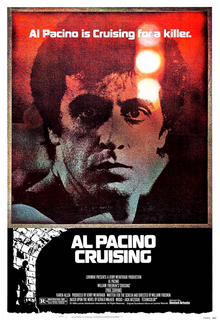
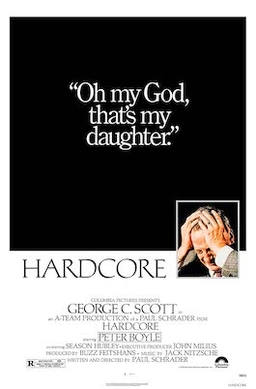
HARDCORE (1979)
Written and directed by Paul Schrader
Main Cast: George C. Scott, Peter Boyle and Season Hubley
Hardcore (1979) is arguably one of Paul Schrader’s most abrasive and fascinating films—a work that feels both deeply personal and deliberately confrontational. The setup is pure father’s nightmare. Jake Van Dorn (George C. Scott), a devout Calvinist businessman and single father in Grand Rapids, Michigan, sees his world collapse when his teenage daughter Kristen disappears during a church-sponsored trip to California. Months later, a Los Angeles private investigator (Peter Boyle) produces devastating evidence—an 8mm stag film bought in a sex shop, showing Kristen performing a sexual act with two men. Convinced she has been abducted and forced into sex work, Van Dorn heads west, dragging his rigid moral certainty into a world he neither understands nor believes should exist.
Hardcore (1979) functions as a grim reworking of The Searchers (1956), filtered through the urban decay of Taxi Driver (1976). Schrader replaces the western frontier with peep shows, porn theatres, and back-alley sex shops, turning Los Angeles into a hostile moral wilderness. The journey into hell is not only about rescuing a daughter but about testing the limits of Van Dorn’s faith. Further, the performances are uniformly excellent. George C. Scott is volcanic as Van Dorn, embodying righteous fury in a way that makes the character both frightening and tragic. Season Hubley brings unexpected vulnerability to sex worker, Niki, while Peter Boyle is unforgettable as the sleazy private dick—equal parts comic and repellent.
Ultimately Hardcore (1979) is uncomfortable, morally thorny, and visually steeped in neon-lit grime. It stands as one of Schrader’s most uncompromising statements: a film less interested in salvation than in forcing its audience to stare directly into the abyss between religion and reality.
Mark: 8.5 out of 11
CRUISING (1980)
Directed by William Friedkin
Screenplay by William Friedkin – Based on Cruising
by Gerald Walker
Main cast: Al Pacino, Paul Sorvino and Karen Allen
Cruising (1980) remains one of William Friedkin’s most troubling and unresolved works—a film whose reputation is inseparable from the controversy that engulfed it. Loosely based on the novel Cruising by Gerald Walker, a New York Times reporter, the film follows a serial killer preying on gay men connected to New York’s leather scene in the late 1970s. From its earliest production stages, the project was met with fierce objections from gay rights protestors, and even its star, Al Pacino, later described the film as “exploitative,” a criticism that has clung to it for decades.
Watching it now, divorced from some of its original cultural shockwaves, Cruising (1980) plays as a strangely compelling B-movie detective whodunnit. Friedkin leans hard into the sleaze and menace of the underground clubs, bars, and back rooms, presenting them as shadowy labyrinths of danger and desire. On the surface, the film often seems to revel in this grime, exploiting its setting as lurid texture rather than fully interrogating it. Yet beneath that pulpy exterior, there’s a more interesting, if underdeveloped, psychological study trying to claw its way out. Seen through the eyes of Pacino’s “virgin” cop, Detective Steve Burns, the film is not just about catching a killer and more about a man destabilized by prolonged exposure to a world that awakens desires he cannot comfortably name.
Friedkin arguably doesn’t quite get the script or character dynamics right, and those thematic ambitions often feel half-formed. Pacino, while committed, also feels miscast; his star persona never fully dissolves into the role. Still, what Cruising (1980) undeniably achieves is mood. Its oppressive sound design, pounding club music, and nocturnal visual texture generate a creeping dread that lingers. Lastly, there’s a strong sense that Friedkin was hamstrung—by studio interference, censorship demands, and mandated cuts—which may explain why the film feels fractured, particularly in its famously ambiguous ending. The result is a movie that feels incomplete, but also strangely haunting: a compromised work whose unease, confusion, and moral instability scratch under the skin in ways more polished films manage.
 The Cinema Fix presents
These trailers remind me of one “descent into hell” movie I saw many years ago. Angel Heart with Mickey Rourke and Robert De Niro, as Louis Cypher (ha ha, get it?). 🙂
LikeLiked by 1 person
Ha-ha! 😊Yes, Angel Heart is a great film noir/horror story and an excellent book too.
LikeLike