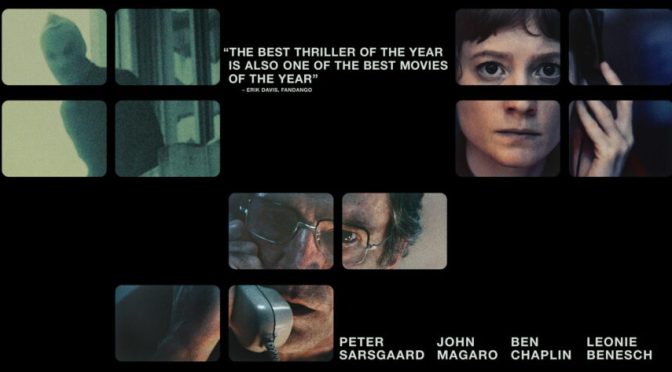
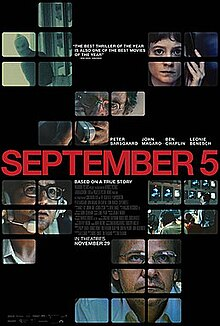
Cinema Review: September 5th (2024) – an inside-out snapshot of tragedy at the 1972 Munich Olympics!

Directed by Tim Fehlbaum

Written by Moritz Binder, Tim Fehlbaum and Alex David

Produced by Philipp Trauer, Thomas Wöbke, Tim Fehlbaum, Sean Penn, John Ira Palmer and John Wildermuth

Main cast: Peter Sarsgaard, John Magaro, Ben Chaplin, Leonie Benesch, Jim Mckay (archival footage), Zinedine Soualem, etc.

Cinematography by Markus Förderer

Edited by Hansjörg Weißbrich

*** MAY CONTAIN SPOILERS ***


The events of September 5th, 1972, during the Munich Olympics are deeply connected to the tragic and harrowing story of the attack by the Palestinian group ‘Black September’, which targeted the Israeli Olympic team. This day is crucial in understanding the impact of the attack, as it marks the beginning of what became known as the ‘Munich Massacre’. The documentary One Day in September (2000) directed by Kevin Macdonald, offered a detailed account of the events providing chilling footage, interviews with survivors, and insights from those who witnessed the attack and as a moment that deeply altered the course of history, influencing global politics, the perception of terrorism, and the nature of security at international events.

Steven Spielberg’s fictionalised film Munich (2005) dramatized the aftermath of the ‘Munich Massacre’, focusing on Israel’s covert response to the attack. The film based on the book Vengeance by George Jonas, told the story of a team of Israeli agents tasked with assassinating those involved in the planning of the massacre. The plot of Munich (2005) unfolds as these agents track down and kill individuals connected to ‘Black September’. The film, criticized for a series of inaccuracies, portrayed the moral complexities and psychological toll of vengeance, showing the personal conflict faced by the agents as they carry out their mission. Now, covering the same event, we have September 5th (2024), a drama-documentary that snapshots the conflict from the perspective of the ABC Sports crew and their coverage of the events.
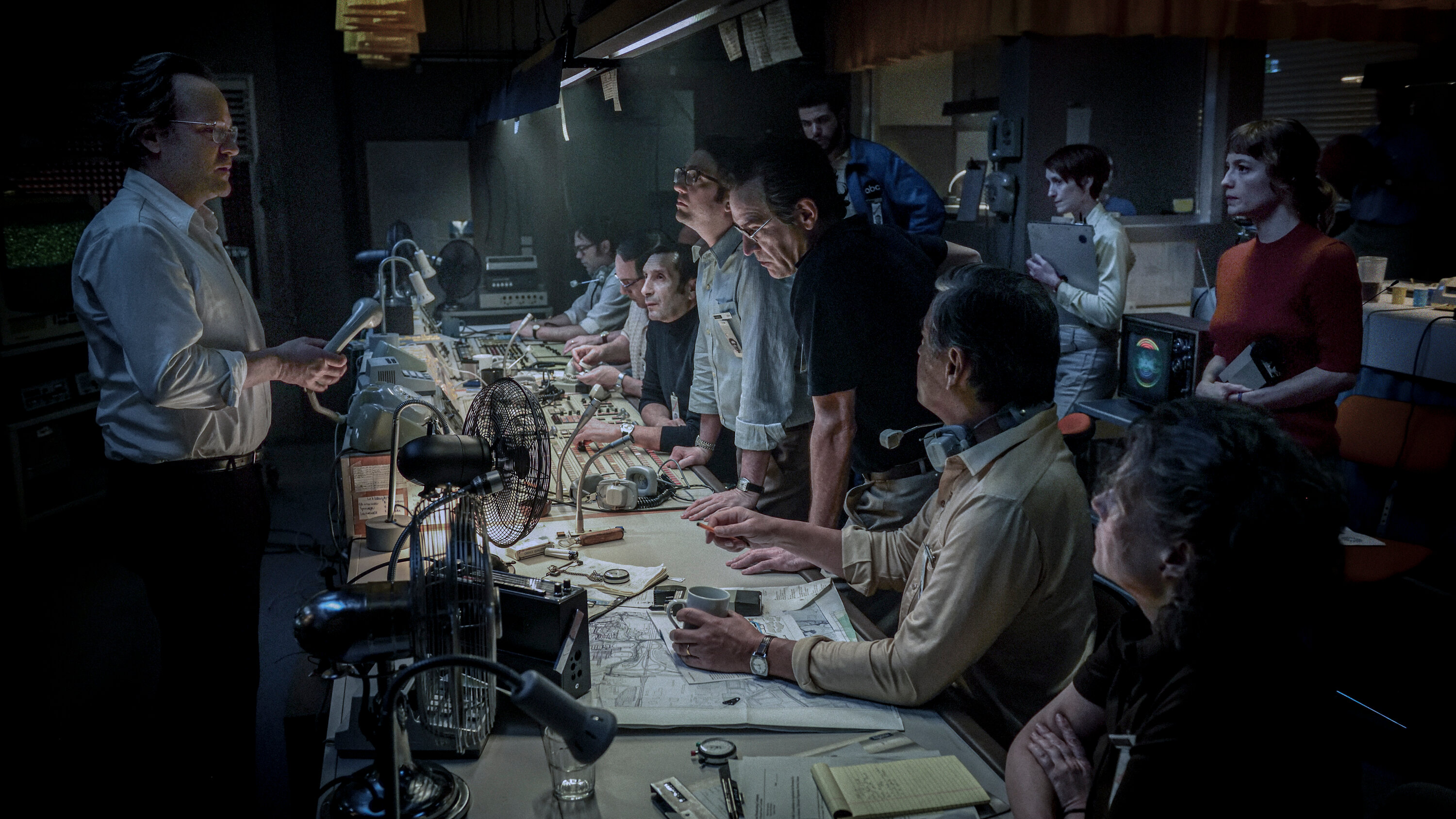


Director, Tim Fehlbaum, and his talented production team effectively utilize constraints in geography, time, space, and structure to craft a highly claustrophobic thriller, drawing viewers into the escalating crisis as it unfolds. From the moment the athletes are taken hostage the ABC media team headed by Peter Sarsgaard as Roone Arledge, the president of ABC Sports, John Magaro as Geoffrey Mason, the head of the control room in Munich and Ben Chaplin as Marvin Bader, the head of operation at ABC Sports are on red alert striving to capture the story and prevent it being taken from them by the ABC News team. Fehlbaum makes use of limited settings, “real-time” structure, and confined spaces expertly as the audience find out information of the hostages plight and subsequent runway killings at precisely the same time as the crew do.

The films’ use of psychological space, close-ups, shadows and screens, creates a claustrophobic atmosphere, starving the audience of air and making them feel the increasing emotional pressure on each character. Like the world’s population today witnessing the brutal events unfold between Israel and Palestine on the news, they ultimately have little power over the situation as news of tragedy bleeds through to them. Further, the cast are uniformly compelling with Peter Sarsgaard, John Magaro and Leonie Benesch, as a translator for the ABC crew, stand out amongst an impressive ensemble. Lastly, special mention for the editing team led by Hansjörg Weißbrich, who skilfully weaved in actual footage from the ABC archive, creating a seamless and powerful cinematic experience.
Mark: 8 out of 11


Cinema Review: Hard Truths (2024) – an unflinching look at a family struggling with depression.

CINEMA REVIEW: HARD TRUTHS (2024)

Directed by Mike Leigh

Written by Mike Leigh

Produced by Georgina Lowe

Main Cast: Marianne Jean-Baptiste, Michele Austin, David Webber, Tuwaine Barrett, Ani Nelson, Sophia Brown, Jonathan Livingstone, etc.

Cinematography by Dick Pope

*** MAY CONTAIN SPOILERS ***


Mike Leigh’s career has been defined by an unflinching exploration of everyday existence, shaped by a commitment to realism and a deep understanding of human behaviour. His films, whether contemporary or period pieces, dissect the nuances of ordinary lives, often capturing the struggles, aspirations, and quiet triumphs of working- and middle-class individuals. His signature improvisational approach—where actors develop their characters through extensive rehearsal—allows for an organic authenticity that makes his work resonate with honesty and emotional depth.

Leigh’s early films, such as Bleak Moments (1971) and Nuts in May (1976), established his interest in the mundanities and disappointments of daily life. His later films, such as High Hopes (1988) and Life is Sweet (1990), continued this trend, portraying ordinary people navigating personal and societal challenges with humour and pathos. Secrets & Lies (1996), one of his most acclaimed works, epitomizes his fascination with human vulnerability, as it dissects family relationships, race, and identity in a way that feels raw yet tender.

Leigh’s career trajectory has also included excursions into period dramas, notably the heart-wrenching, Vera Drake (2004) and arguably his most political film, Peterloo (2018). But rather than abandoning his focus on the intricacies of human experience, he applies the same observational precision to historical subjects. Topsy-Turvy (1999), about the creation of Gilbert and Sullivan’s The Mikado, examines the creative process with the same detail he grants his modern-day working-class protagonists. Mr. Turner (2014), a biopic of the painter J.M.W. Turner, similarly explores the artist’s struggles, eccentricities, and societal context without falling into the clichés of the genre. These films reveal that, for Leigh, the past is not a grand spectacle but an extension of the same human complexities that define his contemporary work.


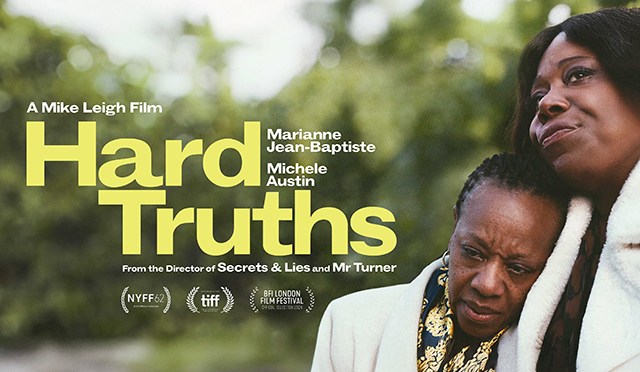
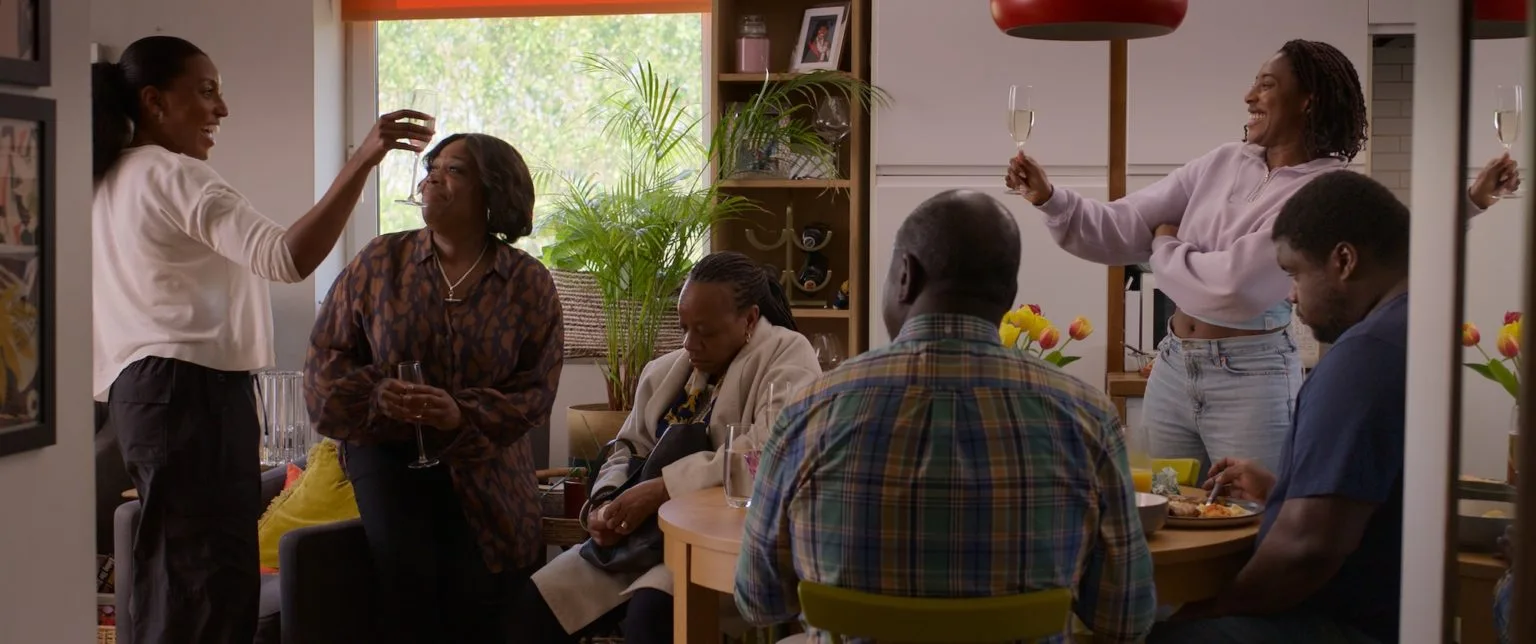
His latest film, Hard Truths (2024), follows in this tradition, delving into the stark realities of its characters with the same empathy and directness. Set in London in the present day, it focuses on the Deacon family unit and extended relations, notably two personality-divergent sisters, Pansy Deacon (Marianne Jean-Baptiste) and sibling, Chantelle (Michele Austin). Pansy is a middle-aged London housewife whose relentless irritability and sharp tongue mask a deep-seated inner turmoil. Her acerbic interactions—whether berating her husband Curtley, chastising her son Moses, or lashing out at unsuspecting strangers—serve as both a source of dark humour and a window into her dissatisfaction with life. Indeed, some of her rants are absolutely laugh-out-loud hilarious.

Leigh’s nuanced direction ensures that while Pansy’s outbursts may elicit laughter, they simultaneously reveal the tragic underpinnings of her character. Her vitriolic remarks, often delivered with biting wit, are symptomatic of her internal struggles, painting a portrait of a woman grappling with unarticulated pain. This duality is evident in scenes where Pansy’s caustic rants thinly veils her profound sense of isolation and despair. The film delves deeper into Pansy’s psyche during interactions with the more upbeat, Chantelle. A pivotal moment occurs during a Mother’s Day visit to their mother’s grave, where Chantelle confronts Pansy about her pervasive anger. Pansy’s anguished admission, “I don’t know!” encapsulates the bewildering nature of her depression, highlighting how her defensive humour serves as a barrier against this insidious mental illness.

Marianne Jean-Baptiste’s absorbing portrayal brings emotional depth to Pansy’s character, capturing the delicate interplay between her abrasive exterior and the fragility it conceals. Similarly, Michele Austin brings light and optimism to the screen, along with her effervescent daughters, somehow striving to combat the all-pervasive cloud of depression. Some of my favourite scenes of the film were with Chantelle in conversation with customers in her hair salon. Thus, in essence, Hard Truths (2024) presents a compelling character study that intertwines humour with the sombre realities of depression. Through Pansy Deacon, Leigh illustrates there are no easy answers to the pain of an affliction that remains silent and invisible but is ever-present within everyone’s lives.

Mark: 8 out of 11


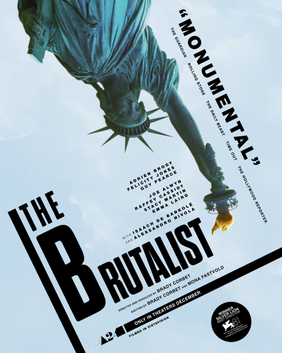
Cinema Review: The Brutalist (2024) – There will be Concrete!

CINEMA REVIEW: THE BRUTALIST (2024)

Directed by Brady Corbet

Written by: Brady Corbet & Mona Fastvold

Produced by Trevor Matthews, Nick Gordon, Brian Young, Andrew Morrison, Andrew Lauren, D.J. Gugenheim and Brady Corbet
.

Cast: Adrien Brody, Felicity Jones, Guy Pearce, Joe Alwyn, Raffey Cassidy, Stacy Martin, Emma Laird, Isaach de Bankolé and Alessandro Nivola.

Cinematography Lol Crawley

Edited by Dávid Jancsó

*** MAY CONTAIN SPOILERS ***


A new wave of American filmmakers—directors like Todd Field, Robert Eggers, and Brady Corbet—have emerged as some of the most technically proficient and ambitious voices in contemporary cinema. Their work is marked by rigorous formal control, deep thematic ambition, and an almost obsessive dedication to craft. These filmmakers, arguably influenced by auteurs like Sofia Coppola and Paul Thomas Anderson, demonstrate an understanding of film language that is both deeply referential and boldly experimental. Whether it’s Eggers’ meticulous historical recreations, Field’s austere and cerebral storytelling, or Corbet’s overtly intellectualized narratives, they all exhibit an undeniable mastery of their medium. Their films, often dense with literary and philosophical allusions, cater to cinephiles who relish formal precision and narrative audacity.

Yet, for all their brilliance, there’s an argument to be made that their work veers into self-indulgence, if not outright pretension. Their films sometimes feel like exercises in artistic superiority, catering to an audience that appreciates the challenge but perhaps not the emotional accessibility that cinema can offer at its best. Whether it’s the cold remove of TÁR (2022), the self-serious mythologizing of The Lighthouse (2019), or the arch, affect-laden approach of Vox Lux (2018), these works often feel encased in a layer of knowing detachment. There’s a fine line between intellectual rigor and a kind of smug, insular artistry, and some critics argue that these filmmakers, however talented, sometimes tip too far in the latter direction—prioritizing aesthetic and conceptual ambition over genuine human connection. I mean, I love a lot of these filmmakers’ work, but I was raised on the American films of Coppola, Scorsese, DePalma, Spielberg, Lucas and Friedkin; auteurs who knew their art, but also how to entertain the audience too.


In Corbet’s, and film partner’s Mona Fastvold’s, phenomenally designed and constructed film, The Brutalist (2024), Adrien Brody portrays fictional László Tóth, a Hungarian-Jewish architect and Holocaust survivor. Brody’s is an incredibly memorable piece of work, acting as a spiritual performance sequel to his Oscar-winning role in The Pianist (2002). But rather than focus on an individual attempting to escape the Nazis during the war, the narrative concentrates on Tóth, who arrives in post-war America with nothing but his talent and ambition, only to find himself trapped in a system that celebrates his work while rejecting him as a person. In America, racism is delivered with a smile, and generosity is a means of control. High society rewards Tóth but also suffocates him with subtle condescension, as he is paraded around as an artistic trophy but never fully embraced as an equal.

As an epic character study of the life of an immigrant and exploitation of the financially stricken Jew in America, The Brutalist (2024), is a powerful work. Such themes compel us to think of today and the fact that America continues to struggle with the integration of people travelling there, even though it was built with the hands of migrant families. Here the screenplay exerts true power in critiquing the United States’ treatment of those travelling to America with hope. As the narrative unfolds across the decades, Corbet, Fastfold and Brody illustrate the slow erosion of Laslo’s dreams in an America that welcomes his work but not his humanity. As the key antagonist, Harrison Lee Van Buren, Guy Pearce delivers another chilling and precise character study. Van Buren is a spoilt, rich and brattish man whose charm and refinement mask a deeply exploitative nature.

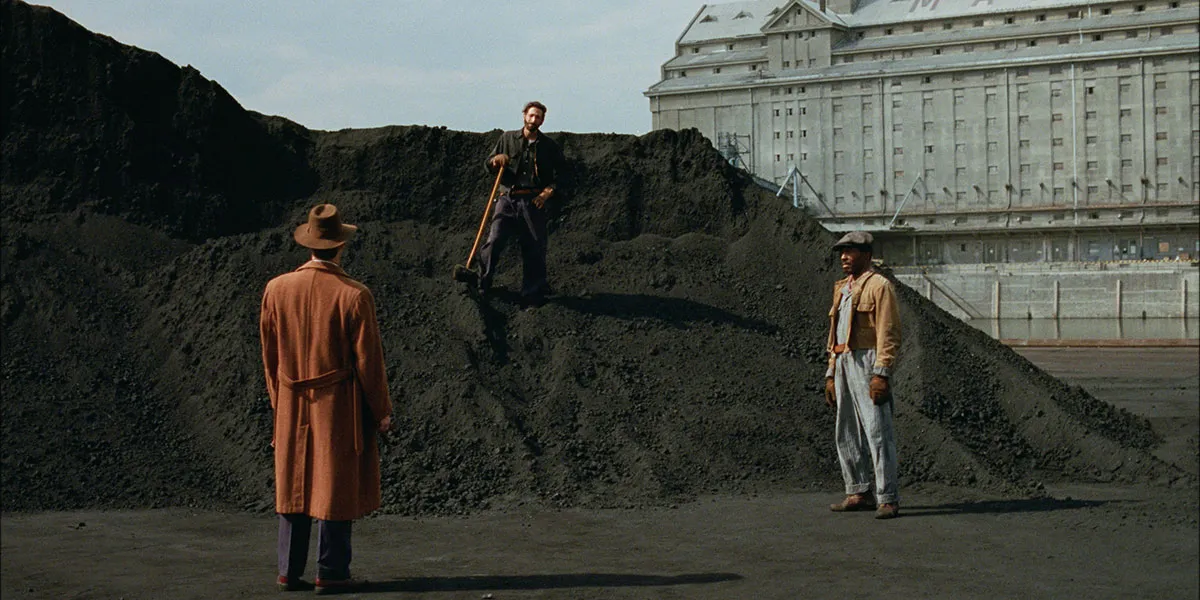
Photographically, The Brutalist (2024) is indeed a work of art. Lol Crawley and the production team immerse viewers in a stark, architectural visual language—monolithic structures, rigid compositions, and a muted, desaturated color palette mirroring the emotional and physical isolation Tóth experiences. Yet, for for all its incredible craftsmanship and bold cinematic ambition, the film is a test of endurance—an unrelenting, patience-draining experience that stretches well beyond three hours. Even the inclusion of chapters, and a self-consciously “prestigious” intermission only serve to amplify the film’s pretensions, prolonging the agony of watching layer upon layer of misery unfold like a slow-moving roller-coaster that induces motion sickness with no escape. It’s a brilliant film that demands submission rather than engagement, wielding its bleakness like a weapon against the audience’s stamina. It will probably win the Academy Award for Best Film. That or Wicked (2024).

Mark: 8 out of 11


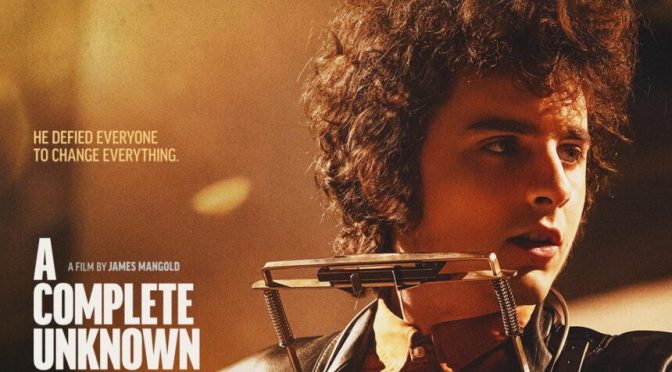
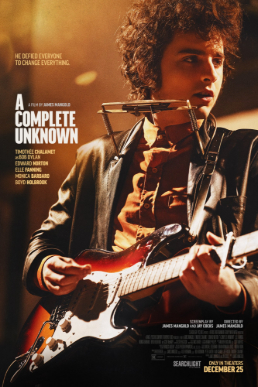
Cinema Review: A Complete Unknown (2024) – an electric but over-polished cover version!

CINEMA REVIEW: A COMPLETE UNKNOWN (2024)

Directed by James Mangold

Screenplay by James Mangold and Jay Cocks

Based on Dylan Goes Electric! by Elijah Wald

Produced by Peter Jaysen, James Mangold, Alex Heineman, Bob Bookman, Alan Gasmer, Jeff Rosen, Timothée Chalamet, Fred Berger etc.

Main cast: Timothée Chalamet, Edward Norton, Elle Fanning, Monica Barbaro, Boyd Holbrook, Scoot McNairy, Dan Fogler, etc.


James Mangold is rarely mentioned as one of the best directors around. Probably because he is not a flashy cigar-munching quote machine or a even a household name. Yet, he has consistently delivered a series of extremely entertaining genre films over the past few decades. These include: Copland (1997), Identity (2003), Girl, Interrupted (1999), Walk the Line (2005)3:10 to Yuma (2007), Logan (2017) and Ford v Ferrari (2019). His films always feature solid characterisation, compelling conflict and well-structured plots. They also have a pristine and attractive look and style. Further, they always attracts impressive A-list actors and striking ensemble casts. His cover version of the music biography, Dylan Goes Electric! by Elijah Wald is no different.

A Complete Unknown (2024) showcases events from the era of 1961 to 1965 where Dylan rose to major stardom delivering stunning and poetic lyrics with hypnotic melodies. This period culminates in his movement from acoustic guitar to full electric band, causing controversial and violent reactions from the audience and organisers of the Newport Folk Festival. This furore may seem mildly inconsequential in today’s social-media digital coliseum where intellectual debates are fought with emojis by individuals with nano-seconded attention spans. But for many, Bob Dylan’s perceived treachery of moving from the purity of folk over to the dark side of rock was a significant event of the epoch. Having said that, Dylan was always an enigmatic maverick and genius who marched to the time of his own drum. Thus, such audial rebellion was no surprise, especially when looking back at it now.


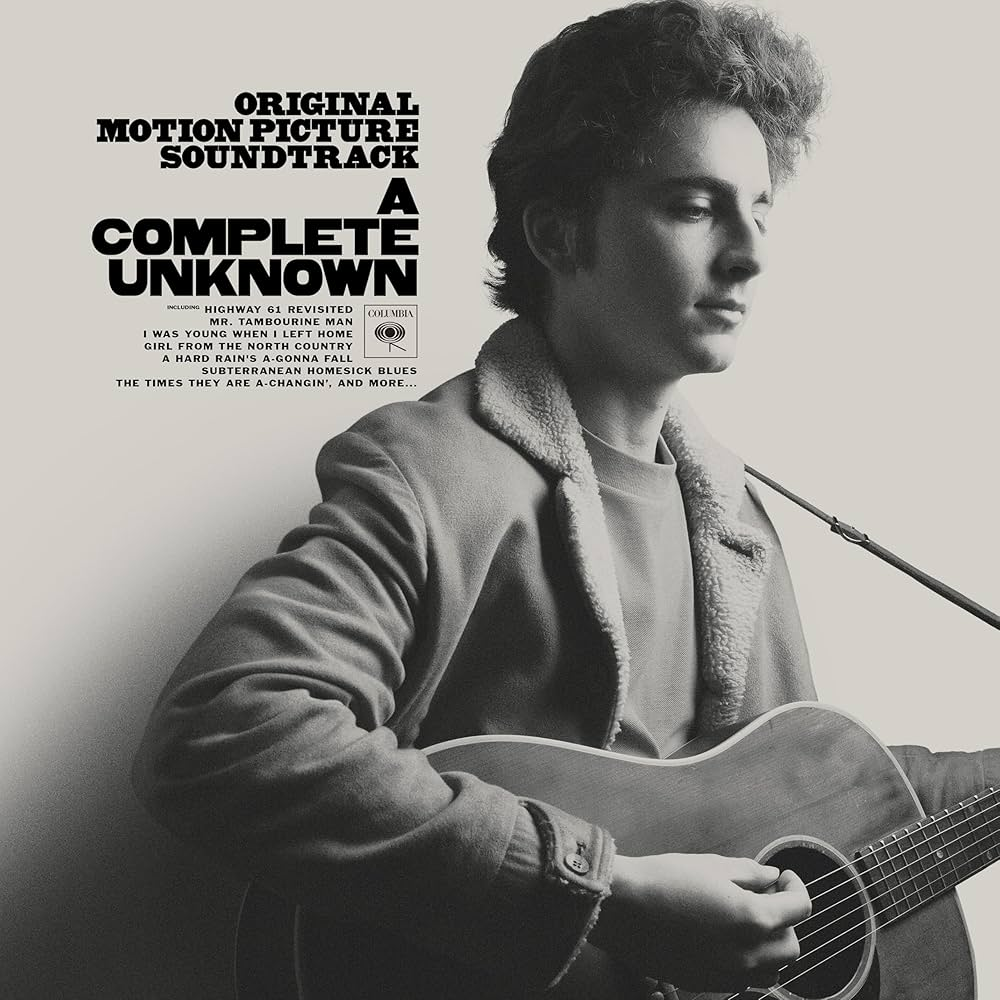
As a tribute to the incredible musical and writing brilliance of Dylan, A Complete Unknown (2024) is definitely worth a watch. Timothée Chalamet does a sterling job with the musicianship, mannerisms and vocal duties. He even brings a suggestion of character to someone who isn’t just a musician. Dylan’s a shape-shifter, a poet, a myth, a paradox wrapped in a harmonica riff. To play Dylan is not to “become” him but to capture the way he constantly eludes being known. Personally, I enjoyed Chalamet’s charismatic performance in Wonka (2023 more, but he is commanding as Dylan nonetheless. The supporting cast are terrific too, notably Edward Norton as the affable folk singer Pete Seeger and Boyd Holbrook as a muscular Johnny Cash. Mangold deserves much praise for getting so many consistently fine performances, even if the script could have been punched up with more drama throughout. Dylan being a bit of a self-driven “arsehole” and slight philanderer hardly raises the pulse.

Overall, Mangold directs with a sure hand and there are many fantastic musical set-pieces, gigs and recording sessions. But the film’s glossy sheen feels at odds with the grit of the 1960’s Greenwich Village folk scene. The world Dylan emerged from was smoky, messy, and filled with hungry artists scraping by in dimly lit coffeehouses, where folk music wasn’t just a style but a battle cry. A Complete Unknown (2024) captures the aesthetic—the period costumes, the dimly lit clubs, the jangling guitars—but everything feels just a touch too manicured, too cinematic. Dylan’s rise was not glamorous and the film makes the counterculture movement feel almost nostalgic rather than revolutionary. It’s an engaging snapshot, and Chalamet’s performance is undoubtedly compelling, but much like a pristine re-recording of an old folk song, the imperfections—the very thing that gave the music its soul—are missing.

Mark: 7.5 out of 11