Tag Archives: IRA

Amazon Prime Film Review: Kneecap (2024) – Irish rap rebels substitute words-for-bombs in riotous youth-in-revolt triumph!

Amazon Prime Film Review: Kneecap (2024)

Directed by Rich Peppiatt

Screenplay by Rich Peppiatt

Story by Rich Peppiatt, Liam Óg Ó hAnnaidh, Naoise Ó Cairealláin, JJ Ó Dochartaigh

Produced by Jack Tarling and Trevor Birney

Main cast: Naoise Ó Cairealláin, Liam Óg Ó hAnnaidh, JJ Ó Dochartaigh, Josie Walker, Fionnuala Flaherty, Jessica Reynolds, Adam Best, Simone Kirby, Michael Fassbender, etc.

Cinematography by Ryan Kernaghan

*** MAY CONTAIN SPOILERS ***
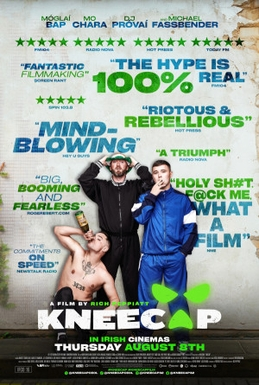


The 2024 film Kneecap is a riotous, politically charged portrait of youth in revolt, channeling the raw energy of punk and hip-hop into a uniquely Irish-language rebellion. Starring the real-life Belfast rap trio—Mo Chara, Móglaí Bap, and DJ Próvaí—as fictionalized versions of themselves, the film blends anarchic humour, biting satire, rites of passage, and cultural defiance to tell the story of how a group of working-class misfits wove their frustrations into musical gold.

Set in post-Troubles West Belfast, the film captures the lingering scars of British occupation and the generational trauma it left behind. Liam (Mo Chara) and Naoise (Móglaí Bap) are introduced as small-time drug dealers navigating poverty, police harassment, and fractured families. Their lives take a turn when JJ Ó Dochartaigh, a disillusioned Irish-language teacher, discovers their lyrical talents and joins them as DJ Próvaí. Together, they form the eponymous group, an Irish-language rap group that weaponizes music as a form of cultural resistance.

The film is unapologetically rebellious, using the Irish language not just as a means of communication but as a symbol of defiance. Arlo (Michael Fassbender), Naoise’s father and a former republican paramilitary, encapsulates this sentiment when he declares, “Every word of Irish spoken is a bullet fired for Irish freedom” . This philosophy permeates the group’s music, which tackles issues like British colonialism, drug culture, and the complexities of identity in a divided society.
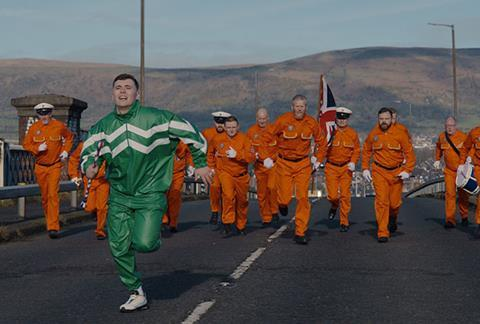


Kneecap (2024), while a bold and electric celebration of youth rebellion arguably overstretches itself emotionally by attempting to cover too many themes at once. In its ambition to be both a political statement and a coming-of-age tale, a musical odyssey and a generational cry for recognition, the film occasionally dilutes its emotional impact. As the film juggles a multitude of weighty themes: the trauma of post-Troubles Northern Ireland, the fight for Irish-language preservation, the drug culture plaguing working-class communities, the fractured nature of family life, absent fathers and mothers, and the burden of political legacy. Add to this the rise of a rap group in an unexpected cultural context, and the film becomes a whirlwind of ideas competing for attention. The result is a film that sometimes feels like it’s racing to say everything at once, rather than letting its most resonant emotional threads breathe.

Nonetheless, director and co-writer, Rich Peppiatt, displays strong visual flair evoking the urban vibrancy of Trainspotting (1996) and underdog musical joy of The Commitments (1991). It helps that the film is often fucking hilarious. Plus, I realise it’s a raw reflection of their life choices, I could take or leave the perpetual scenes of gratuitous drug-taking. At the same time, the film doesn’t shy away from the gritty realities of its setting. It portrays the trio’s clashes with radical republican groups, their run-ins with the police, and the family and romantic struggles that come with their newfound fame.

Amidst the chaos, Kneecap (2024) maintains a sense of humour and humanity, offering a nuanced look at the power of art to challenge the status quo and inspire change. In essence, Kneecap is a ballsy and risk-taking celebration of rebellion, a testament to the enduring power of language and music as tools of resistance, and a vivid portrayal of youth challenging the remnants of a colonial past and a country attempting to find peace and identity after centuries of conflict.

Mark: 8.5 out of 11


MY CINEMATIC ROMANCE #18 – KEN LOACH

MY CINEMATIC ROMANCE #18 – KEN LOACH


I haven’t done one of these articles for a while, but in light of the Conservative Party victory in the General Election the other day, I thought it interesting to lean toward a more political filmmaker for my latest post. Thus, I once again pick five highly recommended films by one of my favourite cinema creatives. Today, I look at the work of Ken Loach.

Loach is now, at time of writing, eighty-three year’s old, and has just released a new film called Sorry We Missed You (2019). At the cinema alone he has singularly directed twenty-five films, plus been involved with many television productions too. His ‘Wednesday Play’ Cathy Come Home (1966), was voted in the top ten best British television programmes of all time at the turn of the millennium. It was so powerful in its depiction of a struggling homeless character, the issues were raised in Parliament at the time. His work continues to address socio-political issues even now and has often provoked controversy.

Loach works generally in the dramatic or social realist genre. However, his raw, almost documentary style, which centres on working or characters from the under-classes, does have much comedy going through it too. Structurally his films build empathy with his characters in a generally linear fashion; slices of life which more often than not result in tragedy. While the landscapes he displays are quite depressing, his characters aren’t victims though. They are always strong and passionate and striving for the best outcome. However, poor life choices, poverty, bureaucracy, gangsters, criminality, addiction, military, and unfair government laws and procedures provide fierce obstacles.

Some have accused Loach of, over the years, being a ‘Champagne Socialist’, comfortably attacking the ruling classes from a position of privilege. He’s also been accused of vicariously holidaying in the land of the under-privileged, for what gain I’m unsure of. Personally, I am always compelled by Loach’s cinema, the issues raised and the characters he presents. He is a true humanist director and storyteller, who has made some consistently brilliant films. Whether you agree with his politics or views, he is at least attempting to reflect the injustices in the world and the underdogs within in it. Here are five films which capture this perfectly.

**CONTAINS SPOILERS**


KES (1969)

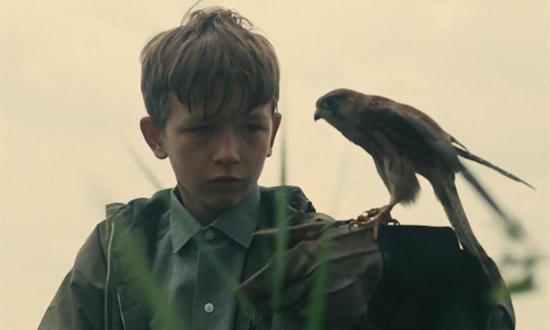
Based on Barry Hines’ novel, Kes is one of the finest British films ever. It concerns the everyday existence of Billy Casper (David Bradley) and his attempts to survive the harsh realities of Northern life in Barnsley. Billy struggles at school, but finds salvation when he adopts and trains a young kestrel. Kes represents a microcosm of working-class life where the kids are either damned or sent down the pit to work. Simultaneously warm, harsh, bitter, funny and tragic, Kes is a memorable early work from Ken Loach and deserves revisiting over and over again.


MY NAME IS JOE (1998)

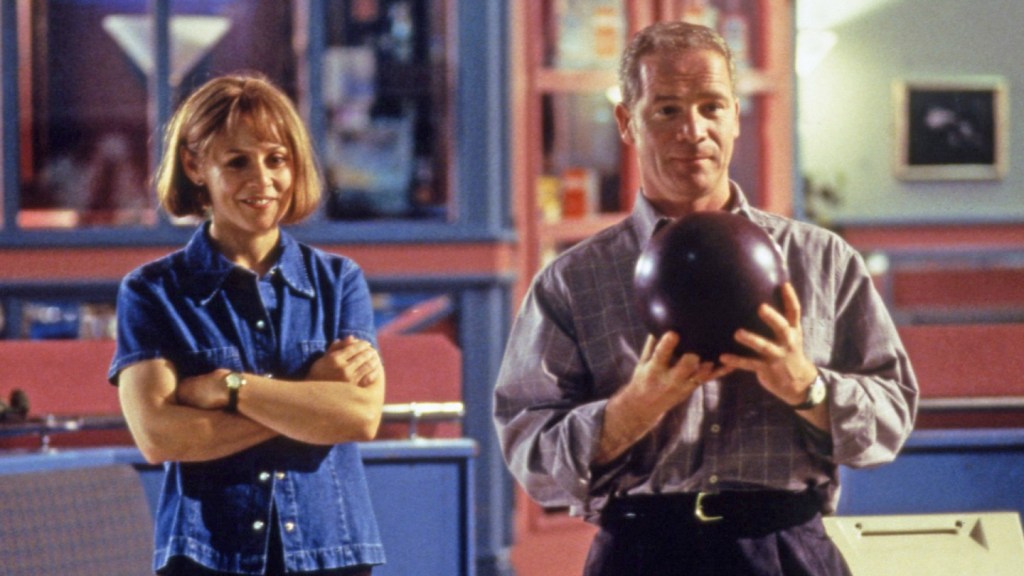
Anchored by an incredible leading performance from Peter Mullen, My Name is Joe, centres on Joe Kavanagh and his attempts to stay sober. Joe has been a destructive alcoholic for some years and uses AA to control his drinking. The narrative drive comes from Joe’s attempt to assist recovering drug addict, Liam (David McKay), plus Joe’s blossoming romance with a local health worker, Sarah (Louise Goodall). It’s a raw rendition of Scottish working-class life with romance and tragedy lying side-by-side in a moving portrait of addiction, love and life’s everyday struggles.


THE WIND THAT SHAKES THE BARLEY (2006)

Incredibly controversial when released, Loach’s war drama is set in 1920’s, Cork, Ireland. It centres on the conflict between the Irish Republican Army and the British army, as civil war broke out prior to the Anglo-Irish Treaty. The lead protagonists are two brothers portrayed by Cillian Murphy and Padraic Delaney. As the war and violence heightens the two brothers, their families and their compatriots are devastated by harsh British rule. Loach was described as “anti-English and traitorous” by the English press and Conservative politicians, when the film was released. However, irrespective of your politics, it is a stunningly human work of cinema; both shocking and heart-wrenching in equal measures.


LOOKING FOR ERIC (2009)

Films about football (soccer in the U.S.A) and footballers can be very tricky to get right as the game itself arguably works better as a live spectacle, rather than at the cinema. However, Loach scored a big win with this really moving story about a lowly postman, Eric Bishop (Steve Evets), who is struggling with family, love and work pressures. Depressed and almost suicidal, Eric finds unlikely help in the magical appearance of Manchester United football legend, Eric Cantona. Sprinkling the kitchen sink realism with fantasy is a departure for Loach, and Paul Laverty’s wonderful script brilliantly espouses the need for teamwork, fraternity and community within its touching narrative.


I, DANIEL BLAKE (2016)

Having worked for the Benefits Agency a few decades ago, I have some understanding of social security and government assistance schemes. Via the titular character of Daniel Blake (the brilliant Davey Johns), Loach savagely criticises Conservative austerity measures. The systematic turning of the screw has seen many British people have their benefits stopped because of somewhat Kafkaesque measures. Of course, the system should work to stop people abusing it, but many deserving people suffered too. This is demonstrated here in this heartfelt drama of one man, who having suffered a heart attack, battles for his pride and future.