Tag Archives: Song Kang-ho

Hirokazu Kore-eda Film Reviews: AFTER LIFE (1998) and BROKER (2022)

BROKER (2022)

Directed and written by Hirokazu Kore-eda

Produced by Eugene Lee

Cast: Song Kang-ho, Gang Dong-won, Bae Doona, Lee Ji-eun
and Lee Joo-young.

Cinematography: Hong Kyung-pyo
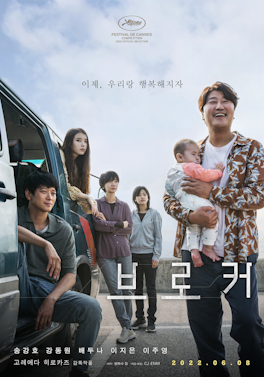


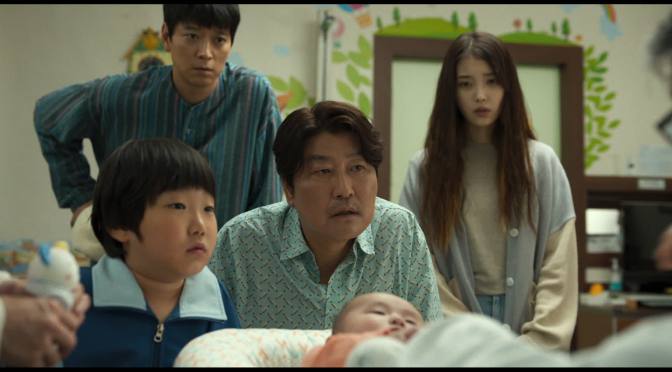
Arguably Japanese director’s Hirokazu Kore-eda’s most accessible film to date is the slice-of-life comedy-drama, BROKER (2022). Elements of Little Miss Sunshine (2006) meets Parasite (2019) meets Juno (2007) as kind-of-likeable and empathetic criminals create a dysfunctional family unit around stealing orphans and finding them families to makes ends meet. Lighter than many of his other brilliant human dramas, there is much to savour here from one of the best filmmakers working today.

There’s a lot going on in Broker (2022) as the duo of Sang-hyeon (Song Kang-ho) and Dong-soo (Gang Dong-won) work a grift of taking the unwanted babies, a police thriller involving murder, an impromptu road movie in a camper van, a cute kid looking for a surrogate father and a mother, Moon So-young (Lee Ji-eun) battling the dilemma of whether to sell or keep her child. A lesser filmmaker could have struggled balancing the many story, character and tonal shifts but Kore-eda manages it with aplomb.

Broker (2022) arguably has too many intertwining subplots though, as it strives to redeem all of the complex characters, but the wonderfully believable performances and brilliant screenplay really grabs you and rarely lets you go. Kore-eda’s direction is, as usual, masterly and assured as he balances the various tones confidently. Overall, this film makes you laugh, cry and is really moving as it highlights that family units can be lovingly born of collective experience, as well as blood.

Mark: 9 out of 11


AFTER LIFE (1998)

Directed and written by Hirokazu Kore-eda

Produced by Masayuki Akieda, Shiho Sato

Cast: Arata Iura, Erika Oda, Susumu Terajima, Sayaka Yoshino, Takashi Naito, Kei Tani, etc.

Cinematography Yutaka Yamazaki
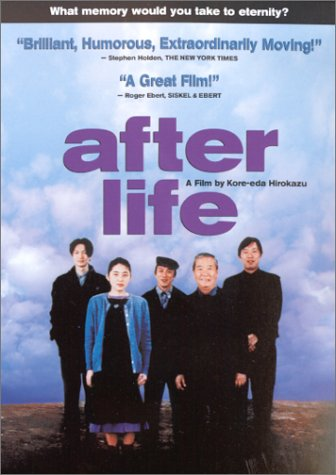


What a delightful, surreal and beautiful film. AFTER LIFE (1998), is easily one of the most imaginative and human films I have watched in a long time. It is set in an administrative centre somewhere between the realms of life and death. Here the staff of the office, kind of social workers, welcome recently deceased people and ask them to recall their life and choose a single memory. After which the filmmaking staff will recreate the memory, shoot this scene and the souls will be able to re-experience this moment forever in heaven.

To me this is a mind-blowing concept for a feature film and I am surprised that it has not been remade (and probably ruined) by Hollywood for either cinema or TV. What makes it so great is, that despite the high concept idea, the design and delivery is so down-to-earth. The offices where events confirmed are not presented with any of the usual angelic or heavenly cliches. Instead, Hirokazu Kore-eda, of which this is only his second feature film, and his production team, decide that the after-life is an unglamorous place run by kindly bureaucrats.

One of the many strengths of After Life (1998) lies with the human representations, both the people who have passed and the office angels who counsel them. The love, humour and emotion derived from the various interviews given by many of the characters are full of joy, sadness and longing. Along with the soulful characters coming to terms with their recent passing, the narrative also focuses on two “young” counsellors, Takashi (Arata Iura) and Shiori (Erika Oda), who must overcome their personal conflicts while helping others. Overall, After Life (1998) builds slowly and beautifully weaves so many fantastic human stories. When the filmed memories are revealed my heart melted, as Kore-eda delivers cinematic moments that will stay with one eternally.
Mark: 10 out of 11


CINEMA REVIEW: MEMORIES OF MURDER (2003)

CINEMA REVIEW: MEMORIES OF MURDER (2003)

Directed by: Bong Joon-ho

Produced by: Cha Seung-jae

Written by: Bong Joon-ho, Shim Sung-bo

Based on: Memories of Murder (play) by Kim Kwang-rim

Cast: Song Kang-ho, Kim Sang-kyung, Kim Roi-ha, Park Hae-il, Byun Hee-bong etc.

Music by: Tarō Iwashiro

Cinematography: Kim Hyung-koo

***MAY CONTAIN SPOILERS***


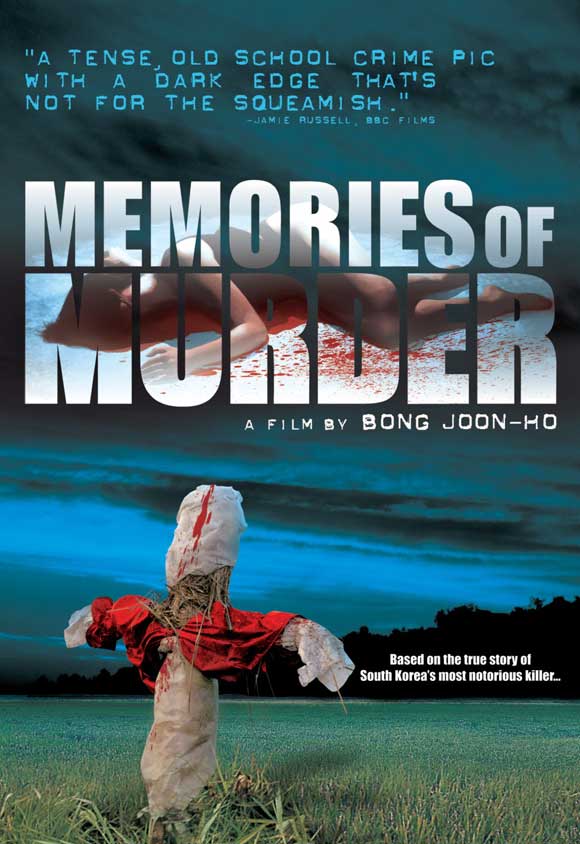
In this current COVID-19 climate it’s going to take a big film release or an extremely excellent film to get me to go to the cinema. Not only because of the underlying health risks, but also because I think social distancing is a societal duty to be respected. Moreover, it is better to be safe than sorry where health and wealth are concerned. If I was to come in contact with an individual or group who possibly had the virus then having to self-isolate would leave me in a tricky place where work is concerned. Of course, the number of new releases have been stymied too. Yet, despite these factors and armed with our face coverings and hand sanitizers, myself and my wife, ventured to Clapham Picturehouse to watch a re-released genre classic, namely Bong-Joon-ho’s, MEMORIES OF MURDER (2003).

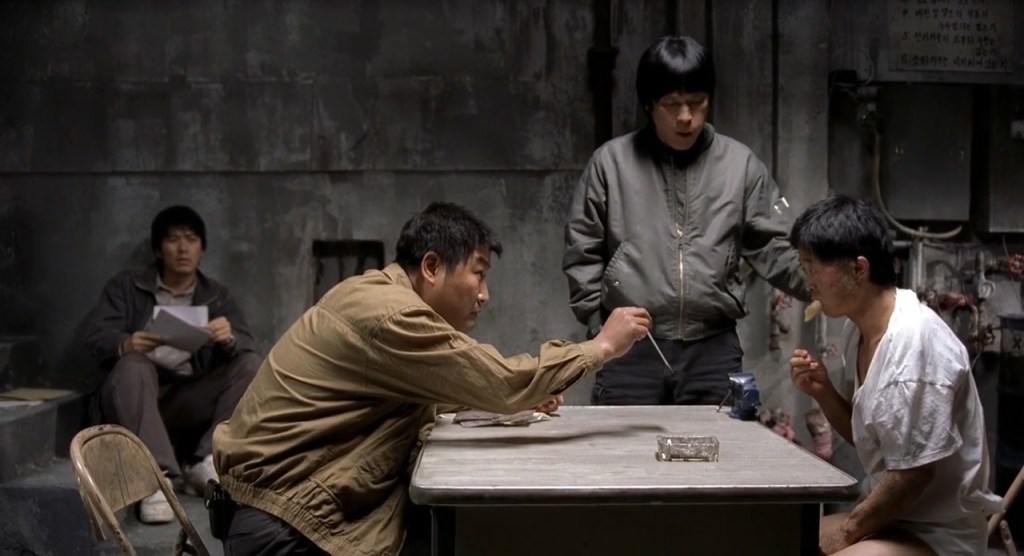
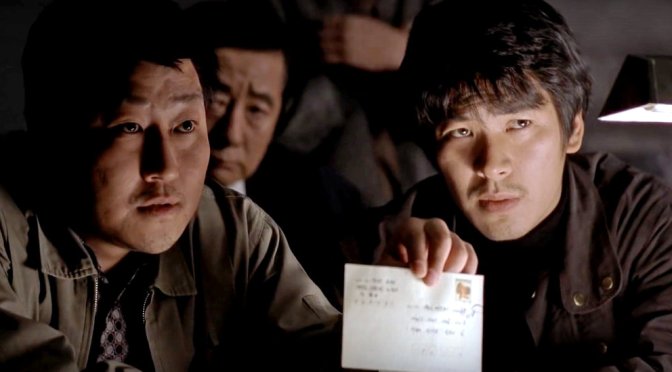
Interestingly, it made me long for the days of the proper independent repertory films that I frequented in the late 1980’s and 1990’s like the Scala, Prince Charles and Everyman. There you could catch old, forgotten and classic movies on re-release, often on double bills or late- night line-ups. To be fair some of these cinemas are still around, but unfortunately not as many as twenty years ago. Unsurprisingly, because of the commercial and critical success of PARASITE (2019), Bong Joon-ho’s back catalogue has been plundered, hence the re-release of MEMORIES OF MURDER (2003). This truly brilliant police procedural thriller is loosely based on the true story of Korea’s first serial murders which took place between 1986 and 1991 in the Gyeonggi Province. The story follows the police department as they pursue a number of leads and suspects over a number of years. However, the killer proves incredibly cunning and, as in the David Fincher helmed crime classic, ZODIAC (2007), it becomes an almost impossible case to crack.


Song Kang-ho and Kim Sang-kyung star as Detective Park and Detective Seo, respectively. They are two very different cops striving to solve the murders of young women who usually wear red. Esteemed Korean actor Song Kang-ho portrays the more instinctive and emotional detective, while Kim Sang-kyung’s cop relies on thorough investigation and deduction. Kang-ho especially proves what a wonderfully natural talent he is and his character’s marital relationship provides warmth amidst the bloody horror of the serial killings. Indeed, it made a change to see a police officer who wasn’t an alcoholic, divorced or utterly cynical.

Allied to a plot that over many narrative years is full of twists and turns, the themes and characters within MEMORIES OF MURDER (2003) are what makes it a cut above the standard police drama. While the lead detectives are mostly empathetic, the screenplay finds time to critique their unscrupulous interviewing techniques of suspects. It is only when Detective Seo applies proper forensics and logic do they begin to make headway in the case. Seo especially becomes obsessed with catching this venal murderer of young women. So much so it pushes him to breaking point.

MEMORIES OF MURDER (2003) also presents an early example of the intelligent and precise directorial style of Bong Joon-ho. His framing of multiple actors in the same shot, overlapping dialogue and the exquisite cinematographic representations of both rural and urban landscapes make this an aesthetically pleasing film to experience. Joon-ho loves scenes in the rain too and these add to the film’s atmosphere. Lastly, while it deals with crimes that are dark and shocking, there is also much quirky humour within the excellent screenplay. The bickering between the exasperated police Captain his team provides laughs that spike the grim mood the murders bring. Thus, overall this is very much a film worth leaving the house and going to the cinema for.

Mark: 9.5 out of 11


PARASITE (2019) – CINEMA REVIEW

PARASITE (2019) – CINEMA REVIEW

Directed by: Bong Joo-ho

Produced by: Kwak Sin-ae, moon Yang-kwon, Bong Yok-cho, Jang Young-hwan

Screenplay by: Bong Joon-ho & Han Jin-won

Cast: Song Kang-ho, Jang Hye-jin, Choi Woo-shik, Park So-dam, Lee Sun-kyun, Cho Yeo-jeong, Jung Ji-so, Jung Hyeon-jun, Lee Jung-eun

Cinematography by: Hong Kyung-pyo

******* MAY CONTAIN SPOILERS ********


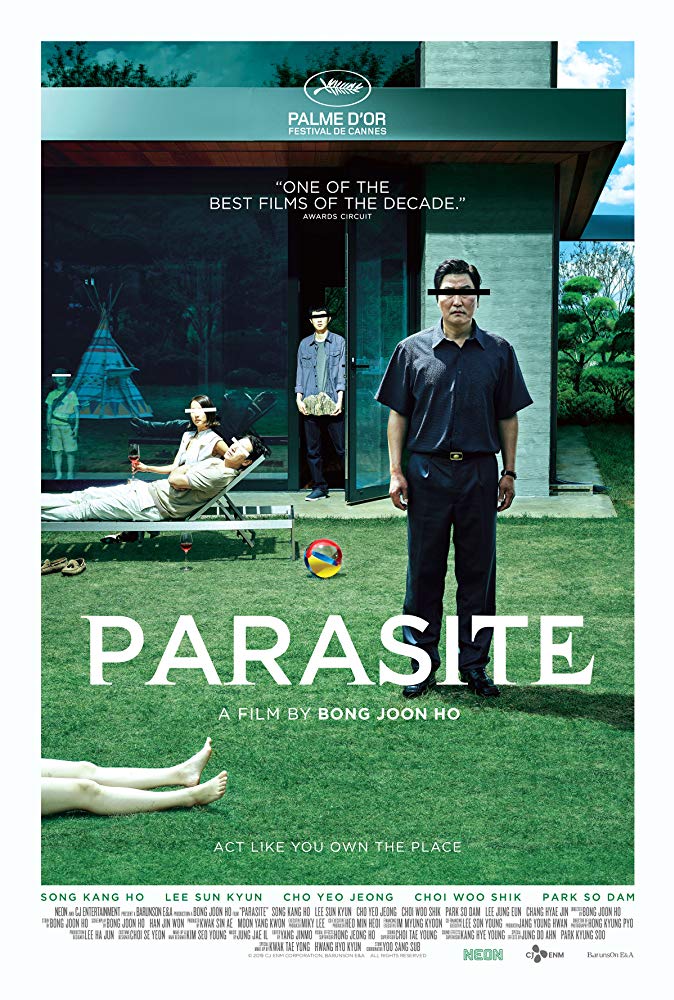
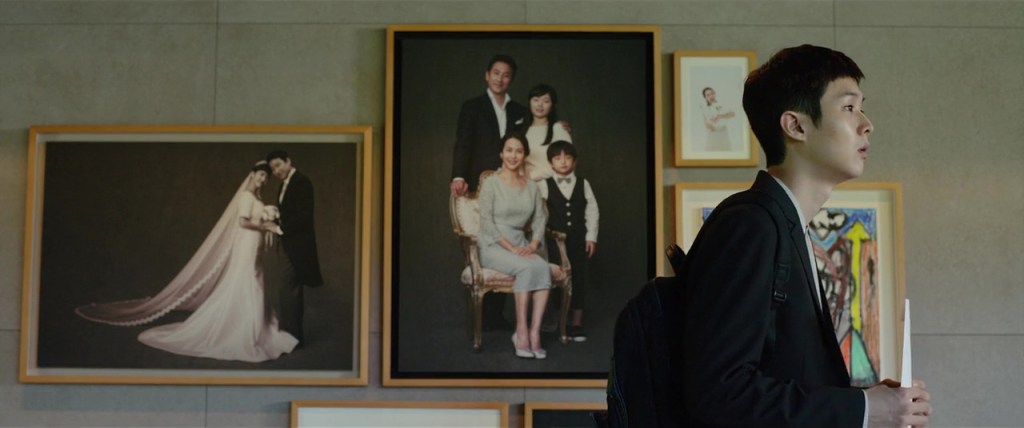
I actually saw this incredible work of cinema storytelling on Saturday just passed, so am writing this review AFTER the film rather incredibly won several Oscars at the 92nd Academy Awards ceremony on Sunday. I say “rather incredibly”, not because the film wasn’t a worthy winner of the Best Film award, but because high quality films not in the English language usually have to be satisfied with the Best International Film Award, as it is known now. Parasite (2019) in fact, deservedly won that award too. Anyway, irrespective of the awards it has earned, the film has also been universally praised. Not surprisingly, because it is not just a Korean arthouse film, but rather an ingenious genre classic. It blends dark comedy, horror, drama and thriller tropes to create a funny, suspenseful and consistently surprising experience.

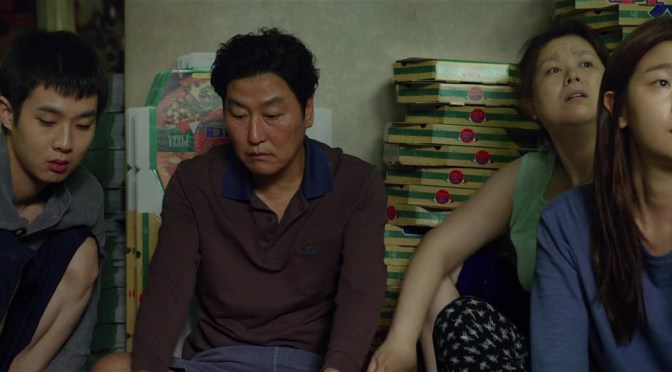
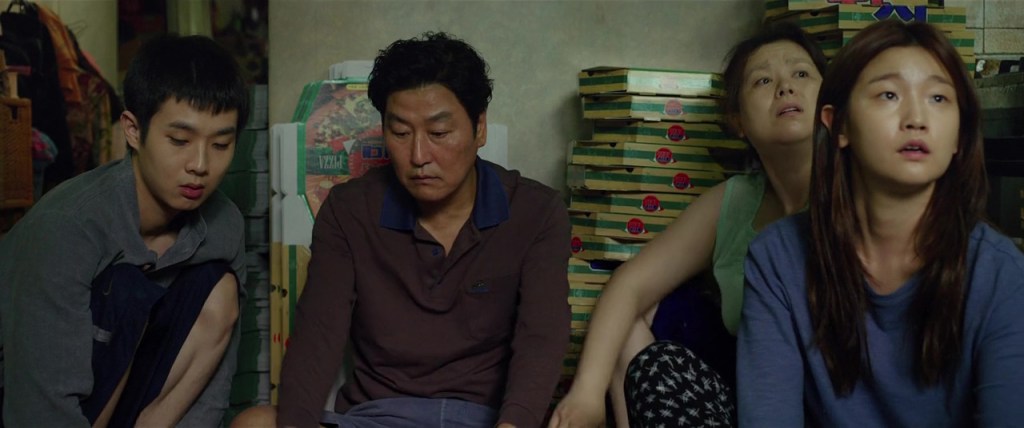
The story premise itself is relatively simple and it begins not too differently from a Japanese film I watched recently called, Shoplifters (2018). A lower class family, in this case Korean, live in cramped conditions and struggle to survive on a daily basis. Their apartment is below level and the Kim’s including father, Ki-taek, mother Chung-sook, daughter Ki-jeong and son Kim Ki-woo are all out of work. While they struggle on they stick together as a family, battling drunks who piss against their window, steal local wi-fi and also carry out menial part-time jobs like making up pizza boxes. Fortunately, a friend of Ki-woo recommends him for a teaching position within a very wealthy household belonging to the Park family. Then the narrative really gathers pace as the Kim family surreptitiously begin to infest and inveigle their way into the Park’s privileged lives.


You’d be forgiven for thinking that the Kim family are the antagonists in the narrative, however, they are very empathetic characters. Their dubious actions lead the story into very dark and funny territory, as they manipulate Mr and Mrs Park, plus their young son and teenage daughter. While not condoning their actions one can identify with their class struggle because they are desperate to improve their situation and prosperity. The issue is though they get a bit greedy and the superb screenplay throws a massive twisting curve-ball at them as the Kim’s plans unravel and events go completely off the rails.

Filmmaker, Bong Joon-ho, like he did with the brilliant films, Snowpiercer (2013) and The Host (2006) is clearly using the social status of his characters to satirise and critique capitalist society. It’s literally an ‘Upstairs versus Downstairs’ narrative in terms of both locations and themes. Beautifully filmed, in a property that was actually built for the film, the cinematography makes clever use of glass and windows to mirror characters and reflect identity. Moreover, it has more than a voyeuristic air to it with characters hiding around doorways and stairwells, as well as following, spying and watching each other secretly. It’s a film which Hitchcock would have been proud to have directed too, with many suspenseful and gripping set-pieces throughout.


Ultimately, the first three-quarters of the Parasite (2019) are a cinematic masterpiece, so brilliantly plotted and planned out. When the Kim’s plans are then upended, the film gives way to an unhinged ending as events descend into bloody chaos. However, Bong Joon-ho is so in control of the material he tells us, via Ki-taek, that this careful planning is about to give way to something more messy. Furthermore, the final act while moving and tenderly rendered, I felt, was replete with somewhat poetic narrative holes. But, this is not a criticism as even in the final scenes Joon-ho is inventive while surprising the audience. Although, overall, the biggest shock would come when Parasite (2019) won the best film at the Oscars. I’m still reeling the Academy made such a risky choice!

Mark: 10 out of 11