
Tag Archives: Suspiria

Cinema Review: After the Hunt (2025) – a compelling exploration of #MeToo and #Cancel Culture polemics!

Cinema Review: After the Hunt (2025)

Directed by Luca Guadagnino

Written by: Nora Garrett


Produced by: Brian Grazer, Allan Mandelbaum, Luca Guadagnino

Main Cast: Julia Roberts, Ayo Edebiri, Andrew Garfield, Michael Stuhlbarg, Chloë Sevigny, Thaddea Graham, etc.

Cinematography Malik Hassan Sayeed

*** MAY CONTAIN SPOILERS ***
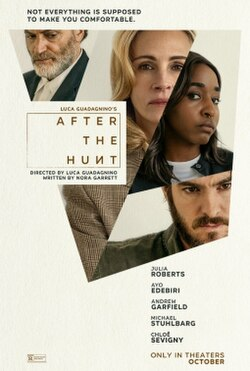


After the Hunt (2025), the latest work from Luca Guadagnino, further cements the director’s reputation as one of contemporary cinema’s most assured chroniclers of morally fraught, emotionally layered human drama. Having already proven his commanding directorial touch with Call Me by Your Name (2017) and Challengers (2024), plus a superior-than-the-original Suspiria (2018), Guadagnino again, from an insightful screenplay by Nora Garrett, demonstrates an uncanny ability to draw out great performances and create a sense of first world suspense that feels both sensual and cerebral.

Set within the hallowed halls of Yale University, After the Hunt (2025) delves into the ramifications of power, privilege, and academic integrity when allegations of sexual assault surface against a lauded professor, played by Andrew Garfield. The film positions itself within a lineage of stories interrogating abuses of power within established and esteemed hierarchies — in much the same way that Doubt (2008) examined such tensions within the church, and Tár (2022) explored them in the rarefied world of classical music. Guadagnino’s film strives for a similar level of psychological and thematic complexity, exploring how institutional prestige and human frailties often shield misconduct and complicity.
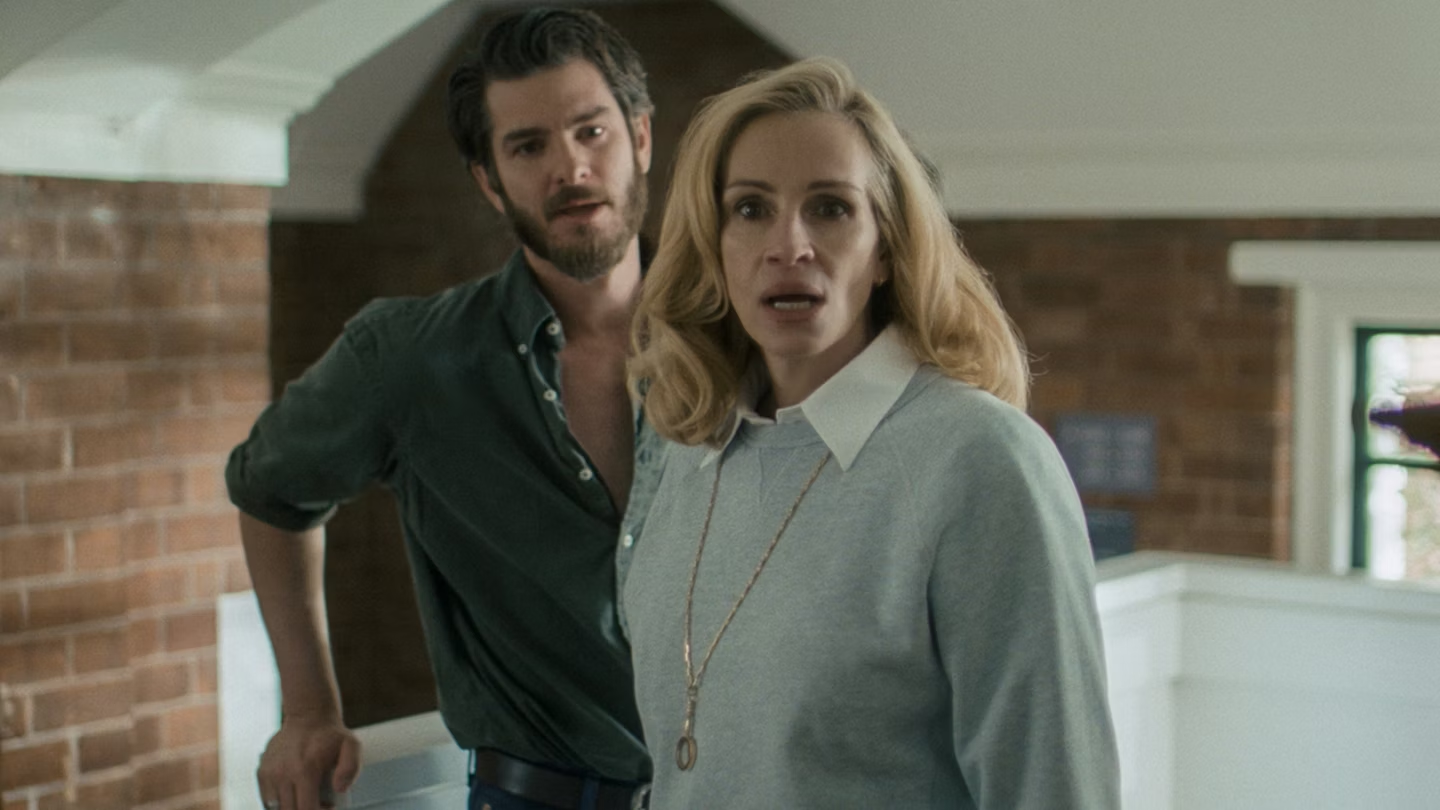


The main drama arrives after a dinner party hosted by philosophy professor Alma Imhoff (Julia Roberts) and her psychiatrist husband, Frederik Imhoff (Michael Stuhlbarg). Also present at the party are Alma’s colleague and longtime friend Hank Gibson (Andrew Garfield), who is also up for tenure, and Alma’s star PhD student Maggie Resnick (Ayo Edebiri). After the party, Maggie accuses a drunken Hank of sexual assault after he walks her home. Alma finds herself caught between loyalty to her friend and colleague, her own desire for academic tenure and her obligation as mentor to Maggie. Meanwhile, Alma’s own secrets—her illness and a youthful relationship situation that occurred as a teenager—begin to surface.

What follows is an intriguing and quite gripping drama about a series of flawed characters who may or may not make, depending on your viewpoint, good, bad, or terrible decisions. The acting is absorbing from the ensemble led by Roberts, with Stuhlbarg and Chloe Sevigny being the resident scene stealers. I frequently found myself drawn into the story as it navigates socially and culturally challenging situations, notably the “she said-he said” assault accusation and aftermath. However, the screenplay occasionally falters, particularly in its middle act. Thus despite the thematic suspense the plot omission such as a lack of criminal enquiry, plus the moment in which Garfield’s character is abruptly dismissed without any formal inquiry undercuts the film’s credibility and emotional momentum. For a story concerned with systems of accountability and institutional procedure, this narrative oversight was difficult for me to overlook.

Even so, After the Hunt (2025) remains an engrossing and well-crafted drama that showcases Guadagnino’s continuing fascination with human pride, weakness and moral ambiguity. Adroitly, there are a number of cheeky nods to cancel culture with the Woody Allen font-style credits and Morrissey / The Smiths songs featuring on the soundtrack. Yet, overall, and perhaps due to a lack of a cathartic ending, the story may have worked better as a stage play. Ultimately, it may not wield the same searing power as Doubt (2008) or Tár (2022), but it stands as another testament to Guadagnino’s skill as a go-to director for mature, provocative, and emotionally intelligent cinema.

Mark: 7 out of 11


FILMS THAT GOT AWAY #1 – REVIEW – SUSPIRIA (2018)

SUSPIRIA (2018) – FILM REVIEW

Directed by: Luca Guadagnino

Produced by: Marco Morabito, Brad Fischer, Luca Guadagnino, Silvia Venturini, Francesco Melzi d’Eril, William Sherak, Gabriele Moratti

Screenplay by: David Kajganich – Based on Suspiria (1977) by Dario Argento and Dari Nicolodi

Cast: Dakota Johnson, Tilda Swinton, Mia Goth, Angela Winkler, Ingrid Caven, Elena Fokina, Chloe Grace Moretz, Malgosia Bela, Lutz Ebersdorf, Jessica Harper etc.

Music by: Thom Yorke

Cinematography: Sayombhu Mukdeeprom

**MAY CONTAIN SPOILERS**

There are so many films released that it is virtually impossible to see them all. Plus, even if you didn’t have to work to earn a damned wage or physically need sleep you still wouldn’t be able to watch everything at the cinema. More specifically though, we may choose NOT to go to see a film on the big screen for certain reasons. Collectively, I consider these movies to be “one’s that got away!”

Thus, in a new section called, unsurprisingly, FILMS THAT GOT AWAY, I will be reviewing films which I missed first time round at the cinema and have subsequently caught up with on Sky, Amazon, Netflix, Blu-Ray or even good old-fashioned terrestrial television. I will consider the film critically as entertainment and why I missed it first time round. As usual the film will be marked out of eleven.

When the UK release of Suspiria (2018) was announced there were many reasons I was immediately put off from wanting to see it. Firstly, despite having watched it three times, I genuinely could not stand the original Dario Argento film. I know people consider it a horror classic; however, I think story wise, it’s a bad film. It’s neither scary from an emotional point-of-view or actually makes any sense logically. I know it’s meant to be based on surreal and nightmarish imagery, montage and performance, but the story or characters did not connect with me. The colour design, gore and soundtrack are outstanding but, overall, I felt I was trapped watching the manic outpourings of an Italian psychopath.

The second reason I did not want to watch it is I haven’t always got on with Luca Guadagnino’s cinematic works. Don’t get me wrong, he is a brilliant filmmaker. However, I find him an indulgent artist whose tone, pace and direction seems haphazard. Of the films I have seen, I Am Love (2009) was a brilliant character study, anchored by a stunning Tilda Swinton performance. But A Bigger Splash (2011) and Call Me By Your Name (2017), were expertly constructed but indulgent and over-rated travelogues littered with narcissistic bores. Nonetheless, I really liked Suspiria (2018). It is almost, but for Guadagnino’s typical excesses, a horror masterpiece.

Set in 1977 (when the original was released), at the height of the Cold War in divided Germany, Suspiria, is a heady mix of rites of passage, cold war and horror genres. There are many narrative strands with which the screenplay, by David Kajganich, attempts to balance. Further, we also have personal, political, religious, artistic, gender and communal themes prevalent through the story. While it’s an ensemble cast the focus is Dakota Johnson’s Susie. She is a young aspiring dancer, from an Amish background, who joins the world-famous Markos dance company. In the process she is determined to impress Tilda Swinton’s commanding mentor. The parallel narrative involves psychiatrist Dr Josef Klemperer and his investigation into a missing patient (Chloe Grace Moretz); who also happens to be a dancer from the troupe.

As the story unfolds Susie proves herself an incredibly powerful dancer. At the same time, it is revealed that the elders and teachers of the dance group are hiding a sinister secret with darkness and ritual to the bloody fore. Memorable dance sequences full of beauty, energy and gore dominate, with Dakota Johnson giving an impressively physical acting portrayal. I also liked the nuanced control within her character as she grows stronger with each dance. Meanwhile, further dark events occur as Dr Klemperer’s investigations draw him closer to the troupe’s shadowy doors.

As I said, Suspiria is almost a horror masterpiece. The filmmaking, cinematography, art direction, choreography and score by Thom Yorke all collide to create an incredibly tense and terrifying experience. Moreover, while I was fully committed to the characters in the dance troupe and Susie’s movement up the ranks, the choice to juxtapose the socio-political events seemed to belong in another film. The religious context and notions of family and matriarchal dominance were incredibly powerful too and served the horror well. However, Guadagnino, in my humble view should have shaved some scenes from the running time. While I much prefer this film to the Argento original, a further edit for pace would have made this even better. Nonetheless, it had me riveted throughout through the sheer quality of filmmaking. I was incredibly impressed by the melding of dance and death. Indeed, the final orgiastic ritual with buckets of blood, decapitations and gnarled monsters was supernaturally unforgettable.

Mark: 9 out of 11