

Tag Archives: Gaelic

Amazon Prime Film Review: Kneecap (2024) – Irish rap rebels substitute words-for-bombs in riotous youth-in-revolt triumph!

Amazon Prime Film Review: Kneecap (2024)

Directed by Rich Peppiatt

Screenplay by Rich Peppiatt

Story by Rich Peppiatt, Liam Óg Ó hAnnaidh, Naoise Ó Cairealláin, JJ Ó Dochartaigh

Produced by Jack Tarling and Trevor Birney

Main cast: Naoise Ó Cairealláin, Liam Óg Ó hAnnaidh, JJ Ó Dochartaigh, Josie Walker, Fionnuala Flaherty, Jessica Reynolds, Adam Best, Simone Kirby, Michael Fassbender, etc.

Cinematography by Ryan Kernaghan

*** MAY CONTAIN SPOILERS ***



The 2024 film Kneecap is a riotous, politically charged portrait of youth in revolt, channeling the raw energy of punk and hip-hop into a uniquely Irish-language rebellion. Starring the real-life Belfast rap trio—Mo Chara, Móglaí Bap, and DJ Próvaí—as fictionalized versions of themselves, the film blends anarchic humour, biting satire, rites of passage, and cultural defiance to tell the story of how a group of working-class misfits wove their frustrations into musical gold.

Set in post-Troubles West Belfast, the film captures the lingering scars of British occupation and the generational trauma it left behind. Liam (Mo Chara) and Naoise (Móglaí Bap) are introduced as small-time drug dealers navigating poverty, police harassment, and fractured families. Their lives take a turn when JJ Ó Dochartaigh, a disillusioned Irish-language teacher, discovers their lyrical talents and joins them as DJ Próvaí. Together, they form the eponymous group, an Irish-language rap group that weaponizes music as a form of cultural resistance.

The film is unapologetically rebellious, using the Irish language not just as a means of communication but as a symbol of defiance. Arlo (Michael Fassbender), Naoise’s father and a former republican paramilitary, encapsulates this sentiment when he declares, “Every word of Irish spoken is a bullet fired for Irish freedom” . This philosophy permeates the group’s music, which tackles issues like British colonialism, drug culture, and the complexities of identity in a divided society.
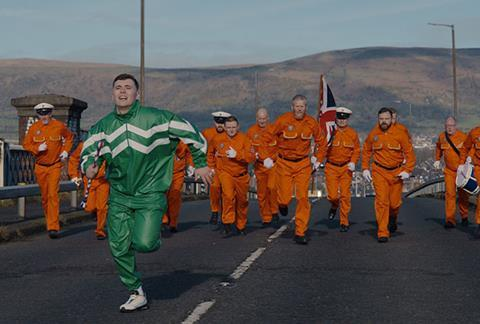


Kneecap (2024), while a bold and electric celebration of youth rebellion arguably overstretches itself emotionally by attempting to cover too many themes at once. In its ambition to be both a political statement and a coming-of-age tale, a musical odyssey and a generational cry for recognition, the film occasionally dilutes its emotional impact. As the film juggles a multitude of weighty themes: the trauma of post-Troubles Northern Ireland, the fight for Irish-language preservation, the drug culture plaguing working-class communities, the fractured nature of family life, absent fathers and mothers, and the burden of political legacy. Add to this the rise of a rap group in an unexpected cultural context, and the film becomes a whirlwind of ideas competing for attention. The result is a film that sometimes feels like it’s racing to say everything at once, rather than letting its most resonant emotional threads breathe.

Nonetheless, director and co-writer, Rich Peppiatt, displays strong visual flair evoking the urban vibrancy of Trainspotting (1996) and underdog musical joy of The Commitments (1991). It helps that the film is often fucking hilarious. Plus, I realise it’s a raw reflection of their life choices, I could take or leave the perpetual scenes of gratuitous drug-taking. At the same time, the film doesn’t shy away from the gritty realities of its setting. It portrays the trio’s clashes with radical republican groups, their run-ins with the police, and the family and romantic struggles that come with their newfound fame.

Amidst the chaos, Kneecap (2024) maintains a sense of humour and humanity, offering a nuanced look at the power of art to challenge the status quo and inspire change. In essence, Kneecap is a ballsy and risk-taking celebration of rebellion, a testament to the enduring power of language and music as tools of resistance, and a vivid portrayal of youth challenging the remnants of a colonial past and a country attempting to find peace and identity after centuries of conflict.

Mark: 8.5 out of 11


BFI PLAYER FILM REVIEWS: THE BEASTS (2022) and THE QUIET GIRL (2022)

BFI PLAYER FILM REVIEWS: THE BEASTS (2022) and THE QUIET GIRL (2022)

I watched DUNE: Part II (2024) at the cinema but was not drawn to write a review of that masterly sci-fi-behemoth and technical marvel, such was the life-draining and utterly emotionless lack of reaction on my behalf. Instead, for my latest reviews I have chosen lower budget films, in comparison, which offer compelling characters and drama which made me feel and think something.


THE BEASTS (2022)

Directed by: Rodrigo Sorogoyen

Written by: Isabel Peña and Rodrigo Sorogoyen

Main Cast: Denis Ménochet, Marina Foïs, Luis Zahera, Diego Anido,
Marie Colomb
etc.

Multiple Goya award-winning drama The Beasts (2022) is an intelligent and muscular drama that reminded me of the equally compelling Jean de Florette (1987) and Only the Animals (2019). The latter also starred the sizable talent that is Denis Ménochet. Here he inhabits the character of former teacher, Antoine Denis, who along with his wife, Olga (Marina Foïs) have taken to renovating properties and farming eco-vegetables in the area of Galicia, Spain.

Honest and hardworking the Denis’ are unfortunately considered outsiders and a threat to the locals, notably the brutish Anta brothers, led by the menacing Xan (Luis Zahera). The conflict is exacerbated as Xan blames them for losing his family money when the Denis’ blocked the sale of land to a wind energy company. Luis Zahera provides a formidable performance as the intimidating bully who begins by poisoning their water before moving onto even more vile and threatening acts.

The theme of city academics versus rural folk is explored with intensity, at times evoking Sam Peckinpah’s more exploitational film, Straw Dogs (1971). But rather than containing an explosive and violent ending, The Beasts (2022) delivers a more slow-burn, riveting and moving denouement. Superbly directed, filmed, and acted throughout, this is a fine work of cinema, only let down for me, by a final act which could not deliver on the highline suspense and tension established in the first two.

Mark: 8.5 out of 11


THE QUIET GIRL / An Cailín Ciúin (2022)

Directed by Colm Bairéad

Screenplay by Colm Bairéad – Based on Foster
by Claire Keegan

Produced by Cleona Ní Chrualaoí

Main cast: Carrie Crowley, Andrew Bennett, Catherine Clinch, Michael Patric, Kate Nic Chonaonaigh etc.

Not only is this 1980’s set Gaelic drama about a quiet girl, it is very much a quiet film that is quietly devastating in mood and emotion. Centred around nine-year old, Cait (Catherine Clinch), she is a neglected outsider, and one of many siblings to a pregnant-again mother and horrible father. Worried about being able to cope, her mum “fosters” Cait to distant cousins, Eibhlín (Carrie Crowley) and Sean Kinsella while she is in the latter stages of pregnancy. Thus begins a meditative forming of a heartfelt relationship between the girl and the Kinsellas.

Initially the film’s narrative unfolds very slowly, being light on pace and exposition, but deft in mood and feeling. There is a certain poetry in the lighting and framing against the beautiful countryside landscapes. The Kinsellas and Cait, while reserved on the outside, are hiding strong emotions and even more powerful secrets. Colm Bairéad’s confident screenplay slowly reveals certain enigmas, but still plays his story cards close to his chest. Yet, the warmth of the leading characters and the interpretive dramatic subtext expertly pulls you into their lives, rather than distance you from them.

The Quiet Girl (2022) broke box office records for the opening weekend of an Irish-language film and became the highest-grossing Irish-language film of all time. Further, it received 11 nominations at the 18th Irish Film & Television Awards (IFTAs) in March 2022, and won in seven categories. It’s no surprise given the quality of the writing, photography, acting and direction that the film has achieved such accolades. Indeed, Catherine Clinch as Cait is a phenomenon. By the end I defy anyone not to be moved by the heart wrenching final scenes, as the film ultimately proves less is most certainly more.

Mark: 9 out of 11