Tag Archives: Korea

CINEMA REVIEW: PAST LIVES (2023)

CINEMA REVIEW: PAST LIVES (2023)

Directed by Celine Song

Written by Celine Song

Produced by: David Hinojosa, Christine Vachon and Pamela Koffler, etc.

Main cast: Greta Lee, Teo Yoo, John Magaro, Ji Hye Yoon, Choi Won-young, etc.

Cinematography: Shabier Kirchner

Edited by: Keith Fraas

*** MAY CONTAIN SPOILERS ***
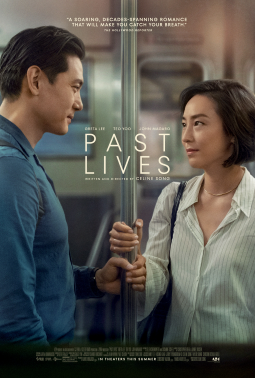


“It’s an in-yeon if two strangers even walk past each other in the street and their clothes accidentally brush, because it means there must have been something between them in their past lives. If two people get married, they say it’s because there have been 8,000 layers of in-yeon over 8,000 lifetimes.”Nora from Past Lives (2023)


Are we fated to connect with the ones we love through each life we lead? Is love a connecting force for good which enriches and links us to our forever soulmate? Or is it a complex chemical reaction driven by three chemicals in the brain such as noradrenaline that stimulates adrenaline production, dopamine, and phenylethylamine. Be it spiritual or chemical, love drives many of the highs of our lives, but it is also responsible for disappointing lows. Safe to say that love and romance are also a staple for many emotionally charged and beautiful works of cinema, of which Celine Song’s Past Lives (2023) is certainly one of them.

Past Lives (2023) is a love story which transports the audience across time and continents through the spiritual and spatial connection of characters, Na Young (Greta Lee) and Hae Sung (Teo Yoo). The opening act establishes the relationship of the two as schoolfriends in Seoul. Alas, any potential fledgling romance for the teenagers is blocked as Na Young’s family moves to Canada, leaving Hae Sung’s alone with his future unknown. The film then moves twelve years forward where Na Young, now known as Nora, lives in New York. Through a chance quirk of social media fate, she reconnects with Hae Sung. Is that adolescent spark still there?



In the second act, Song’s elegantly devised screenplay explores and Nora Hae Sung’s long distance relationship over several heartfelt online calls. But complex emotional circumstances dictate the two cannot reconcile the friendship further. The two drift apart and they take other partners as another twelve years pass. With Nora in a strong relationship with the sensitive and kindly, Arthur (John Magaro), it would appear Nora and Hae Sung’s friendship is at an end. Or is it? Because Song delivers one of the most powerfully moving third acts I have seen at the cinema in some years.

Without explosions, or car chases, or superheroes or fast-paced cutting or extraordinary heroes defeating powerful foes, Past Lives (2023), is one of the most impactful and stirring films of this year. Celine Song achieves this with a delicate hand in the writing and direction, plus a purposeful naturalistic cinematographic palette delivered by Shabier Kirchner. Above all else Song creates two honest characters who you root for from the start, as the one feels the romantic electricity build on the screen. Indeed, Greta Lee and Teo Yoo’s on-screen chemistry is an acting masterclass, with John Magaro further providing touching support within the triangle.

Now, I am not without sensitivity, but it’s virtually impossible to make me cry at the cinema. But Past Lives (2023) almost did. It made my heart swell and ache. It made me laugh as well, because Song’s script has lovely humour throughout. Above all else, whether it is karma or chemicals, it made me grateful to have known love.

Mark: 10 out of 11


SKY CINEMA REVIEW: MINARI (2020)

SKY CINEMA REVIEW: MINARI (2020)

Directed by Lee Isaac Chung

Written by Lee Isaac Chung

Produced by: Dede Gardner, Jeremy Kleiner, Christina Oh

Cast: Steven Yeun, Han Ye-ri, Alan Kim, Noel Kate Cho, Youn Yuh-jung, Will Patton, etc.

Cinematography: Lachlan Milne

Music by: Emile Messeri

*** MAY CONTAIN SPOILERS ***


See the source image

I missed Minari (2020) at the cinema. Which is a shame because out of all the Oscar-nominated films from earlier in the year it is now my favourite. Further, it should certainly have won the best film award. (Note: I have yet to see The Father (2020).) It has the heart and warmth and realistic hope that eventual winner, Nomadland (2020) lacked. Chloe Zhao’s powerful character study was arguably too meditative and glacially paced, without any real diversion from the plodding repetition of monotonous existence. I love slice-of-life and character-driven work, but I want some drama too. While Minari (2020) has certain meditative qualities, writer-director Lee Isaac Chung has crafted a supeb cinematic memoir of tender power and emotion.

Set in 1983, Minari (2020), centres around the Yi family. They had been working in California, but have moved to Arkansas to farm the land. The father, Jacob (Steven Yuen) dreams of growing produce to sell to fellow Korean businesses. However, the farm and static caravan he has purchased is remote with no guarantee of water to ripen the fruits and vegetables. Jacob must either pay exorbitant prices from the water company or find a natural spring underground. Alas, rain rarely threatens the Arkansas plains.

Jacob’s wife, Monica (Han Ye-ri) hates the caravan and does not share his farming dream. This marital conflict drives the much of the narrative as the two argue constantly. Monica is especially angry that her young son, David (Alan Kim) is so far from a hospital. The boy has a heart condition and like any good mother she consistently worries. Their teenage daughter, Anne (Noel Kate Cho) is too young to be a full-time caregiver to David while Jacob and Monica support themselves working at a local chicken factory. To placate Monica, Jacob brings grandmother, Soon-ja (Youn Yuh-jung) to the farm for support. Here a beautiful and funny parallel plot begins as David and his grandmother’s relationship comes to the fore.


See the source image

I watched Minari (2020) on a Sunday morning at home, relaxed and cosy, filled with breakfast and coffee. I loved experiencing the film. The music wondrously supports the beautiful photography that illuminates the green and wheats that fill the lens’ gorgeous palette. Like the masterpiece, Parasite (2019), Minari (2020) represents a working-class family striving to stay together and survive in difficult times. The main difference though is the Yi family were doing it with honest hard graft rather that grifting, ducking and diving. The Yi’s connect with nature and the land rather than skimming the city and the rich. I really rooted for the Yi’s. Jacob’s desires and battles to find water reminded me of the equally moving French classic, Jean De Florette (1986).

Minari (2020) doesn’t take the obvious route of making the Arkansas locals racists who rail against the Yi’s. While there are some scenes involving cultural clashes, much of the drama and humour derives from the families interactions with each other. Indeed, the scenes where David antagonises his unconventional grandmother are hilarious. Youn Yuh-jung as the elderly matriarch is fantastic, deservedly winning a best supporting actress role at the Oscars. Moreover, Lee Isaac Chung gets a miraculous performance from child actor, Alan Kim. Special mention for a busy, but nuanced portrayal of a troubled but helpful worker, Paul, by Will Patton. His deeply pious character could have easily been made an antagonist, but Chung ensures he is another relatable human being in a film full of them.

Mark: 9.5 out of 11


PARASITE (2019) – CINEMA REVIEW

PARASITE (2019) – CINEMA REVIEW

Directed by: Bong Joo-ho

Produced by: Kwak Sin-ae, moon Yang-kwon, Bong Yok-cho, Jang Young-hwan

Screenplay by: Bong Joon-ho & Han Jin-won

Cast: Song Kang-ho, Jang Hye-jin, Choi Woo-shik, Park So-dam, Lee Sun-kyun, Cho Yeo-jeong, Jung Ji-so, Jung Hyeon-jun, Lee Jung-eun

Cinematography by: Hong Kyung-pyo

******* MAY CONTAIN SPOILERS ********


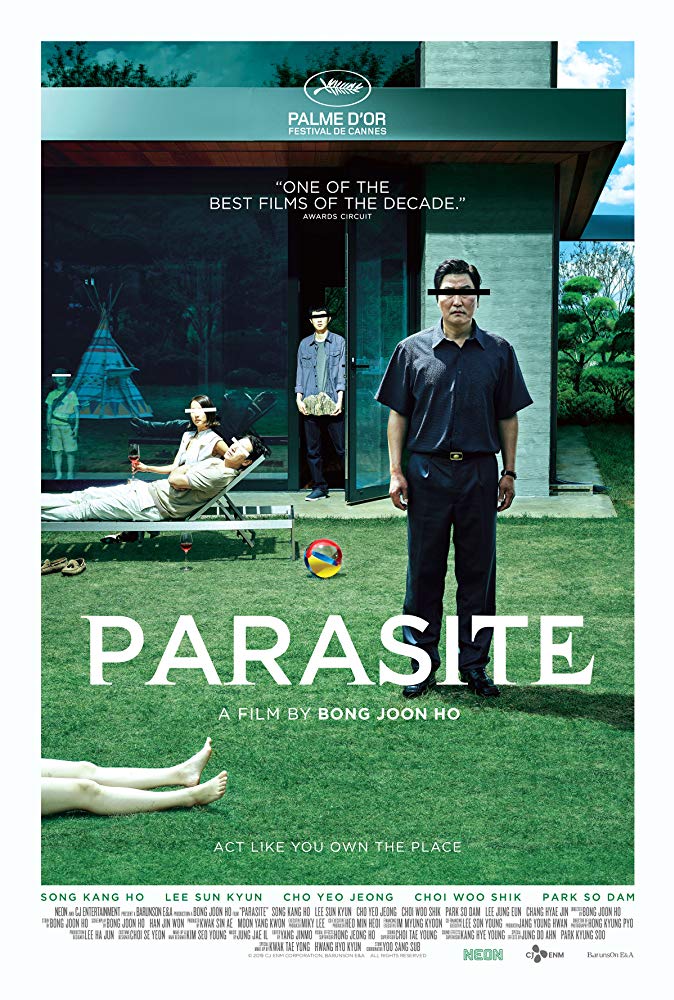
I actually saw this incredible work of cinema storytelling on Saturday just passed, so am writing this review AFTER the film rather incredibly won several Oscars at the 92nd Academy Awards ceremony on Sunday. I say “rather incredibly”, not because the film wasn’t a worthy winner of the Best Film award, but because high quality films not in the English language usually have to be satisfied with the Best International Film Award, as it is known now. Parasite (2019) in fact, deservedly won that award too. Anyway, irrespective of the awards it has earned, the film has also been universally praised. Not surprisingly, because it is not just a Korean arthouse film, but rather an ingenious genre classic. It blends dark comedy, horror, drama and thriller tropes to create a funny, suspenseful and consistently surprising experience.

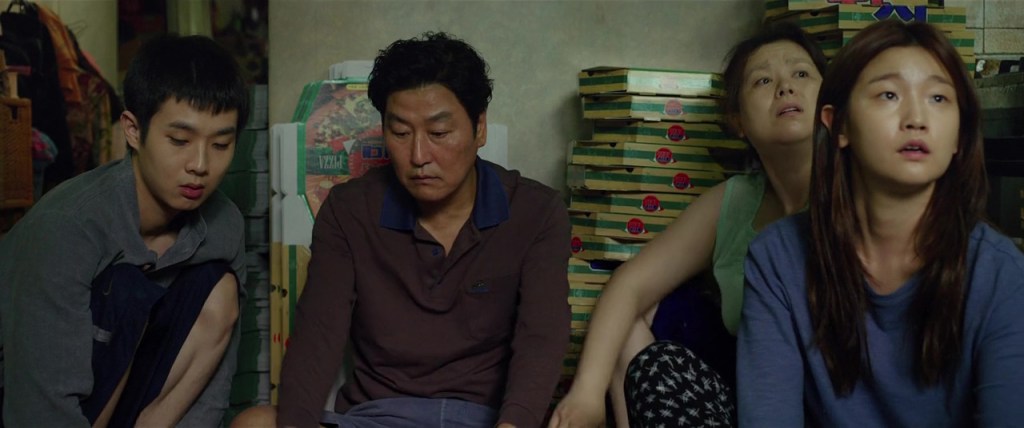
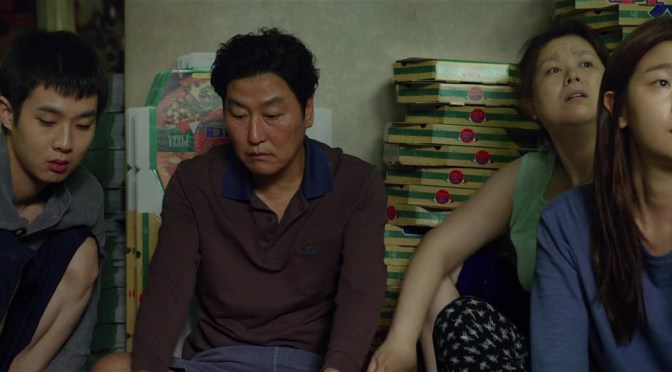
The story premise itself is relatively simple and it begins not too differently from a Japanese film I watched recently called, Shoplifters (2018). A lower class family, in this case Korean, live in cramped conditions and struggle to survive on a daily basis. Their apartment is below level and the Kim’s including father, Ki-taek, mother Chung-sook, daughter Ki-jeong and son Kim Ki-woo are all out of work. While they struggle on they stick together as a family, battling drunks who piss against their window, steal local wi-fi and also carry out menial part-time jobs like making up pizza boxes. Fortunately, a friend of Ki-woo recommends him for a teaching position within a very wealthy household belonging to the Park family. Then the narrative really gathers pace as the Kim family surreptitiously begin to infest and inveigle their way into the Park’s privileged lives.


You’d be forgiven for thinking that the Kim family are the antagonists in the narrative, however, they are very empathetic characters. Their dubious actions lead the story into very dark and funny territory, as they manipulate Mr and Mrs Park, plus their young son and teenage daughter. While not condoning their actions one can identify with their class struggle because they are desperate to improve their situation and prosperity. The issue is though they get a bit greedy and the superb screenplay throws a massive twisting curve-ball at them as the Kim’s plans unravel and events go completely off the rails.

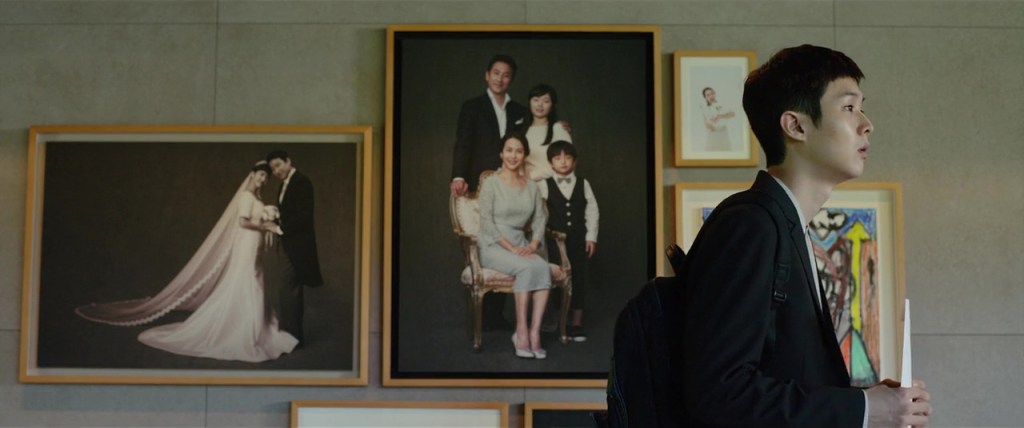
Filmmaker, Bong Joon-ho, like he did with the brilliant films, Snowpiercer (2013) and The Host (2006) is clearly using the social status of his characters to satirise and critique capitalist society. It’s literally an ‘Upstairs versus Downstairs’ narrative in terms of both locations and themes. Beautifully filmed, in a property that was actually built for the film, the cinematography makes clever use of glass and windows to mirror characters and reflect identity. Moreover, it has more than a voyeuristic air to it with characters hiding around doorways and stairwells, as well as following, spying and watching each other secretly. It’s a film which Hitchcock would have been proud to have directed too, with many suspenseful and gripping set-pieces throughout.


Ultimately, the first three-quarters of the Parasite (2019) are a cinematic masterpiece, so brilliantly plotted and planned out. When the Kim’s plans are then upended, the film gives way to an unhinged ending as events descend into bloody chaos. However, Bong Joon-ho is so in control of the material he tells us, via Ki-taek, that this careful planning is about to give way to something more messy. Furthermore, the final act while moving and tenderly rendered, I felt, was replete with somewhat poetic narrative holes. But, this is not a criticism as even in the final scenes Joon-ho is inventive while surprising the audience. Although, overall, the biggest shock would come when Parasite (2019) won the best film at the Oscars. I’m still reeling the Academy made such a risky choice!

Mark: 10 out of 11