
Tag Archives: Rodrigo Prieto

CINEMA REVIEW: KILLERS OF THE FLOWER MOON (2023)

CINEMA REVIEW: KILLERS OF THE FLOWER MOON (2023)

Directed by: Martin Scorsese

Screenplay by: Eric Roth and Martin Scorsese

Based on: Killers of the Flower Moon by David Grann

Produced by: Dan Friedkin, Bradley Thomas, Martin Scorsese and Daniel Lupi

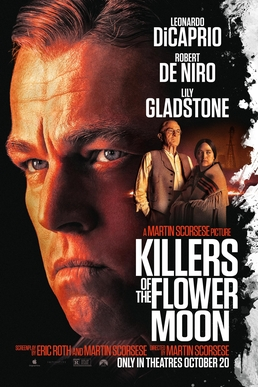
Main cast: Leonardo DiCaprio, Robert De Niro, Lily Gladstone, Jesse Plemons, John Lithgow, Tantoo Cardinal, Scott Shephard, etc.

Cinematography: Rodrigo Prieto

Edited by: Thelma Schoonmaker

*** MAY CONTAIN SPOILERS ***


Who can tell how the world and society as we know it would’ve evolved if Christopher Columbus, the explorer credited with finding the Americas in 1492, had not landed and begun the first steps toward colonising this uncharted part of Earth. Of course, there were existing natives in the Americas and over time they would experience first contact with Spanish, Portuguese, British and other European, predominantly white, settlers. It may be that the natives would have had equally difficult experiences, and colonists brought with them many positive things. But one has to surmise they would not have had their land and lives gradually taken from them over the centuries without the European invasion.

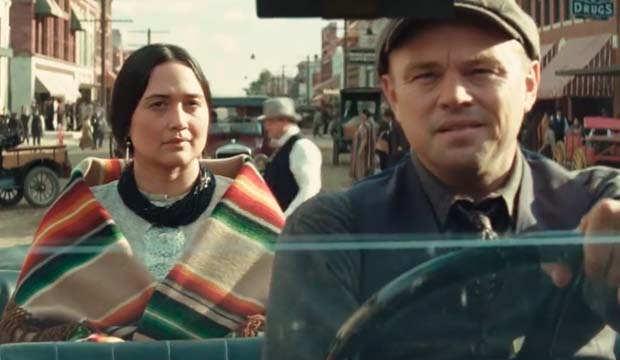
The violent theft of land and wealth from Native Americans forms the bedrock of the narrative of Martin Scorsese’s latest epic drama, Killers of the Flower Moon (2023). Adapted from David Grann’s critically acclaimed nonfiction book, the film centres on the series of murders of wealthy Osage people that occurred in Oklahoma in the early 1920s. The motive for the heinous culling was the greed of white men. Such individuals lusted after the richness present after big oil deposits were discovered beneath the Osage people’s land. Whereas Grann’s book is a monumental study of the murders, perpetrators, the Osage culture, politics of the era, and how the newly formed FBI delved into the crimes, Scorsese’s incredibly slow and long adaptation does all that, while also exploring the romance and murderous treachery between Osage native, Mollie (Lily Gladstone) and war veteran, Ernest Burkhart (Leonardo DiCaprio).
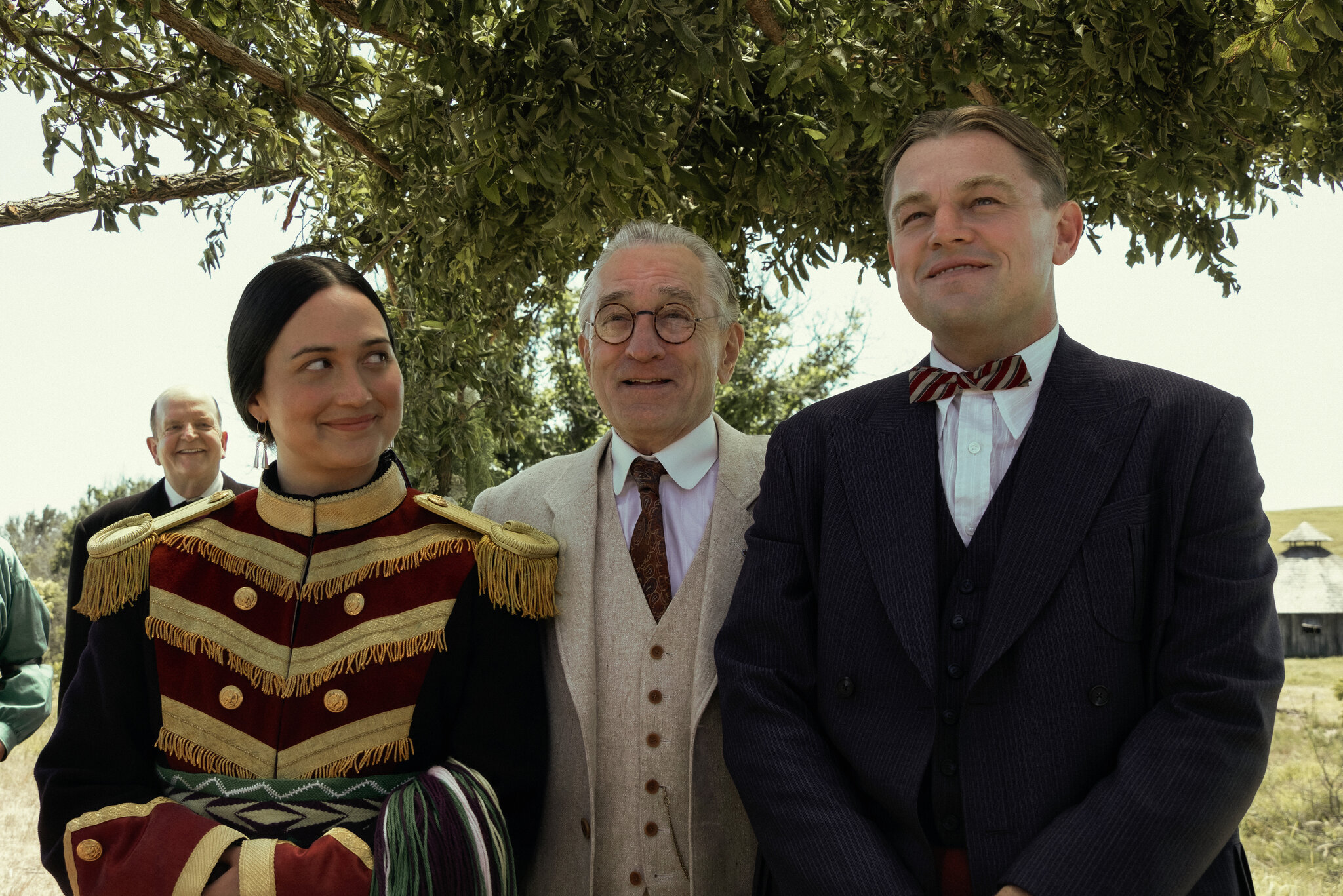


Opening by establishing how the oil erupted and blackened the green land, the film then firmly sets up how the American businessmen used the legality of the headright system to manipulate the flow of sudden wealth that came to the Osage people. One such man is William King Hale (Robert DeNiro) who presents himself as a benefactor to the Osage, but truly speaks with a forked tongue. Having left the infantry unit after World War One, Hale’s nephew Ernest joins him to work and ultimately do his bidding. Hale cajoles Ernest to romance wealthy Mollie and get further feet under the table and closer to that beloved black gold money. Yet, enough is never enough for the likes of Hale and driven by another formidable Scorsese directed performance, De Niro delivers a deviously evil characterisation.

DiCaprio here takes the less charismatic role as the doltish Ernest. As Hale urges him to do further misdeeds the banality of everyday evil is palpable in Ernest’s actions. Along with a litany of professional and thuggish cowboy types Ernest and Hale’s other minions wreak havoc on the Osage people, committing arson, murder, poisonings, robbery, and shootings. All just for more money. The tragedy is that Ernest clearly has feelings for Mollie, serenely portrayed by a revelatory Lily Gladstone, but he just cannot stand up for himself against his wicked uncle. So much so that I just wondered why the hefty runtime was concentrating on Ernest’s character. I mean, Scorsese and DiCaprio give us little in the way of anti-heroism to bounce off, or even some cathartic sense of redemption. Ernest starts out as a loser and finished the story the same. Over three hours spent with a gurning idiot left me frustrated.

Directed, as one would expect with a masterful hand, mind and eye by Scorsese, who once again surrounds himself with an incredibly talented cast and production crew. Not to forget the unbelievable $200 million budget. But Scorsese’s movement of late to ultra-long and methodical cinema is an artistic choice that requires much patience. While Killers of the Flower Moon (2023 is thematically very powerful, beautifully filmed, and contains a number of exceptionally impressive sequences, there was genuinely not enough story to justify such a long running time. Whereas The Irishman (2019) was slow, it was methodically thrilling and absorbing throughout. Killers of the Flower Moon (2023) on the other hand becomes repetitive in its reveals of greedy Cowboys breaking bad and raising hell to the cost of the Osage. The introduction of the FBI and their subsequent investigation comes way too late to save the over-bloated length and pace. However, there is no doubt, the film remains vital in highlighting the historial horror perpetrated upon the Osage land and people. Perhaps Apple TV should have just given the money to the Osage descendants as reparation?
Mark: 8 out of 11


LFF REVIEW – THE IRISHMAN (2019)

LFF REVIEW – THE IRISHMAN (2019)

Directed by: Martin Scorsese

Written by: Stephen Zaillian – based on the book I Heard You Paint Houses by Charles Brandt

Produced by: Martin Scorsese, Robert De Niro, Jane Rosenthal, Gaston Pavlovich, Randall Emmett, Emma Tillinger Koskoff, Gerald Chamales, Irwin Winkler

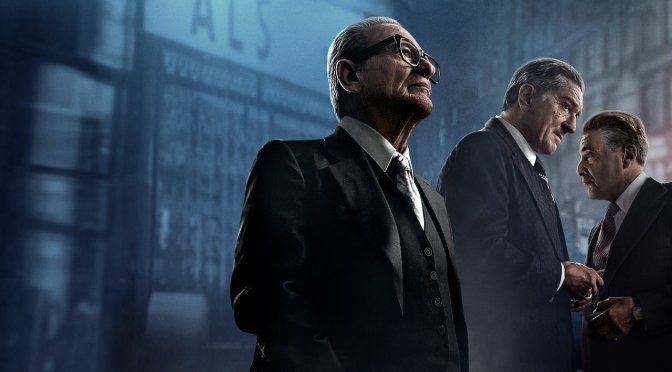
Cast: Robert De Niro, Al Pacino, Joe Pesci, Harvey Keitel, Anna Paquin, Bobby Cannevale, Stephen Graham, Kathrine Narducci, Jesse Plemons, Jack Huston, Ray Romano, Stephanie Kurtzuba and many more.

Cinematography: Rodrigo Prieto

Distribution: Netflix

******MAY CONTAIN SPOILERS ******


“I heard you paint houses…”

As well as watching new films that have yet to be released, one of the pleasures of film festivals can be when the filmmakers, writers, crew and actors themselves attend and introduce their work. Having said that, I’m not usually one for big and lengthy introductions and back-slapping celebration. I’m also not one for star-gazing and celebrity-spotting hysteria. They are just human beings; let them get about their business in peace.

But, when the cinematic geniuses that are: Martin Scorsese, Robert DeNiro, Al Pacino and Harvey Keitel took to the stage for the premiere of THE IRISHMAN (2019), even I was star struck! Add the brilliant actors Stephen Graham, Anna Paquin and Jack Huston to the mix and I can confirm I was in the presence of all-round film greatness.


Scorsese is the best genre filmmaker still living today. But what of THE IRISHMAN (2019)? Is it yet another cinematic masterpiece to add to an incredible list of classics that Scorsese has directed? On first watch I would say both yes and no. I sit on a fence because the film is SO long, detailed and intense, I need another sitting to really nail an absolute opinion. It’s very, very good – BUT is it a great? I remember first watching Goodfellas (1990) and feeling dazed by the end of it. It is now one of my favourite films of all time.

First impressions are that, once again, Scorsese has delivered yet another impeccable film in the gangster movie genre. Film is a collaborative endeavour though and he has surrounded himself with an army of major talents in the production and acting departments. Robert De Niro, who himself, optioned the book on which the film is based, takes the lead as Frank Sheeran. In support are the aforementioned Al Pacino, Harvey Keitel, Stephen Graham, Anna Paquin, Jack Huston and the out-of-retirement Joe Pesci. All work from a superlative screenplay adaptation from uber-writer Steven Zaillian


The story is structured, in many ways, like another gangster classic, Once Upon a Time in America (1984). An elderly character looks back on key aspects on their life; the highs, the lows, the deals, the crimes, the relationships and the bloody carnage. Frank Sheeran, as delivered by De Niro and Scorsese, is another complex presentation of masculinity. He was a trained soldier who did his duty in World War II against the Nazis. Then, on return to America, he found himself driving trucks. With a family to support he finds he cannot turn down the chance to “paint houses” and carry out important work for the mob family run by Russell Bufalino (Joe Pesci). I must say that Pesci is a revelation as the quiet shot caller, in the shadows, giving orders out of the spotlight. His mob boss is the total opposite from the psychopaths he’s played before.

Talking of great performances, Al Pacino as Jimmy Hoffa steals the whole film. It is incredible to think this is the first Scorsese film he has been in. It was definitely worth the wait. De Niro himself is also impressive. His role as narrator and story conduit guides us through many exhilarating scenes involving gangland deals, explosive action and violent hits. Moreover, we are also compellingly embroiled in Hoffa’s Teamster Union business conflicts, as well as, some of the most iconic historical moments from U.S. politics and history.


Scorsese’s approach to style is less frenetic when compared to his other gangster films or the rapid velocity of say, The Wolf of Wall Street (2013). There are fireworks and gunfights of course, plus explosive arguments between the angry and powerful men which inhabited this era. The heated debates between Hoffa (Pacino) and Tony Provenzano (Stephen Graham) are especially memorable. Plus, I liked that Hoffa’s character had very specific demands in regard to time-keeping and punctuality. It’s beautifully filmed but the pace is not as say, rock and roll, as his other films. In one long tense sequence toward the end of the film, Scorsese uses silence rather than trademark rock music to enhance the visuals.

Overall, themes of death, murder, loyalty, friendship, politics and regret dominate the story narrative. From the nursing home where Frank Sheeran begins his epic tale, to the multitude of hits and shootouts we experience, the Grim Reaper follows these characters like a constant shadow. I wasn’t sure how I was meant to feel about Frank Sheeran by the end. He is a complex character who, as a trained killer, is difficult to empathise with. But his, the bosses and Hoffa’s stories are compelling nonetheless. However, the last part of the film raises a lot of emotionally painful questions with equally difficult answers.

Lastly, certain things about the film, such as the “de-aging” CGI and lengthy running time, detracted from my initial enjoyment. However, Netflix have an absolute monster of a gangster film here, with Scorsese once again delivering a very special cinematic offering. The irony is that it will only have a limited theatre release. THE IRISHMAN (2019), therefore, deserves to be painted and seen on the biggest screen you can find.

Mark: 9.5 out of 11