Tag Archives: Cannes

Mubi Film Review: Hirokazu Kore-eda’s exquisite tale of love, loss and rebirth – Monster (2023)

MUBI FILM REVIEW: MONSTER (2023)

Directed and edited by Hirokazu Kore-eda

Written by Yuji Sakamoto

Produced by: Hirokazu Kore-eda, Minami Ichikawa, Kenji Yamada, Megumi Banse, Taichi Itō and Hijiri Taguchi

Main cast: Sakura Andō, Eita Nagayama, Sōya Kurokawa, Hinata Hiiragi and Yūko Tanaka

Cinematography by Ryuto Kondo

Music by Ryuichi Sakamoto

*** MAY CONTAIN SPOILERS ***
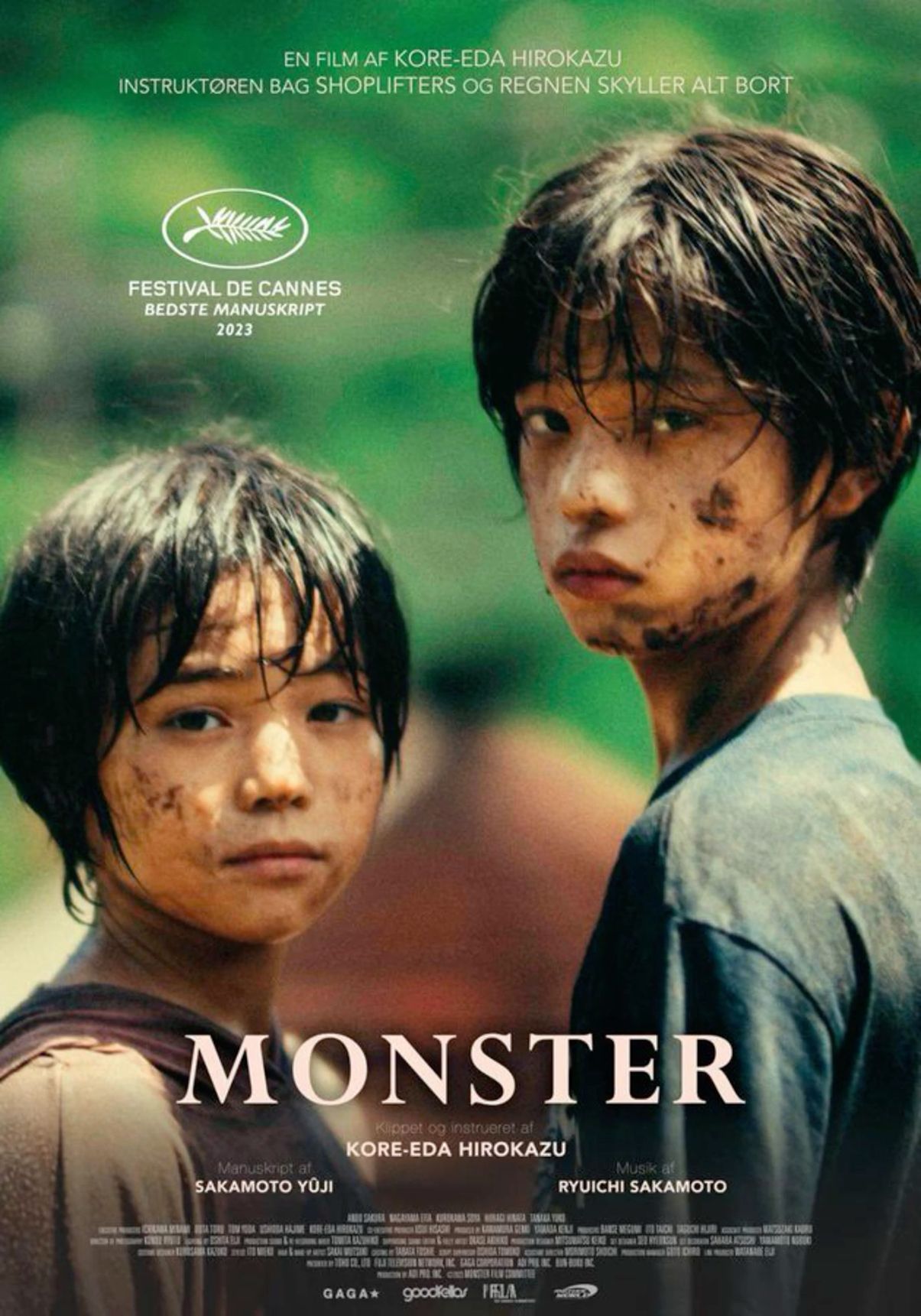


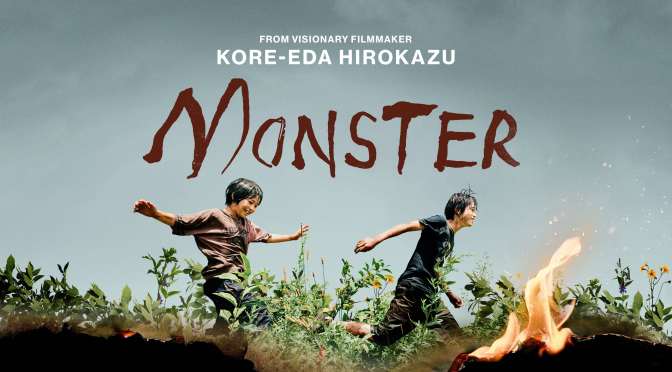
Hirokazu Kore-eda’s Monster (2023) exemplifies his continued mastery of humanist storytelling, a hallmark of his career. As with prior works such as the classic Afterlife (1998), critically acclaimed Shoplifters (2018), and the recent, arguably more commercial comedy-drama, Broker (2022), Kore-eda demonstrates a keen ability to explore the quiet complexities of human relationships, here through themes of bullying, young love, and the tender, taboo nature of queer affection. Monster (2023) delves deeply into the fragility of human connections, revealing the pain and misunderstandings that arise when societal expectations collide with individual identities.

The story focuses on shifting narrative perspectives of two young boys, Minato (Sōya Kurokawa) and Yori (Hinata Hiragi), Mugino’s mother, Saori (Sakura Andō) and the boy’s teacher, Michitoshi Hori (Eita Nagayama). Initially, Minato begins displaying slightly disturbing behavious such as cutting his own hair and throwing tantrums in class. His mother then believes the teacher is bullying him and begins to campaign for Mr Hori’s punishment. What then unfolds is something altogether more complex and powerfully ambiguous.

With Monster (2023), crafted via a Rashomon-style structure by screenwriter Yuji Sakamoto, the narrative approach provides a formidable layer to the film’s emotional resonance. It allow the audience to revisit pivotal events from multiple perspectives. By shifting viewpoints the script highlights how perception shapes reality, illustrating the subjectivity of truth in deeply personal and often painful ways. The multifaceted storytelling reveals how moments of cruelty, compassion, and misunderstanding ripple across different lives, underscoring Kore-eda’s central humanist message: no person is simply a villain or a hero, but a complex amalgam of motives and vulnerabilities.
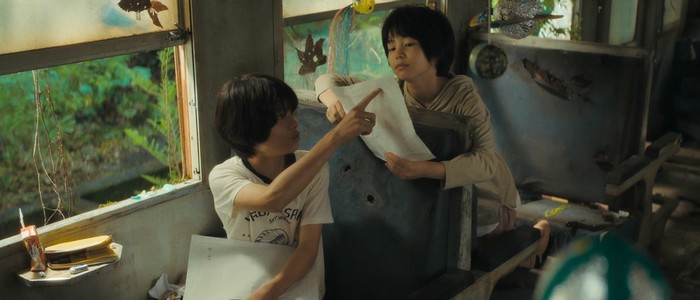


The script’s structural ingenuity enhances the film’s exploration of societal issues, such as the alienation of queer youth and the lasting scars of bullying. Each retelling reframes the characters’ actions, fostering empathy for even the most seemingly antagonistic figures. This interplay of perspectives elevates Monster (2023) beyond a straightforward tale of adolescent struggle, transforming it into a profound meditation on the intersection of memory, identity, and the pursuit of love and acceptance.

By marrying Kore-eda’s subtle directorial touch with Sakamoto’s intricate script, Monster (2023) achieves a rare cinematic feat: a story that is as intellectually engaging as it is emotionally devastating. Moreover, it reaffirms Kore-eda’s place as a preeminent chronicler of the human condition. Safe to say that it is beautifully filmed, cast and acted. To elicit such incredible performances from these boys is wondrous direction. It also features a fragmented but beautifully poetic final film score of the recently departed Ryuichi Sakamoto. Overall, it’s cinema that breathes pathos and humanity into each and every character, and provides no easy solutions. Monster (2023) is a film that burns, like the fiery tower block featured throughout, long in the heart and memory.

Mark: 9.5 out of 11


FILMS THAT GOT AWAY #16: OFFICIAL COMPETITION (2021)

FILMS THAT GOT AWAY #16: OFFICIAL COMPETITION (2021)

Directed by Gastón Duprat and Mariano Cohn

Written by: Mariano Cohn, Andrés Duprat and Gastón Duprat

Produced by: Jaume Roures

Main cast: Penélope Cruz, Antonio Banderas, Oscar Martínez, José Luis Gómez, Irene Escolar, Manolo Solo, Nagore Aranburu, Pilar Castro
Koldo Olabarri, etc.

Cinematography Arnau Valls Colomer

**MAY CONTAIN SPOILERS**


It’s no surprise there are an abundance of films about the actual process of filmmaking. The film industry is full of rich possibilities in terms of drama, action, tragedy, romance and comedy. Moreover, cinema down the years is replete with imaginative, tough, evil, spoilt, egotistical, eccentric, pretentious and frankly insane individuals working in the film industry. 8 1/2 (1963), Dolemite is My Name (2019), Shadow of the Vampire (2000), Sullivan’s Travels (1941), Barton Fink (1991), State and Main (2000), Once Upon A Time In Hollywood (2019), Hugo (2011)Living In Oblivion (1995), Boogie Nights (1997), The Disaster Artist (2017), Ed Wood (1994), The Player (1992), and Tropic Thunder (2008) are just a few brilliant films about filmmaking. Now you can add the hilarious Argentinian-Spanish co-production, Official Competition (2021) to that list.

With stunningly funny performances from Penelope Cruz, Antonio Banderas and Oscar Martinez, Official Competition (2021), centres on a film-within-a-film production, as Cruz’s ostentatious director, Lola Cuevas, helms a billionaire-backed-big-budget adaptation of a critically acclaimed book. Banderas is Felix Rivero, a famous movie star, while Martinez is a method-driven actor, and with the wildly unpredictable Cuevas between them, a rivalry soon develops between their different acting styles and personalities. As the production progresses any respect they had evaporates and descends into hilarious acrimony amidst a series of expertly staged comedic set-pieces.

I find it incredibly irritating that so many films get critical praise and win awards and you watch them and, while technically brilliant, they are ultimately boring and pretentious. Then we get Official Competition (2021), with a perpetually inventive screenplay by Mariano Cohn, Andrés Duprat and Gastón Duprat, that has not received nearly enough critical praise or awards. In fact, it mocks those artistically inflated directors and actors whom often get over-praised by fawning film critics and journalists. So, if you love films about filmmaking and funny ones at that, please do check this film out streaming on Netflix. It is certainly a cut above the pretentious films, actors and directors it is cleverly satirising.


CINEMA REVIEW: TRIANGLE OF SADNESS (2022)

CINEMA REVIEW: TRIANGLE OF SADNESS (2022)

Directed by Ruben Östlund

Written by: Ruben Östlund

Produced by: Erik Hemmendorff, Philippe Bober

Main cast: Harris Dickinson, Charlbi Dean, Dolly de Leon, Zlatko Burić, Henrik Dorsin, Vicki Berlin, Woody Harrelson etc.

Cinematography: Fredrik Wenzel

Edited by: Ruben Östlund, Mikel Cee Karlsson

Music by: Mikkel Maltha, Leslie Ming

*** MAY CONTAIN SPOILERS ***


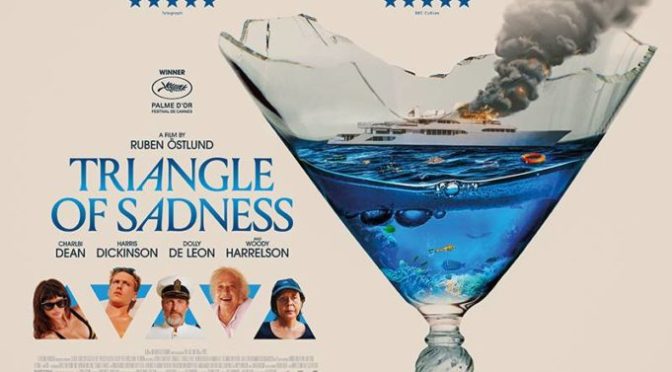
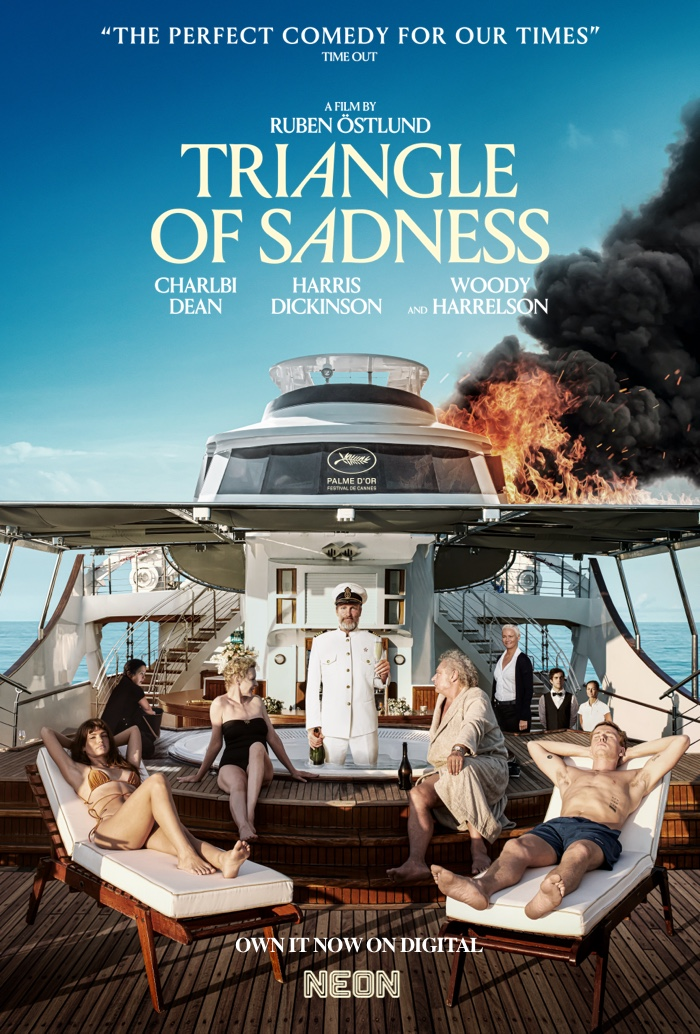
Ruben Ostlund is fast becoming one of those go to directors who can be relied upon to deliver cinema of the highest quality. His latest film, Triangle of Sadness (2022) is his finest to date. Having said that, his Force Majeure (2014) was one of those excellent films I hated.  Technically, it was beautifully shot, performed, and directed, however, I just found the characters too irritating. Personally despising ski holidays probably didn’t help either. I actually wished the characters had been killed in the avalanche to save on all the middle-class matrimonial moaning.

Ostlund’s next film The Square (2017) was bravura arthouse storytelling containing wonderful digs at the nature of modern art and how rich people will buy any old crap if it is put in a gallery. While a tad overlong, it was wonderfully funny with hilarious mocking of the bourgeoisie, art and the rise of social media. With Triangle of Sadness (2022), Ostlund has moved up the social strata and focussed his satirical eye on the uber-wealthy, combining socialist dialectic with gross-out comedy, as Das Kapital meets Monty Python’s The Meaning of Life (1983).


The film opens with Carl (Harris Dickinson) and Yaya (Charlbi Dean), a model and Social Media influencer, as a couple whose relationship is fraught with problems. Through Yaya’s connections she secures them free passage on one of the most luxurious yachting holidays on the ocean. While they aren’t short of money, they have nothing compared to the wealthy millionaires and business types on the boat. As Carl and Yaya act as our conduits in the story, Ostlund uses them to explore the petty first world problems which impact many romances. The staff are also introduced as key players in the “Upstairs, Downstairs” character dynamic, notably Woody Harrelson’s drunken socialist Captain Thomas Smith, and Vicki Berlin’s staff supervisor, Paula. Lastly, the money is represented essentially by lonely tech millionaire, Jarmo (Henrik Dorsin), obnoxious Russian, Dimitry (Zlatko Burić) and stroke victim, Therese (Iris Berben) and her husband.

Throwing these disparate, and latterly desperate personalities, into the trapped spaces of a superyacht is great writing by Ostlund. What unfolds in the second act of the film is an extended set-piece of riotous fun. As the yacht becomes battered by the stormy sea and weather, the guests all become violently ill to devasting impact. While it may not be to everyone’s taste, I was laughing for twenty odd minutes straight at this sickening skewering of these privileged people. At the same time the drunken Dimitry and Captain Smith argue relentlessly about the differences and merits of capitalist and Marxist ideologies. It’s easily one of the funniest and impressively directed sequences of this cinematic year.

But Ostlund isn’t finished yet. These characters have not suffered enough for him, and the final section of Triangle of Sadness (2022) drenches the story in another hilarious and satirical direction. I won’t spoil the events which unfold, but Carl and Yaya’s relationship issues come to the fore as a darkly comedic peril strikes the yacht and passengers. Here Ostlund strikes a further blow against capitalism, exploring the nature of survival of the fittest and true values of human currency in a savage indictment against the obscenely rich. Overall, while the characters may not be the most likeable, that is never Ostlund’s aim. Ostlund’s desire is to critique capitalist hegemony through both high and low brow humour. He succeeds, making Triangle of Sadness (2022) one of the most thought-provoking and exhilarating cinema experiences of the year.

Mark: 9.5 out of 11