Tag Archives: Chris Cooper

Classic Film Review: Matewan (1987)

Classic Film Review: Matewan (1987)

Directed by John Sayles

Written by John Sayles

Produced by Peggy Rajski and Maggie Renzi

Main Cast: Chris Cooper, James Earl Jones, Mary McDonnell, Will Oldham, David Strathairn, Kevin Tighe, Gordon Clapp, Bob Gunton, etc.

Cinematography by Haskell Wexler

** MAY CONTAIN SPOILERS **
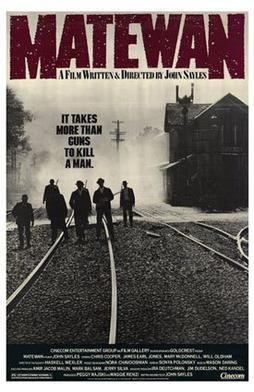


For me, John Sayles represents almost everything that is admirable about independent filmmaking and is quite simply a phenomenal screenwriter. His best scripts never feel mechanically constructed. They breathe. Characters wander into scenes carrying entire histories with them, and seemingly casual conversations reveal class, politics, relationships, disappointments and decades of buried resentment. Films such as the magnificent, Matewan (1987), Passion Fish (1992), Eight Men Out (1988) and impressive, Lone Star (1996) demonstrate just how sophisticated his writing can be, yet there is rarely anything flashy or self-conscious about it.

Moreover, I also love the sheer pragmatism of the career he built. Sayles understood that being an independent filmmaker didn’t mean pretending Hollywood didn’t exist. He started out writing wonderfully entertaining low-budget genre pictures for Roger Corman — Piranha (1978), The Lady in Red (1979), Alligator (1980) and Battle Beyond the Stars (1980) among them — and went on to become a successful screenwriter and highly regarded script doctor on much bigger Hollywood productions. He could take the money and experience from those assignments and then return to the films that really mattered to him. Rather than waiting for the industry to give him permission to make his movies, he found a way of financing and sustaining them himself.

And perhaps that is why I find Sayles so inspiring. The Hollywood work didn’t dilute his independence — in many ways, it enabled it. Across decades of filmmaking, he retained his curiosity, his integrity and his belief that audiences were intelligent enough to engage with complicated characters and complicated ideas. For any filmmaker trying to make personal work outside the mainstream, John Sayles isn’t simply a great writer-director. He’s a genuine indie filmmaking hero — and proof that it is possible to survive within the film business without allowing the business to define the films you make.

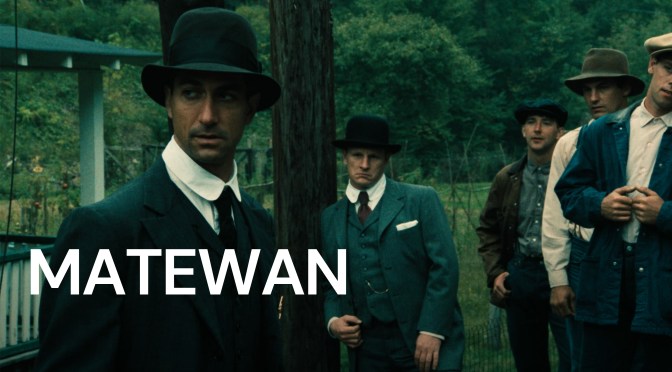
I recently re-watched, Matewan (1987), having not seen it for years. It is a beautifully crafted, deeply humane piece of American cinema in which the personal, political and historical become inseparable. Taking the real-life Matewan coal conflicts of 1920 as his foundation, Sayles creates something far richer than a conventional historical drama. This is a film about miners and their families, immigrants and outsiders, union organisers and company men; about people discovering that their only real strength lies in standing together against corporate bosses prepared to use intimidation, exploitation and outright violence to maintain their power.
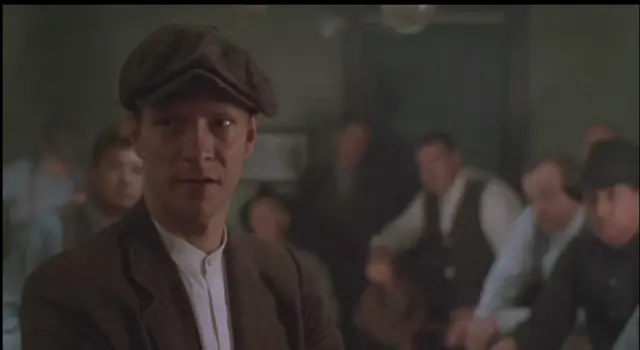


There is an incredible humanity running throughout the film. Sayles understands the divisions between these workers — racial, cultural, religious and economic — and therefore never makes their eventual solidarity feel easy or sentimental. The miners have to overcome suspicion and prejudice before recognising that the forces dividing them are also helping to keep them powerless. At the centre of it all is Chris Cooper, superb as union organiser Joe Kenehan: quiet, intelligent, principled and determined to prevent an already volatile situation from descending into violence. Around him Sayles constructs an entire community, allowing individual lives, marriages, friendships and rivalries to exist alongside the larger political struggle.

The film is also visually magnificent. Working with the great cinematographer Haskell Wexler, Sayles gives Matewan (1987) a rich, earthy, almost tactile quality. The mountains, forests, railway tracks, wooden houses and coal-blackened interiors don’t merely provide an interesting period backdrop; they seem to contain the history of the people living and working within them. There is mud, smoke, sweat, blood, tears and darkness everywhere, contrasted with the natural beauty of the West Virginia landscape. The mines themselves feel oppressive and dangerous, while the wider landscape can appear both beautiful and imprisoning. Further, while these people live among extraordinary natural beauty they are being economically trapped by the company that controls the coal mines.

Rather than building the film around conventional movie stars, Sayles assembled the kind of extraordinary American character actors who make every face and every voice feel as though it belongs in this world. Chris Cooper – in his debut feature – gives the film its moral centre, while James Earl Jones brings enormous dignity, warmth and authority to ‘Few Clothes’ Johnson. David Strathairn is wonderfully memorable as Sid Hatfield, and Mary McDonnell brings intelligence and emotional complexity to Elma Radnor. Then there is Kevin Tighe as Hickey, one of the Baldwin-Felts agents sent into Matewan to intimidate the miners and break their resistance. Tighe gives the film a genuinely menacing presence: smiling, controlled and utterly comfortable with the threat of violence.

The combination of historical detail, political conviction, memorable acting and direction, magnificent cinematography, beautifully observed characterisation and gripping storytelling is what makes Matewan (1987) such a remarkable achievement. Sayles takes a specific labour dispute in a West Virginia mining town and turns it into something both intimate and expansive: a story about solidarity, dignity, prejudice, exploitation and the terrible price ordinary people can pay when they challenge entrenched power. Yet for all its anger, Matewan (1987) never loses its compassion. Sayles remains interested in people first. It is muscular, intelligent, visually beautiful and deeply moving filmmaking, made with enormous integrity — and one of the finest examples of just how powerful American independent cinema can be.
Mark: 9.5 out of 11


GREAT ENSEMBLE FILM CASTS #6 – AUGUST: OSAGE COUNTY (2013)

GREAT ENSEMBLE FILM CASTS #6 – AUGUST: OSAGE COUNTY (2013)

Directed by: John Wells

Screenplay by: Tracy Letts

Based on: August: Osage County by Tracy Letts

Produced by: George Clooney, Grant Heslov, Jean Doumanian, Steve Traxler

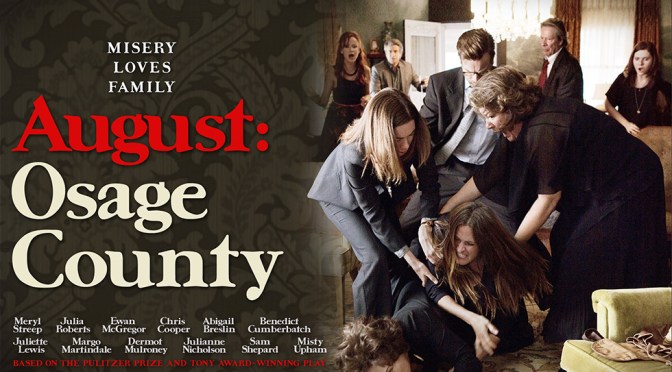
Cast: Meryl Streep, Julia Roberts, Ewan McGregor, Chris Cooper, Abigail Breslin, Benedict Cumberbatch, Juliette Lewis, Margo Martindale, Dermot Mulroney, Julianne Nicholson, Sam Shepard, Misty Upham, etc.

Cinematography: Adriano Goldman

*** MAY CONTAIN SPOILERS ***


Unsurprisingly, the play, August: Osage County, from the typewriter of Tracey Letts – the formidable playwright behind Killer Joe and Bug – about a family suffering loss of a “loved” one was not going to be a feelgood and uplifting affair. Instead, over the period of a month we are introduced to a whole host of characters with a variety of anger, addiction and attitude issues. Brought together by apparent grief, when patriarch, Beverley Weston (Sam Shepard) drowns, the extended Weston family fight and vent spleen at each over current and past dramas, with many a secret soon to be revealed.

Winning the Pulitzer Prize for Drama in 2008, Letts play was subsequently adapted into the dark, feel-bad and tragi-comedy film in 2013. Directed by John Wells, August: Osage County (2013), brought together an unbelievable ensemble cast of actors who did spectacular work with Letts acerbic and razor-sharp dialogue. Given that many of the personalities in the narrative are dominant matriarchal characters, the casting of Meryl Streep and Margo Martindale in the roles of Violet Weston and Mattie Fae respectively, is certain to create sparks on the screen. So, it proves.

Streep has delivered so many memorable characterisations over the years, but as Violet Weston I’m not sure she’s been so bilious and cancerous, both literally and symbolically. Her daughters, portrayed by Julia Roberts, Juliette Lewis and Julianne Nicholson, all have their own issues to deal with, but with such a vicious mother it’s a surprise they aren’t in a psychiatric ward. As harsh truths and bitter revelations unfold over the dinner and kitchen table conversations, Letts shows the complex nature of family existence; how it traps us with people we have nothing in common with. Women are seemingly in charge of the Weston family as the men, represented by Ewan McGregor, Benedict Cumberbatch, Sam Shephard and Chris Cooper, appear more passive and bullied.

Altogether, August: Osage County (2013), is a difficult to watch as there’s not a lot of love shown in the Weston household. Nonetheless, as an acting and writing tour-de-force there are few films that can best it. I guess we all have family problems and many ups and downs to deal with in life. What we can learn from this play and film is that this is definitely NOT the way to behave to people you’re meant to love and care for.


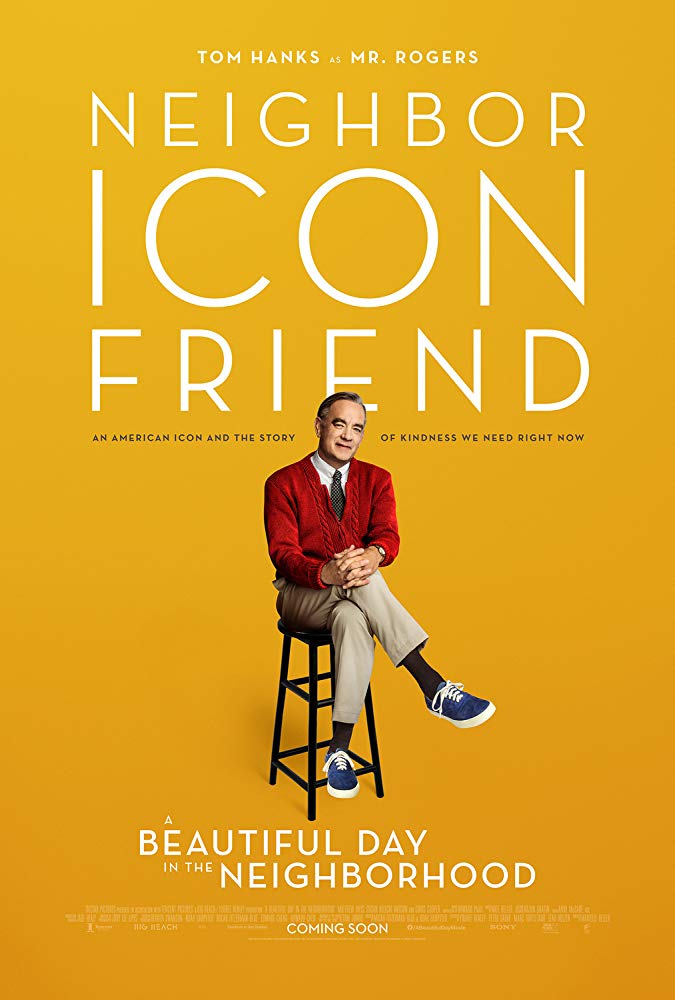
A BEAUTIFUL DAY IN THE NEIGHBORHOOD (2019) – CINEMA REVIEW

A BEAUTIFUL DAY IN THE NEIGHBORHOOD (2019) – CINEMA REVIEW

Directed by Marielle Heller

Produced by: Youree Henley, Peter Saraf, Marc Turtletaub, Leah Holzer

Written by: Micah Fitzman-Blue and Noah Harpster – Based on the article – “Can You Say Hero?” by Tom Junod

Cast: Matthew Rhys, Tom Hanks, Susan Kelechi-Watson, Chris Cooper, Christine Lahti

Cinematography: Jodee Lee Lipes

**CONTAINS MILD SPOILERS**


“Hello Neighbour!” – Fred Rogers


I watch a lot of horror, thriller and drama films that you could say are “feel-bad” in nature. They may eventually have some form of happy or morally satisfying ending, but such cinema seeks to create a sense of danger, anxiety and emotional distress as entertainment. Now I enjoy watching films on the edge of my seat and having my nerves shredded, however, sometimes it’s great to watch something that is quite the opposite. A Beautiful Day in the Neighborhood (2019) is one such “feel-good” film, profiling an American icon and arguably one of the nicest people who ever lived: Fred Rogers.

Rogers (Tom Hanks) was the creator and host of Mister Rogers’ Neighbourhood which ran for decades on U.S. cable channel PBS. The programme, while aimed at children, dealt with serious subjects like illness, divorce and death via puppetry, songs and Rogers’ wise and simple homespun philosophies. Over the years he became a household name and a staple of American family life. Yet, A Beautiful Day in the Neighbourhood (2019), is not a standard biopic exploring Fred Rogers life from birth to death. In fact, he’s more of a magical mentor type of character for the lead protagonist, journalist Lloyd Vogel, portrayed by Matthew Rhys.


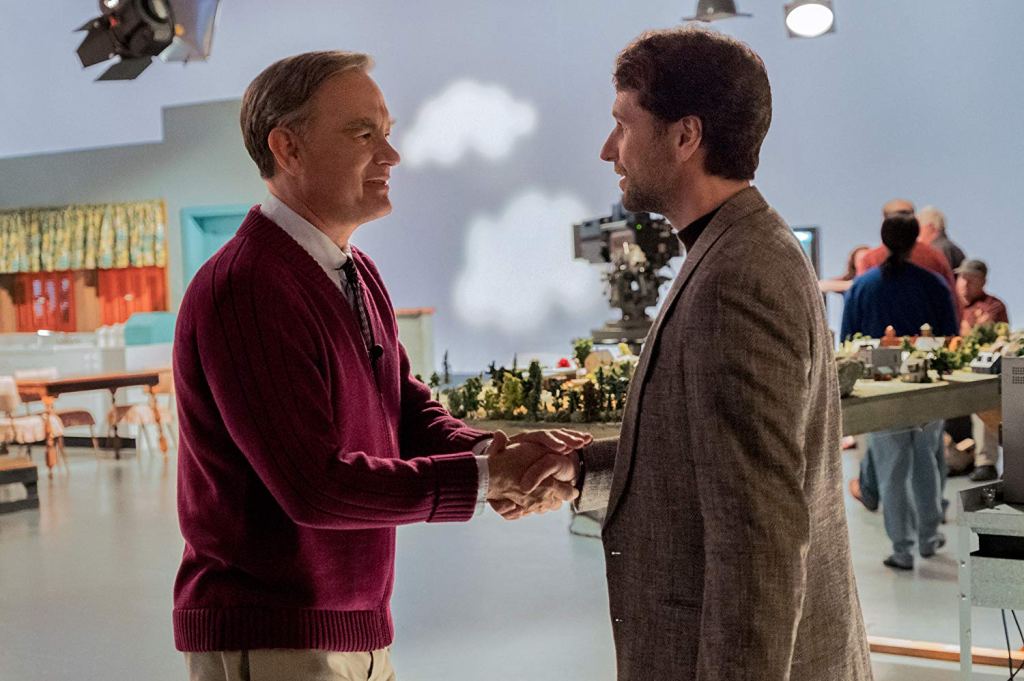
Opening with a meticulously presented simulacrum of Mister Rogers’ Neighbourhood TV show with Tom Hanks in the hosting chair, the film immediately welcomes us into a positive and safe place. The audience are the children and we are about to be told a story about Lloyd. Because Lloyd is lost and troubled and needs help. Cleverly combining the TV show with flashbacks to Lloyd’s difficult family life is just one of the wonderful devices the film presents. Another is the use of models to emulate the locations within the film. Given the job of interviewing Fred Rogers for an Esquire piece, there’s a sense that Lloyd could well be looking to do a hatchet job on Rogers. However, he finds himself drawn to Rogers’ soft, magnetic and calming charm. The relationship between Rogers and Vogel’s character is superbly teased and developed by an excellent script.

While the drama is relatively low-key, the film is not without emotional impact throughout. There are several stand-out scenes where Lloyd’s negative and cynical worldview is airbrushed away by Rogers’ incredible goodness. As Vogel’s attitude to Rogers changes, so does his feelings toward his estranged father, his wife and child and the world in general. At the same time, Tom Hanks exceptional performance completely captured my heart. I’d never seen any of Fred Rogers TV shows before, but Hanks conveyed the inner peace and wisdom of this man perfectly. Moreover, my wife, who is American, was crying her eyes out with joy and nostalgia all the way through. Ultimately, this is another fine character and human drama from director, Marielle Heller. So, if you want a break from all the nasty unpleasantness in the world, you should definitely knock on Mr Rogers’ door. Everyone is welcome.

Mark: 8.5 out of 11


LITTLE WOMEN (2019) – CINEMA REVIEW

LITTLE WOMEN (2019) – CINEMA REVIEW

Screenplay and Direction by: Greta Gerwig

Based on: Little Women by Louisa May Alcott

Produced by: Amy Pascal, Denise Di Novi, Robin Swicord

Cast: Saoirse Ronan, Emma Watson, Florence Pugh, Laura Dern, Timothee Chalamet, Meryl Streep, Tracy Letts, Bob Odenkirk, James Norton, Louis Garrel, Chris Cooper etc.

Cinematography: Yorick Le Saux

**MAY CONTAIN SPOILERS**


It’s Boxing Day and you’re nursing a slight Christmas Day hangover, plus your brain is still trying to piece together the crazy jigsaw that was HBO’s Watchmen (2019). You now want a story that’s a bit more comforting; something that will make you warm and snug and feel safe. Step forward Greta Gerwig, Louisa May Alcott and an incredible cast of fine actors in the latest adaptation of the classic novel, Little Women (2019). It’s a perfect Christmas film full of romance, love, spirit, passion and just a little bit of pathos and heartache.

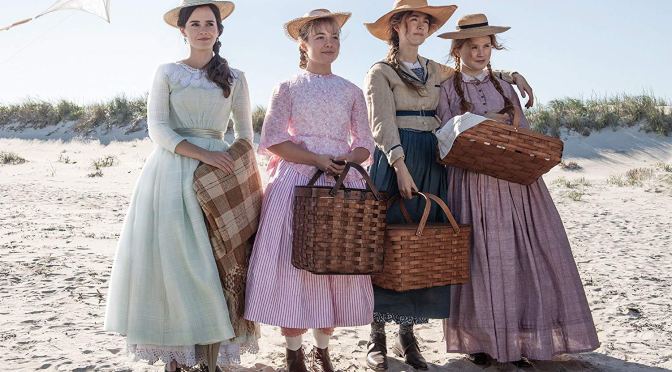
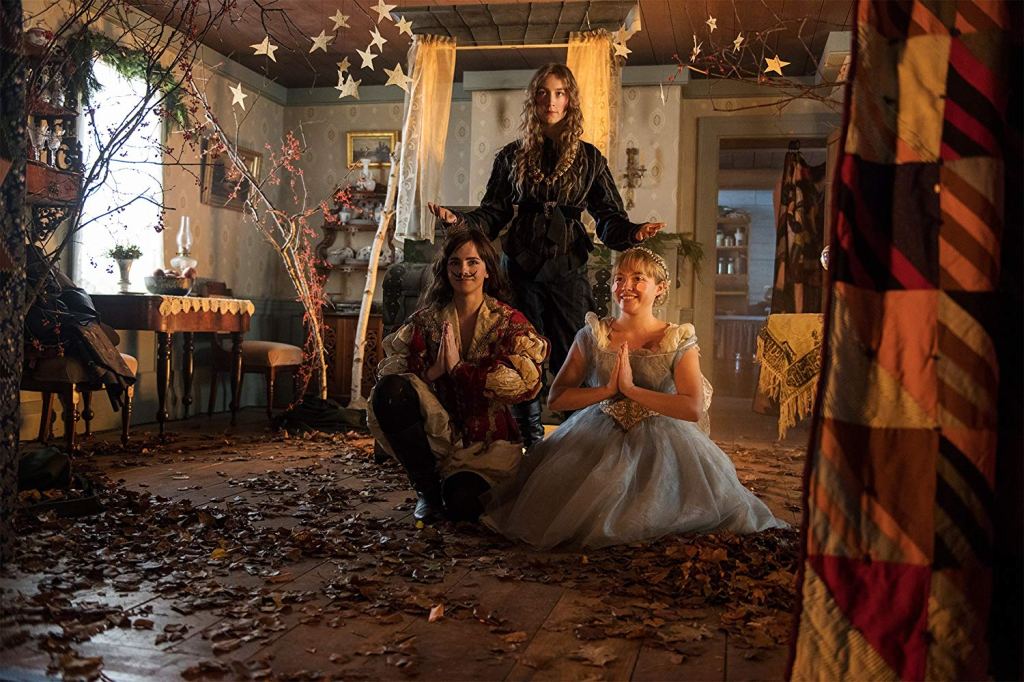
Set in Massachusetts at the time of the American Civil War, this splendid old chestnut of a story covers the lives of four teenage sisters — Meg (Emma Watson), Jo (Saoirse Ronan), Beth (Eliza Scanlan) and Amy March (Florence Pugh). They live with their Marmee (Laura Dern) and the story criss-crosses various years and narrative events as they search, find, lose and find again happiness, sadness and love. While the sisters prove to be very different personalities and clash often throughout the film, ultimately, it’s a film about solidarity, strength, sisterhood and family bonds.


It’s interesting Gerwig would choose something so safe for her next film project following the acclaim she correctly received for writing and directing Ladybird (2017). However, it’s not surprising either. While the title states these women are little, they are in fact anything but. Ronan as Jo and Pugh as Amy are especially energetic and larger than life. Both strive for artistic excellence and attempt to gain control over their personal and working lives in a traditionally patriarchal society. Jo’s desire to be a successful writer drives the story along impressively as Gerwig determines a meta-structure through her character. Indeed, Jo’s scenes with Tracy Letts’ publisher and editor are particularly amusing amdist some of the losses the March family suffer.

Amidst the familiarity of the text, Gerwig does attempt originality in her cutting between past and present events. While cross-cutting becomes slightly distracting from the emotions of the narrative, you can see how Gerwig wanted to stamp her own identity. The device also allows some wonderful juxtaposition of shots, emotions and camera movement. My one criticism would be that because the characters looked of a similar age in past and present, you did not always know what year you were in. Ultimately though, I really enjoyed this high-class film production. Greta Gerwig is an incredibly talented filmmaker and obtains exceptional performances from all the cast, especially Ronan and future stars, Florence Pugh and Timothee Chalamet. The film was so warm and safe, my Christmas Day hangover, like my heart, all but melted.

Mark: 8.5 out of 11