Tag Archives: cinematography

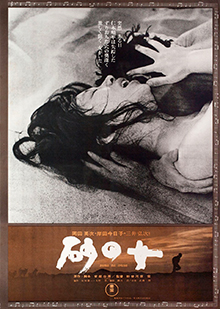
Classic Film Review: Woman in the Dunes (1964)

Classic Film Review: Woman in the Dunes (1964)

Directed by Hiroshi Teshigahara

Screenplay by Kōbō Abe
Based on The Woman in the Dunes
by Kōbō Abe


Produced by Kiichi Ichikawa and Tadashi Ono

Main cast: Eiji Okada, Kyōko Kishida, Kōji Mitsui

Cinematography by Hiroshi Segawa

*** MAY CONTAIN SPOILERS ***


I’d never seen Woman in the Dunes (1964) before, but after watching the director’s cut on the BFI Player, it has now catapulted into one of the best films I have ever seen. This could be first-watch bias, however, thematically, emotionally, philosophically and stylistically speaking, it absolutely touched upon, connected and spoke to me greatly about my life’s experiences and the human condition.

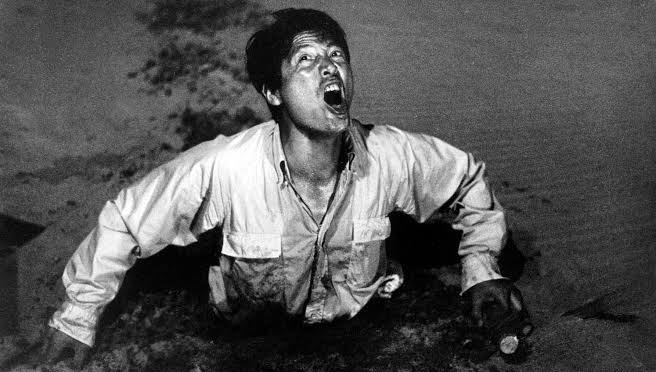
Niki Junpei (Eiji Okada), a frustrated schoolteacher and amateur entomologist from Tokyo, travels to a remote coastal village in search of rare insects. After missing the last bus home, he accepts an invitation to stay overnight with a young widow (Kyōko Kishida) who lives alone in a hut at the bottom of a vast sand dune. He soon learns that her husband and daughter were killed in a sandstorm and that she spends every night shovelling away the endless sand that threatens to bury her home. Though Junpei initially sees himself as a temporary guest, strange comments from the villagers hint that something more sinister is unfolding.

The following morning, Junpei discovers that the rope ladder leading out of the sand pit has been removed. Trapped by the villagers, he realizes he has been chosen to become the widow’s permanent companion and labourer, helping her dig sand that the village secretly sells for profit. As he struggles to escape, Junpei learns that the widow is also a prisoner of the community, both of them controlled through dependence on the villagers for food and water. What begins as an accidental overnight stay becomes a nightmare of confinement, survival, and the gradual erosion of freedom beneath the relentless weight of the sand.


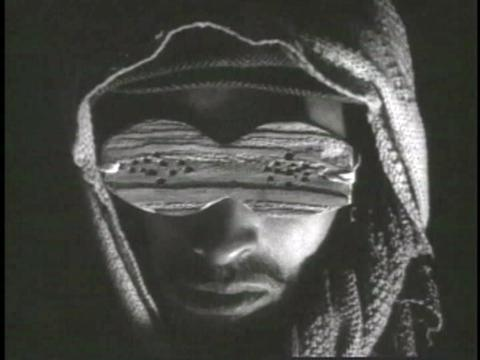
Hiroshi Teshigahara’s Woman in the Dunes (1964) is one of those rare films where image, character, theme and performance become inseparable. Shot in pristine black and white by cinematographer Hiroshi Segawa, it is visually astonishing: every grain of sand, bead of sweat and shadow across a human body is rendered with an almost microscopic intensity. The beauty of the photography is deliberately juxtaposed with the darkness of Niki Junpei’s predicament. What begins as an innocent expedition to collect insects becomes an existential prison, as he finds himself trapped by commerce, a surrogate marriage and, most powerfully, the natural wall of sand that pins both him and the unnamed widow to their strange subterranean existence.

The sand is both physical and metaphorical. It shifts, pours, consumes and rebuilds itself, turning Junpei’s captivity into a distinctly Sisyphean struggle. Every attempt at escape merely seems to return him to where he started, yet what makes Junpei such a compelling character is his absolute refusal to surrender. He builds ladders, devises increasingly ingenious escape plans, attempts to train crows to carry messages and continually tries to outwit the villagers who have ensnared him. Each failure intensifies rather than diminishes his determination. Like Sisyphus pushing the rock back up the hill, Junpei is condemned to confront an obstacle that endlessly renews itself.

Yet Woman in the Dunes (1964) is far more complicated than a straightforward story of imprisonment. Junpei is trapped by the villagers, but also by economic necessity, social expectation and an enforced domestic relationship that gradually begins to resemble a marriage. The villagers need the sand removed; the widow needs a man to help her survive; Junpei needs water, food and eventually human companionship. Teshigahara transforms this bizarre situation into a miniature society in which freedom itself becomes increasingly difficult to define. The more Junpei fights against his surroundings, the more deeply he becomes connected to them.

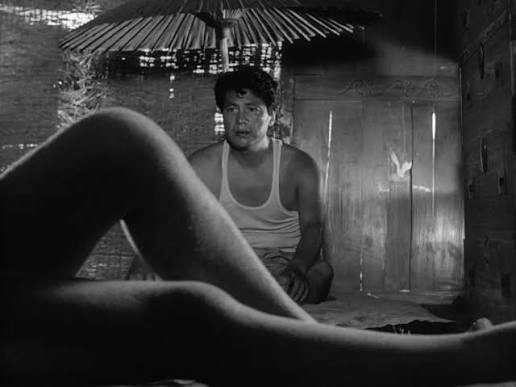
The relationship between Junpei and the widow, played with extraordinary physical and emotional commitment by Eiji Okada and Kyōko Kishida, gives the film its human core. Their intimacy moves between hostility, dependency, tenderness and desire without ever becoming conventional romance. Although sex is an important element of the film, Teshigahara rarely needs explicit imagery. Bodies appear as silhouettes, fragments and outlines; Kishida’s naked form is often suggested rather than displayed. A shoulder, a curve, a shadow or sand clinging to skin can communicate more than an explicit image ever could. One sees more from less throughout.


That principle extends to the entire film. Teshigahara makes the smallest details monumental. Sand resembles water, skin resembles landscape and the walls of the pit sometimes appear infinite. Extreme close-ups turn grains of sand into an entire universe, while wider compositions emphasise just how insignificant these two people are against the enormous shifting landscape surrounding them. The immaculate monochrome photography makes the film simultaneously beautiful and suffocating. The sand can look almost luminous in one shot and utterly threatening in the next.

There is also a wonderful irony at the heart of Junpei’s predicament. He arrives as an entomologist searching for insects, only to become a specimen himself: captured, observed and contained within a pit from which he cannot escape. The collector has become the collected. Teshigahara never labours the metaphor because he does not need to. It exists naturally within the imagery and situation, allowing the audience to discover its implications rather than having them explained.

Woman in the Dunes (1964) is virtually flawless in character, theme, cinematography, direction and performance. More than sixty years after its release, it remains startlingly modern and visually unlike almost anything else. Its central image — two human beings endlessly shovelling away a mountain of sand that will simply return tomorrow — is cinema distilled into an unforgettable metaphor for existence itself.

The only negative? Why didn’t I watch it sooner?

Mark: 10.5 out 11


SIX OF THE BEST #30 – FAVOURITE FILM MONTAGES!

SIX OF THE BEST #30 – FAVOURITE FILM MONTAGES!

Who doesn’t love a film montage!? The passage of time edited and set to a memorable soundtrack is fine cinematic tradition. Not only is a montage a great way to tell a story visually, it can also give pace to a narrative, provide a perfect cinematic bridge to the final act or even supply emotional impetus at the start and middle of a film.

Here I choose six of my favourite movie montages. All have been selected due to both the style and content of the sequence, plus the music accompanying the montage. Of course, I could have chosen a more artistic aspect to montage by including examples from Eisenstein, Kubrick or the incredible editing in the The Godfather (1972), when Michael Corleone wipes out his rivals during his nephew’s baptism. That I will save for another day.


ROCKY (1976)

No film franchise has exploited the fight montage and training sequence to the max like Rocky. I could have chosen others, but the original remains the best. I love the urban locations and the Philadelphian streets are just so gritty as Stallone’s down-on-his-luck boxer gets a crack at the championship of the world! That music just soars too!

SCARFACE (1983)

With a combustible screenplay written by Oliver Stone, Scarface (1983), is a cocaine driven and incendiary viewing experience. Everything is ramped up to eleven, including: the violence, shouting, swearing, shooting, politicking, drug-taking, sex, killing, avarice, cocaine, money-making, decadence and corruption. It is an epic film with many classic scenes, but the 80’s pop-synth-driven montage here adds real pace to the brutal proceedings.


THE KARATE KID (1984)

Another fighting film and another John G. Avildsen pick! More than just a teenage Rocky rip-off, The Karate Kid (1984) is a terrific rites-of-passage drama that incorporates a love story and a boy overcoming bullies with the help of a wise mentor. Joe Esposito’s song, “You’re the Best” was originally chosen for Rocky III, but ultimately ended up here in the fantastic fighting tournament montage.


FERRIS BUELLER’S DAY OFF (1986)

John Hughes fast-paced-set-in-one-day-comedy-classic has some brilliant dialogue and is anchored superbly by Matthew Broderick’s cocky lead performance as mischievous Ferris Bueller. For all the craziness on show one of my favourite scenes is when Hughes slows the pace down at the museum. Here we get some wonderfully framed shots, sly humour and a beautiful instrumental version of The Smiths’ song, “Please, Please, Please, Let Me Get What I Want!”


UP (2009)

So many films struggle to establish empathy for their characters either through bad writing or poor creative choices. Pixar, however, are masterful at establishing both character identification and motivation. None more so than in this classic montage featuring the mostly blissful life of Carl and Ellie Fredericksen. With Michael Giacchino’s iconic score called “Married Life” providing energetic and poignant emotional support, this is one of the most moving four minutes in movie history.


DJANGO UNCHAINED (2012)

Tarantino’s epic Western runs the gamut of action, violence, comedy and drama, even throwing a buddy-buddy dynamic in there for good measure. While often known for his quotable dialogue, Tarantino’s films always feature crisp editing and a powerful visual storytelling too. I love this montage in Django Unchained (2012), with Django and King Schultz framed against the wonderful snowy vistas as Jim Croce sings his catchy tune.


1917 (2019) – CINEMA REVIEW

1917 (2020) – CINEMA REVIEW

Directed by: Sam Mendes

Produced by: Sam Mendes, Pippa Harris, Jaybe-Ann Tenggren, Callum McDougall, Brian Oliver

Written by: Sam Mendes, Krysty Wilson-Cairns

Cast: George McKay, Dean Charles-Chapman, Mark Strong, Andrew Scott, Colin Firth, Claire Duburcq, Benedict Cumberbatch etc.

Cinematography: Roger Deakins

Music by: Thomas Newman

**CONTAINS HISTORICAL SPOILERS**


Image result for 1917 film

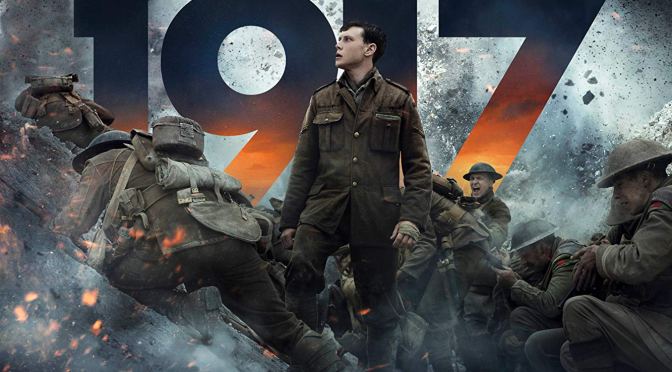
If Roger Deakins doesn’t win every single award for best cinematography in the world, I will be completely shocked! Together with Sam Mendes’ and their respective creative and production teams they have delivered a barnstorming, aggressive and beautiful work of pulsating cinema with 1917 (2019). In fact, the whole project is such a feat of technical brilliance, I think Sam Mendes will probably win best direction and the film will most likely win best film at the 2020 Academy Awards.

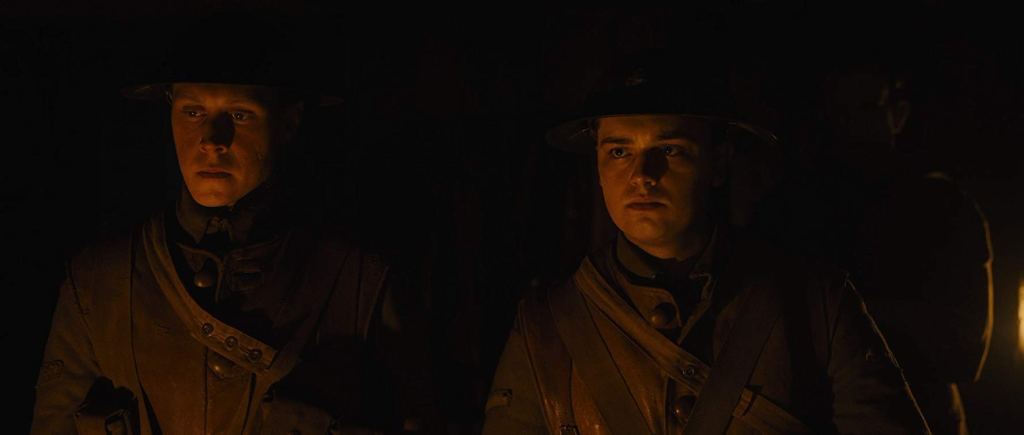
The form and style of the film are dictated by Mendes and Deakins audacious decision to film in one long continuous take. Set, as the title states in 1917 during World War I, we open with a long tracking shot and from there the shot never ends. Establishing the main protagonists Lance Corporal Will Schofield (George MacKay) and Lance Corporal Tom Blake (Dean-Charles Chapman), the camera glides along as they make small-talk, creating humour, warmth and calm before the storm to come. That storm derives from their mission to carry a message through perilous territory and prevent 1,600 British soldiers falling into a German trap. Immediately the stakes are high and these two brave men set out to achieve this dangerous task.


The choice to film in one continuous shot is a fascinating one and here it is executed brilliantly. Of course, there are occasions where a cut has occurred, but this is masked by darkness, water, camera movement or CGI. I personally am not a massive fan of longer takes though. They can be seen as a stylish, but empty process and usually work best in opening scenes. Moreover, by not cutting or using montage techniques I feel you can lose suspense, impact and pace from a film. However, that is certainly not the case with 1917 (2019). Here it works perfectly with the camera following, tracking, running, falling and stalking the characters, so much so, the audience becomes the camera. We are right in this war with them!

As we track Blake and Schofield through bunkers, trenches, fields, farmhouses, derelict buildings and villages, the stench of death and destruction surrounds them. Mendes and his writing partner, Krysty Wilson-Cairns, also create some heart-sweating and explosive set-pieces for the soldiers to overcome. Indeed, the pace with which they regularly find themselves under attack, married with the filmmaking style, puts you in the heart of the action and fight. The final battle where Schofield valiantly strives to reach his final destination and relay the message is utterly exhilarating and spellbinding cinema.


As the two everyman soldiers, George MacKay and Dean-Charles Chapman give convincing performances. MacKay is especially memorable as his tall frame, hollowed cheekbones and haunted eyes dominate the screen. Furthermore, the two leads are supported ably by a “who’s-who” of British actors. The likes of: Mark Strong, Colin Firth, Benedict Cumberbatch and Andrew Scott puncture the action throughout with their quality. Scott is especially excellent as a cynical officer, drunk and bereft of hope. The two heroes ignore his jaded battle worn persona, but soon find themselves surrounded by corpses, quickly coming to understand this character’s despairing heart.

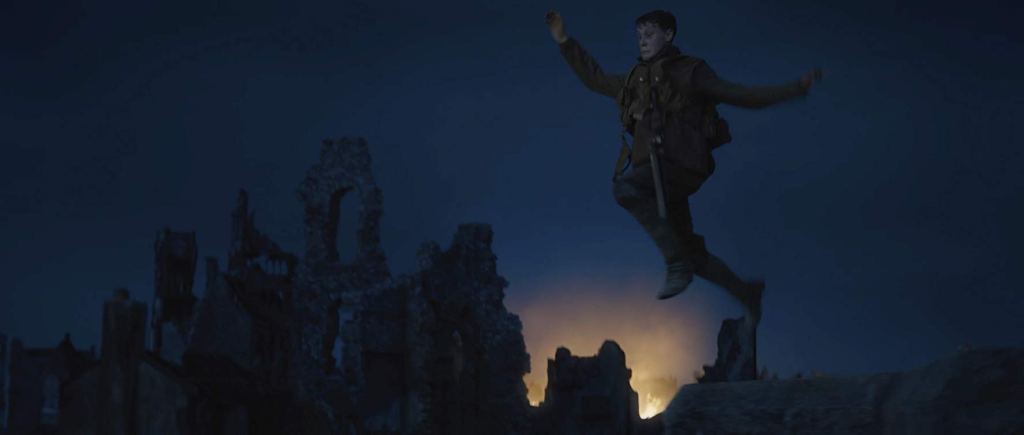
Like Dunkirk (2017), the film is arguably thin on characterisation and character development, but stylistically impressive in it’s rendition of the horrors of war. Indeed, when the events switch to night, Deakin’s lighting skills dominate as he paints images with darkness, moonlight and fire with majestic results. Thus, overall, one could argue this is just one long chase film; an extended version of the climax of another World War I classic, Gallipoli (1981). However, the cinematic marvel that is, 1917 (2019), overcomes it’s narrative and thematic familiarity with an amazing technical achievement in both form and style. Awards glory beckons for all involved; and more importantly the film pays fine tribute to the gallant soldiers who served in an ultimately senseless war.

Mark: 9.5 out of 11