Tag Archives: Jayme Lawson

Cinema Review: The Running Man (2025) – Edgar Wright – a decent cardio cinema workout that breaks into intermittent sprints!

Cinema Review: The Running Man (2025)

Directed by Edgar Wright

Screenplay by Michael Bacall & Edgar Wright – Based on The Running Man by Stephen King

Produced by Simon Kinberg, Nira Park & Edgar Wright

Main Cast: Glen Powell, William H. Macy, Lee Pace, Michael Cera, Emilia Jones, Daniel Ezra, Jayme Lawson, Sean Hayes, Colman Domingo and Josh Brolin, etc.

Cinematography by Chung-hoon Chung

*** MAY CONTAIN SPOILERS ***
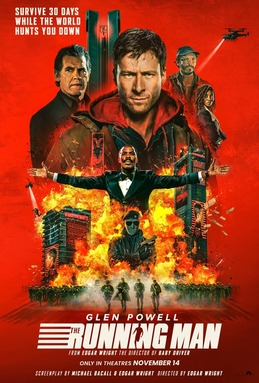


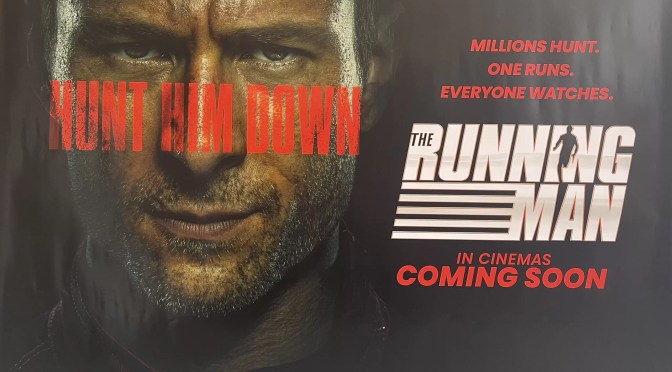
As a fan of Edgar Wright’s stylish, kinetic direction, the camp cult charm of the original Arnold Schwarzenegger 1980’s action romp, and of course Stephen King’s sharp literary concepts, I went into The Running Man (2025) with high hopes. The film certainly starts brilliantly where Wright unloads a barrage of inventive visual gags, flashy transitions, and razor-clean action choreography. The set-pieces are spectacular from the outset, and when the film is firing on all cylinders, it’s exactly the sort of propulsive, high-concept entertainment you’d expect from this creative cocktail.

It remains a fantastic concept with a near-future game-show rewarding contestants with great wealth as long as they survive a month on the run and are not killed by all manner of uber-mercenaries chasing them. But as a whole the script and tone never quite settle. As such, the film wavers between being a comedy-actioner and a revolutionary dystopic thriller. It can be both, but here the shifts feel abrupt and under-cooked. The last forty-five minutes and final act especially drag, weighed down by a new character who is introduced mainly to witness Richards (Glen Powell) strike back at his foes, without adding much thematic or emotional heft. Emilia Jones does okay but her character should’ve entered the story much earlier—ideally as one of the contestants—so her eventual role feels earned rather than tacked on.



Powell is solid, charming, and physically believable in the role, but he’s not (at least yet) a true blockbuster star—more a handsome, reliable leading actor as demonstrated in the excellent, Hit Man (2024). I couldn’t help but imagine someone like Lee Pace in the part. Instead he is playing the lead henchmen. Pace is an actor with the gravitas and presence to anchor the story’s darker undercurrents and sell the rebellion with more weight. Indeed, Pace, Michael Cera, Colman Domingo, and Josh Brolin bring depth and texture to The Running Man (2025), each grounding the film’s wild energy with sharply defined performances. Pace delivers charismatic menace, while the underused Cera adds an unexpected nervy humour that sharpens the satire. Domingo, as always, lends personality as the show host, and Brolin rounds it out with rugged corporate authority that makes the world feel dangerous.

Ultimately, even Wright’s trademark ADHD-fueled visual dynamism can’t fully rescue a script that overreaches in ambition. Thus, The Running Man (2025) could have been truly great if it had taken just a little more time to breathe—letting its world, its fears, and its people settle in before the chaos kicked off. Beneath the neon splatter and bombastic satire is a sharp idea about media, violence, voyeurism, and manipulation, but the film races past its own potential. With a touch more patience to build tension, deepen the stakes, and let us actually care about the characters caught in the spectacle, its dystopia might have hit harder, felt richer, and lingered longer after the credits rolled. Still, the craft and energy make it an intermittently thrilling ride—just one that needed sharper focus to become the definitive The Running Man (2025) adaptation fans were hoping for.
Mark: 7 out of 11


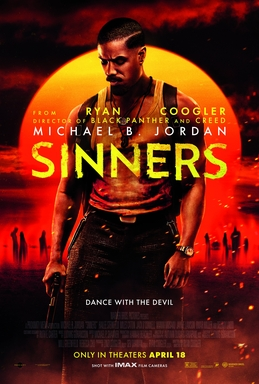
Cinema Review: Sinners (2025) – a blazing, bold and bloody blues opera!

Cinema Review: Sinners (2025)

Directed by Ryan Coogler

Written by Ryan Coogler

Produced by Zinzi Coogler, Sev Ohanian, Ryan Coogler

Main cast: Michael B. Jordan, Hailee Steinfeld, Miles Caton, Jack O’Connell, Wunmi Mosaku, Jayme Lawson, Omar Miller, Delroy Lindo, etc.

Cinematography by Autumn Durald Arkapaw


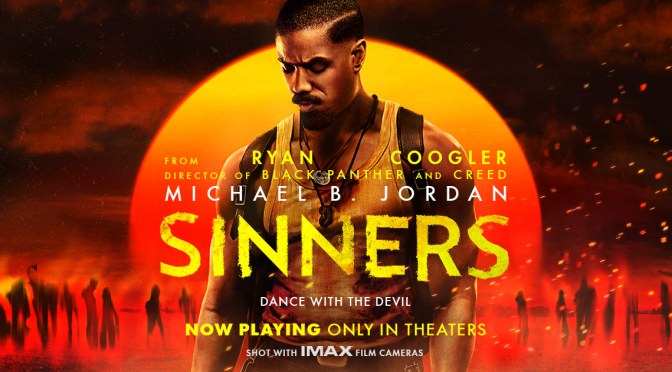
After the bleakly lustful vision of Robert Eggers’ Nosferatu (2024) — a film steeped in shadow, dread, and tragic sensuality — Ryan Coogler offers a wildly different, electrifying take on the vampire mythos: a bold, colourful, and deeply soulful experience that pulses with life even as it drinks from the dead. Where Eggers lingers in gothic majesty, with Sinners (2025), Coogler surges forward with kinetic energy, blending grind-house thrills and emotional depth with From Dusk Till Dawn-style narrative turns.

Coogler’s film is set in the richly textured American South of the 1930s, a world still nursing the scars of the Great War and on the cusp of social upheaval. Into this volatile landscape, he drops the muscular Michael B. Jordan as twin war veterans turned Chicago gangsters, Smoke and Stack — men who carry both physical and spiritual wounds from the trenches — now repurposed as businessman looking to set up a juke joint. These characters feel reminiscent of the working class anti-heroes of Peaky Blinders, their emotional trauma rendered in everything from flickering glances to bursts of brutal, operatic violence. The twins have ghosts of the past and present to battle including relationship issues with Stack’s ex-girlfriend, Mary (Hailee Steinfeld), as well as Smoke’s painful reunion with his wife, Annie (Wunmi Mosaku).

Sinners (2025) plot is muscular and sinewy, establishing the characters impressively before shifting the moody Southern gothic tale into an all-out genre-bender. The film contains a fine ensemble cast knitting a series of substantial supporting characters each with their own personalities, humour and wants. The most striking is Miles Caton as the twins’ cousin, Sammie “Preacher Boy” Moore, a young blues musician with an incredible ability, that proves to be a somewhat dangerous talent. Delroy Lindo also throws in another memorable performance as the ebullient pianist, Delta Slim. With the first night’s festivities in full swing three mysterious strangers appear from the near dark, desiring to be let in. Their leader is charismatic Remmick (Jack O’Connell) and he has more than partying in mind.


Visually, Coogler lets his imagination loose, notably in a memorable cross-generational musical montage that literally burns up the cinema screen. Gone is the shadow-heavy monochrome of Eggers; in its place is a palette of dusk reds, moonlit silvers, and deep bayou greens. The film pulses with colour, sex, motion, and sweat. Blood flows, but it never feels gratuitous — it feels earned, ritualistic, even sacramental. But what ultimately makes Coogler’s film so potent is its soul. Amid the genre thrills and gore, there’s a beating heart full of soul. These vampires are not romanticised, nor merely feared; they are hungry creatures. Coogler gives them back their humanity, and in doing so, reanimates the genre with urgency.

Music is where the film truly soars. Coogler and his production team, attuned to the cultural pulse, curate a soundtrack that fuses Delta blues, Appalachian folk, and early jazz into a feverish, ghostly soundscape. There are scenes where the music alone tells the story: a backwoods funeral scored by a bone-dry slide guitar; a juke joint confrontation where the rhythm of violence matches the stomp of the blues; a haunting lullaby sung by Remmick the migrant vampire that channels generations of sorrow. It is music as memory, as resistance, as raw emotional texture.

Sinners (2025) is not just a vampire film. It’s a blues opera. A folk horror elegy. A pulpy, poignant, and powerfully visceral story about the things that haunt us, and how we fight to keep our humanity intact. What begins as a slow-burning period drama smolders into a blood-soaked explosion of action and moral reckoning. Coogler even delivers a Klan-blasting and redemptive shoot-out final act set-piece. Lastly, in Coogler’s hands, the vampire becomes more than a monster; it’s a metaphor for trauma, addiction, religion, racism, and survival. Coogler reclaims the myth for a new generation, one shaped by history, crime, grief, music, and spiritual struggle, delivering a genre masterpiece that bites deep and lingers long after the lights come up.

Mark: 9.5 out of 11