
SIX OF THE BEST #12 – UNRELIABLE NARRATORS IN CINEMA
**CONTAINS MASSIVE SPOILERS**
I find the nature of storytelling and narrative construction a fascinating craft. As someone who reads and watches a lot of stories via: books, cinema, theatre, comedy, radio and television, I am always drawn to devices which differ from the conventional norm. When I was younger I used to pour scorn on stories told straight and in chronological order. I like difficult or unconventional works as it appealed to my younger rebellious side. Of late though, I have come to realise that unconventional or non-linear storytelling can be used as a stylistic device for the sake of it and adds nothing to the story. Screenwriting navel-gazing devices such as fragmented timelines can detract from the emotional impact of the characters’ journey. Thus, to get a complex layered and non-linear storyline right is difficult. Many writers and filmmakers experiment with variant structures to escape standard narrative conventions. Indeed, with hard work and positive creative decisions it is possible to capture magic in a script and transport it to the screen.
Conversely, the device of the unreliable narrator is another means which a screenwriter can differentiate a narrative from conventional classic storytelling. Usually, in say a Hollywood blockbuster our hero or heroes will be those we root for from beginning to end. To switch our main protagonist or narrative focus from positive to negative or good to bad is brave writing. To even begin with an anti-heroic or even unlikable lead protagonist is obviously a risk and can alienate the audience. Furthermore, to make the lead character or characters unreliable is very difficult. However, the tricky craft of leading us one way with a protagonist before revealing them to be untrustworthy or twisted is a device which can provide much narrative satisfaction.
In 1981, William Riggan, created a study of various unreliable types, including: The Picaro, The Madman, The Clown, The Naif and The Liar. The Picaro will typically be a bragger, similar to the Liar but not as heinous. The Madman or Mad Woman, however, will be more sinister but The Clown and The Naif will either be playing for laughs or in the latter’s case, telling their story from a naïve position. Moreover, an unreliable narrator will potentially be hiding their own crimes or actions out of guilt. Or they will have amnesia, selective or deliberate to mislead the audience. They may just take great joy in telling lies or simply be unhinged to believe their fractured personality is presenting their version of the truth. It could be they are also attention seekers; OR actually a combination of all of the above.
Examples of unreliable narrators are legion throughout theatrical and literary presentations. Indeed, Agatha Christie and Jim Thompson often utilised them in their crime stories; as did novelists such as: Emily Bronte, F. Scott Fitzgerald, Bret Easton Ellis, Gillian Flynn, Vladimir Nabokov and many more. In this piece I would like to consider six of the best films featuring unreliable narrators. It was tough to get just six as I could have easily doubled it but here we are!
***CONTAINS MASSIVE SPOILERS***

ATONEMENT (2007)
Joe Wright’s majestic directorial adaptation of Ian McEwan’s tragic war story is a poignant study of petty revenge and romantic conflict. While the story focusses on the doomed love affair between James McEvoy and Keira Knightley’s class-crossed lovers, the narrator is novelist Briony Tallis (Vanessa Redgrave). Due to a spiteful action by her thirteen year-old self the events of the drama are revealed at the end to be manipulated out of sheer guilt. While she attempts to give the romance story a more positive ending the horrors of war are to the fore and Briony’s remorse will never be humbled.
THE CABINET OF DR CALIGARI (1920)
This silent movie classic is seen as the epitome of German Expressionist cinema. Set within the confines of a mental health asylum it was directed by Robert Wiene and written by Hans Janowitz and Carl Mayer. The story concerns a man named Francis (Friedrich Feher) as he tells of a strange tale involving the mysterious somnambulist Cesare and nefarious Dr Caligari. Both stylistically and structurally formidable the film features: twisted and painterly sets, shadowy key lighting and ghostly make-up. Also, the story-within-the-story is both terrifying and all a lie in the mind of a madman. The ending would now be seen as potential cliché but on release it was astounding and clearly influenced another story with a troubled and unreliable narrator in Shutter Island (2010).
FIGHT CLUB (1999)
Chuck Palahniuk’s seminal novel and David Fincher’s incendiary cinematic adaptation is way too complex a piece to sum up in this little list. However, it still stands the test of time in terms of style and structure as Fincher directs the hell out of Edward Norton’s everyman and his charismatic alter-ego, Tyler Durden. A brutal, violent and coruscating vision of masculinity in crisis within a crumbling, corporate and schizophrenic society, Norton’s unreliable narrator spits and spirals and finally splits literally in half. Funny, dark, and a genuine film classic, no one’s meant to talk about Fight Club but it certainly deserves all the praise heaped upon it.
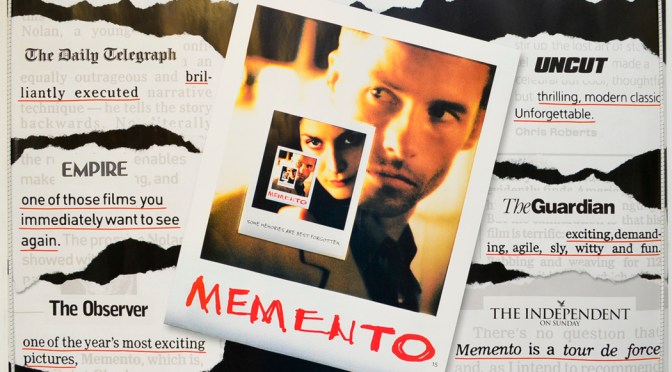
MEMENTO (2000)
Christopher Nolan’s early noir classic Memento (2000) is famously told in reverse chronological fashion, thus subverting the very nature of linear storytelling. His anti-hero, Leonard Shelby, has no means of making new memories thus via tattoos and Polaroid photos he constructs a present day movie of his own life in visual form. As the story unfolds we flash back and forth to a film within a film about a character called Sammy Jankis. Yet, incredibly and sadly, it turns out that Sammy is an imagined character used to suppress a terrible event in Leonard’s life and the film within a film is in fact the imagined vision of an unreliable narrator.
RASHOMON (1950)
Akiro Kurosawa’s superbly directed crime classic has not just one but numerous unreliable narrators. Structured around the investigation into a rape and murder in Japan the story splinters around the investigation of said crimes. Various versions of the same story are told from different perspectives as the subjectivity of truth is tested to the full. Are the characters’ stories from the perspective of: the bandit, the wife, the samurai and woodcutter lies or “true” reflections of the events in their respective minds? We all tell stories and is it possible we have got it wrong by mistake or manipulating the truth to our own benefit. Rashomon posits such questions and more in a beautifully rendered cinema classic.
THE USUAL SUSPECTS (1995)
Christopher McQuarrie’s screenplay remains one of the best I have ever read and the film is not too bad either. Shot on a low budget but cast perfectly the whole story is set around Chazz Palminteri’s cop grilling Kevin Spacey’s Verbal Kint about a major crime at the docks. What follows is a fractured structure which twists and turns on the basis of the narratives Kint is providing. We flash into event within event which is initially perceived to be truth but ultimately is a fiction. The final reveal where we find Kint has, in fact, been hiding a devilish truth all along astounds the cop and audience beyond belief. The story was so complex that Gabriel Byrne and other cast members actually thought they were Keyser Soze; only finding out they weren’t when they’d seen the incredible twist ending.

 The Cinema Fix presents