Tag Archives: narcotics

Cinema Review: Him (2025) – find blood, sweat, and meltdowns galore in this visceral NFL thriller!

Cinema Review: Him (2025)

Directed by Justin Tipping

Written by Skip Bronkie, Zack Akers & Justin Tipping

Produced by Jordan Peele, Win Rosenfeld, Ian Cooper & Jamal Watson

Main cast: Marlon Wayans, Tyriq Withers, Julia Fox, Tim Heidecker, Jim Jeffries, Maurice Greene etc.

Cinematography by Kira Kelly

** MAY CONTAIN SPOILERS **



“In modern slang, “Him” is used to signify a person who is considered a standout or a “star” in their field, often in sports or entertainment.” — Google search result.


Him (2025) is a visually arresting and thematically potent descent into the underbelly of American athletic obsession — a pitch-black thriller that trades stadium lights for the strobe of psychological torment. Centered on Cameron “Cam” Cade, a young quarterback hungry to dethrone San Antonio Saviors’ reigning legend Isaiah White (a commanding Marlon Wayans), the film begins as a standard sports drama and swiftly morphs into something far darker. Director Justin Tipping captures the suffocating intensity of modern competition with a painter’s eye — sweat, blood, and neon collide in every frame, turning locker rooms and training fields into cathedrals of self-destruction.

As Cam endures Isaiah’s brutal “boot camp,” the film exposes the rot beneath the rhetoric of greatness. Fear, humiliation, and violence dominate the regimen, transforming mentorship into a form of ritualized hazing. Themes of steroid abuse, distorted masculinity, and father-son guilt weave through the story like poison veins. The omnipresence of social media — the constant surveillance, the demand for curated perfection — amplifies the claustrophobia. In its best moments, Him (2025) feels like a nightmarish hallucination of ambition, where performance and identity blur until nothing human remains.



Yet for all its kinetic power and aesthetic daring, Him (2025) stumbles when it comes to coherence. The screenplay rushes through emotional beats, failing to give its characters space to breathe or evolve. Key relationships and motivations are truncated by editing that favours rapid cuts over logic — the film’s pulse races, but its heart falters. The result is an experience that dazzles visually but feels narratively hollow, more like a hypnotic music video than a fully realized character study. Indeed, the ending drops the ball most of all. The nightmarish satire culminates in a bloodbath which, while visually powerful, feels like something more twisted and subtle would have served Cam’s character arc better.

Overall, there’s no denying Him (2025) and its impact as a cinematic spectacle, with Wayans and Withers delivering standout performances. Its imagery lingers — bodies breaking under fluorescent light, cheers warping into screams — as does its commentary on the performative nature of modern masculinity, crazy fan worship, monetization of athletes and sporting sacrifice. If only the script matched its visuals, Him (2025), might have stood shoulder to shoulder with the psychological thrillers it so clearly reveres.


Mark: 6.5 out of 11


Amazon Prime Film Review: Kneecap (2024) – Irish rap rebels substitute words-for-bombs in riotous youth-in-revolt triumph!

Amazon Prime Film Review: Kneecap (2024)

Directed by Rich Peppiatt

Screenplay by Rich Peppiatt

Story by Rich Peppiatt, Liam Óg Ó hAnnaidh, Naoise Ó Cairealláin, JJ Ó Dochartaigh

Produced by Jack Tarling and Trevor Birney

Main cast: Naoise Ó Cairealláin, Liam Óg Ó hAnnaidh, JJ Ó Dochartaigh, Josie Walker, Fionnuala Flaherty, Jessica Reynolds, Adam Best, Simone Kirby, Michael Fassbender, etc.

Cinematography by Ryan Kernaghan

*** MAY CONTAIN SPOILERS ***


The 2024 film Kneecap is a riotous, politically charged portrait of youth in revolt, channeling the raw energy of punk and hip-hop into a uniquely Irish-language rebellion. Starring the real-life Belfast rap trio—Mo Chara, Móglaí Bap, and DJ Próvaí—as fictionalized versions of themselves, the film blends anarchic humour, biting satire, rites of passage, and cultural defiance to tell the story of how a group of working-class misfits wove their frustrations into musical gold.

Set in post-Troubles West Belfast, the film captures the lingering scars of British occupation and the generational trauma it left behind. Liam (Mo Chara) and Naoise (Móglaí Bap) are introduced as small-time drug dealers navigating poverty, police harassment, and fractured families. Their lives take a turn when JJ Ó Dochartaigh, a disillusioned Irish-language teacher, discovers their lyrical talents and joins them as DJ Próvaí. Together, they form the eponymous group, an Irish-language rap group that weaponizes music as a form of cultural resistance.

The film is unapologetically rebellious, using the Irish language not just as a means of communication but as a symbol of defiance. Arlo (Michael Fassbender), Naoise’s father and a former republican paramilitary, encapsulates this sentiment when he declares, “Every word of Irish spoken is a bullet fired for Irish freedom” . This philosophy permeates the group’s music, which tackles issues like British colonialism, drug culture, and the complexities of identity in a divided society.


Kneecap (2024), while a bold and electric celebration of youth rebellion arguably overstretches itself emotionally by attempting to cover too many themes at once. In its ambition to be both a political statement and a coming-of-age tale, a musical odyssey and a generational cry for recognition, the film occasionally dilutes its emotional impact. As the film juggles a multitude of weighty themes: the trauma of post-Troubles Northern Ireland, the fight for Irish-language preservation, the drug culture plaguing working-class communities, the fractured nature of family life, absent fathers and mothers, and the burden of political legacy. Add to this the rise of a rap group in an unexpected cultural context, and the film becomes a whirlwind of ideas competing for attention. The result is a film that sometimes feels like it’s racing to say everything at once, rather than letting its most resonant emotional threads breathe.

Nonetheless, director and co-writer, Rich Peppiatt, displays strong visual flair evoking the urban vibrancy of Trainspotting (1996) and underdog musical joy of The Commitments (1991). It helps that the film is often fucking hilarious. Plus, I realise it’s a raw reflection of their life choices, I could take or leave the perpetual scenes of gratuitous drug-taking. At the same time, the film doesn’t shy away from the gritty realities of its setting. It portrays the trio’s clashes with radical republican groups, their run-ins with the police, and the family and romantic struggles that come with their newfound fame.

Amidst the chaos, Kneecap (2024) maintains a sense of humour and humanity, offering a nuanced look at the power of art to challenge the status quo and inspire change. In essence, Kneecap is a ballsy and risk-taking celebration of rebellion, a testament to the enduring power of language and music as tools of resistance, and a vivid portrayal of youth challenging the remnants of a colonial past and a country attempting to find peace and identity after centuries of conflict.

Mark: 8.5 out of 11


NETFLIX TV REVIEW – BETTER CALL SAUL (2020) – SEASON 5

NETFLIX TV REVIEW – BETTER CALL SAUL (2020) – SEASON 5

Created by: Vince Gilligan, Peter Gould

Executive producer(s): Vince Gilligan, Peter Gould, Mark Johnson, Melissa Bernstein, Thomas Schnauz, Gennifer Hutchison,

Producer(s): Bob Odenkirk, Nina Jack, Diane Mercer, Robin Sweet, Gordon Smith, Jonathan Glatzer,

Directors: Bronwen Hughes, Norberto Barba, Michael Morris, Gordon Smith, Jim McKay, Melissa Bernstein, Vince Gilligan, Thomas Schnauz, Peter Gould,

Writers: Vince Gilligan, Peter Gould, Thomas Schnauz, Gordon Smith, Alison Tatlock, Heather Marion, Ann Cherkis,

Cast: Bob Odenkirk, Jonathan Banks, Rhea Seehorn, Patrick Fabian, Michael Mando, Tony Dalton, Giancarlo Esposito, etc.

Cinematography: Arthur Albert, Marshall Adams

Production company(s): High Bridge Productions, Crystal Diner Productions, Gran Via Productions, Sony Pictures Television

Original network: AMC

UK Release: Netflix

***MAY CONTAIN SPOILERS***


“We all make our choices. And those choices, they put us on a road. Sometimes those choices seem small, but they put you on the road. You think about getting off. But eventually, you’re back on it.”
Mike Ermantraut – Better Call Saul (S5 – Episode 9)


One thought, of many, that I will take to my dying day is in regard to the business of the war on drugs. I get that people want to strive for intoxication in order to medicine themselves against the pain and struggle of everyday life. I get that humans love to get high and have a party. I get that people unfortunately get addicted to substances, so much so they turn into junkies existing only for their next fix. It may not make it right, but I get why people do drugs.

I also understand the business of making money selling drugs. The drug dealers and Cartels across the world earn a fortune farming, creating, distributing and selling narcotics. Moreover, Governments, across our civilisation, attempt yet fail, to stop them. I get all this. What I don’t understand though is when the Cartels make SO much money, and wall it up in safehouses, farms and apartments — why don’t they stop!! They have enough! Just retire. It’s a naive question, obviously. Because the money, drugs, lifestyle and power are also an addiction. It’s an insane game. It’s a bad road. It’s another indictment against the evil of humanity and our greed-driven society. Having said that the conflict with drugs and more specifically that of the Mexican drug Cartels is also providing the masses with some fine television drama.


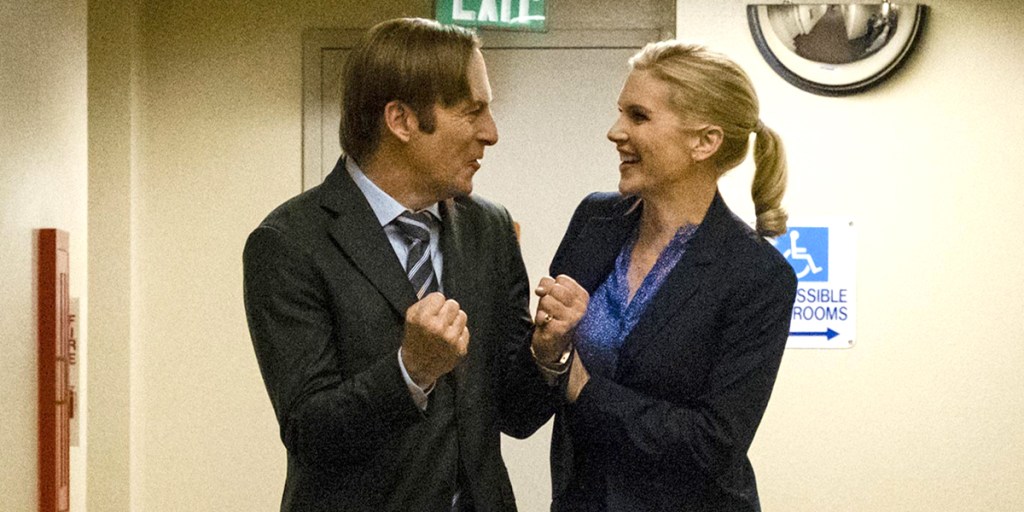
Bob Odenkirk as Jimmy McGill, Rhea Seehorn as Kim Wexler – Better Call Saul – Photo Credit: Nicole Wilder/AMC/Sony Pictures Television

Following hot on the heels of the gripping Season 3 of Cartel-driven thriller, Ozark (2020), comes Season 5 of Vince Gilligan and Peter Gould’s crime prequel to Breaking Bad — the brilliant, Better Call Saul. Once again, it proves itself an incredibly well written character drama, containing some of the finest acting around. I mean, some shows you watch, and they can be a struggle. But Better Call Saul is like digital silk, so smooth in its presentation. The overall style, colour scheme, imaginative camera angles and framing make the show a joy to experience. The story isn’t too bad either.

Having worked through his conflicts with his brother, Chuck (Michael McKean), in the previous sterling seasons, Jimmy McGill finally embraces the ‘Saul Goodman’ legal name and persona. In this season though, in attempting to create a niche making a living helping the lower level criminal element, Jimmy/Saul, eventually finds his legal skills being employed by the Salamanca drug Cartel. Here Saul makes decisions which drag him, and his partner, Kim Wexler (Rhea Seehorn), into a series of dangerous drug-related situations in and out of court. Indeed, episode 8, Bagman, is as good as crime drama gets in terms of narrative, conflict, characterisation and dialogue.

While Bob Odenkirk again sparkles as the cheeky ducker-and-diver-lawyer, Saul Goodman, it’s Rhee Seehorn as Kim Wexler who steals the show. The development of her character from corporate legal player to something more than a money-driven suit is fascinating. In addition, her shifting attitudes also reflect a possible adrenaline addiction to the danger that Saul’s questionable choices bring. Meanwhile, Jonathan Banks as experienced fixer, Mike Ermantraut; Giancarlo Esposito as drug boss, Gustavo Fring; and new cast member, Tony Dalton as Lalo Salamanca, all add to sheer acting charisma and talent on screen. Ultimately, the war on drugs will never be won because there is an insatiable demand for narcotics, and a more fervent demand to supply them. I’m just so happy I am very far removed from the ‘Badlands’ of the Mexican drug Cartels. No doubt after the latest season of Better Call Saul, Saul Goodman, will be feeling very much the same. After all, we are all eventually a prisoner of our own bad choices.

Mark: 9.5 out of 11