Category Archives: New Releases

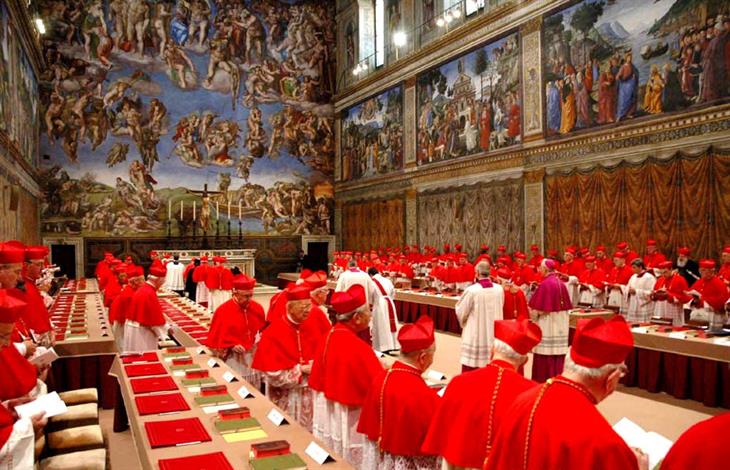
Cinema Review: Conclave (2024) – A Technically Brilliant, Yet Emotionally Faithless Experience (2024)

CINEMA REVIEW: CONCLAVE (2024)

Directed by Edward Berger

Screenplay by Peter Straughan

Based on the novel Conclave by Robert Harris

Produced by Tessa Ross, Juliette Howell, Michael Jackman, Alice Dawson and Robert Harris

Main cast: Ralph Fiennes, Stanley Tucci, John Lithgow, Sergio Castellitto, Isabella Rossellini, Lucian Msamati, Carlos Diehz, etc.

Cinematography by Stéphane Fontaine

Music by Hauschka

*** MAY CONTAIN SPOILERS ***


When you think about organized crime families, images of the Sopranos or Godfather-esque figures probably come to mind. But, if we’re playing with definitions one might allege the Catholic Church—an ancient institution with global influence—is one of the biggest crime organisations ever historically and in the present. I mean, organized crime families are notorious for their code of silence. The Church has had its fair share of. . . shall we say, discretion? From the Vatican’s secret archives to a several public scandals they’d rather we not dwell on, there’s certainly a flair for keeping things in the family.

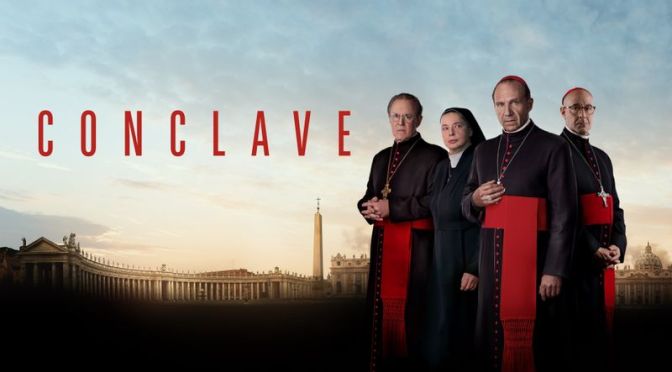
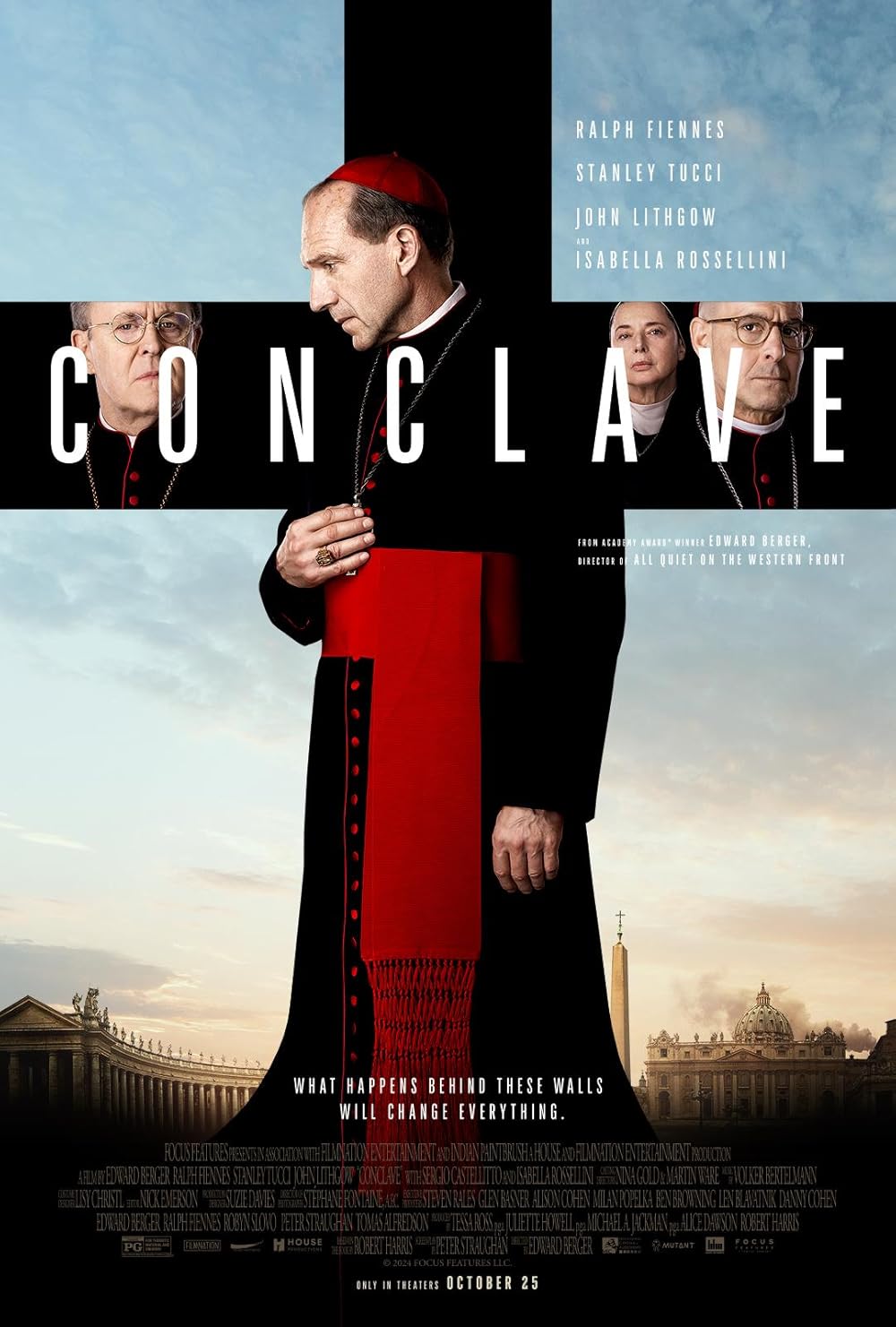
The Pope, aka the Holy Father, wears white, sits on a throne, and apparently has a direct line to the big “man” upstairs. Replace “Vatican” with “Sicily,” and suddenly, the resemblance to the Mafia is uncanny. Moreover, crime families thrive on wealth accumulation. The Vatican’s art collection, gold reserves, and prime real estate make even the most successful mobster green with envy. Not to forget, from Rome to Rio, the Catholic Church has an unparalleled network. Mobsters may have their territories, but the Church claims everywhere. With over a billion followers worldwide, even Don Corleone would bow to that reach. Thus, power struggles ensue within many organisations with coups and betrayals and internal competitions occur, including who is going to be the new boss. Welcome to the cinematic adaptation of Robert Harris’ novel, Conclave (2024); a beautifully constructed, serious and ultimately quite silly story.


Ralph Fiennes is majestic as Cardinal-Dean Thomas Lawrence, the individual tasked with finding a successor after the Pope dies of a heart attack. Fiennes anchors this serious faith-based drama with an intellectual depth as a series of potential candidates throw their zuchettos into the ring including:

  • Aldo Bellini (Stanley Tucci) of the United States, a liberal spirit echoing the compassionate legacy of the late pontiff.
  • Joseph Tremblay (John Lithgow) of Canada, a voice of moderation, bridging the Church’s timeless values and modern sensibilities.
  • Joshua Adeyemi (Lucian Msamati) of Nigeria, a steadfast advocate of social conservatism, grounded in enduring traditions.
  • Goffredo Tedesco (Sergio Castellitto) of Italy, an unwavering traditionalist, fiercely loyal to the ancient rites of faith.

With a narrative based on a book by Robert Harris, it is certain that the powerful developments and twists will grip the audience. Furthermore, Edward Berger’s direction is undeniably captivating, as is Stéphane Fontaine’s cinematography, which paints each scene with a reverence befitting the Vatican’s grandeur. Their collaboration crafts a visually stunning vision, pulling viewers into the cloistered rituals of electing a new Pope. Yet, for all its technical brilliance, the process itself feels devoid of emotional resonance.

Why should we, the audience, care about who becomes the next Pope? Unless one is deeply invested in the Catholic Church or its doctrine, the stakes remain distant. The election of a spiritual leader for over a billion followers is, of course, significant—but the film offers little to make this significance tangible for those outside that fold. Harris’ story spices things up with a provocative, irreverent twist in its final act. Yet, this narrative grenade lands with a thud rather than an explosion. Yes, it’s shocking, even subversive, but it doesn’t pack enough weight to unsettle an institution as colossal and entrenched as the Catholic Church.

Ultimately, Conclave (2024) is a masterclass in craft but a missed opportunity in damning the status quo of this alleged criminal organisation. Berger, Fontaine, Fiennes, plus the production design, score and sound-mixing artistry elevate the film, making it an incredibly effective cinematic version of the proverbial page-turner. But the story’s failure to connect on a deeper, emotional level found me losing my religion; what little I have left.

Mark: 7 out of 11


Apple TV+ Film Review: Blitz (2024) – A fine testament to the Human Spirit during Wartime!

Apple TV+ Review: Blitz (2024)

Directed by Steve McQueen

Written by Steve McQueen

Produced by Tim Bevan, Eric Fellner, Steve McQueen, Anita Overland, Adam Somner, Arnon Milchan, Yariv Milchan, Michael Schaefer

Main Cast: Saoirse Ronan, Elliott Heffernan, Harris Dickinson, Benjamin Clementine, Kathy Burke, Paul Weller, Stephen Graham etc.

Cinematography by Yorick Le Saux

*** MAY CONTAIN SPOILERS ***


Officially classed as acclaimed filmmaker Steve McQueen’s first feature since the release of Widows (2018), Blitz (2024) is a WW2 drama of extremely high quality. But before I get into the review, lest we forget the series of films Steve McQueen delivered to the BBC a few years. The ‘Small Axe’ anthology should and shall be revisited as one of the most important documents of British history, such is its searing power, dramatic drive and the stunning rich tapestry of characterful moments. So, I urge you to watch, if you haven’t, what I consider to be Steve McQueen’s masterworks. I have reviewed the first one Mangrove (2020) here and the remaining of the collection here:


Blitz (2024) is a bigger budgeted production when compared to the ‘Small Axe’ anthology. But, similarly, it is a period piece, focusing on the working class and Black experience, this time set during the brutal bombing of London in 1940. McQueen shoots very much from the perspective of George (Elliot Heffernan), his mother, Rita (Saoirse Ronan) and grandfather, Gerald (Paul Weller). George, like many war children, is packed on a train to the relative safety of the countryside, while parents live in the hope of surviving the incessant German bombs.

After establishing the close family bond between the Hanways, and the wrenching emotion of sending her son away, Rita continues working in a munitions factory and sings beautifully on a national radio show. At the same time, George, finds trouble with a gang of child bullies on the train, before fighting back and jumping off. A tough and resourceful boy, George, makes the perilous choice to return to battered and burning London to reunite with his mother. The city, scarred by the relentless ‘Blitzkrieg’, is a treacherous labyrinth of collapsing buildings and choking smoke, but George’s determination burns brighter than the fires raging across the skyline.


Like a modern Oliver Twist, Blitz (2024) George’s journey through the devastated capital is both a physical and moral odyssey, with each encounter shaping his understanding of loyalty, survival, and the fragile threads that bind people together in times of crisis. George becomes trapped by his own choices, the bombs, bricks, buildings and characters he meets on the way. Some are friendly, but others exploit George preventing his return home. McQueen’s script also finds time to flashback to show Rita meeting George’s father, providing significant context to his mixed race background. Indeed, through George, McQueen explores themes relating to race and his emotional journey to find his place in the world as a person of colour.

Blitz (2024) is a superbly shot and designed film, with Yorick Le Saux’s cinematography rendering war torn London with an almost mythical beauty. However, Hans Zimmer’s overblown soundtrack is too much for me. Further, Steve McQueen’s hagiographic and episodic approach does somewhat diminish the raw drama and bloody horror of war. Notably, the under-use of Kathy Burke and Stephen Graham’s gutter snipe thieves. Plus a thrilling action set-piece during a flooded tube station that cuts away from George’s almost-demise, denying us suspense and dramatic catharsis. Thus, at times, the film sacrifices potential complexity during George’s journey, making his survival seem almost predestined rather than hard-fought. Still, Steve McQueen remains one of the country’s most important cinematic artists and Blitz (2024) is yet another fine testament to the strength and resilience of the human spirit.

Mark: 8 out of 11


Cinema Review: Wicked (2024) – delivers a Magical Yet Overstuffed Musical Experience

Cinema Review: Wicked (2024)

Directed by Jon M. Chu

Screenplay by Winnie Holzman and Dana Fox

Based on the musical, Wicked by Stephen Schwartz & Winnie Holzman
and novel by Gregory Maguire
.

Produced by Marc Platt and David Stone

Main Cast: Cynthia Erivo, Ariana Grande-Buter, Jonathan Bailey, Ethan Slater, Bowen Yang, Marissa Bode, Peter Dinklage, Michelle Yeoh and Jeff Goldblum etc.

Cinematography by Alice Brooks

Edited by Myron Kerstein

Music by John Powell (score) and Stephen Schwartz (score and songs)

*** MAY CONTAIN SPOILERS ***


I truly believe my love of cinema began when I was aged five. Or was it six? Picture the scene. Christmas Day circa 1976 and the living room of a Battersea tower block. A television emits a classic musical fantasy called The Wizard of Oz (1939). Shades of grey with a flickering light and shadow, drew me into its spell. I sat wide-eyed, cradled by the screen’s soft glow, unaware that something wondrous lay just beyond the monochrome.

And then it happened—like a magician’s flourish, the black and white world I had known melted away. Dorothy opened that door, and the screen burst into life, a kaleidoscope of impossible hues. Emerald greens, ruby reds, a yellow road that glowed with the promise of adventure. My eyes widened. Hang on! It was black and white and NOW the images are in colour! This was magic. This was film. This was Oz!

Forty-eight years later and back to the present. In 2024, I am sat in the cinema intrigued to watch the musical prequel, Wicked (2024). Based on a successful novel, then a spectacularly successful stage musical and now a big-budget Christmas cinema extravaganza indulgently split into a two-parter, does Wicked (2024) capture the cinematic sorcery I experienced in my youth? Of course it possibly cannot live up to my warm and fuzzy childhood memories, but it is a well-crafted, superbly choreographed and energetically performed Hollywood product with Cynthia Erivo and Ariana Grande on majestic form.


The film, based on Wicked: The Life and Times of the Wicked Witch of the West by Gregory Maguire, is a brilliant twist on the “what if” storytelling lens—a speculative reimagining that turns a villain into a deeply human, complex protagonist. The novel takes the flat archetype of the Wicked Witch and asks: What if we misunderstood her? What if the “wickedness” she’s condemned for is not inherent, but the result of a life shaped by prejudice, politics, and pain? Indeed, the journey of Elphaba Thropp (Cynthia Erivo) powerfully drives the story, and in some fashion Wicked (2024) works brilliantly as a Breaking Bad-meets-Mean Girls-type-rites-of-passage musical.

Unfortunately, such strong narrative bones with weighty themes of identity, morality, and the price of power are adorned in a dazzling, over-the-top spectacle. While its core narrative explores profound questions about destiny and the nature of “wickedness,” these ideas often get buried under an excessive parade of well-designed production numbers that stretch the running time and tested one’s patience. The powerful emotional arcs of Elphaba and Glinda, rich with potential, are interrupted by TOO MANY songs that (Dancing Through Life is one such culprit), while entertaining in isolation, often feel like detours from the story’s heart.

By the final curtain, the spectacular musical embellishments, though undeniably crowd-pleasing, can leave the story feeling bloated. I am probably the wrong demographic for the production, given the cinema was full of children and parents. So, while there is much to enjoy in comparison with the original film’s genius, notably the invention of the flying monkeys, Wicked (2024), for all its glitter and showmanship, finds the greedy desire for a two-parter ultimately draining Oz of pace and magic.

Mark: 7 out of 11


Cinema Review: Gladiator II – an Epic Sequel that Echoes the original in Eternity

CINEMA REVIEW: GLADIATOR II (2024)

Directed by Ridley Scott

Screenplay by David Scarpa

Story by Peter Craig, David Scarpa

Based on Characters by David Franzoni

Produced by Ridley Scott, Michael Pruss, Douglas Wick, Lucy Fisher, Walter F. Parkes, Laurie MacDonald and David Franzoni
.

Main cast: Paul Mescal, Pedro Pascal, Joseph Quinn, Fred Hechinger, Lior Raz, Derek Jacobi, Connie Nielsen and Denzel Washington.

Cinematography by John Mathieson

*** MAY CONTAIN SPOILERS ***


Ridley Scott’s Gladiator (2000) stands as a modern genre classic, redefining the historical epic with its visceral storytelling, evocative visual style, and emotional depth. The film not only revitalized interest in the sword-and-sandal genre but also solidified Russell Crowe as a major star, earning him an Academy Award for Best Actor. Crowe’s portrayal of Maximus Decimus Meridius—a betrayed Roman general seeking justice—exudes both raw power and profound vulnerability, making him an enduring figure in cinematic history.

Gladiator’s superb screenplay intricately followed the structure of Joseph Campbell’s Hero’s Journey, charting Maximus’ transformation from a celebrated general to a fallen slave, and ultimately to a venerated martyr. Also invoking the archetype of one of Christopher Booker’s seven basic plots, ‘Overcoming the Monster’. Indeed, Maximus’ journey aligns with the ‘Overcoming the Monster’ archetype, where the hero confronts a seemingly insurmountable evil. Commodus and the Roman Empire embodies the “monster,” wielding unchecked power, moral corruption, and cruelty. Maximus battles not only physical opponents in the gladiatorial arena but also the corrupt system that Commodus represents. His ultimate triumph over Commodus is both personal vengeance and symbolic justice, restoring balance to a fractured world.

Finding Ridley Scott at arguably the height of his directorial power, Gladiator’s success rested on its ability to blend archetypal storytelling with deeply human emotions. It revitalized the historical epic for modern audiences by prioritizing character-driven drama over spectacle, though its battle sequences remain iconic. With its sweeping Hans Zimmer score and Russell Crowe’s unforgettable performance, the film transcended its genre, made a lot of money and become a modern myth that continues to resonate with audiences worldwide. So, the burning question is why did it take so to make a sequel?


I’d say the answer to this question is that because the original was so iconic and powerful it didn’t need a sequel. Still, when has that ever stopped the money-making behemoth of the Hollywood machine from not following up. The surprise is that it took twenty-four years to bring to the screen. Which is a similar length of time after the first one that Gladiator II (2024) is set, namely 211AD. Similarities do not cease there.

So, I will just say I had so much fun watching Gladiator II. It is an exhilarating return to the grandeur of the Roman Empire, delivering breathtaking visuals, high-stakes action, and a muscular lead performance from Paul Mescal as Hanno, a fighter with a mysterious history. However, despite its ambitious scale and technical brilliance, the sequel draws heavy parallels to the original, feeling more like a reimagining than a bold continuation. Hanno’s journey echoes Maximus’ so closely that it lacks the freshness that made the 2000 film a groundbreaking modern epic.

Indeed, Hanno’s arc is essentially a mirror image of Maximus’ but while Gladiator II adheres to the same Hero’s Journey structure that defined the first film, the beats feel overly familiar. Hanno’s transformation, while compelling, doesn’t quite reach the mythic resonance of Maximus’ odyssey. Where Maximus was a reluctant hero drawn into a larger-than-life struggle, Hanno’s motivations and journey feel more cloudy and contrived, lacking the gravitas of the original’s moral and emotional complexity. Script and character inconsistencies do not help, with Hanno too quickly switching emotions where Connie Nielsen’s Lucilla is concerned.


That said, the sequel contains many strengths. The world-building is as immersive as ever, with Ridley Scott’s regal direction ensuring that every frame pulsates with life and detail. The sheer energy and brutality of the Colosseum set-pieces are worth the admission alone. The flooding of the arena battle and introduction of a number of fantastic and vicious beasts are especially memorable. The action is bloody and gripping, the score soars, and the themes of resilience and justice remain timeless. Moreover, Mescal delivers a commanding performance, injecting moments of raw intensity and vulnerability into the role.

Having said that, it is Denzel Washington’s Macrinus who pulls narrative focus and power throughout. Washington brings his trademark gravitas and charisma to the role, crafting a character arc that is both morally complex and emotionally resonant. Macrinus’ journey of manipulation, becomes the film’s most compelling thread, overshadowing Hanno’s more conventional hero’s path. Washington imbues Macrinus with subtlety, allowing audiences to see flashes of vulnerability and moral conflict beneath his stoic exterior. He oscillates effortlessly between commanding authority and quiet introspection, making every line delivery impact. Washington’s natural charisma ensures that Macrinus commands attention in every scene. His dialogue crackles with intensity, and his moments of silence speak volumes, often eclipsing Hanno’s more straightforward emotional beats.

Gladiator II undeniably thrills as a cinematic experience, but its adherence to the original’s blueprint leaves it struggling to step out of Maximus’ shadow. While it showcases the enduring power of its core narrative themes, it ultimately feels more like a polished homage than a groundbreaking sequel, relying on echoes of past triumphs rather than forging an entirely new path. For fans of the original, this familiarity is a strength and weakness, yet nonetheless Scott’s epic facsimile remains a powerful and bone-crunching adrenaline rush.

Mark: 8 out of 11


Cinema Review: Heretic (2024) – A Devilish Twist on Religious Horror

Heretic (2024)

Directed by Scott Beck & Bryan Woods

Written by Scott Beck & Bryan Woods

Produced by Stacey Sher, Scott Beck, Bryan Woods, Julia Glausi and Jeanette Volturno

Main cast: Hugh Grant, Sophie Thatcher, Chloe East and Topher Grace.

Cinematography by Chung Chung-hoon


Hugh Grant has been leaning into edgier, more complex roles in recent years, breaking away from the charming, rom-com archetype that first made him famous in films like Notting Hill (1999) and Four Weddings and a Funeral (1994). His performance as the scheming Fletcher in The Gentlemen (2019) showcased his versatility and willingness to play morally ambiguous, darker characters, a notable shift from his earlier, more likeable characters. Additionally, his involvement in projects like Heretic (2024) demonstrates a continued exploration of grittier, layered personas, signaling a reinvention of his career as he embraces unconventional, often villainous roles that display a new level of depth and unpredictability.

In the theologically-driven horror thriller, Heretic (2024), he portrays a certain Mr Reed, who is door-stepped by two Mormon missionary’s, Sister Barnes (Sophie Thatcher) and Sister Paxton (Chloe East). After the opening scenes which establish empathy for the Mormons, despite some slightly risque dialogue, they knock on the door of Mr Reed and soon the tension begins to rise as he clearly has ulterior motives. But what could they be?


The excellent script by Scott Beck and Bryan Woods truly comes alive in the second act, diving into a sharp, intelligent critique on the nature of religion and faith. The narrative shifts into thought-provoking territory, dissecting the contradictions and complexities of belief systems with nuance and wit. Hugh Grant, delivers these lines with palpable relish, embodying a character that’s both captivating and unsettling. His performance amplifies the script’s incisive commentary, bringing a darkly charismatic edge to the film’s anti-treatise that leaves a lasting impression on the viewer. There’s some great humour in there too, even name-checking South Park and The Book of Mormon during a thrilling game of verbal cat-and-mouse as Mr Reed challenges the sweet missionaries’ whole doctrine. Which, let’s face it, as invented by Joseph Smith, is arguably founded on many ridiculous ideas.

Heretic loses some of its originality toward the end as it leans into familiar horror and “final girl” tropes, diluting the impact of its earlier, more mazy, twisted and thought-provoking narrative. After building a layered critique on religion and faith, the climax reverts to predictable genre conventions, somewhat undermining the complexity established in the second act. This shift might feel like a missed opportunity, as the nuanced themes give way to traditional horror cliches that prioritize shocks over substance. While still entertaining, the reliance on these tropes makes the conclusion feel less daring compared to the film’s more intellectually ambitious setup. Still, Hugh Grant’s devilish Mr Reed and a fantastic soundtrack, make it well worth the admission fee. Meanwhile Woods and Beck again prove themselves as genre filmmakers worth keeping faith with.

Mark: 8.5 out of 11


HORROR REVIEWS: SPEAK NO EVIL (2022) / SPEAK NO EVIL (2024)

SPEAK NO EVIL (2022)

Directed by Christian Tafdrup

Written by Christian Tafdrup and Mads Tafdrup

Main Cast: Morten Burian, Sidsel Siem Koch, Fedja van Huêt, Karina Smulders, Liva Forsberg and Marius Damslev.

Speak No Evil (2022), directed by Christian Tafdrup, is a chilling psychological horror that explores the perils of politeness within middle-class sensibilities, turning everyday discomfort into a waking nightmare. The film follows a Danish family with a young daughter, visiting a Dutch family unit, only to find themselves trapped in a horrifying and twisted game of cat and mouse. All smiles and charisma at first, the ‘Alpha’ Patrick, dominates his wife and young son, who unfortunately has no tongue. Tafdrup deftly dissects how the fear of offending others—deeply ingrained in bourgeois values—leads the protagonists to ignore increasingly unsettling behaviour.

Losing or not using one’s voice is inherent within the text. Further, what begins as awkward social tension escalates into something far more sinister, as the family is manipulated through their desire to maintain decorum. This dynamic plays on the anxieties of modern, polite society, where confrontation is often avoided at all costs. The film’s climax delivers a shocking, almost biblical punishment for their inability to break free from these conventions, suggesting a moral reckoning for those who allow fear of impoliteness to override survival instincts.

Subtle, creeping dread makes Speak No Evil (2022) a disturbing meditation on the dangers of middle-class complacency, and the terrifying consequences of choosing politeness over personal safety. Lastly, the film also explores the theme of toxic masculinity as the muscular ‘Alpha’ threatens the ineffective ‘Beta’ male, proving one should always stand up to bullies or face the consequences.

(Note: for those seeking out the film in the UK, it is currently screening on Shudder.)

Mark: 8.5 out of 11


SPEAK NO EVIL (2024)

Directed by James Watkins

Screenplay adaptation by James Watkins


Main cast: James McAvoy , Mackenzie Davis, Scoot McNairy, Alix West Lefler, Dan Hough, and Aisling Franciosi

The English remake of Speak No Evil (2024) delivers a faithful and unnerving adaptation of Christian Tafdrup’s original, with James McAvoy’s chilling performance at its heart. McAvoy, playing the charming yet menacing antagonist, brings a sinister edge to the character that heightens the tension and discomfort throughout the film. His portrayal effortlessly captures the unsettling power dynamics, making each of his polite gestures and subtle manipulations all the more terrifying. McEvoy relishes every moment of this characterful performance.

What truly stands out in this remake is how it retains the meticulous craftsmanship of the original. The film carefully balances tension, awkwardness, and psychological dread, maintaining the slow-burn atmosphere that made the Danish version so unsettling. Director James Watkins ensures the pacing and visual style honour Tafdrup’s vision, with each shot and interaction loaded with unease. Watkin’s adaptation also provides further exposition and fleshes out the character dynamics and motivations, notably with the children, whose actions are integral to propelling the narrative thrills.

The Cape Fear (1991)-style climax veers away from the original’s more subtle, thought-provoking and bleak ending. However, it further amplifies the anxiety, offering a nerve-shredding confrontation that feels both inevitable and brutal. The remake pays homage to the original’s themes of social etiquette, hidden danger and finding one’s voices against bullies, while delivering a climactic showdown that mirrors the power struggles found in classic thrillers. Overall, like the original Speak No Evil (2024) successfully inverts the home invasion dynamic, making it a worthy, terrifying and almost necessary remake.

Mark: 8.5 out of 11


CINEMA REVIEW: BLINK TWICE (2024)

Directed by Zoë Kravitz

Written by Zoë Kravitz & E.T. Feigenbaum

Produced by Bruce Cohen, Tiffany Persons, Garret Levitz, Zoë Kravitz and Channing Tatum

Cast: Naomi Ackie, Channing Tatum, Christian Slater, Simon Rex, Adria Arjona, Kyle MacLachlan, Haley Joel Osment, Geena Davis and Alia Shawkat etc.

Cinematography by Adam Newport-Berra

*** MAY CONTAIN SPOILERS ***


The theme of toxic masculinity is almost becoming a sub-genre of itself in the wake of the #MeToo movement. Films such as The Royal Hotel (2023), How to Have Sex (2023) and Men (2022) are powerful genre films which take the manipulative, malevolent and violent aspect of men, utilizing it as both nemesis and a destructive force the main protagonists must contend with. While She Said (2022) dealt specifically with the Harvey Weinstein legal case, Zoe Kravitz’ energetic blend of genres in Blink Twice (2024), takes a more fictional and heightened route while exposing the horrors surrounding the potential happenings at the notorious Epstein Island.

Frida (Naomie Ackie) and her friend Jess (Alia Shawkat) work at an exclusive event where Frida meets Slater King (Channing Tatum), a billionaire tech mogul who recently resigned as CEO after a public scandal. Despite the scandal Frida and Jess gladly accept an invitation to his private island, where his assistant Stacy (Geena Davis) confiscates their phones. The island hosts Slater’s friends and business partners along with three glamorous guests including Sarah (Adria Arjona). The men and women are treated to lavish rooms, gift bags, gourmet meals, cocktails, and party like hedonistic rock stars drinking champagne and taking hallucinogens.


If you’ve seen the similar island-based, The Menu (2022), which I loved, plus the less than riveting 1950’s perfect suburb-set, Don’t Worry Darling (2022), one soon realises that not all is well in paradise. Amidst the sun, sea and partying the narrative slowly builds the tension until Frida and Jess begin to suspect all may not be as it seems. Kravitz carefully ratchets up the tension, with several strange discoveries heightening the paranoia and anxiety. Latterly the suspense gives way to all-out gory horror and black comedy in the thrilling final act. Naomi Ackie and Adria Arjona are impressive “final girls”, however, the script arguably throws in too many twisty reveals at the end, testing narrative credibility.

Zoe Kravitz is clearly a talented filmmaker and Blink Twice (2024), while unsubtle, is highly entertaining. But does the diversion to the horror genre dilute the power of the themes of toxic masculinity? Kravitz aims to critique the evils of men by showcasing male characters who embody arrogance, dominance, and emotional suppression. But while Kravitz may intend to address toxic masculinity, the reliance on traditional horror tropes potentially undermines this message by exaggerating characters, victimizing women, and prioritizing sensationalism over substance. Still, as a revenge fantasy, Blink Twice (2024), is both stylishly and dynamically rendered.

Mark: 7.5 out of 11


CINEMA REVIEW: TRAP (2024)

CINEMA REVIEW: TRAP (2024)

Directed by M. Night Shyamalan

Written by M. Night Shyamalan

Produced by Ashwin Rajan, Marc Bienstock, M. Night Shyamalan

Main cast: Josh Hartnett, Ariel Donoghue, Saleka Night Shyamalan, Hayley Mills, Alison Pill, Jonathan Langdon, etc.

Cinematography by Sayombhu Mukdeeprom


*** CONTAINS SPOILERS ***


If you’re into mysterious and suspenseful genre films, M. Night Shyamalan’s most recent works Old (2021) and Knock at the Cabin (2023) left a lasting impression on me. Both movies dive deep into the human psyche, exploring themes of time, fear, and the unknown, and I really enjoyed them. Old (2021) combined Shyamalan’s signature twisty narrative with a meditation on the passage of time. Sure, the ending was over-cooked but I thought it was a brilliant Twilight Zone infused ensemble suspense twister. Meanwhile, Knock at the Cabin (2023) was a compelling claustrophobic apocalyptic thriller finding a family faced with making a horrendous sacrifice. While he is not everyone’s cinematic cup of tea, I for one have enjoyed Shyamalan’s recent output.

His latest high concept B-movie thriller is called Trap (2024). It stars Josh Hartnett as a loving and attentive father, Cooper Adams, who takes his teenage daughter, Riley, to see Lady Raven (Saleka Night Shyamalan) in a huge concert venue. Obviously, musical-based films such as A Star is Born (2018), Purple Rain (1984), and Bohemian Rhapsody (2018) feature gigs as part of their genre conventions. Here in Trap (2024) the concert becomes much more than that. Because Cooper is in fact a serial killer, and acting on a tip-off, the authorities and FBI profiler, Dr Josephine Grant (Hayley Mills), mobilize to turn the location into a means to ensare him. Thus, the whole concert becomes a living, breathing trap, a maze with which Cooper must avoid capture while ensuring his daughter, and the law, do NOT discover his evil dark side.


What follows is a dynamic series of situations where Shyamalan asks the audience to identify with Hartnett’s ‘Butcher’ and see if he can escape the law as they close in. As the music blares and the lights flash, you’re drawn into the tension of a manhunt. The ‘R and B’ pop music, while not my thing, is actually pretty decent as performed by Shyamalan’s daughter, Saleka Night Shyamalan. Can ‘the Butcher’ outsmart the law and vanish into the night, or will he be caught in this electrifying game of cat and mouse? The script certainly answers that in a thrilling set of scenes and confident twists. Of course, it’s all highly improbable and preposterous, but I found all the contrivances incredibly entertaining.

Trap (2024) has some dark and crafty humour in there too, notably in Hartnett’s committed performance. At times I almost thought he was going to speak to the audience directly. I love it when you can see an actor reveling in their performance and Hartnett has so much fun playing this OCD-controlling-complex-double-life-leading family man and serial killer. Thematically, the film is strong too as Cooper is locked in a psychological and emotional struggle against powerful matriarchal figures who inhabit his world. These are represented by his deceased mother who haunts his thoughts and the very-much-alive, Doctor Grant, the psychologist charged with stopping him.

While Trap (2024) requires the audience to swallow a huge piece of “suspend disbelief” pie, Shyamalan infuses Hitchcock levels of suspense – think Rope (1948) on steroids – that had me gripped all the way. It isn’t meant to be taken too seriously and does contain some massive plot-holes you can drive a tour bus through. But I didn’t care as Trap represents another chunk of thoroughly enjoyable genre cinema from M. Night Shyamalan.

Mark: 8 out of 11

CINEMA REVIEW: FURIOSA – A MAD MAX SAGA (2024)

CINEMA REVIEW: FURIOSA – A MAD MAX SAGA (2024)

Directed by George Miller

Written by George Miller & Nico Lathouris

Based on characters by George Miller & Byron Kennedy

Produced by: Doug Mitchell & George Miller

Main Cast: Anya Taylor-Joy, Chris Hemsworth, Tom Burke, Alyla Browne, Lachy Hulme, Angus Sampson, etc.

Cinematography by Simon Duggan

*** CONTAINS SPOILERS ***


George Miller’s fifth entry of the Mad Max series is Furiosa: A Mad Max Saga (2024). Given the meaning of the word ‘saga’ is defined as, “a long story of heroic achievement, especially a medieval prose narrative in Old Norse,” it’s an attempt by Miller to connect the Mad Max films to mythical storytelling and folk lore, yet paradoxically set such ye olde yarns in the future. Conversely, while being part of the post-apocalyptic sci-fi sub-genre, there is certainly more than a suggestion of marauding and pillaging Vikings within the freakish characters of the radioactive Aussie wasteland.

Of course, the hi-tech and vehicular monsters smashing up and down the ‘Fury Road’ render the action far from the medieval, replacing long boats for super-charged two, three and four-and-more-wheel souped-up demons driven by mutated future humans. The gigantic rock, bullet, fuel, and scrap metal designed bases of ‘The Citadel,’ ‘Bullet Farm’ and ‘Gas Town’ inhabited by these tattooed ravagers, while rough in exterior represent humanity’s industrial survival and base-building instincts par excellence. So much for the imperious nature of Miller’s world-building, what of the narrative?

If one is honest, the screenplays for all four of the previous Mad Max films are the exercises in economy, with hard-cut structures, granite-boiled dialogue often spat out via twisted one-liners, and poetically yelled slang-speak. Introduced as a maverick cop, but loving family man in Mad Max (1979), Max Rockatansky (Mel Gibson) is essentially a cops-versus-gangs-meets-revenge exploitation thriller. By the time gangs have killed his family and nuclear war has destroyed the world, Max has become the Road Warrior (1981), in what is one of the greatest action films and sequels of all time. However well regarded the mayhem of Fury Road (2015), and it is incredible, The Road Warrior remains one of my favourite films ever.


Beyond Thunderdome (1985) was the slicker third film, and while the action was terrific, there was too much money and sheen in there, reminiscent of what they did with the glamoured cast in the last season of Game of Thrones. Plus, the script was broken in half, with an amazing first section set in Bartertown with Tina and crew, before giving way to a more philosophical, but less exciting kids-in-a-commune driven story. In comparison Furiosa: A Mad Max Saga (2024) is certainly the most ambitious of all the narratives. It is set over several years, from the moment Furiosa (Alya Browne) witnesses her mother killed by Dementus (Chris Hemsworth) and his nasty marauders, to her rites of passage ascent toward gaining a vicious revenge.

Keeping the literary theme, the film is set over five chapters replete with headings to let the audience know what is about to occur. Easily the most impressive is – Chapter III – The Stowaway – where Furiosa comes of age in action during a brutal and mind-blowing action set-piece as the Octoboss, goes rogue and launches an air assault on the “War Rig” as it races along the ‘Fury Road.’ Here Furiosa also bonds with Praetorian Jack (Tom Burke) and the two become partners, with George Miller throwing in an under-cooked romance amidst the petrol, dust, blood and fire.

It is great that Miller and his co-writer Nico Lathouris have strived for more emotional depth and epic storytelling within Furiosa: A Mad Max Saga (2024). However, I felt that at times the rapid pacing and ramped-up action crushed any feelings I may have had about the characters of Furiosa and Jack. Plus, the film suffers a serious case of “prequelitis” where one is joining the dots of Furiosa’s backstory to connect with Charlize Theron’s characterisation in Fury Road. Yes, of course, we find out how she had her arm torn from her body, her drives and motivations, plus how she became a kick-ass future road warrior.  

Taylor-Joy is striking in the all-action role of Furiosa, but a little anorexic on screen to really dominate. Gibson and Hardy are a hard act to follow! Tom Burke stands out amidst the support ensemble, while Chris Hemsworth treats us to another revved-up messianic lunatic. With the character of Mad Max on hiatus, the true stars of this show are Miller and his impressive production, camera, editing, driving, effects and stunt teams. They have once again produced cinematic carnage of the highest order.

Mark: 8.5 out of 11


CINEMA REVIEW: CIVIL WAR (2024)

CINEMA REVIEW: CIVIL WAR (2024)

Directed by Alex Garland

Written by Alex Garland

Produced by Andrew Macdonald, Allon Reich, Gregory Goodman

Main Cast: Kirsten Dunst, Wagner Moura, Cailee Spaeny, Stephen McKinley Henderson, Sonoya Mizuno, Nick Offerman, etc.

Cinematography by Rob Hardy

*** MAY CONTAIN SPOILERS ***


Alex Garland has an impressive literary, cinema and televisual curriculum vitae. He gained acclaim as the writer of the novel, The Beach, before moving onto screenwriting duties with fine films such as: 28 Days Later (2002), Sunshine (2007), Never Let Me Go (2010), and under-rated Dredd (2012). He made his directorial debut with Ex Machina (2014), which earned him an Academy Award nomination for Best Original Screenplay. His second film, Annihilation (2018), garnered further acclaim, so much so, FX bypassed a pilot and went straight to series for his science fiction TV narrative, Devs (2020).

While I am a massive fan of Garland’s work, I wasn’t too enamoured of Annihilation (2018). I found it brilliantly made with some fantastic concepts and incredible moments, yet overall it was too slowly paced. With eight superlative episodes of Devs (2020), Garland delivered a story which really connected with me by merging a compelling technological espionage plot to an intelligent exploration of philosophical thought and human behaviour. Where Devs (2020) presciently examined the impact of artificial intelligence, Garland’s new political thriller, Civil War (2024), prophetically imagines an apocalyptic America in the throes of war between combined California and Texas state rebel forces and the current President’s (Nick Offerman) retreating army.

With the ‘January 6 United States Capitol attack’ in mind, Garland opens up a “what if” narrative where the whole of America is conflicted and consuming itself from within. At the heart of the violence is the war photographer, represented by Lee Smith (Kirsten Dunst) and Reuters journalist, Joel (Wagner Moura). Their journey to Washington to photograph the President reveals confusion, destruction and further bloodshed. Generically speaking, a road movie meets dystopian thriller, Civil War (2024) contains thought-provoking themes and incredible cinematography, but with shaky writing in places.


Films about war photographers and/or journalists can be problematic for me. Such characters lend themselves to heroic and the anti-heroic. The writing has to be right because I can lose empathy between such crusading journos and the narcissistic adrenaline junkies looking to deflect their own loathing and self-destructive tendencies. Civil War (2024) struggled to get me onside with the lead characters, although Dunst’s characterisation of Lee Smith is superb. However, her mentor-apprentice relationship with Cailee Spaeny, Jessie Cullen, was under-developed. Spaeny’s “innocent” being used more as a suspense device as opposed to learning the true horrors of humanity and war. Perhaps Garland intended for her to be a sociopath without depth just looking for blood? She finds it!

Moreover, Jessie’s journey from a political perspective was weak as there was no real sense of development in her character. That’s where the decision not to overtly take political sides causes a lack of sociological depth. War films such as Salvador (1986) and The Killing Fields (1984) are more successful as Civil War (2024) loses political impact by not choosing precise sides. But I guess whether they are Democratic or Republican is the whole point. Garland is saying that political parties are all as bad as each other, with human beings their own worst enemy. Politics, like football, gender, sexuality, and religion, are propellants for humans to fight each other.

For a film about photographers, the images on show are incredible and Rob Hardy’s work is genius. Fire, blood and war have never looked so brutal and aesthetically impressive. As well as Dunst, Wagner Moura and Stephen McKinlay Henderson are terrific in their respective roles. Further, there are some nail-biting and suspenseful scenes, notably one involving a film-stealing performance from Jesse Plemons. However, many of the characters’ decisions were weakly written for me. This is surprising given Garland’s prodigious literary and screenwriting talent. Civil War (2024), however, remains another stunning addition to his oeuvre and for all my perceived script weaknesses, the hell of war has never been so artistic and artful.

Mark: 8 out of 11