
Tag Archives: corporate greed

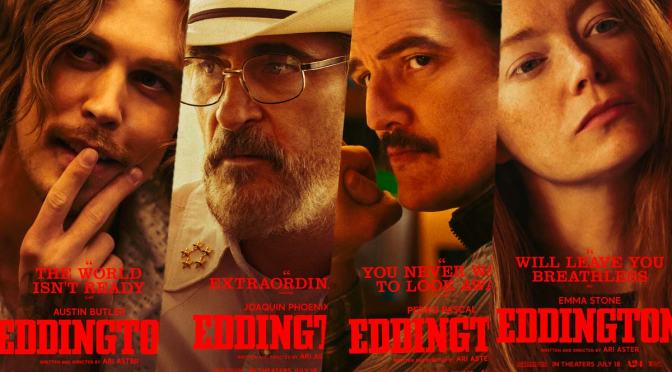
Cinema Review: Eddington (2025) – a daring Western satire on COVID-era America, US politics and the poison of social media!

Cinema Review: Eddington (2025)

Directed by Ari Aster

Written by Ari Aster

Produced by: Lars Knudsen, Ari Aster & Ann Ruark

Main Cast: Joaquin Phoenix, Pedro Pascal, Luke Grimes, Deirdre O’Connell, Micheal Ward, Austin Butler and Emma Stone.

Cinematography by Darius Khondji

*** MAY CONTAIN SPOILERS ***
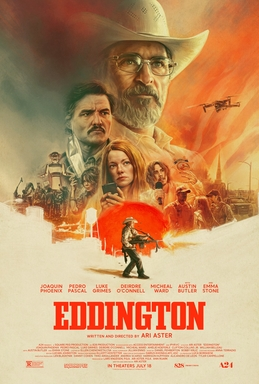


Ari Aster’s first two horror films, Hereditary (2018) and Midsommar (2019) were rightly critically acclaimed and delivered at the box office too. His third film Beau is Afraid (2023) was a flop when compared and in my view not surprising. The film was arguably, depending on your view, a hilarious, risk-taking arthouse tragi-comedy or a self-indulgent act of egregious career self-sabotage. Safe to say I did not enjoy it, so approached the latest A24-produced film of Aster’s, Eddington (2025), with emotional caution.

Thankfully Aster’s screenplay, characters and all-round production of Eddington (2025), are far more accessible and focused than his third feature. Pedro Pascal and Joaquin Phoenix anchor Eddington (2025) superbly, as Aster delivers a blistering small-town allegory that uses a public health crisis as the spark for something far larger. What begins with Mayor Ted Garcia (Pascal) dutifully following the Governor’s lockdown orders quickly escalates when Sheriff Joe Cross (Phoenix) refuses to comply and runs for Mayor himself. This casts the town and people into a conflict that mirrors America’s own political division.
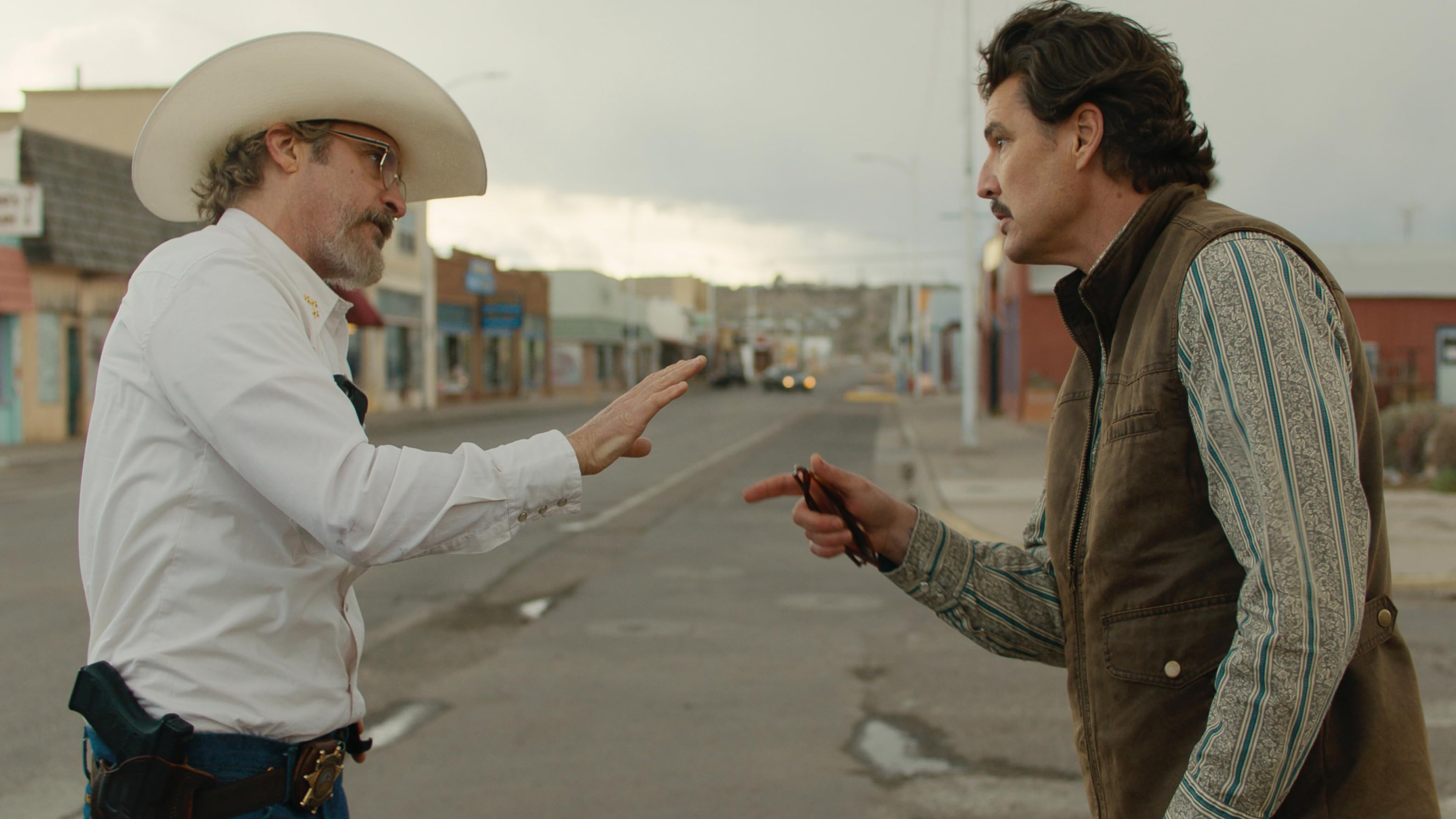


Phoenix brings his trademark intensity to Sheriff Cross, whose defiance feels equal parts principled and unhinged, while Pascal’s Mayor, revealed to be a corporate puppet, balances him as a leader losing grip on his authority. Thus, Eddington (2025) is a powerful film whose strength lies in the performances and a brave, intelligent screenplay which asks many questions. The main issues I had were under-developed character arcs for Emma Stone’s and Austin Butler’s characters. Further, as in previous films Aster relies heavily on left-field plot turns, which go more for shock, rather than understandable character development. Indeed, the final act Western-style shootout, while incredibly exciting, seems out-of-sync with the thoughtful build-up and drama established in the first hour.

Ultimately, Director Ari Aster resists turning Eddington (2025) into just a COVID-era-morality tale; instead, the film confidently threads together a powerful mix of left and right-wing US politics, toxic masculinity, historical sexual abuse, conspiracy and alternative theories, cultish religious fervour, white saviour virtue-signalling, homegrown terrorism, algorithmic influence of social media, and the creeping threat of corporate greed. Each theme and subplot fold back into the central question: who really controls the narrative in modern America or is it a nation spiraling out of control toward inevitable civil war? The result is a tense, unsettling portrait of a town—and a country—at war with itself.

Mark: 8 out of 11


DARK WATERS (2019) – CINEMA REVIEW

DARK WATERS (2019) – CINEMA REVIEW

Directed by: Todd Haynes

Produced by: Mark Ruffalo, Christine Vachon, Pamela Koffler

Screenplay: Mario Correa, Matthew Michael Carnahan

Based on “The Lawyer Who Became DuPont’s Worst Nightmare” by Nathaniel Rich

Cast: Mark Ruffalo, Anne Hathaway, Tim Robbins, Bill Camp, Victor Garber, Bill Pullman, William Jackson Harper, Mare Winningham etc.

Cinematography: Edward Lachman

**MAY CONTAIN SPOILERS**


Every now and then one watches a film you kind of wish you hadn’t. Not because it is bad, quite the contrary with director’s Todd Haynes’ legal drama, Dark Waters (2019). No, you wish you hadn’t watched it because it unveils a tragic series of events relating to environmental, corporate, chemical, legal and human corruption. I prefer to possess hope that human beings can be trusted to do the right thing. However, based on this story that is definitely not the case. Moreover, given the information revealed about huge corporation, DuPont, and their environmental procedures, it’s a damning indictment against corporate greed and community murder.

A two-hour film is certainly not long enough to do justice to a story which has taken decades to unfold and cost the lives of many people and animals, while irreparably damaging the environment in the process. However, it effectively bullet points the crimes of the DuPont conglomeration in a riveting fashion. At the heart of it is corporate lawyer, Robert Bilott, here portrayed by the always excellent, Mark Ruffalo. Beginning circa 1998, Bilott, is approached by farmer Wilbur Tennant (Bill Camp) whose livestock have died or been culled due to tumours and other cancerous illnesses. Bilott who is usually employed to act as a lawyer FOR the big companies, investigates further. Subsequently he uncovers something rotten in the state of West Virginia.


Mark Ruffalo as Bilott inhabits an intelligent, caring and dogged man, driven by his desire to see justice for Wilbur Tennant and the people of Parkersburg. It’s often remarked Ruffalo would make a great Columbo; and like that famous fictional TV detective, Bilott never ever gives up. This is even in the face of years and years of environmental tests, litigation, DuPont’s dirty legal tactics and hundreds of court appearances. Anne Hathaway as his wife Sarah Bilott is also good, although her role is slightly underwritten. Bill Camp impresses though in his turn as the exasperated farmer whose life and livestock has been destroyed by synthetic chemical waste dumped into adjacent land.

Like A Class Action (1991), A Civil Action (1998) and Erin Brockovich (2000), this film rarely transcends the genre conventions of the legal drama. There are moments where it leans toward the conspiracy thriller elements of say, The Insider (1999). Bilott’s family life almost crumbles and he becomes paranoid that their lives are in danger from chemicals and DuPont. Overall though, the film’s strength is in the conveyance of the legal proceedings and agony of a community impacted by corporate negligence. Moreover, I was seriously in awe at the diligence Bilott showed in wading through the reams of legal paperwork.

Ultimately, this is a consistently solid narrative with Bilott’s resolute determination providing a sturdy spine throughout. It was slightly surprising to see the film was directed by American arthouse auteur, Todd Haynes. Nonetheless, it is not about making poetic cinema, but rather presenting a powerful environmental message that highlights the murderous avarice of DuPont. Haynes and his cinematographer inject some creative technique in the lighting style. Murky, shadowed and opaque, the cinematography match the dark recesses of the system Bilott fights against. Lastly, Ruffalo, as he did in Foxcatcher (2014) wrestles with the DuPont family, only this time with a wholly different conclusion.

Mark: 8.5 out of 11