Tag Archives: eccentric

Cinema Review: One Battle After Another (2025) – an exhilarating revolutionary romp that lacks the depth of those films it attempts to emulate!

Cinema Review: One Battle After Another (2025)

Directed by Paul Thomas Anderson

Written by Paul Thomas Anderson

Inspired by Vineland by Thomas Pynchon

Produced by Adam Somner, Sara Murphy, Paul Thomas Anderson

Main Cast: Leonardo DiCaprio, Sean Penn, Benicio del Toro, Regina Hall, Teyana Taylor, Chase Infiniti, Wood Harris, Tony Goldwyn, Kevin Tighe, Shayna McHayle, etc.

Cinematography by Michael Bauman

Music by Jonny Greenwood

*** CONTAINS SPOILERS ***
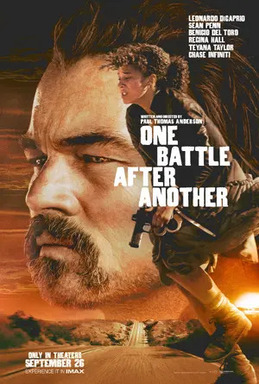


It’s a brave filmmaker that quotes one of the greatest revolutionary films of all time during it’s runtime, namely Battle of Algiers (1966). But Paul Thomas Anderson’s formidable cinematic career more than earns him the right to quote a film as towering as The Battle of Algiers (1966) in his latest release One Battle After Another (2025).

Across works like Boogie Nights (1997) and Magnolia (1999), he has demonstrated a mastery of ensemble storytelling and emotional crescendo; with Punch-Drunk Love (2002) he revealed a gift for intimate, offbeat romance; and in There Will Be Blood (2007) and Phantom Thread (2017) he proved himself one of the most rigorous visual stylists and psychological dramatists of his generation. Such a body of work grants him the authority to converse with cinema’s political masterpieces, even if his more recent Licorice Pizza (2021) felt comparatively diffuse and lacking in urgency. His filmography, at its strongest, stands as evidence of a filmmaker deeply attuned to the legacies and possibilities of the medium.

Having said that, Gillo Pontecorvo’s The Battle of Algiers (1966) wields revolutionary power through its raw immediacy, embedding viewers in the lived experience of anti-colonial struggle with a documentary-like realism that blurs the line between record and re-creation. By contrast, Anderson’s One Battle After Another (2025) approaches revolution less as lived history than as a cinematic genre to be emulated, drawing on the tropes and textures of upheaval without grounding itself in the direct urgency of political struggle. Where Pontecorvo conjures revolution as something happening before our eyes, Anderson refracts it through the prism of style, making revolution as much a matter of aesthetic construction as lived reality. It is during its lengthy running time extremely entertaining though.
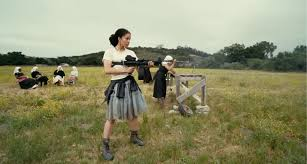


The opening hour is fast-paced and crams in a lot of action and personality. It establishes a fine ensemble cast, strong characters, striking palette and compelling themes which bring to life Anderson’s sharply written and fantastically filmed screenplay. The narrative focuses on “Ghetto” Pat Calhoun (Leonardo DiCaprio) and Perfidia Beverly Hills (Teyana Taylor), lovers and leaders of the far-left French 75, who storm detention centres, bomb banks, and sabotage power grids, while their soon-to-become nemesis—Officer Steven Lockjaw (Sean Penn)—becomes erotically obsessed with Perfidia, sparing her life when he catches her planting a bomb in exchange for a sexually masochistic tryst. Thus, begins a warped love/hate triangle and rivalry which provides the backbone for the action.

The second hour pivots sharply after establishing Perfidia as a commanding revolutionary presence. The focus pulls to her daughter, Willa (Chase Infiniti), some sixteen years later, now living off the grid and avoiding all but the most basic technology out of fear of surveillance. ‘Pothead’ Pat, has withered into a paranoid and barely functioning stoner-alcoholic, leaving Willa to emerge as the steadier, more mentally resilient figure in their fractured household. The film undeniably suffers from the absence of Perfidia’s charisma and drive, yet it regains momentum when the now Colonel Lockjaw revives his obsessive pursuit, setting the stage for a tense reconfiguration of the story’s revolutionary stakes.

The acting in One Battle After Another (2025) crackles with intensity, led by standout turns from Taylor, Penn, and crafty scene-stealer, Benicio Del Toro. Further, Anderson’s casting team find some amazing supporting military personnel who deliver with uncanny authenticity. Sean Penn’s performance as a swaggering officer radiates brute masculinity—his very walk and gait dripping with testosterone and worthy of awards consideration on their own. Leonardo DiCaprio, meanwhile, folds another eccentric, messy, and deeply contradictory figure into his already remarkable CV, a creation that resonates with the layered complexity of his recent work in Scorsese’s Killers of the Flower Moon (2023). He is actually far more hilarious here, as demonstrated in his desperate attempts to overcome the revolutionary helpline he calls for instructions.

Overall, One Battle After Another (2025) works best as a searing, darkly funny revolutionary black comedy, blending sexual, military, conspiracy, and social politics into a heady mix of action, crime, road movie, and romance tropes. The result is a wildly entertaining visual and musical feast, even if it stops short of delivering true socio-political depth. While the film’s closing stretch leans into deliberate plot ambiguities that complicate its resolution, Anderson ultimately serves up a combative cinematic blast—stylish, sharp, and exhilarating—if just shy of a bona fide classic.

Mark: 8.5 out of 11


Cinema review: The Phoenician Scheme (2025) – plus Wes Anderson’s Top 11 films ranked in order of favourite!

Cinema review: The Phoenician Scheme (2025)

Directed by Wes Anderson

Screenplay by Wes Anderson

Story by Wes Anderson and Roman Coppola

Produced by Wes Anderson, Steven Rales, Jeremy Dawson, John Peet

Cinematography by Bruno Delbonnel

Main cast: Benicio del Toro, Mia Threapleton, Michael Cera, Riz Ahmed, Tom Hanks, Bryan Cranston, Mathieu Amalric, Richard Ayoade, Jeffrey Wright, Scarlett Johansson, Benedict Cumberbatch, Rupert Friend, Hope Davis, etc.


Reviewing films for me is a form of study—a way to sharpen one’s eye, expand one’s perspective, and gain insight into the craft of filmmaking. It’s a dialogue between the film and the viewer, where curiosity, analysis, and empathy fuel a deeper appreciation for the storytelling process. Yet, Wes Anderson’s films often feel unreviewable in the traditional sense because they exist entirely within their own meticulously crafted universe—one governed by its own visual grammar, emotional tone, and narrative rhythm. His work defies conventional cinematic benchmarks not because it fails to meet them, but because it invents new ones.

His films are stylized to the point of abstraction: symmetrical compositions, pastel palettes, theatrical performances, deadpan dialogue, and storybook framing devices. These are not aesthetic flourishes added to conventional storytelling—they are the storytelling. Every element is calibrated to serve a singular artistic vision that prioritizes mood, irony, and emotional restraint in a way that often bypasses mainstream emotional cues. As a result, trying to evaluate Anderson’s films on the basis of relatability or realism can feel like trying to critique a painting for not being a photograph. You either enter his world and accept its rules, or you don’t.


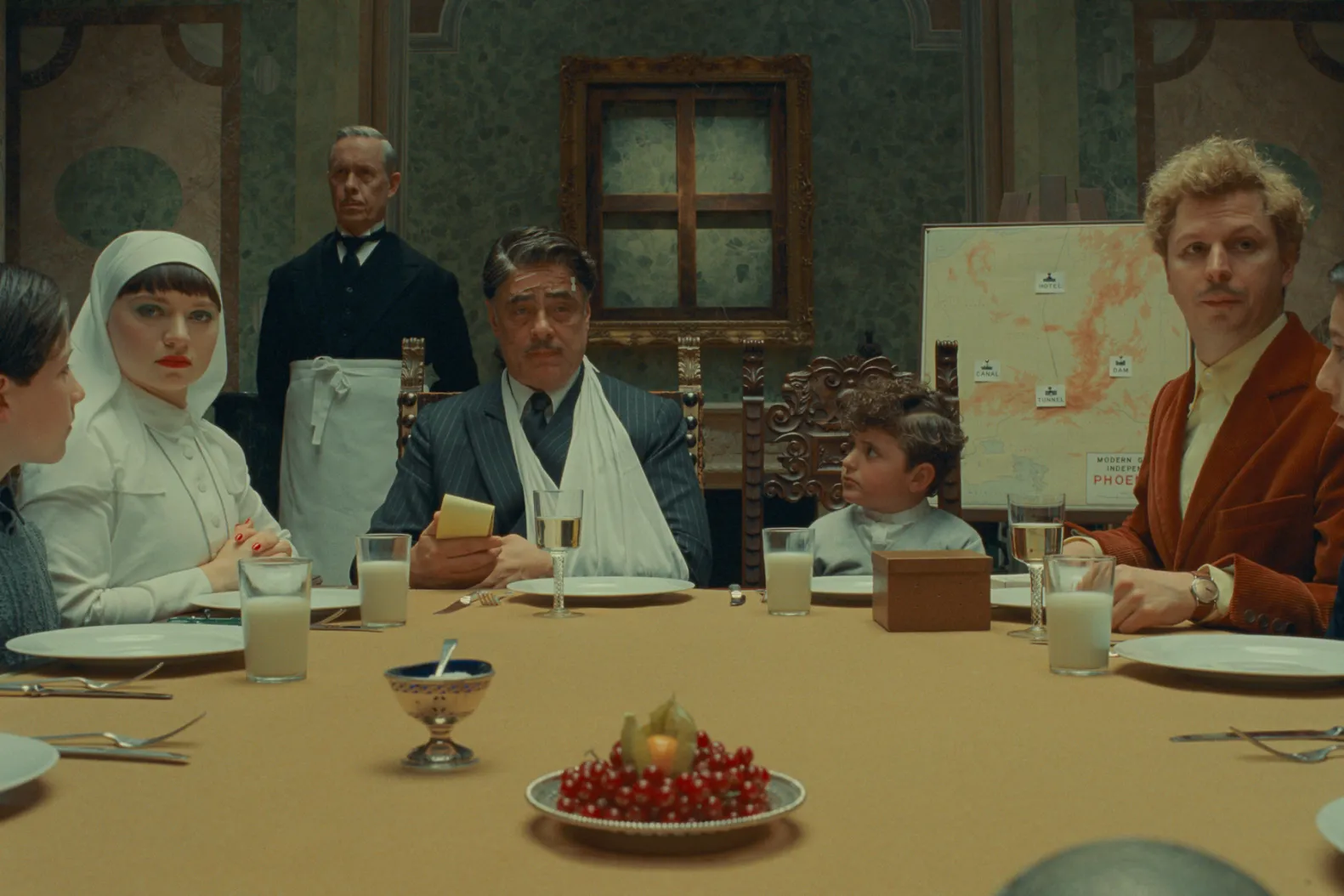
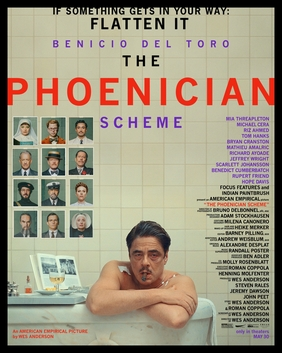
The Phoenician Scheme (2025) is a whimsically convoluted tale of betrayal, bureaucracy, and buried emotion, anchored by a surprisingly tender pairing: Benicio Del Toro and Mia Threapleton as an estranged father and daughter navigating a pastel-hued world of espionage, assassination attempts and eccentricity. Del Toro brings his signature quiet intensity—filtered through Anderson’s signature deadpan—as Anatole “Zsa-Zsa” Korda, a controversial businessman seeking backing from an array of peculiar business types. Threapleton, in a breakout performance, plays Sister Liesl, a guarded young nun.

As always, Anderson’s aesthetic is immaculately controlled—every frame a still life, every line delivered with just-so detachment. But where the plot sometimes meanders through its own labyrinth of quirk, the film’s emotional core remains grounded in Del Toro and Threapleton’s quiet push-and-pull: a relationship built on misread intentions, half-kept promises, and a strange kind of inherited stoicism. Michael Cera is on splendid form too as Bjørn Lund, a Norwegian entomologist, tutor, and Korda’s administrative assistant.

Overall, The Phoenician Scheme (2025) is best enjoyed as a moving art installation and while thematically strong in terms of the father-daughter-reconciliation theme, doesn’t reach the narrative heights of Anderson’s best work. It’s a visually charming and emotionally sincere entry—proof that even in a world of plane crashes, quirky business deals, weird relatives, religious fervour, eccentric guerrillas, the arc of connection between a father and daughter can still feel radical.

Mark: 7.5 out of 11


Wes Anderson’s Top 11 films ranked in order of MY favourites!

1. Rushmore (1998)

2. The Grand Budapest Hotel (2014)

3. The Royal Tenenbaums (2001)

4. Bottle Rocket (1996)

5. Asteroid City (2023)

6. Isle of Dogs (2018)

7. Moonrise Kingdom (2012)

8. The Darjeeling Limited (2007)

9. The Phoenician Scheme (2025)

10. The Life Aquatic with Steve Zissou (2004)

11. The French Dispatch (2021)


CINEMA REVIEW: POOR THINGS (2023)

CINEMA REVIEW: POOR THINGS (2023)

Directed by Yorgos Lanthimos

Screenplay by Tony McNamara


Based on Poor Things: Episodes from the Early Life of Archibald McCandless M.D., Scottish Public Health Officer by Alasdair Gray

Produced by Ed Guiney, Andrew Lowe, Yorgos Lanthimos and Emma Stone

Main cast: Emma Stone, Mark Ruffalo, Willem Dafoe, Ramy Youssef, Christopher Abbott, Kathryn Hunter and Jerrod Carmichael.

Cinematography by Robbie Ryan


*** MAY CONTAIN SPOILERS ***


I have now seen all of Greek filmmaker Yorgos Lanthimos’ most recent directorial works, namely: Dogtooth (2009), Alps (2011), The Lobster (2015), The Killing of a Sacred Deer (2017), and The Favourite (2018). Collectively they defy conventional film styles and tropes to deliver absurd, surreal, funny, disturbing, thought-provoking, erotic and imaginative visions of human behaviour. Also, let’s not forget the writers too; so kudos to his writing partner Efthymis Filippou, and latterly Tony McNamara, who have combined with Lanthimos to create such memorable cinematic offerings.

The director’s early lower-budget dysfunctional comedy-dramas such as Dogtooth (2009), and Alps (2011) are unforgettably strange films to experience. They feature uncomfortable depictions of family, sex, death and relationships. While offbeat, you sense they are from the mind of a filmmaker seeking to provoke thought rather than exploit. While equally dark and strange The Lobster (2015) is clearly more comedic, even though it probes strange love, fascism and violence within romantic relationships. Further, in The Killing of a Sacred Deer (2017), Lanthimos and Filippou, in Godardian fashion, constantly called attention to cinema form; especially with a strangely effective form of anti-acting within the arguably more conventional revenge narrative. Whereas in The Favourite (2018), Lanthimos’ delivered a unique period satire, with the language and behaviour of the characters often crude and shocking. His visual choices are always fascinating, with his use of the fish-eye lens creating a distorted effect that made the characters seem trapped by their surroundings and circumstances.


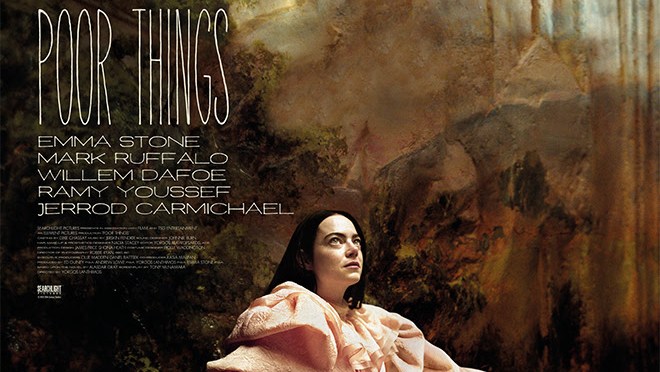
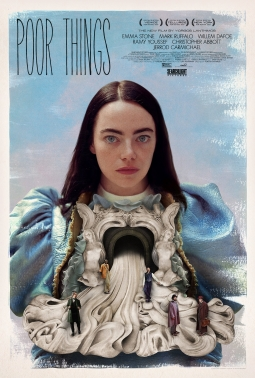
With the success of The Favourite (2018), both critically and commercially, Lanthimos has of late been given an increased budget, reported as $35 million. His bold choice, along with screenwriter Tony McNamara is to adapt award-winning novel, Poor Things: Episodes from the Early Life of Archibald McCandless M.D., Scottish Public Health Officer by Alasdair Gray has produced by far the most originally conceived and fantastic genre-bending comedy, drama, horror, rites of passage and salacious film of many a year. If there is a more bizarre, enthralling and enjoyable film of 2024, than Poor Things (2023) then this will be a most excellent year for cinema releases.

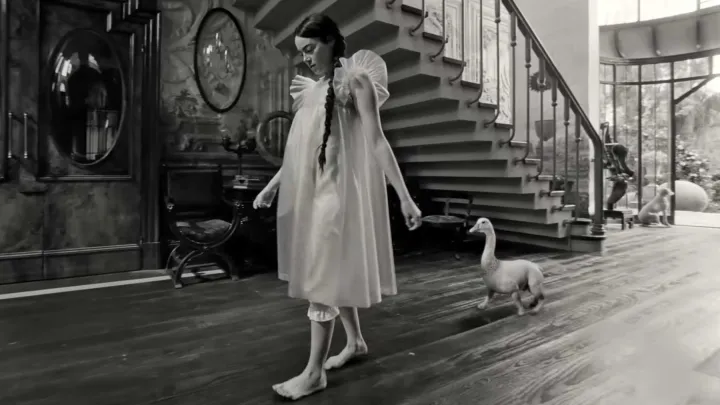
Set in Victorian London, we are introduced to the rather eccentric household of Dr Godwin “God” Baxter, an expert but secretive surgeon whose home hides bizarre animal experiments, and the beautiful but frankly odd human specimen, Bella Baxter (Emma Stone). Entering this weird abode of pig-hens and goose-dogs, comes innocent medical student, Max McCandless (Remy Youseef). “God” asks Max to assist with the childlike Bella’s development, charting her daily physical, speech and mental growth. Now, if you think the chimeric beast experiments are disturbing then brace yourself for the events of Bella’s ‘Frankensteinesque’ happenstance. I am not going to spoil it here, but it truly is a fantastic concept as invented by the author, Alasdair Gray, to contemplate. I was teetering on the fence with the film until this stunning reveal was given, but then I was committed to this medical oddity.


The first act finds Bella developing her speech, emotions and intelligence, as if a young child growing within this woman’s body. Bella also locates her libido and begins experimenting with her lust to great pleasure. Here Lanthimos continues exploring the themes of previous films with sex not only a natural expression of humans, but also an act used to control and drive people mad. Enter Mark Ruffalo’s caddish lawyer, Duncan Wedderburn who spirits a willing and rebellious Bella on a European trip. One where she truly discovers and satisfies her continual carnal desire or “furious jumping” as she hilariously calls it. Bella’s rites of passage, frankness and rapid growth threatens Duncan’s masculine insecurities and he finds it difficult to control her. Here the hilarious screenplay shows Bella and Duncan becoming more and more fraught until she craves further independence from his cloying envy. The central theme of Bella overcoming the chains of controlling masculinity dominates right up until the extremely dark final act.

While there is a lot of sex and nudity in this film, I felt that Lanthimos balances the exploitative nature of such material by contextualising it within Bella’s fascinating character arc. Emma Stone also provides a complex performance, funny and moving, as the woman-child discovering her mind, body, soul and the world. Ruffalo is particularly over-the-top as the sneaky but pathetic reprobate, Wedderburn. While Remy Youssef’s young medical student adds some compassionate balance within the ensemble, Willem Dafoe gives his customary brilliant turn as the tragic man of science. He himself had his childhood tainted by a father determined to use Godwin Baxter as a human guinea pig.

With a spectacular production design that employs a rich palette of colours, sets, lighting and immaculately furnished rooms, Lanthimos, stamps his authorial style along with genius cinematographer Robbie and his array of lens. Such creative choices evolve a spectacularly hyper-real vision of Victoriana. Indeed, the form and style coalesce with the content and themes in Poor Things (2023) to create what could already be the favourite film of my year. The screenplay dares to provoke the audience with gender political, sociological, historical and hysterical analysis as Yorgos Lanthimos again proves himself to be one of the most original filmmakers of his generation. Owing much to the imagination of Alasdair Gray’s source book, this is a shocking and explicit Frankenstein’s monster of a film. Lastly, it had me consistently thinking and laughing throughout, testifying to the power of family, however dysfunctional that Victorian household may be.

Mark: 10 out of 11


CINEMA REVIEW: ASTEROID CITY (2023)

CINEMA REVIEW: ASTEROID CITY (2023)

Directed by Wes Anderson

Screenplay by Wes Anderson

Story by: Wes Anderson and Roman Coppola

Produced by: Wes Anderson, Steven Rales, Jeremy Dawson

Ensemble Cast: Jason Schwartzman, Scarlett Johansson, Tom Hanks, Jeffrey Wright, Tilda Swinton, Bryan Cranston, Edward Norton, Adrien Brody, Liev Schreiber, Hope Davis, Stephen Park, Rupert Friend, Maya Hawke, Steve Carell, Matt Dillon, Hong Chau, Willem Dafoe etc.

Cinematography Robert Yeoman

*** MAY CONTAIN SPOILERS ***


Wes Anderson is a phenomenal filmmaker with an imaginative set of style and narrative conceits. Everyone one of his releases is a rich tapestry containing memorable ensemble casts, adjacent framing, effervescent use of colour, geographical pertinence, intellectual humour and subjects situated in the far-left field of genre cinema. Yet, I do not enjoy ALL his films. Often, they veer too far into eccentric pretentiousness. Indeed, I found The French Dispatch (2021), frustrating and, other than the tremendous story set in the asylum with the mad artist (Benicio Del Toro), disconnected with it overall. While it was another admirable work of cinema, I did not enjoy it as a paying punter.

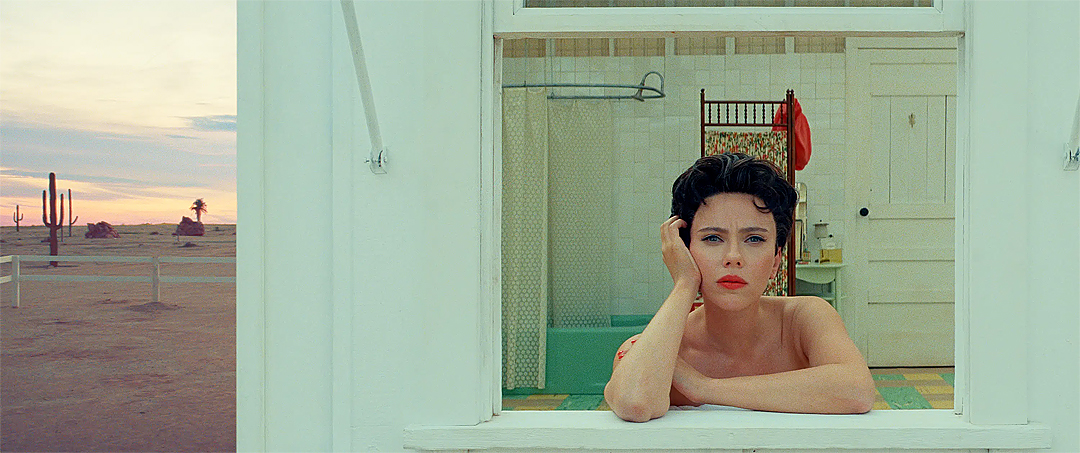
Asteroid City (2023), however, is a film I enjoyed greatly. The famous actors immersed within the ensemble, the cinematic artifice, the clever meta-narrative structure, symmetrical shot composition, beautiful use of colour, offbeat characters, specific era and geographical setting, imaginative props and costume design, and witty humour are all present as per Anderson’s impressive body of work. But Asteroid City (2023) had a larger emotional heart than his recent films, and is my favourite since the superb, The Grand Budapest Hotel (2014).


A heady combination of genres, one could describe, Asteroid City (2023), as a hyper-sci-fi-Western-retro-romantic-futuristic-comedy and study of grief set in 1950s, America. Despite filming taking place in Spain. Anyway, Anderson establishes the characters through the structure of a film within a play. Bryan Cranston’s narrator introduces us to the various middle-class, working class, military and scientific personalities who become trapped in the town of Asteroid City by a series of unlikely but hilarious misfortunes. Throughout the chapter inter-titles the scenes return us to our narrator as Anderson cleverly comments on the process of creating a story while delivering the narrative events.

Anderson delves into familiar themes of grief via the story of war photographer, Augie Steenbeck (Jason Schwartzmann) and his four kids, one of whom is a genius, Woodrow (Jake Ryan). He is there for a Junior Stargazer competition amidst the setting of the gigantic meteorite bunker. Again, the theme of prodigious children is mined for great humour and intellectual wit by Anderson. The futuristic inventions created by the children are especially fantastic. The plot strand of the science geniuses being exploited by the military and corporate sharks is deftly done. Yet, the main emotional heft is delivered within Augie and Hollywood actress, Midge Palmer’s (Scarlett Johansson) budding relationship. Johansson is especially compelling in the role, anchoring the film in welcome pathos, amidst the flurry of idiosyncratic absurdities Anderson throws at us. His framing of Augie and Midge between the their chalets is aesthetically memorable, visually augmenting their growing human connection.

Asteroid City (2023) proves once again Wes Anderson is one of the most original filmmakers of this generation. Will he gain some more converts to his particular set of cinematic bag of tricks? Who knows. What I do know is that I was completely immersed in the colour, movement, pace, humour, aesthetics, performances and themes with the film. I must say though, while it was necessary, the “Area 51” style — and I don’t want to give it away — absurd plot-turn halfway through was not my favourite aspect of the piece. But I realise it was narratively integral to the story. The meta-framing also seemed to get in the way at times of the main action effecting the occupants of Asteroid City. But these are minor gripes at a thoroughly artistic, beautifully immersive, and technically impressive cinematic achievement.

Mark: 9 out of 11


MY CINEMATIC ROMANCE #23 – WES ANDERSON

MY CINEMATIC ROMANCE #23 – WES ANDERSON

quirky
[ˈkwəːki]
ADJECTIVE


“having or characterized by peculiar or unexpected traits or aspects.
“her sense of humour was decidedly quirky”


synonyms:
eccentric · idiosyncratic · unconventional · unorthodox · unusual · off-centre · strange · bizarre · weird · peculiar · odd · freakish · outlandish · offbeat · out of the ordinary · Bohemian · alternative · zany · outré ·


I thought I’d save myself a lot of time using the above variant words in one go. Because they, and the word auteur, are utterly inevitable while writing a short article in praise of the Wes Anderson films I rate. It’s intriguing to write about Anderson though. While many of the pieces in the My Cinematic Romance series concentrate on people in cinema I absolutely adore, he is more a filmmaker who I respect rather than have an undying emotional connection with.

Wes Anderson is a phenomenal filmmaker with an imaginative set of style and narrative conceits. Everyone one of his releases is a rich tapestry containing memorable ensemble casts, adjacent framing, effervescent use of colour, geographical pertinence, intellectual humour and subjects situated in the far left field of genre cinema. Yet, I don’t enjoy ALL of his films. Often they veer too far into eccentric pretentiousness. Indeed, I was going to write a review of The French Dispatch (2021), but I found it frustratingly dull and, other than the tremendous story set in the asylum with the mad artist (Benicio Del Toro) disconnected with it on the whole. But, I must say, it was another admirable work of cinema, but one I did not enjoy as a paying punter.

So, rather than write a middling review about a genius filmmaker’s latest work, here is a piece about my favourite five films of Wes Anderson.

***MAY CONTAIN SPOILERS ***


BOTTLE ROCKET (1996)

Anderson’s debut feature film is based on his short film of the same name. Co-written with Owen Wilson, it is a freewheeling take on the heist movie which eschews hard-boiled professionals for a group of hapless losers led by the positively loopy Dignan (Wilson again). Shot way before Anderson got his ruler and set square out, it’s a naturally filmed, hilarious character comedy that destabilises crime genre conventions with charming effect. Launching the acting careers of the Wilson brothers it is an oddly charming filmic treat.


RUSHMORE (1998)

This is still my favourite Wes Anderson film because it combines a perfect combination of uncommon humour and prevailing verisimilitude. What I mean is I did not feel I was watching a showcase of artistic flourishes, but a true human story full of empathetic characters, feeling and emotion. It is also incredibly funny as we follow the rites of passage story of school maverick, Max Fischer (Jason Schwartzman), a working class kid rebelling against the adults he believes are beneath him. Bill Murray’s career renaissance began here and his character’s vengeful battles with Max are one of the film’s many highlights.


THE ROYAL TENENBAUMS (2001)

The first Wes Anderson film that saw the stylistic devices and themes so prevalent in his later work to truly come to the fore. The ensemble cast crammed with famous names, the omnipotent narrator, symmetrical framing, consistent and complimentary colour palettes, typography, fantastic use of nostalgic music, distinctive costumes and stories structured in chapters of the literary kind. The Royal Tenenbaums (2001) contains many absurd comedic moments, but has several tragic scenes too. This demonstrates Anderson’s growing maturity and remains a confident vision of a dysfunctional American family of geniuses and misfits.


THE GRAND BUDAPEST HOTEL (2014)

While Rushmore (1998) is my favourite film of Wes Anderson, his best is the tour-de-force comedy, The Grand Budapest Hotel (2014). It’s the pinnacle of bravura style and well-honed narrative competence, confidently presenting the rags-to-riches story of Zero Moustafa beginning in 1930s. Europe. Moustafa’s story takes in his first love, his job at the opulent hotel and his moving friendship with the prideful Gustave, an amazing Ralph Fiennes. It’s a film packed with invention, colour, humour, sadness and romance all wrapped in themes of the rise of fascism, loss, love and the wonder of friendship.


ISLE OF DOGS (2018)

Put aside ridiculous millennial online accusations of cultural appropriation and submerge yourself within Anderson’s rich canine narrative and stop-motion tapestry. As aforementioned, I’m not always a fan of his story subjects but he is a master of style and form. Isle of Dogs (2018) is no different and is a wonderful cinematic experience. Set in Japan we concentrate on, hence the title, a bunch of stray dogs dumped on a wasteland left to die and their subsequent adventures. This is much darker than prior Anderson films, but full of the imagination, wit, colour and brilliant technique, containing funny gags and twisting drama throughout. I preferred this to his version of the Roald Dahl classic, Fantastic Mr Fox (2009), as Bryan Cranston and the marvellous cast breathe life into the Anderson’s visionary animated box of tricks.

ALL 4 TV REVIEW – DEREK (2013 – 2014)

ALL 4 TV REVIEW – DEREK (2013 – 2014)

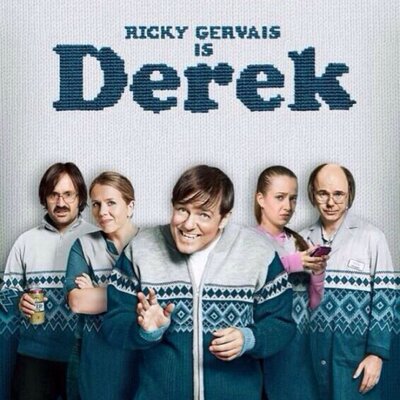
Created, written and directed by: Ricky Gervais

Producer: Charlie Hanson

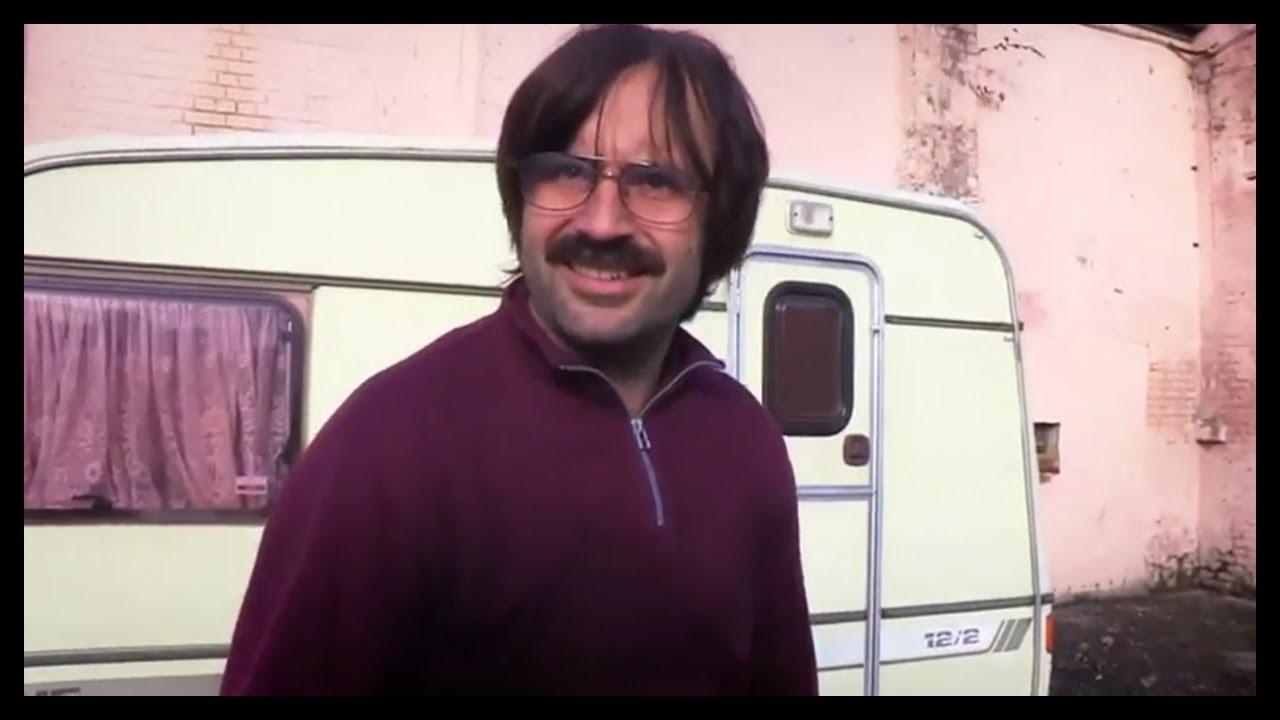
Cast: Ricky Gervais, Kerry Godliman, David Earl, Karl Pilkington, Brett Goldstein, Colin Hoult, Holli Dempsey, Ruth Bratt, Arthur Nightingale, Doc Brown, Joe Wilkinson etc.

Original Network: Channel 4

**MAY CONTAINS SPOILERS**

So, let’s address the elephant in the room with my review of ALL 4/Netflix bittersweet comedy, Derek. Is it acceptable for a person to seemingly inhabit the character of someone who could be perceived to be mentally challenged or disabled? Not forgetting, the person is a successful TV writer/actor, Ricky Gervais. After all we’re in a progressive age where it is right to be sensitive of perceptions and reactions to the representations of people of colour, religion, race, heritage and mental capacity. Is it in poor taste for Ricky Gervais to ultimately, get seemingly cheap laughs out of a gurning, simple man?

Well, on the surface and initial watch Derek, could be deemed offensive for reasons of poor taste. However, having watched series one, two and the final hour-long special for the third time, I have decided that, while it may have puerile and childish humour, Gervais has created a positive, and in some cases, heroic role model who promotes kindness to the elderly, animals, friends and basically everyone, whether they are horrible or not. The comedy and pathos derive not simply from cheap shots, but, organically from a set of outsiders and forgotten people inhabiting a care home. Lastly, Gervais is a talented actor and while he’s no Daniel Day Lewis in My Left Foot (1989), his character of Derek Noakes is a genuinely fine human being worth spending time with.

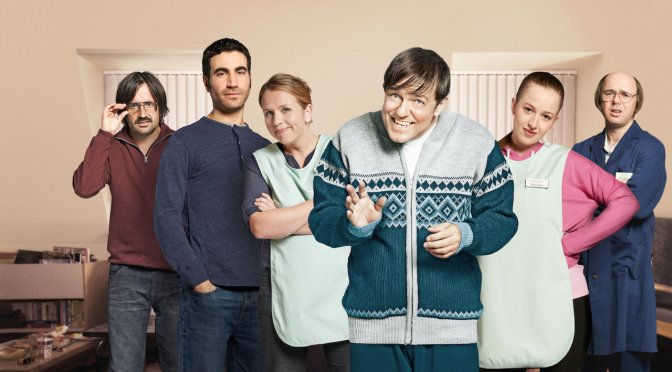
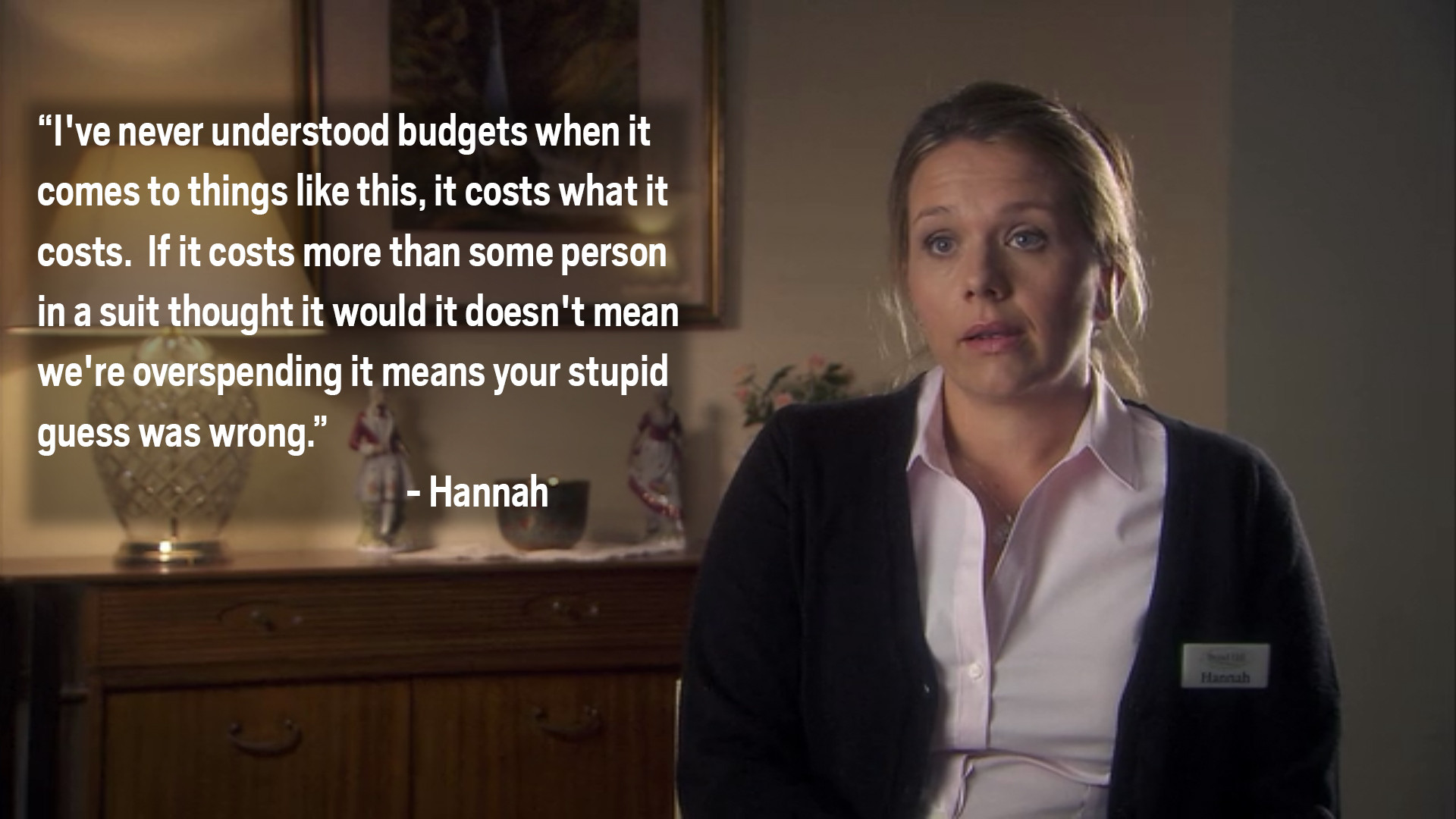
Moving past the controversial issues of taste the most important question remains: is Derek funny? Well, it is both funny and very moving, encompassing themes relating to life, death, grief, romance, love, redemption, depression and memory. Set in a care called Broad Hill it features a collection of disparate ensemble of characters who are existentially trapped within their day-to-day lives. These include hard-working Hannah (Kerry Godliman), gruff handyman, Dougie (Karl Pilkington), alcoholic wastrel, Kev (David Earl), and the titular, Derek. Furthermore, the care home becomes a haven for characters doing community service such as Vicky (Holli Dempsey) and of course the elderly residents who are cared for at Broad Hill.

Shot in Gervais’ often used mockumentary style, each episode unfolds in a gentle slice-of-life style as the Broad Hill employees go about their business. A common theme running through the series is the pressure the staff, notably Hannah, find themselves under looking after old people who have been dumped by their family and society at large. Moreover, the children or grandchildren of the residents are mostly represented as greedy, callous or self-absorbed. Gervais has commented that the show is a tribute to family members who worked in care homes and Derek succeeds in that context.

In representing the working classes and societal outsiders, Derek also works very well. I’ll be honest there is some easy humour to be had from the sexual perversity and drunken antics of Kev, portrayed with greasy acumen by David Earl. However, in Season 2, Kevin’s sad decline comes into focus as his alcoholism causes his health to fail and the friends he has alienated have tough choices to make. Nonetheless, the comedic interactions between Pilkington, Gervais, Earl and Kerry Godliman are priceless. These, plus Brett Goldstein as Hannah’s boyfriend, Tom, are all gifted performers and they shine throughout the episodes.

Gervais faced much critical controversy when Derek was first released. But having watched it again I actually think this was undeserved. Derek is not a figure of fun but rather a complex human being and richly empathetic character. If you find it offensive or do not enjoy Gervais’ performance then I understand that. Ultimately though, the series has some childish humour such as characters writing obscenities on crabs at the seaside, Dougie’s stupid hair, and Kev crapping himself at a staff meeting. However, it also has some fine comedic set-pieces as occurs when Derek, Dougie and Kevin put on a play about Duran Duran at a talent night. Plus, the scene where Kev and Derek try and sell their autographs of “famous” people is pure comedy gold.

Overall, Derek is a life-affirming comedy full of eccentric characters on the fringe of society. Somehow, they all band together to create this weird dysfunctional but very caring family. It’s a show about life, death, gain, loss and the human spirit. Moreover, through Derek’s homespun philosophical musings we get a lot of simple, yet effective life lessons. Yes, it’s full of toilet and school-playground humour, and at times is really mawkish and sentimental, but it is also full of heart and poignancy all performed by a fantastic ensemble cast.

Mark: 9 out of 11