
Tag Archives: Hateful Eight

TELLING STORIES WITH STYLE: THE TROPES OF TARANTINO

TELLING STORIES WITH STYLE: THE TROPES OF TARANTINO

**CONTAINS MOVIE SPOILERS**

Quentin Tarantino is a powerhouse of cinema. He has proved consistently, since his debut film Reservoir Dogs (1992) right up to his most recent film The Hateful Eight (2015), a filmmaker of incredible invention. His works are well known for their references to pop culture, TV shows, music, fashion, and quoting in general from an array of cinematic influences. Indeed, his films are always firmly planted in genre, from: war films to Martial Arts to Western to crime and B-movie pictures. However, despite utilising other genres as a springboard for his writing, Tarantino instils his own style within his work. This creates a paradoxical form of originality, making him what I would call a postmodern auteur. The postmodern auteur not only quotes, borrows and steals from other influences but they are able to present them in a fashion so as to make them feel fresh and somehow original.
thC9Q8HYP4

It would be easy to write an essay of Tarantino-style bingo pointing out which films and genres he has used and stolen or quoted from, thus, as an alternative, I would like examine the narrative tropes he employs to tell his screen stories. Tarantino isn’t simply a cultural magpie throwing in arbitrary pop references but he has a magic box of narrative tricks gained from cinema, stage, literature and music. In this essay I would like to explore some of these methods and how he diverts from the linear narrative style represented by the classical Hollywood norm. I will also examine his work in general and scenes from his films to show how he has created some fascinating means of telling stories.

Tarantino differentiates his films from the classical narrative style in a legion of ways. Such tropes include: “Chapter Headings”; non-linear timelines; unreliable narrators; and what I have termed “the long game” scene or sequence. Along with his perpetual references to various genres, specific films and the use of soundtracks from other movies, such devices work brilliantly to propel the narratives of his films. It may seem quite a simplistic device to use, but “Chapter Headings” are a very effective story device.  It’s obvious to say Tarantino has borrowed from literature in order to structure his films this way, but the ‘Chapter’ introductions establish the nature of storytelling and literally inform the audience of a change in scene, time, place and character.
014-quentin-tarantino-theredlist.jpg

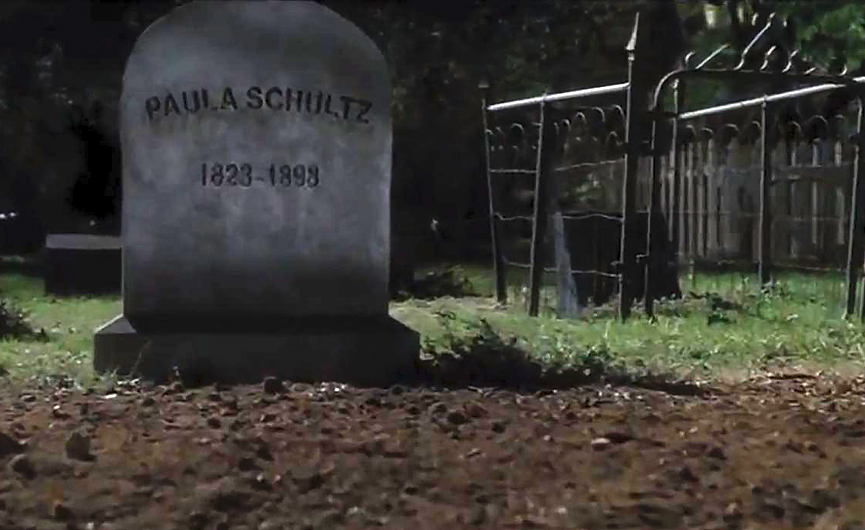
While classical Hollywood works to immerse us in the invisibility of filmmaking, Tarantino calls attention to the form with “Chapter Headings.” He does this not as a Brechtian distanciation device but rather as a means to include us in the story intellectually. The “Chapter Headings” also create humour, mystery and suspense. For example in Kill Bill: Volume 2, one chapter is called The Lonely Grave of Paula Schultz, which immediately conjures a mysterious and eerie story to come. It  turns out to be just that as Beatrice ends up buried alive as the segment further reveals more of her fascinating back-story. In an ingenious aside in Tarantino’s “Universe”, Paula Schultz is in fact the wife of King Schultz from his own Western Django Unchained (2012).

“Chapter Headings” also seek to cement and bind another of Tarantino’s tropes: the non-linear or fractured timeline structure. Here, fractured events are portrayed out of chronological order and do not follow the direct causality pattern of the events in the standard narrative model. Non-causality is as old as the hills with Homer’s The Iliad in the 8th century BC being one of the first examples of such a narrative device. Indeed, it’s easier to pick out a Tarantino film that doesn’t follow a non-linear structure than not. However, even his most linear film Jackie Brown (1997), which follows the eponymous protagonist’s attempts to stay out of jail and alive, finds the narrative splintering into a triptych of varying perspectives during the final act.
grave.jpg

Often non-linearity is used to show dreams, flashbacks, time-travel and explore splintered identities or point-of-view; nonetheless, the non-linear narratives of, for example, Reservoir Dogs (1992), Pulp Fiction (1994), Kill Bill (2003/2004) and Inglorious Basterds (2009) contain fractured timelines from mainly a creative and aesthetic choice. But they are not just style for style’s sake as they create a dazzling intellectual response and activate the viewer to piece the stories together like a jigsaw. Reservoir Dogs (1992) is especially ingenious in breaking the rules of genre as it’s one of the only films I’ve seen about a robbery which shows us everything aside from the actual crime. It is important, however, to say that while Tarantino knows the rules of linearity he chooses to break them, on the whole, to enhance the cinematic experience. Interestingly, in my opinion, his most satisfying films are those which are his most linear. Tony Scott proved this when he re-wrote and re-ordered Tarantino’s script of True Romance (1989), while Django Unchained (2012), aside from a few brief illusory dream sequences and momentary flashbacks, builds powerful emotions as Django hunts down his slave captors and wreaks revenge in order to be reunited with his wife.

A narrative off-shoot of fractured timelines is Tarantino’s use of stories within stories and unreliable narrators. The device of the unreliable narrator is another means in which Tarantino differentiates his narratives from classic storytelling. In 1981, William Riggan, created a study of various unreliable types, including: The Picaro, The Madman, The Clown, The Naif and The Liar. The Picaro will typically be a bragger, similar to the Liar but not as heinous. The Madman or Mad Woman, however, will be more sinister but The Clown and The Naif will either be playing for laughs or in the latter’s case, telling their story from a naïve position. Tarantino takes great joy with narrators, unreliable or otherwise, telling lies; something seen brilliantly in both Reservoir Dogs (1992) and his most recent film The Hateful Eight (2015).
reservoirdogs_mrorange

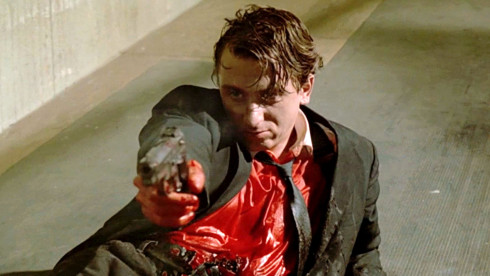
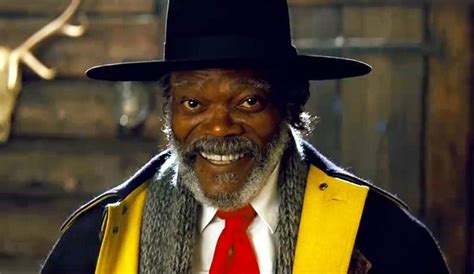
In Reservoir Dogs (1992), Tim Roth’s “Mr Orange” is revealed to be an undercover Police officer. “Orange’s” cop superior actively tells him to invent a story – because you “gotta have a story,” – to inveigle his way into the Joe Cabot’s gang. Thus, he invents a shaggy dog tale about the time he almost got bust by cops in a toilet. Tarantino presents a dishonest character delivering a story in a false reality providing both suspense and entertainment from a wholly unreliable basis. More ambiguous and vile is the story Samuel L. Jackson’s Major Marquis Warren tells to Bruce Dern’s irascible Confederate, General Sandy Smithers, in The Hateful Eight (2015). Sworn enemies while occupying opposing sides during the American Civil War, Warren, raises the dramatic stakes by regaling the story of how he strips, sexually humiliates and then kills Smithers’ own son. We flash-back to this incident and must consider if this is actually real or invented in order for Warren to provoke Smithers to grab a gun; thus allowing the Major to shoot him self-defence. These devices are tremendously effective narrative tools for creating shifting emotional responses to characters and again mark Tarantino’s work outside the classical norm.

The Hateful Eight (2015), given it is virtually set in one location, is very theatrical in feel. Marrying the influences of the Western genre in such television shows as Bonanza with Agatha Christie’s novel And Then There Were None (1939), the film also evokes principles of the “Shaggy Dog” story and Chekhov’s gun theory where every element of a narrative has cause effect irreplaceability. Consequently, the whole film feels like one long sequence of scenes and event with a massive and particularly violent payoff at the end. Indeed, this narrative conceit is a major styling of Tarantino. While most basic screenwriting books will tell you to get in and out of a scene as quickly as possible to move the narrative along, Tarantino disregards this rule throughout his oeuvre. This, I call the “Long Game” scene where lengthy dialogue gives way to a spectacular punchline at the end.
thN18GKOUU

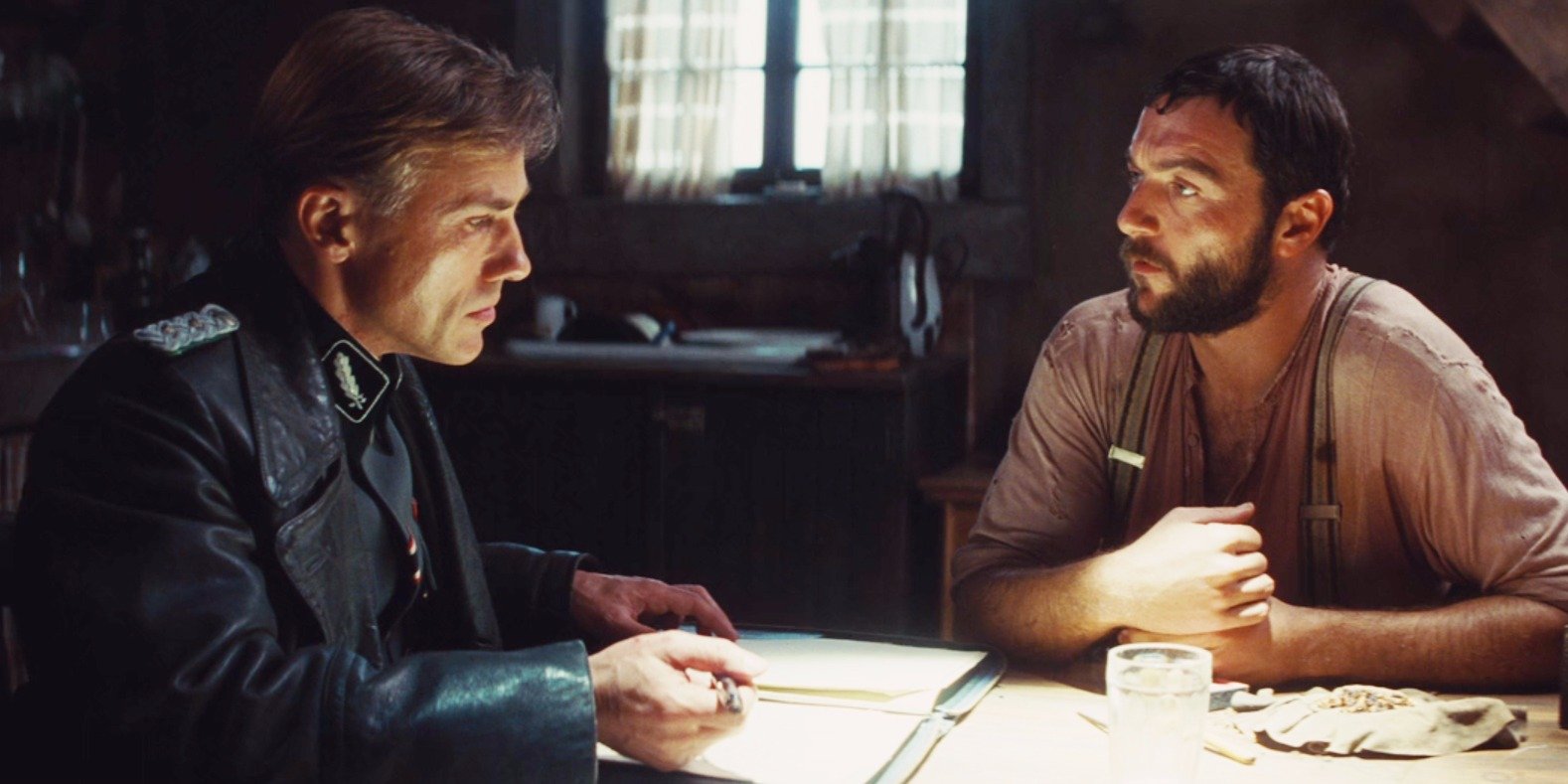
A perfect example of the “Long Game” scene is the beginning of wartime epic, Inglourious Basterds (2009). We open with the “Chapter Heading”: Once Upon a Time in Nazi Occupied France and are introduced to Christophe Waltz’ SS Office Hans Landa. At first Landa is amiable and charming in his inquisition of a French farmer. Indeed the scene moves slowly and not without humour as the German takes out his over-sized pipe and drinks the farmer’s delicious milk. But, as this is Tarantino we know suspense is building to a slow but startling crescendo. When the reveal of the hidden Jewish family below the timbers is shown, we realise that Landa is not the affable German he acts but a devious murderer and the nemesis within the narrative. With machine guns firing and splintering wood in slow motion, the soundtrack swells operatically as the scene ends with Shosanna (Melanie Laurent) sprinting away, her family butchered by the Nazis. Such “Long Game” scenes are one of Tarantino’s memorable tropes and he achieves this through his brilliant handling of conflict, dialogue and expert use of cinematic form and content.
inglouriousbasterds

Overall, Tarantino has had an exceptional film career by using established means of telling stories, both inside and outside the rules of standard narratives. He uses devices like those discussed to invigorate and entertain the audience. There is also much pleasure to be had from experiencing the tropes such as: “Chapter Headings”; unreliable narrators; non-linear structure and the “Long Game” scenes. Thus, using theatrical, literary, cinematic and musical narrative influences Tarantino proves himself a master of storytelling as demonstrated in his impressive body of work.
SCREENWASH REVIEWS– JANUARY 2016

SCREENWASH REVIEWS– JANUARY 2016

Last year was a very good year for filmmaking but 2016 is shaping up even better already. You know the scene in Pulp Fiction (1994) where Bruce Willis’ character is moving from one weapon to a bigger/better one before he tortures Zed in the basement?  That’s what cinema going is like for me in January. I’ve seen so many brilliant films in succession either as good as or better than the last.  Moreover, the Oscar fodder is launched on the silver screen thus; I saw NOT one, but FOUR films which are already likely to be on my Best of 2016 list.

I’ve slightly tweaked my FILM/TV review format so instead of covering, in detail, EVERYTHING I saw, I’ve made it a bit punchier and reviewed in depth the best of the best. As usual – marks out of eleven!

**CONTAINS MASSIVE SPOILERS**

CINEMA FILMS OF THE MONTH – ROOM (2015) + THE REVENANT (2015)


ROOM
(2015) – (MARK: 10.5 out of 11)

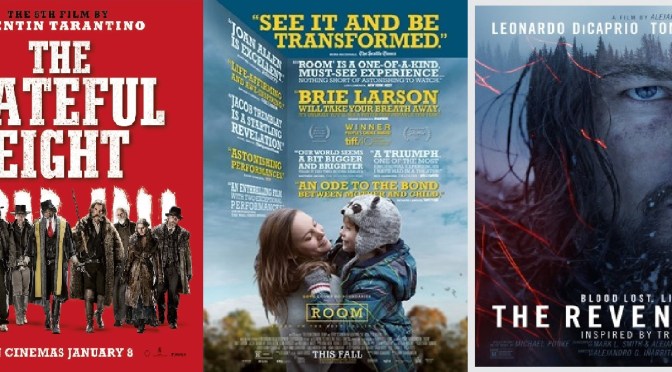
Room is an amazing film. Probably the best and most moving I will see ALL year. It concerns Joy (the incredible Brie Larson) and her young son Jack (stunning Jacob Tremblay) who have been abducted and trapped in a shed by a nefarious kidnapper referred only as “Old Nick”.

The film is presented from the innocent boy’s perspective and the pathos and empathy I felt throughout was both touching and heart breaking. What the writer’s premise does and filmmakers do is make you care about the characters immediately making every scene so suspenseful and soulful. If you are captured by stories about proper characters trying to survive dire events then it’s a must see.

The budget was low at $6 million yet director Lenny Abrahamson, his brilliant cast and writer Emma Donoghue have created a masterpiece in emotional storytelling.  Ultimately, it’s a film not just about isolation, abandonment and the horror of humanity; but also the unbridled love a mother has for their child and child for their mother. This is a truly stunning film which will linger in the memory for some time to come.

THE REVENANT (2015) – (MARK: 10 out of 11)

While Room is intimate and claustrophobic, The Revenant was the polar opposite. It’s a massive, heart pounding survival epic that must be seen on the biggest cinema screen you can find. Don’t stream it illegally online you cheap bastards; leave the house and GO TO THE CINEMA!

It concerns a Trappers’ expedition circa 1823 which is assaulted most violently by the indigenous Arikara Native Americans from the get go. The brutal attack set-piece kicks off the film in startling fashion with fire, blood and bone spilling and crunching and blasting death upon our characters. Our hero – Oscar-winner-elect – Leonardo DiCaprio is a tracker, Hugh Glass, whose expertise is required to get the survivors across the cold and brutal landscape in one piece.  But he is attacked by a bear in one of the most incredible feats of filmmaking I have seen in a long time. It just has to be seen to be believed as Glass is ripped to shreds by the bear leaving him at death’s step knocking on the door.

DiCaprio is then left with his Native American son and the greasy John Fitzgerald portrayed with dirty aplomb by brilliant Tom Hardy, as the rest head back to “civilization.” After which it’s safe to say that things don’t go too well for Glass as the money-grubbing Fitzgerald double-crosses him and leaves him for dead precipitating a series of deadly encounters that left me gasping for air and shaken to the heart of my dramatic core.

This is just superb, grueling, bloody and beautiful filmmaking! Inarritu adds some exquisite artistic touches and the cinematography and vistas are a thing of beauty. The filmmaking team spent nine months shooting the film and they have given birth to an epic masterpiece which, while a simple revenge story at heart, beats a powerful drum to the testament of the human spirit and against-the-odds survival. If you’re not watching this on a massive cinema screen then you haven’t seen it at all!

OTHER CINEMA FILMS

THE BIG SHORT (2015) – (MARK: 9 out of 11)

This is a very entertaining film satire about the global economic crash and the 2008 housing meltdown. It simplified everything in a very amusing fashion and felt like an extended American Office, both in style and humour. Steve Carell and Christian Bale are on particularly good form as are the rest of a very attractive case.  Bankers, Brokers, Regulators and the Government are presented as crooked, greedy, moronic or all of the above! I’m still shocked this actually happened as I have always held humanity in such high regard. NOT!

CREED (2015) – (MARK: 8 out of 11)

For a genre/franchise/boxing film CREED is a fantastic watch; full of emotional ups and downs. Stallone is terrific as ageing Rocky Balboa and this movie harked back to the raw quality of the first Rocky (1976). Ryan Coogler proved with Fruitvale Station (2013) he can direct real heartfelt drama and illustrates it once again here. The boxing scenes are impressive and Michael B. Jordan proves he is a very natural performer as the film delivers some proper knockout entertainment.

DANISH GIRL (2015) – (MARK: 7.5 out of 11)

Eddie Redmayne truly delivers in this story about Einar Wegener/Lili Elbe and their attempts to reassign gender. Alicia Vikander as Gerda Wegener is equally brilliant as Einar’s wife, who at first sees her husband’s flirtations with female impersonation as a game but realises it is much more than that. Overall, this is stunningly attractive filmmaking set in 1920s Copenhagen which could arguably have had a touch more dramatic bite. Yet, Tom Hooper is a formidable director of beautifully humane dramas and this is a touching testament to a person trapped and prepared to risk it all to escape.

 
THE HATEFUL EIGHT (2015) – (MARK: 9.5 out of 11)

Any other month this would have been my film of the month.  I love Westerns. I love Tarantino films (mostly). I love brilliant dialogue. I love lots of blood and violence.  Here QT remakes Reservoir Dogs (1992) via Agatha Christie, setting it in the snowy West of America circa 1870s.  It concerns eight hard-bitten souls consisting of criminals, bounty hunters and soldiers and the mayhem that ensues as they cross paths.

Set pretty much in one location there is tension and bullets galore by the end. However, the main strength lies in the ensemble cast firing verbal stingers at each other as trust breaks down and the characters turn against each other as the plot thickens. Kurt Russell, Walton Goggins and Samuel L. Jackson are real standouts and Jennifer Jason Leigh holds her own amidst the sweat and testosterone.

Though not as epic in stature as Django Unchained (2012), and in need of a wee trim, this is a fine movie which will improve on subsequent views. Tarantino is a proper auteur and can always be relied on to deliver an impressive work of entertainment. Mustn’t forget Ennio Morricone’s awesome score either, which haunts the scenes like the Reaper on collection day.

IN THE HEART OF THE SEA (2015) – (MARK: 7.5 out of 11)

Ever dependable Ron Howard has crafted an excellent adventure and survival story. A well evoked period drama Chris “Thor” Hemsworth takes to the high seas on the hunt for whales, only to come up against the white “monster” which would inspire Herman Melville’s literary classic Moby Dick. Men against nature and the elements always play well on the big screen and overall, it’s very solid entertainment. While the bookended script is old-fashioned by design it has subtext too, indicating the importance oil has always played within our society.

SPOTLIGHT (2015) – (MARK: 9 out of 11)

This is yet another Oscar-runner with an incredible true story at its heart. The film “spotlights” the Boston Globe’s investigation into endemic paedophilia and subsequent cover up by the Catholic Church. It’s a riveting story with a fantastic ensemble cast including Mark Ruffalo and Michael Keaton on very fine form.

Screenwriters Tom McCarthy and Josh Singer have crafted a sterling script that gets into the minutiae of a press investigation and also reveals the corruption and hypocrisy in organised religion, public relations and the legal system.  Just when you think people couldn’t get any lower stories like this highlight the darkness at the heart of humanity.  Thankfully, the press gang at the Boston Globe has proved more than just celebrity-baiters and given the victims of horrific abuse both a voice and justice.

TV, DVD, BLU RAY, NETFLIX and other STREAMERS

adam_paul

ADAM AND PAUL (2004) – YOUTUBE – (MARK: 9 out of 11)

Irish black comedy about two junkies trying to get a hit; manages to be both hilarious and sad simultaneously. Great feature debut from Lenny Abrahamson.

AMERICAN HORROR STORY: COVEN (2013) NETFLIX – (MARK: 8 out of 11)

More bonkers horror as witchcraft, murder and voodoo mix to grisly and hilarious effect.


AND THEN THERE WERE NONE (2015) – BBC1 – (MARK: 8 out of 11)

Stylish drama with a stellar cast committing murder most foul in fine Agatha Christie adaptation.

BLUE RUIN (2014) – NETFLIX – (MARK: 6 out of 11)

Impressive low budget neo-noir let down by the bad plotting and unsympathetic lead protagonist. 

THE FALLING (2014) – AMAZON PRIME – (Mark: 6 out of 11)

Artful period drama about fainting young girls starts well but runs out of story by the end.

THE HUNTER (2011) – AMAZON PRIME – (Mark: 7 out of 11)

Intriguing Aussie drama as Willem Dafoe’s hired gun tracks down the last Tasmanian tiger.

ROME – SEASON 1 – (2005) – NETFLIX – (MARK – 8 out of 11)

Brilliant Caesarean drama with devilish plotting and bloodier battles plus a cracking cast.


SHERLOCK: THE ABOMINABLE BRIDE (2015) – BBC1 – (Mark: 8 out of 11)

Oh-so-clever-meta-drama featured Holmes & Watson on the trail of a ghostly murderess in a wedding dress. Stylish with little substance but entertaining nonetheless.

SLOW WEST (2014) – NOW TV – (Mark: 7 out of 11)

Idiosyncratic Western that is too pretentious in places, but saved by ever-excellent Michael Fassbender and a fine shoot-out at the end.

THEORY OF EVERYTHING (2014) – NOW TV – (Mark: 7 out of 11)

Eddie Redmayne bagged the Oscar for his portrait of Stephen Hawking in this beautifully acted, lovely looking, yet, dramatically tepid romance-biopic.

WHAT RICHARD DID (2012) – DVD – (Mark: 8 out of 11)

Slow moving but impactful drama from Lenny Abrahamson, as a rich teenager’s actions causes massive reverberations amidst an Irish family and the wider community.

AVOID AT ALL COSTS!

THE VISIT (2015) – SKY STORE – (MARK: 2 out of 11)

Some said this was a return to form for M. Night Shyamalan – IT WASN’T! Dreadful supposed horror film with one of the most annoying child actors I’ve had the displeasure to witness.