Tag Archives: John Lithgow

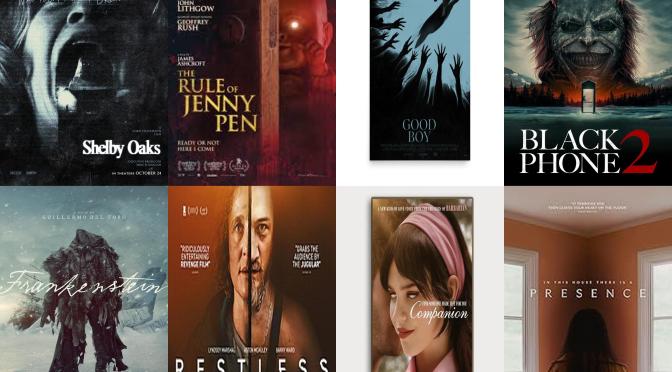
Horror film review round-up including: Black Phone 2 (2025), Companion (2025), Good Boy (2024), Presence (2025), Together (2025) and others. . .

Autumn Horror Film Reviews

In the languid drift of autumn, when Halloween’s shadow lengthens and winter begins its slow, expectant inhale, the world seems to slip into a more suggestive register—one where every rustling leaf feels like a whispered omen. It is, of course, the most appropriate season to surrender to the year’s latest horror releases, as though communing with these cinematic phantoms might prepare us—spiritually, aesthetically—for the deeper darkness to come.

Which basically means I have been catching up with some 2025 horror film releases I missed at the cinema during autumn. A couple of these probably warrant more in depth solo reviews, but as I edge closer to old age and the reaper’s scythe, I am economizing somewhat.

*** MAY CONTAIN SPOILERS ***


Black Phone 2 (2025)

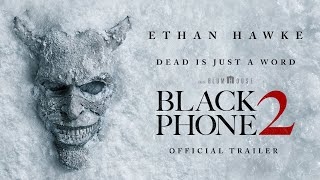
Scott Derrickson and co-writer C. Robert Cargill deliver a sequel to The Black Phone (2021) with Mason Thames, Madeleine McGraw, Jeremy Davies, and Ethan Hawke reprising their roles from the first chiller. I actually enjoyed this one more than the original, which despite the clunky set-up, finds the siblings and others trapped in a teen camp hit by a blizzard. They find themselves hunted and haunted by both The Grabber (Hawke) and other ghostly spirits haunting the area. Derrikson throws a lot of horror tropes and the characters (literally in certain scenes) at the walls, and much of it sticks. Having said that, I still don’t think The Grabber is the scariest villain ever committed to screen, despite Hawke’s presence. (Mark: 7.5 out of 11)


Companion (2025)

Companion (2025) feels like Garland’s Ex Machina (2014) colliding elegantly with Fargeat’s feral Revenge (2017)—a sunny day-horror fable that hides its nastiest surprises in plain sight. Its twists are sharp, its aesthetic confident, and its ideas far more ambitious than its modest surface first suggests. I would have admired it even more were it not, on occasions, completely dumb. Plus, the occasional drift into a comedic register undercuts its more incisive moments. The beautiful Sophie Thatcher once again commands the screen with the same riveting presence she brought to Heretic (2024). Mark: 8 out of 11.


Graduation Day (1981)

Thanks to Bobby Carroll’s site for reminding me about slasher film, Graduation Day (1981), as I had completely forgotten about it. High quality kills and gore mask a screenplay which has more nudity than character development. Yet, I am a sucker for these 1980’s exploitation flicks and this is a watchable one. Mark: 6 out of 11


Good Boy (2025)

An low-budget horror film triumph with Ben Leonberg directing his own dog, Indy, a Nova Scotia Duck Tolling Retriever, as the only witness to nasty spirits threatening his owner. The film emerges as a formal tour-de-force, whose meticulous composition and deliberate pacing elevate its simple premise into something unexpectedly resonant. Its visual precision and rhythmic control shape an atmosphere of dread that feels more sculpted than sensational, grounding the film in an emotionally impactful narrative about loyalty, vulnerability, and the unsettling spaces between trust and fear. For all its craft, and impressive animal direction, the film doesn’t quite sustain a relentless menace throughout. But, it remains a memorable feature debut from Leonberg and Indy the dog. Mark: 8.5 out of 11.


Presence (2025)

In Presence (2024), David Koepp and Steven Soderbergh demonstrate just how potent a one-location horror film can be when discipline and imagination converge. The entire piece unfolds like a controlled exhale: a slow-build structure that trusts the audience to lean in, and a drifting, almost contemplative camera that adopts the ghost’s POV to quietly—sometimes imperceptibly—reveal fragments of the story. Instead of overplaying its hand, the film slow-drips its plot elements with an elegance that keeps tension suspended in the air, letting unease pool in the corners of an otherwise ordinary space. By the time it reaches its finale, Presence (2024) delivers not only a surge of emotional and thematic clarity but two genuinely surprising twists—earned, unsettling, and executed with the kind of precision that affirms both writer and directors’ mastery of the form. Mark: 8.5 out of 11.


Restless (2024)

Really good independent British thriller with Lyndsey Marshal as a nurse, Nicky, who finds herself terrorized by 24-hour partying thug neighbours. Writer-director Jed Hart creates great empathy and identification with the situation and it’s a shame decent British films like this get short shrift at the multiplexes. Nicky’s spiral into insomnia-driven madness is compelling as her desperate attempts to sleep give way to vengeance. But the film’s final act tonal turn denies us a full-on descent into suburban hell, for something amenable but unfortunately less twisted. Mark: 7.5 out of 11


The Rule of Jenny Pen (2025)

The Rule of Jenny Pen is an original, weird, and powerful shock of a film — a mash-up of psychological thriller and nursing-home horror that lands far more often than it stumbles. Its greatest strength is, without question, the towering performances at its centre. Geoffrey Rush and John Lithgow, two masters of calibrated gravitas, turn the film’s cat-and-mouse mind game into a gripping acting showcase. Together, they elevate the film’s themes of aging, vulnerability, and institutional neglect into something both unsettling and strangely beautiful. The plotting, however, does get a bit sticky toward the end. The final act jars slightly, causing me confusion in an otherwise tight psychological narrative. Still, even as the story wobbles a tad, the film’s originality, eerie tone, and powerhouse acting keep it compelling. Mark: 8 out of 11


The Woman in the Yard (2025)

The Woman in the Yard (2025) rises on the strength of Danielle Deadwyler’s commanding lead performance. As a mother trying to protect her two children from a funereal spirit lingering in their backyard, Deadwyler grounds the supernatural dread with raw emotional honesty. The child actors match her with a believable, lived-in family dynamic that makes the haunting feel all the more personal. Where the film falters is in its structure. The script leans heavily on crow-barred flashbacks that interrupt rather than enrich the unfolding tension. A more linear approach could have built a stronger emotional momentum, allowing the story’s grief, guilt, and mental illness to accumulate naturally instead of stuttering backward at key moments. (Mark: 6 out of 11)


Together (2025)

Together (2025) gets an immediate boost from the casting of real-life couple Alison Brie and Dave Franco, whose natural chemistry gives the film an authentic emotional core. As a pair trying to rebuild their relationship after moving from the city to a rural small town, they convincingly inhabit the tensions, resentments, and unspoken fears that surface long before the horror does. Their incompatible expectations feel lived-in — and once they tumble into a sinkhole and the strange bodily transformations begin, that emotional groundwork makes the nightmare hit harder.

I loved the trailer for this film, which promised a truly skin-crawling descent into body-horror chaos. The final product, while atmospheric and often engrossing, doesn’t fully deliver on that promise. It pulls back when it could push further, leaving some of the more disgusting, surreal possibilities off-screen. But the ending — bold, surprising and unexpectedly poignant — is a fantastic payoff. Even if the film doesn’t always reach the extremes it teases, Together still manages to leave a memorably twisted impression. Mark: 8.5 out of 11
Cinema Review: Conclave (2024) – A Technically Brilliant, Yet Emotionally Faithless Experience (2024)

CINEMA REVIEW: CONCLAVE (2024)

Directed by Edward Berger

Screenplay by Peter Straughan

Based on the novel Conclave by Robert Harris

Produced by Tessa Ross, Juliette Howell, Michael Jackman, Alice Dawson and Robert Harris

Main cast: Ralph Fiennes, Stanley Tucci, John Lithgow, Sergio Castellitto, Isabella Rossellini, Lucian Msamati, Carlos Diehz, etc.

Cinematography by Stéphane Fontaine

Music by Hauschka

*** MAY CONTAIN SPOILERS ***


When you think about organized crime families, images of the Sopranos or Godfather-esque figures probably come to mind. But, if we’re playing with definitions one might allege the Catholic Church—an ancient institution with global influence—is one of the biggest crime organisations ever historically and in the present. I mean, organized crime families are notorious for their code of silence. The Church has had its fair share of. . . shall we say, discretion? From the Vatican’s secret archives to a several public scandals they’d rather we not dwell on, there’s certainly a flair for keeping things in the family.

The Pope, aka the Holy Father, wears white, sits on a throne, and apparently has a direct line to the big “man” upstairs. Replace “Vatican” with “Sicily,” and suddenly, the resemblance to the Mafia is uncanny. Moreover, crime families thrive on wealth accumulation. The Vatican’s art collection, gold reserves, and prime real estate make even the most successful mobster green with envy. Not to forget, from Rome to Rio, the Catholic Church has an unparalleled network. Mobsters may have their territories, but the Church claims everywhere. With over a billion followers worldwide, even Don Corleone would bow to that reach. Thus, power struggles ensue within many organisations with coups and betrayals and internal competitions occur, including who is going to be the new boss. Welcome to the cinematic adaptation of Robert Harris’ novel, Conclave (2024); a beautifully constructed, serious and ultimately quite silly story.


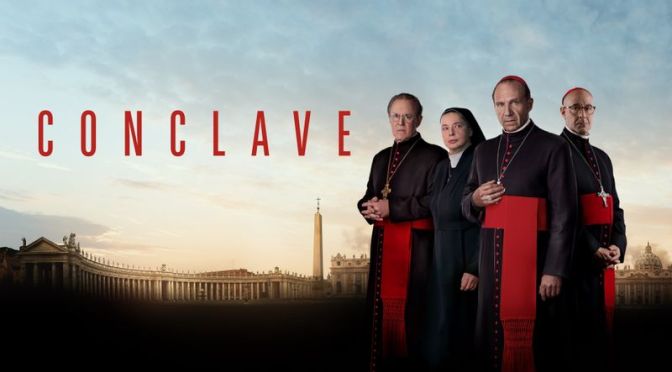
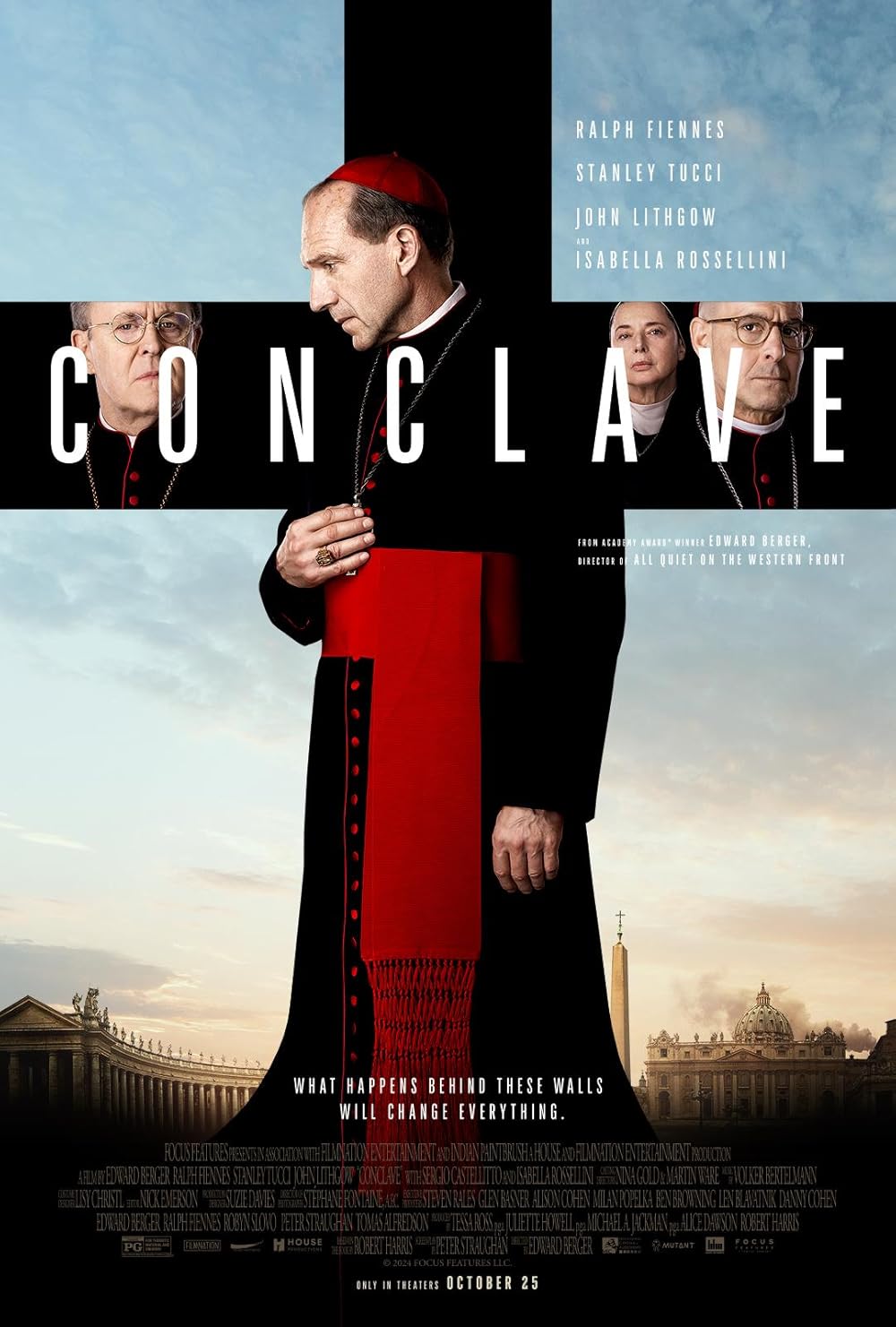
Ralph Fiennes is majestic as Cardinal-Dean Thomas Lawrence, the individual tasked with finding a successor after the Pope dies of a heart attack. Fiennes anchors this serious faith-based drama with an intellectual depth as a series of potential candidates throw their zuchettos into the ring including:

  • Aldo Bellini (Stanley Tucci) of the United States, a liberal spirit echoing the compassionate legacy of the late pontiff.
  • Joseph Tremblay (John Lithgow) of Canada, a voice of moderation, bridging the Church’s timeless values and modern sensibilities.
  • Joshua Adeyemi (Lucian Msamati) of Nigeria, a steadfast advocate of social conservatism, grounded in enduring traditions.
  • Goffredo Tedesco (Sergio Castellitto) of Italy, an unwavering traditionalist, fiercely loyal to the ancient rites of faith.

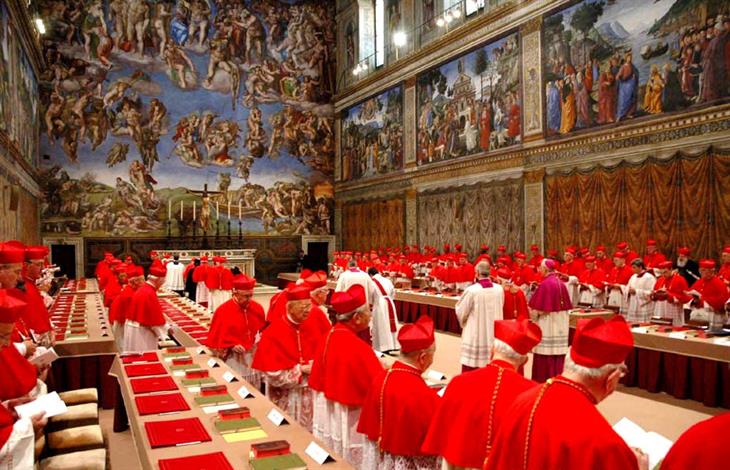
With a narrative based on a book by Robert Harris, it is certain that the powerful developments and twists will grip the audience. Furthermore, Edward Berger’s direction is undeniably captivating, as is Stéphane Fontaine’s cinematography, which paints each scene with a reverence befitting the Vatican’s grandeur. Their collaboration crafts a visually stunning vision, pulling viewers into the cloistered rituals of electing a new Pope. Yet, for all its technical brilliance, the process itself feels devoid of emotional resonance.

Why should we, the audience, care about who becomes the next Pope? Unless one is deeply invested in the Catholic Church or its doctrine, the stakes remain distant. The election of a spiritual leader for over a billion followers is, of course, significant—but the film offers little to make this significance tangible for those outside that fold. Harris’ story spices things up with a provocative, irreverent twist in its final act. Yet, this narrative grenade lands with a thud rather than an explosion. Yes, it’s shocking, even subversive, but it doesn’t pack enough weight to unsettle an institution as colossal and entrenched as the Catholic Church.

Ultimately, Conclave (2024) is a masterclass in craft but a missed opportunity in damning the status quo of this alleged criminal organisation. Berger, Fontaine, Fiennes, plus the production design, score and sound-mixing artistry elevate the film, making it an incredibly effective cinematic version of the proverbial page-turner. But the story’s failure to connect on a deeper, emotional level found me losing my religion; what little I have left.

Mark: 7 out of 11


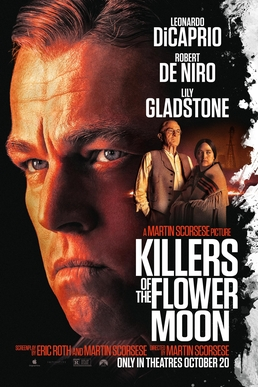
CINEMA REVIEW: KILLERS OF THE FLOWER MOON (2023)

CINEMA REVIEW: KILLERS OF THE FLOWER MOON (2023)

Directed by: Martin Scorsese

Screenplay by: Eric Roth and Martin Scorsese

Based on: Killers of the Flower Moon by David Grann

Produced by: Dan Friedkin, Bradley Thomas, Martin Scorsese and Daniel Lupi

Main cast: Leonardo DiCaprio, Robert De Niro, Lily Gladstone, Jesse Plemons, John Lithgow, Tantoo Cardinal, Scott Shephard, etc.

Cinematography: Rodrigo Prieto

Edited by: Thelma Schoonmaker

*** MAY CONTAIN SPOILERS ***


Who can tell how the world and society as we know it would’ve evolved if Christopher Columbus, the explorer credited with finding the Americas in 1492, had not landed and begun the first steps toward colonising this uncharted part of Earth. Of course, there were existing natives in the Americas and over time they would experience first contact with Spanish, Portuguese, British and other European, predominantly white, settlers. It may be that the natives would have had equally difficult experiences, and colonists brought with them many positive things. But one has to surmise they would not have had their land and lives gradually taken from them over the centuries without the European invasion.

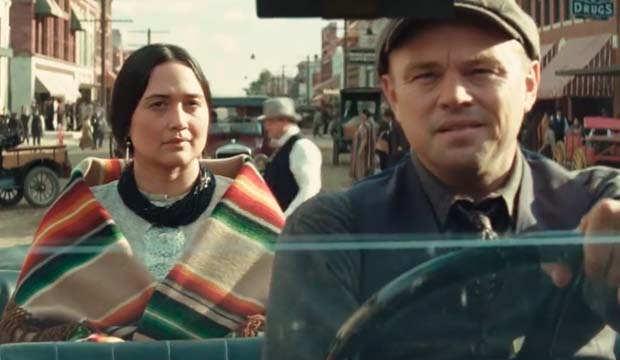
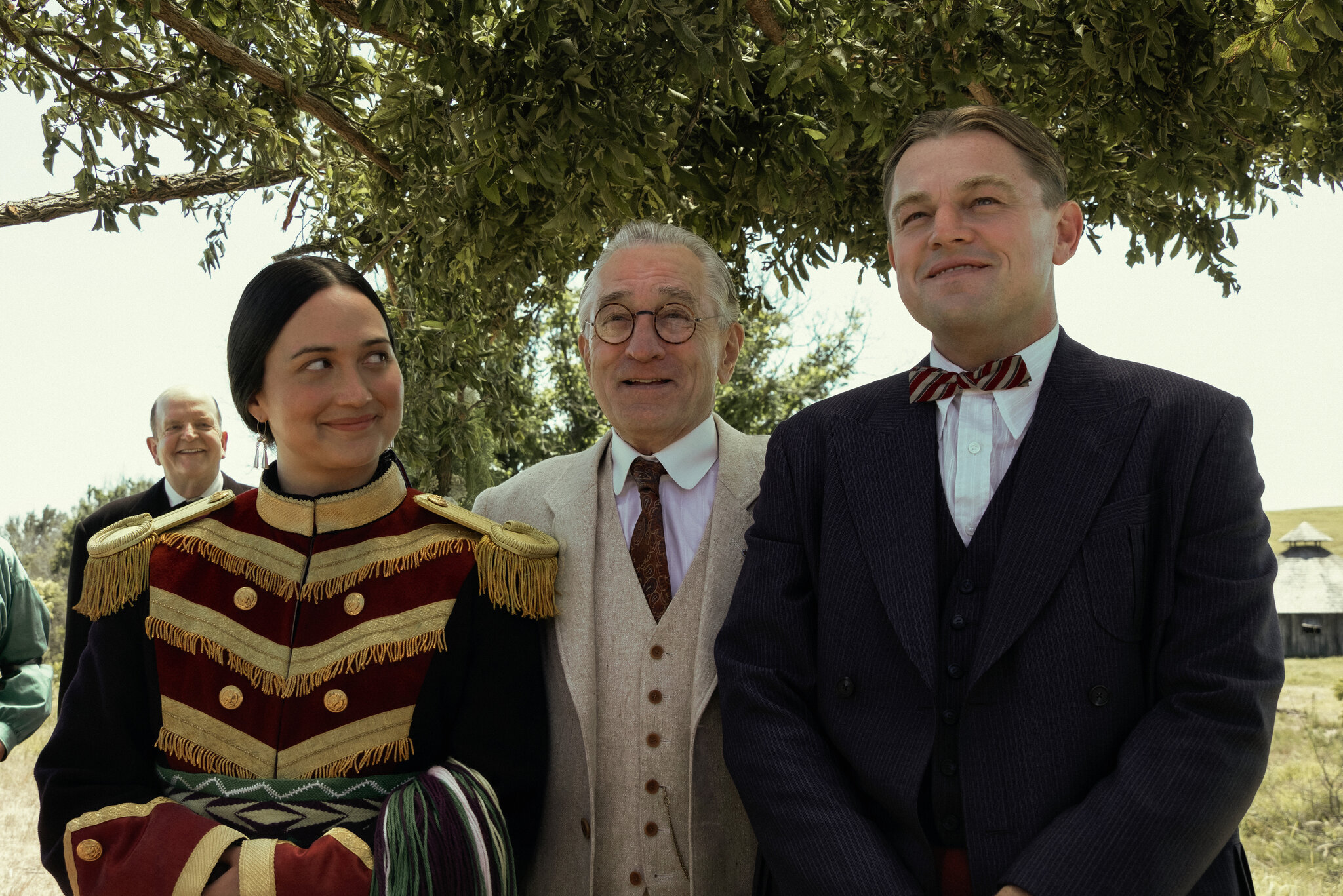
The violent theft of land and wealth from Native Americans forms the bedrock of the narrative of Martin Scorsese’s latest epic drama, Killers of the Flower Moon (2023). Adapted from David Grann’s critically acclaimed nonfiction book, the film centres on the series of murders of wealthy Osage people that occurred in Oklahoma in the early 1920s. The motive for the heinous culling was the greed of white men. Such individuals lusted after the richness present after big oil deposits were discovered beneath the Osage people’s land. Whereas Grann’s book is a monumental study of the murders, perpetrators, the Osage culture, politics of the era, and how the newly formed FBI delved into the crimes, Scorsese’s incredibly slow and long adaptation does all that, while also exploring the romance and murderous treachery between Osage native, Mollie (Lily Gladstone) and war veteran, Ernest Burkhart (Leonardo DiCaprio).


Opening by establishing how the oil erupted and blackened the green land, the film then firmly sets up how the American businessmen used the legality of the headright system to manipulate the flow of sudden wealth that came to the Osage people. One such man is William King Hale (Robert DeNiro) who presents himself as a benefactor to the Osage, but truly speaks with a forked tongue. Having left the infantry unit after World War One, Hale’s nephew Ernest joins him to work and ultimately do his bidding. Hale cajoles Ernest to romance wealthy Mollie and get further feet under the table and closer to that beloved black gold money. Yet, enough is never enough for the likes of Hale and driven by another formidable Scorsese directed performance, De Niro delivers a deviously evil characterisation.

DiCaprio here takes the less charismatic role as the doltish Ernest. As Hale urges him to do further misdeeds the banality of everyday evil is palpable in Ernest’s actions. Along with a litany of professional and thuggish cowboy types Ernest and Hale’s other minions wreak havoc on the Osage people, committing arson, murder, poisonings, robbery, and shootings. All just for more money. The tragedy is that Ernest clearly has feelings for Mollie, serenely portrayed by a revelatory Lily Gladstone, but he just cannot stand up for himself against his wicked uncle. So much so that I just wondered why the hefty runtime was concentrating on Ernest’s character. I mean, Scorsese and DiCaprio give us little in the way of anti-heroism to bounce off, or even some cathartic sense of redemption. Ernest starts out as a loser and finished the story the same. Over three hours spent with a gurning idiot left me frustrated.

Directed, as one would expect with a masterful hand, mind and eye by Scorsese, who once again surrounds himself with an incredibly talented cast and production crew. Not to forget the unbelievable $200 million budget. But Scorsese’s movement of late to ultra-long and methodical cinema is an artistic choice that requires much patience. While Killers of the Flower Moon (2023 is thematically very powerful, beautifully filmed, and contains a number of exceptionally impressive sequences, there was genuinely not enough story to justify such a long running time. Whereas The Irishman (2019) was slow, it was methodically thrilling and absorbing throughout. Killers of the Flower Moon (2023) on the other hand becomes repetitive in its reveals of greedy Cowboys breaking bad and raising hell to the cost of the Osage. The introduction of the FBI and their subsequent investigation comes way too late to save the over-bloated length and pace. However, there is no doubt, the film remains vital in highlighting the historial horror perpetrated upon the Osage land and people. Perhaps Apple TV should have just given the money to the Osage descendants as reparation?

Mark: 8 out of 11