Tag Archives: The Wages of Fear

Classic Film Reviews: Sorcerer (1977)

Directed by William Friedkin

Screenplay by Walon GreenBased on The Wages of Fear (1950 novel) by Georges Arnaud

Produced by William Friedkin

Main cast: Roy Scheider, Bruno Cremer, Francisco Rabal, Amidou, Ramon Bieri, etc.

Cinematography by John M. Stephens & Dick Bush

Music by Tangerine Dream

*** MAY CONTAIN SPOILERS ***
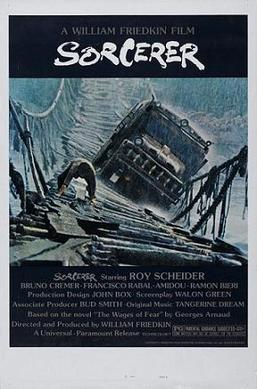


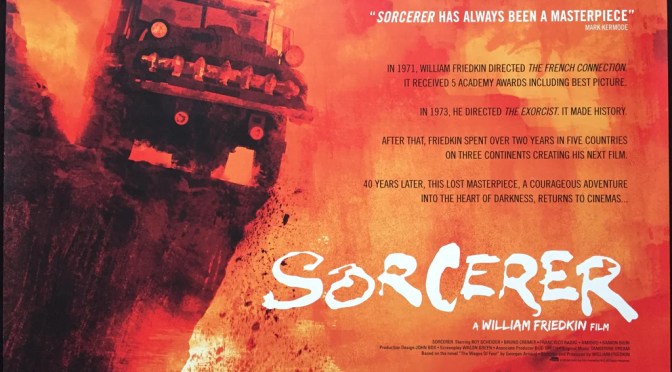
I love The Wages of Fear (1953). It is one of my favourite films of all time. I have reviewed it here. Yet, for years I had never seen William Friedkin’s adaptation of the same 1950 novel, titled, Sorcerer (1977), but thankfully it was screened on Film Four a few years ago, so finally caught up with it. Even better, during the first May Bank Holiday this year it was screened at the Prince Charles Cinema in central London. Amidst a packed crowd I marvelled in the crazed and majestic vision of Friedkin’s filmic adaptation.

Sorcerer (1977) represents one of the clearest examples of how a major studio film can become both a catastrophic commercial failure and, decades later, a revered cult masterpiece. Friedkin, who was at the height of his directorial power, unfortunately did not receive the deserved commercial or critical response during its release and the film disappeared from public view for years. A major reason for the film bombing is it ran directly into the release of Star Wars (1977).

Audiences suddenly wanted escapist fantasy, optimism, and spectacle. Sorcerer (1977) offered the exact opposite: bleak existentialism, sweaty paranoia, moral ambiguity, long stretches of tension and despair and no traditional heroes. Further, audiences were confused by the title, which sounded supernatural even though the film has nothing to do with magic. Many viewers assumed it was a horror or fantasy film and mixed initial reviews, a slow, demanding pace and the film’s nihilistic tone did not help.

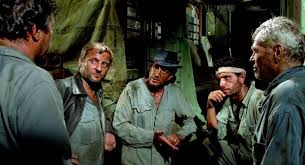
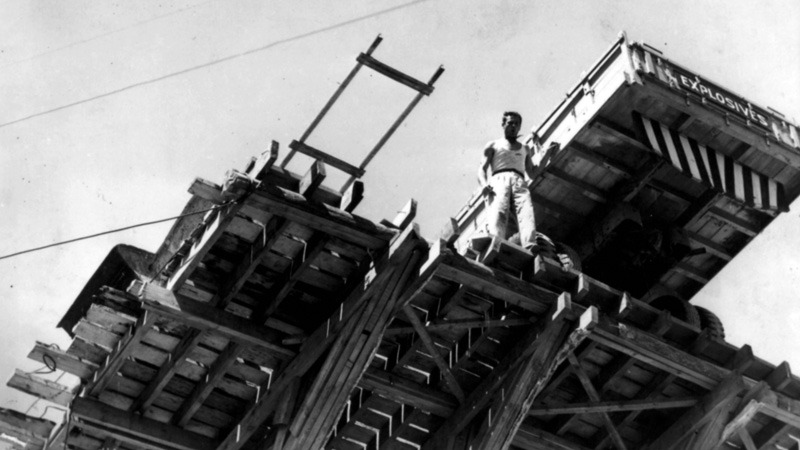
The narrative is tension personified. Four desperate fugitives are handed what is essentially a suicide mission: drive two battered, barely functioning trucks 218 miles through a brutal Latin American jungle, carrying crates of decaying dynamite so unstable that every pothole, every jolt, every wrong move could ignite the sweating nitroglycerin inside and annihilate them instantly. The road is collapsing beneath them, the jungle is unforgiving, and death is riding in the back seat with every mile. This premise gave rise a series of double-crossing plot events and incredible action set-pieces, notably the crumbling bridge scene where you can virtually feel the stormy weather on your face while watching.


As such — the trucks crossing a collapsing rope bridge during a storm — became one of the hardest sequences ever filmed at the time. Friedkin refused miniatures or obvious effects work. The crew built a full suspension bridge over a real river in the Dominican Republic. Then the river dried up. They had to abandon the location, search for another river, rebuild portions of the bridge, and engineer artificial rain systems powerful enough to create a storm effect. Due to this and crew members falling ill in the tropical conditions, the production went over schedule and over budget.

The drama after release did not end. Sorcerer (1977) became trapped in rights issues and studio neglect where quality prints were difficult to find and television broadcasts were rare. Friedkin himself even left a comment on a DVD copy on sale on Amazon saying “DO NOT BUY THIS!” Thankfully a fully restored Blu Ray version was released in 2014 and The Criterion Collection released Sorcerer (1977) on Blu-ray and Ultra HD Blu-ray in June 2025. Thus, the story behind the film mirrors the narrative itself with obsessive men undertaking an impossible task, pushing beyond reasonable limits, suffering incredible stress and barely surviving the journey.

At the time, Hollywood treated Sorcerer (1977) as evidence that the auteur era had gone too far. In retrospect, many see it as one of the last uncompromising masterpieces before blockbuster logic transformed the industry permanently. Lastly, while the characters are all anti-heroic and difficult to root for in Sorcerer (1977), the sheer brilliance of the practical effects, epic Tangerine Dream soundtrack, nerve-shredding editing, stunning cinematography and insane effort make this one of the most suspenseful and incredible action films of all time.

CLASSIC FILM REVIEW – THE WAGES OF FEAR (1953)

CLASSIC FILM REVIEW – THE WAGES OF FEAR (1953)

Winter is coming (Again)

A few weeks ago it was very cold and snowy in London and the UK in general. For the end of February and beginning of March the second coming of winter was most unexpected. My eighteen year old Ford Mondeo had been frozen to death with the battery at some kind of half-life and smoke pouring out of the bonnet; no doubt from the fusion of water and oil and air-conditioning liquid. I managed to park it up safely with no harm done and walked the half-an-hour to work. On route I saw a Supermarket delivery driver lugging shopping to someone’s doorstep in the bitter wind on the treacherous icy pavement. I suddenly thought: why do we do this? Why do we carry on? What is the point in it all?

I cannot complain; because things are actually good for me. I’m grateful because alas some people lose their lives in weather like this and have it much worse in regard to such conditions. How they cope I have no idea. I mean, we carry on don’t we? I thought about my current situation: the trivial issue of my car dying; having to walk in the snow; and the Supermarket worker delivering shopping in the freezing cold. I came to the conclusion it all pales into insignificance considering some of the major issues in the world. But we all carry on. We desire to continue living. The eternal existential question remains: why?!

IMG_1946

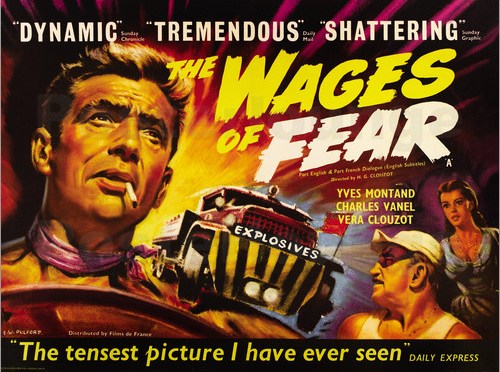
The Wages of Fear

George Arneud’s Le salaire de la peur translated as The Wages of Fear has been made three times into a film; notably by the great directors Henry-George Clouzot and William Friedkin. The desire to survive and fight and live and abide life is an incredibly powerful thing. It’s instinct in all of us; well, until life, poor decisions, bad luck, other humans’ behaviour or extraneous circumstances beat you into submission. Some people take their lives while others fight to the last breath. This, for me is the intrinsic nature of the film. Why carry on living even when it seems pointless to continue?

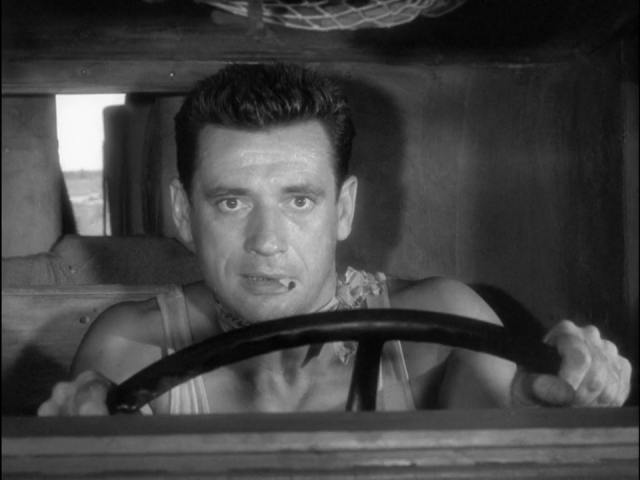
The Wages of Fear (1953) is a film I first saw on May 8th 1994 as a twenty-three year old; introduced by screenwriting guru Robert McKee on his brilliant movie season called Filmworks. It concerns a motley crew of European misfits trapped in an unnamed South American shanty town. They are invited to escape their plight by driving trucks of nitro-glycerine over deadly terrain to put out a massive oilfield fire. With McKee’s foreboding gravel voice introducing the film and the spellbinding premise in mind I was immediately compelled to watch.

current_21_528_large

I had, since the age of sixteen, worked at the Department of Social Security and as a civil servant I had often felt trapped in my job with no end in sight. Of course, I was over-dramatizing my situation somewhat as the next year I just left for University. However, that feeling of being existentially walled in has meant I’m drawn to such stories in film, literature, music and art etc. The Wages of Fear is all about desperate characters who are forced to risk their life to escape their current plight. Clouzot is careful to establish the terrain, motivation and context of the setting and characters. Thus, by the time the action starts and our anti-heroes – Yves Montand (cool and handsome Mario), Peter Van Eyck (laconic Bimba), Folco Lulli (energetic Luigi) and Charles Vanel (back-stabbing Jo) – are on their treacherous suicide mission we have some semblance of connection with them.

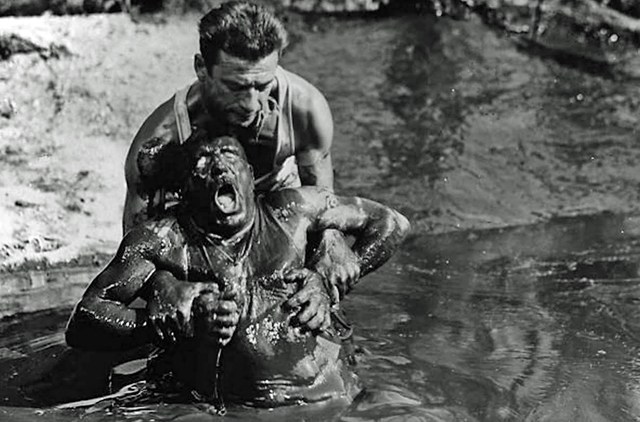
The suspense on the road is incredible. With tight, rocky trails ahead the trucks can only travel at a certain low speed or one bump could blow the vehicles to kingdom come. You have to wonder about the human spirit here and how desperate these characters must be to risk their lives. Clouzot directs the set-pieces with a razor-like precision as each of the trucks must face: oil-filled craters, rickety bridges, boulders and precipices; all while holding their shredded nerves together. Allied to the thriller aspect there is a strong socio-economic context which illustrates the dangerous capitalist ventures of the American oil company draining the 3rd world country of a valuable resource, while scorching the earth and exploiting the indigenous population.

wages-of-fear

On release The Wages of Fear won the Palm D’Or at Cannes and the Golden Bear at Berlin. It also holds 100% rating at Rotten Tomatoes and is regularly voted one of the best films ever made. The book / film has been adapted / remade twice as Violent Road (1958) and by the aforementioned William Friedkin. His film Sorceror (1977) is an over-looked classic as it transplants the action to a jungle in South America. Sorceror was a box office flop. It failed to find an audience during the summer of 1977 which was dominated by a certain George Lucas space adventure called Star Wars (1977). I finally watched it recently on Film Four and it’s a hard-bitten, cynical and explosive experience which despite the loathsome characters, led by Roy Scheider’s career criminal, still manages to thrill and chill in equal measures.

wages11-e1323360224458

FIN

The ending to The Wages of Fear is one of the most startling denouements to a film I’ve ever seen. It confirms the futility of existence and reflects deep down what we all feel about life and spend our days trying to block out. It’s that nagging feeling which never lets us off the hook, which haunts our sleep and whispers to us in the dark: what’s the point? Why carry on? What’s the point? Why bother? But of course you must carry on because life is a gift and life is good; especially when you can watch classic films like The Wages of Fear. Because while they hold a mirror up to the dark nature of existence, the sheer intensity of watching such films, paradoxically make life well worth living.