Tag Archives: Masterpiece

Classic Film Reviews: Sorcerer (1977)

Directed by William Friedkin

Screenplay by Walon GreenBased on The Wages of Fear (1950 novel) by Georges Arnaud

Produced by William Friedkin

Main cast: Roy Scheider, Bruno Cremer, Francisco Rabal, Amidou, Ramon Bieri, etc.

Cinematography by John M. Stephens & Dick Bush

Music by Tangerine Dream

*** MAY CONTAIN SPOILERS ***
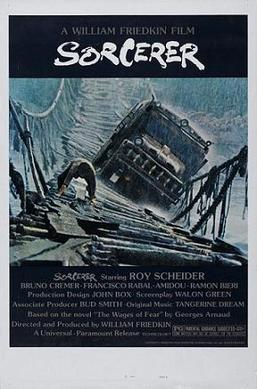


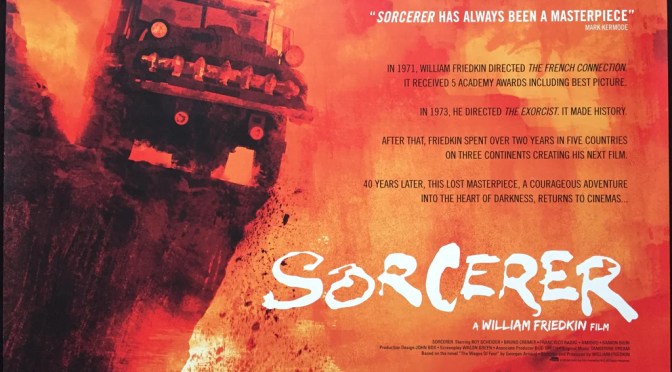
I love The Wages of Fear (1953). It is one of my favourite films of all time. I have reviewed it here. Yet, for years I had never seen William Friedkin’s adaptation of the same 1950 novel, titled, Sorcerer (1977), but thankfully it was screened on Film Four a few years ago, so finally caught up with it. Even better, during the first May Bank Holiday this year it was screened at the Prince Charles Cinema in central London. Amidst a packed crowd I marvelled in the crazed and majestic vision of Friedkin’s filmic adaptation.

Sorcerer (1977) represents one of the clearest examples of how a major studio film can become both a catastrophic commercial failure and, decades later, a revered cult masterpiece. Friedkin, who was at the height of his directorial power, unfortunately did not receive the deserved commercial or critical response during its release and the film disappeared from public view for years. A major reason for the film bombing is it ran directly into the release of Star Wars (1977).

Audiences suddenly wanted escapist fantasy, optimism, and spectacle. Sorcerer (1977) offered the exact opposite: bleak existentialism, sweaty paranoia, moral ambiguity, long stretches of tension and despair and no traditional heroes. Further, audiences were confused by the title, which sounded supernatural even though the film has nothing to do with magic. Many viewers assumed it was a horror or fantasy film and mixed initial reviews, a slow, demanding pace and the film’s nihilistic tone did not help.

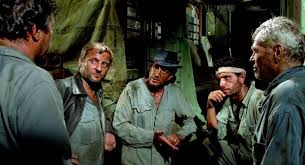
The narrative is tension personified. Four desperate fugitives are handed what is essentially a suicide mission: drive two battered, barely functioning trucks 218 miles through a brutal Latin American jungle, carrying crates of decaying dynamite so unstable that every pothole, every jolt, every wrong move could ignite the sweating nitroglycerin inside and annihilate them instantly. The road is collapsing beneath them, the jungle is unforgiving, and death is riding in the back seat with every mile. This premise gave rise a series of double-crossing plot events and incredible action set-pieces, notably the crumbling bridge scene where you can virtually feel the stormy weather on your face while watching.


As such — the trucks crossing a collapsing rope bridge during a storm — became one of the hardest sequences ever filmed at the time. Friedkin refused miniatures or obvious effects work. The crew built a full suspension bridge over a real river in the Dominican Republic. Then the river dried up. They had to abandon the location, search for another river, rebuild portions of the bridge, and engineer artificial rain systems powerful enough to create a storm effect. Due to this and crew members falling ill in the tropical conditions, the production went over schedule and over budget.

The drama after release did not end. Sorcerer (1977) became trapped in rights issues and studio neglect where quality prints were difficult to find and television broadcasts were rare. Friedkin himself even left a comment on a DVD copy on sale on Amazon saying “DO NOT BUY THIS!” Thankfully a fully restored Blu Ray version was released in 2014 and The Criterion Collection released Sorcerer (1977) on Blu-ray and Ultra HD Blu-ray in June 2025. Thus, the story behind the film mirrors the narrative itself with obsessive men undertaking an impossible task, pushing beyond reasonable limits, suffering incredible stress and barely surviving the journey.

At the time, Hollywood treated Sorcerer (1977) as evidence that the auteur era had gone too far. In retrospect, many see it as one of the last uncompromising masterpieces before blockbuster logic transformed the industry permanently. Lastly, while the characters are all anti-heroic and difficult to root for in Sorcerer (1977), the sheer brilliance of the practical effects, epic Tangerine Dream soundtrack, nerve-shredding editing, stunning cinematography and insane effort make this one of the most suspenseful and incredible action films of all time.


CLASSIC FILM REVIEW: WINGS OF DESIRE (1987)

CLASSIC FILM REVIEW: WINGS OF DESIRE (1987)

Directed by: Wim Wenders

Written by: Wim Wenders, Peter Handke, Richard Reitinger

Produced by: Wim Wenders, Anatole Dauman

Cast: Bruno Ganz, Solveig Dommartin, Otto Sander, Curt Bois, Peter Falk, Nick Cave, etc.

Cinematography: Henri Alekan

*** MAY CONTAIN SPOILERS ***


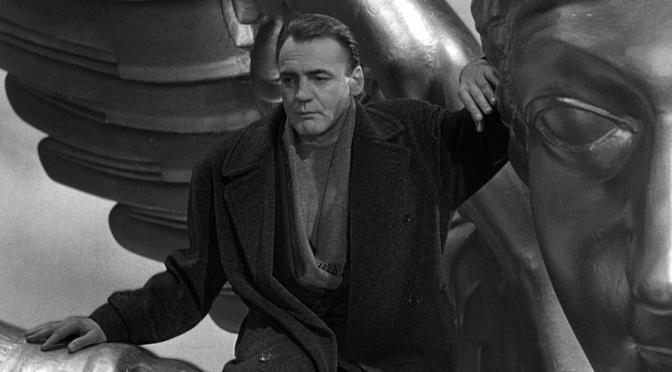
I hadn’t seen Wim Wenders cinematic masterpiece, Wings of Desire (1987), for many years. Probably thirty-three years. I’m glad I waited so long because I think I am mature enough now to appreciate the poetry of the filmmaking style and the soulful gravity of the characters and themes on display.

I am of the belief that cinema is a collaborative craft in general. Yet, on fleeting occasions a film will be released that transcends the craft of the medium and become art. Wings of Desire (1987) is such a film. Moreover, while I am not a religious person watching Wings of Desire (1987) is as close to experiencing a spiritual filmic happening as I could have. It truly is a thing of transcendent beauty concerned as it is with the afterlife, the soul, humanity, angels, life, love, death and rebirth.

Angels walk amongst the living in a Berlin separated by the wall. Voices reveal their inner most thoughts as said Angels listen, watch, witness and gather human experience, thoughts and emotions. The Angels led by Damiel (Bruno Ganz) and Cassiel (Otto Sander) inhabit Berlin aiming to assemble, preserve and testify reality. In a stunningly beautiful opening sequence the gliding camerawork, chiming harps, poetic voiceovers and sublime photography introduces both a majestic world and compelling characterisations. The monochrome film sets a moody glow illuminating and beautifying the urban locales. If you didn’t know, the black & white sequences were shot through a filter made from a stocking that belonged to cinematographer Henri Alekan’s grandmother.


Wim Wenders directs Wings of Desire (1987) with an assured confidence throughout. Every stylistic and formal choice is driven by the characters’ hearts and an imaginative vision of both reality and the afterlife. It is incredible that Wenders and his production team did not have a traditional script when filming began. Thus, the poetic feel of the film derives from a series of experimental concepts and improvisatory creative choices. Having said that, there is a strong narrative spine amidst the seemingly loose narrative and episodic bones. The anchor amidst these hypnotic vignettes is Damiel’s journey of falling in love, ceasing to be immortal and becoming human.

As Damiel experiences the pain of existing outside human life, Bruno Ganz’s performance is heartbreakingly moving. Damiel also finds love too for Solveig Dammartin’s circus artist. His romantic longing and empathy for her and humanity overall is unforgettable. I mean this celestial and immortal being desires the opportunity to feel, taste and love. There is also humour amidst the pathos too, with a supporting story that follows the actor, Peter Falk, working on a film in Berlin. His brilliant scenes provide a quirky counterpoint to Damiel’s celestial crisis and fledgling romance. Indeed, Peter Falk called his role in Wings of Desire (1987) “the craziest thing I was ever offered”. When Wenders told him his part had not been developed yet, Falk responded, “I’ve worked that way with John Cassavetes. I prefer working without a script.”

Wings of Desire (1987) is deservedly acclaimed as one of the best films ever made. I couldn’t agree more, such is its cinematic power and beauty. It combines both visual, aural and literary styles almost to perfection. Thematically it is just as impressive. While it is a universal story about life, death, love and sacrifice, the fact it is set in Berlin adds an incredible gravitas. The politics and separation caused by the Cold War course through the veins of the film like ice. Nevertheless, Wim Wenders and his creative team wholly reject the gloom of oppression, choosing hope, life and love over said deathly wall.*

Mark: 10 out of 11


(*Note: Interestingly, filming the actual Berlin Wall was prohibited, so a replica of the wall twice had to be built close to the original. The first fake wall warped in the rain because the contractor cheated the producers and built it from wood.)

PATHS OF GLORY (1957) – CLASSIC FILM REVIEW

PATHS OF GLORY (1957) – CLASSIC FILM REVIEW

The boast of heraldry, the pomp of pow’r,
And all that beauty, all that wealth e’er gave,
Awaits alike th’inevitable hour.
The paths of glory lead but to the grave.

Thomas Gray, 1751

pathsofglory_2900189b (1)

Stanley Kubrick is the greatest filmmaker who ever lived. That is a fact.  He made films in all genres but indelibly stamped his own genius on the war, comedy, thriller, horror, satire, crime, science-fiction, historical and drama films he adapted and created for the big screen. His work contains a litany of iconic images, searing soundtracks, stupendous performances, great intelligence and provocative thought which ensures his films linger in the memory of those who have witnessed them. All hail a true cinematic master.

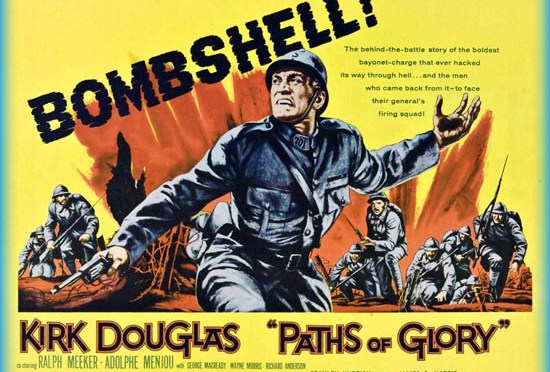
Paths of Glory (1957) was Kubrick’s fourth feature film and certainly his biggest budget film to date. His previous film had been a B-movie crime masterpiece called The Killing (1956), which meticulously examined the planning, progression and aftermath of a racetrack robbery. Using a documentary style and surgically precise narrative structure The Killing is indicative of Kubrick’s subsequent ability to reinvigorate a genre with his masterly eye. However, Paths of Glory was, emotionally speaking, even more powerful than The Killing.

Image result for stanley kubrick paths of glory

The story is set in France, 1916, during the heated battle and burning mud of WW1 trench warfare. World War I is rightly (and then wrongly) thought of as the war to end all wars with millions of soldiers and civilians losing their lives in a coruscating damned hellish indictment against humanity. As if the incredible number of deaths between the warring factions were not enough the powers-that-be would also shoot their own men for cowardice and desertion believing this to be “good for morale” or at very least a warning to those who refuse the fight. This is the frankly insane setting for this formidable dramatic tale.

The main action concerns the court martial of four men chosen, apparently, at random to face a firing squad following a botched attack on a key enemy position called the ’Anthill’. War is a desperate prison even at the best of times but here the men are shown as broken, battered, starving, shell-shocked and on their knees spiritually even before the attack. When the suicide mission unsurprisingly flounders, ambitious and sociopathic General Mireau – portrayed with venal glee by George Macready – proclaims death to all who failed the glory of France. The seemingly more reasonable, yet equally poisonous Major General Broulard (Adolphe Menjou) lowers the numbers to be shot in a chilling scene that reduces human life to no more than barbaric bulls-at-a-market bartering.

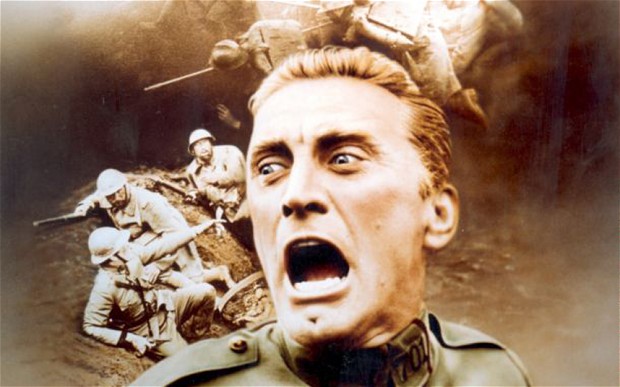
The voice of reason amidst all this insanity is Kirk Douglas’ former-lawyer Colonel Dax; who himself was part of the failed raid on the ‘Anthill’ and could testify to the impossibility of the task. Dax is the audience’s conduit to the madness of those in charge; from the: choosing of one soldier by lots; the farcical trial and even the final execution where one unconscious soldier is woken up only to be shot dead moments later. Douglas is imperious in the role demonstrating a range of emotions from incredulity, despair, anger and a powerful sense of the righteousness. The final heart-breaking scene where he gives his men a few more minutes listening to the folk song tells us Dax is a sane man in an insane world run by psychopaths. The song is delivered hauntingly by the captured German girl (the actress Christine Harlan was later to become Kubrik’s wife) to men who are destined to die in the barbed-wire brutality of war.

Kubrick’s work (Barry Lyndon, Dr Strangelove, Clockwork Orange to name a few) is full of damning critiques of the upper classes, high falutin politicians and war-mongering men who use the working or lower classes to do their filthy bidding. In this film they are represented by Menjou’s politically-driven Broulard who sits comfortably in his Chateau quaffing wine and scissoring quail; all the while brave men are skewered in battle. Full of tragedy, wicked satire and black humour the screenplay based on Humphrey Cobb’s novel is eighty-eight minutes of sheer cinematic perfection, power and heartwrenching injustice and emotion.

Quite rightly Paths of Glory has been proclaimed a masterpiece and one of the greatest anti-war films of all time. Filled with the now-iconic tracking shots of bloody battle, plus many tremendous performances notably Macready, Menjou, Douglas and the scene-stealing, druggy sop that is Timothy Carey. Overall, I have watched this classic many times when young and having seen it on the big screen at the BFI recently I can testify that it has lost NONE of its grandstanding power. Forget the insipid blockbusters of today and revisit the master of cinema where and when you can: his name is Stanley Kubrick.