Tag Archives: Tim Blake Nelson

Cinema Review: The Testament of Ann Lee (2026) – a transcendental Amanda Seyfried performance illuminates the screen.

Cinema Review: The Testament of Ann Lee (2026)

Directed by Mona Fastvold

Written by Mona Fastvold & Brady Corbet

Produced by: Andrew Morrison, Joshua Horsfield, Viktória Petrányi, Mona Fastvold, Brady Corbet, Gregory Jankilevitsch, Klaudia Śmieja-Rostworowska, Lillian LaSalle, Mark Lampert, etc.

Main cast: Amanda Seyfried, Thomasin McKenzie, Lewis Pullman, Stacy Martin, Tim Blake Nelson, Christopher Abbott, etc.

Cinematography by William Rexer

** MAY CONTAIN SPOILERS **
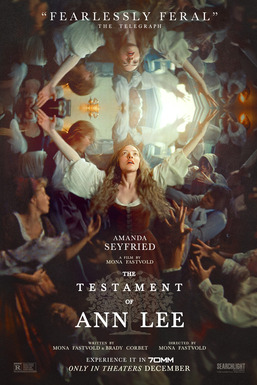


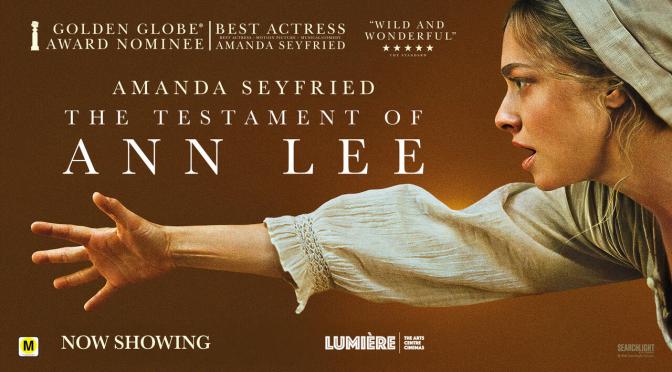
The Testament of Ann Lee (2025), directed by Mona Fastvold and co-written with Brady Corbet, is an ambitious historical musical drama that explores the life of Ann Lee, the charismatic 18th-century founder of the Shaker religious movement. With Amanda Seyfried at its centre, the film approaches Lee less as a traditional saintly figure and more as a woman shaped by trauma, conviction, and spiritual fervour. Fastvold’s direction leans heavily into atmosphere, presenting Lee’s rise to spiritual leadership as something both mystical and deeply human. The result is a film that feels reverent yet curious, as if studying a figure whose faith borders on mania.

Amanda Seyfried delivers an extraordinary performance that anchors the entire film. She plays Ann Lee with an intense interiority—equal parts fragile and formidable—capturing the fervent certainty of a woman who believes she has been chosen for a divine purpose. Seyfried’s physicality, particularly in the film’s musical and ritual sequences, gives Lee a magnetic presence that makes it easy to understand why followers might be drawn to her. It’s the kind of performance that lingers long after the film ends, and it stands as one of Seyfried’s most committed and transformative roles.
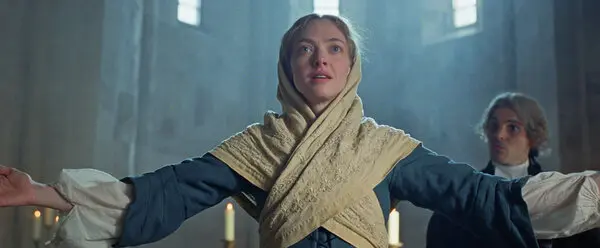


Visually, The Testament of Ann Lee (2025), is stunning. The film’s cinematography and production design immerse viewers in the harsh textures of 18th-century religious life, favouring natural light, muted palettes, and a palpable sense of dirt, wood, and candle smoke. The musical sequences—staged as ecstatic communal expressions of faith—are beautifully choreographed and filmed, capturing the hypnotic rhythms of Shaker worship. Yet while these moments are striking, they begin to feel somewhat repetitive as the film progresses, emphasizing mood over narrative momentum.

For viewers fascinated by charismatic religious figures or the psychology of belief, the film offers a compelling entry point. As someone not particularly religious but drawn to stories of spiritual zeal and cult-like devotion, I found the story initially captivating. Still, Ann Lee’s narrative arc ultimately feels less dramatically satisfying than the film’s aesthetic ambitions might suggest. Rather than a searing drama or a definitive testament to a heroic religious figure, The Testament of Ann Lee (2025), settles into something quieter: a haunting, beautifully crafted piece of moving art that observes its subject with reverence but stops just short of fully interrogating her legacy.

Mark: 7 out of 11


HBO TV REVIEW: WATCHMEN (2019) – META-GONZO TV OF THE HIGHEST ORDER!

HBO TV REVIEW: WATCHMEN (2019)

Adapted by: Damon Lindelhof

Based on: Watchmen by Alan Moore and Dave Gibbons

Writers: Damon Lindelhof, Nick Cuse, Lila Byock, Christal Henry, Carly Wray, Cord Jefferson, Stacy Kuffour-Osei, Claire Kiechel, Jeff Jensen

Directors: Nicole Kassell, Stephen Williams, Andrij Parekh, Steph Green, David Semel, Frederick E. O. Toye

Cast: Regina King, Jeremy Irons, Don Johnson, Jean Smart, Tim Blake Nelson, Louis Gossett Jr., Yahya Abdul-Mateen II, Hong Chau, Andrew Howard, Tom Mison, Frances Fisher, Jacob Ming-Trent, Sara Vickers, Dylan Schombing, and James Wolk.

**SPOILER FREE**


Maybe I am imagining it, but I think we are now entering a different kind of TV narrative storytelling. Perhaps it has always been there? However, I am sure I can now see through the ‘Matrix’ of the internet’s all-powerful influence. My point is that we are moving away from traditional television storytelling which is solely interested in telling an emotionally whole and linear narrative. Is television that has a predictable soul and a beginning, middle and end — in THAT order — disappearing? Or am I just choosing to ignore the saturation of standard dramas involving cops, criminals and medics to watch more complex TV stuff?

Recent television shows such as Legion (2017), Westworld (2016), Dark (2017) and now Watchmen (2019) take stylish, cinematic and transgressive structural and thematic approaches to narrative. One could accuse them of being postmodern fakery or postmodern genius; or both. There does appear to be a movement toward over-complicated-clickbait-viral-trailer-led-ADHD-TV which fragments and shatters its’ story lines. The creators want us to experience their productions not in the traditional beginning, middle and end standard, but rather through shifting timelines, unreliable narrators and a blurred sense of what is right and wrong.


Image result for watchmen comic book

Damon Lindelhof, who is a brilliant writer and very experienced TV creative, does tend toward the pretentious and over-complex in his work. Having said that his recent production The Leftovers (2014 – 2017) contained some absolutely sensational thematic explorations of the apocalypse, damaged humanity and religious fervour. For his latest project HBO has given him a truckload of money to emulate and remix Alan Moore and Dave Gibbon’s seminal 1980’s comic book Watchmen. The original itself was a subversive tome of genius which subverted the mythology of comic book and superhero storytelling.

The main action is set in 2019 Tulsa, but also spans decades of alternative U.S. history and locations on Earth and not on Earth. If you don’t know the original source material or have not seen Zach Snyder’s valiant adaptation Watchmen (2009), you will be very confused initially and throughout. Because Lindelhof’s approach to this alt-world version of masked cops, criminals and vigilantes is via a chopping meta-storytelling structure. The various plots events and character histories are delivered via flashbacks, flash-forwards, narcotic visions, hallucinogenic dreams, splintered timelines and even a TV show within this television show. It’s a very stylish smorgasbord, splashed with crazy characters, witty hard-boiled dialogue, wild science fiction twists, lashings of violence, pockets of substance, cinematic visuals, high class production values and a cast to die for.

Yes, but Paul, what’s it actually about? How about love, hate, racism, superheroes, corruption, giant squids, cloning, rogue scientists, good versus evil, vigilantism, revenge, megalomania, transcendent beings, war, violence, rogue politicians, superheroes, masked identities, nuclear threat; and that the United States continues to be sown with the seeds of intolerance, blood and death. Watch the Watchmen (2019), take your time and piece the crazy jigsaw together for yourself. If not, and you prefer to play it safe, there’s always Law and Order for those who want something less mind-blowing.

Mark: 9 out of 11


THE REPORT (2019) – AMAZON FILM REVIEW

THE REPORT (2019) – FILM REVIEW

Written and directed by: Scott Z. Burns

Produced by: Scott Z. Burns, Jennifer Fox, Danny Gabai, Eddy Moretti, Kerry Orent, Steven Soderburgh, Michael Sugar

Cast: Adam Driver, Annette Bening, Ted Levine, Michael C. Hall, Tim Blake Nelson, Maura Tierney, John Hamm, Douglas Hodge etc.

**CONTAINS REAL EVENT SPOILERS**


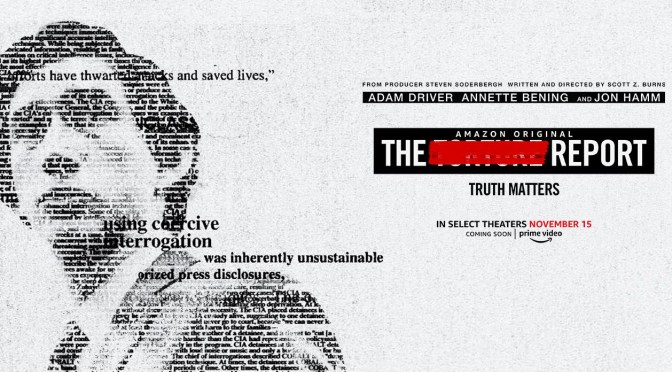
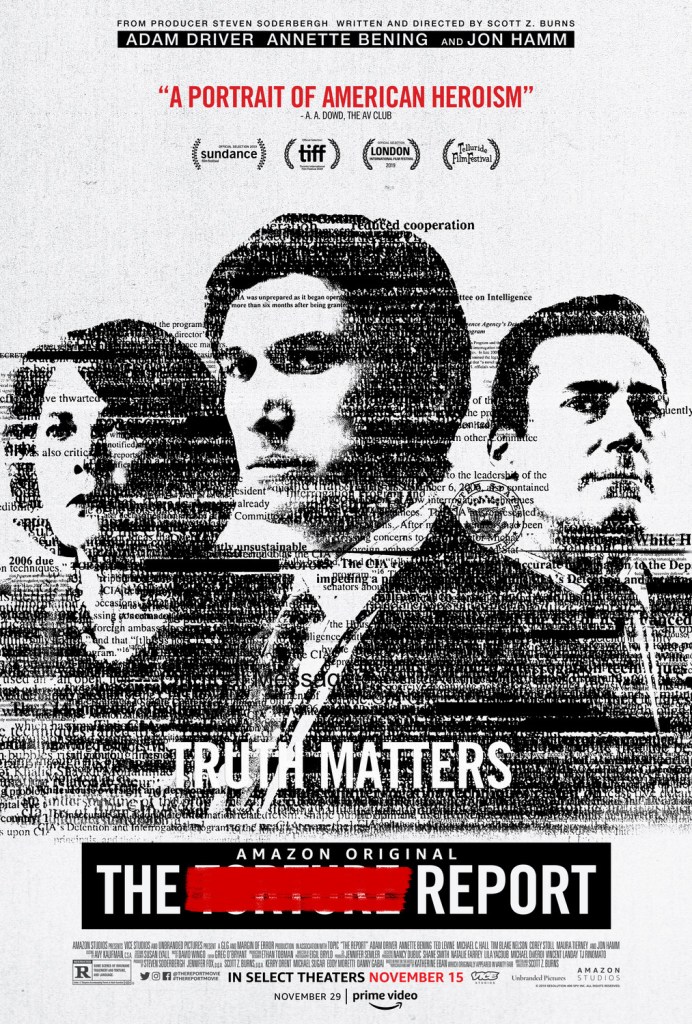
The Report (2019) is in the vein of recent films such as, Kill The Messenger (2014), The Post (2017), and Oscar winner, Spotlight (2015). It is based on true events and forensically documents a period of U.S. history which is both illuminating and engrossing. Adam Driver is cast as U.S. Senate staffer, Daniel J. Jones and given the task by Senator Feinstein (Annette Bening) to lead a team to investigate the 2005 destruction of interrogation videotapes. He begins the work in 2009 and is faced with six million pages of CIA materials to work through. It soon, unsurprisingly, becomes an obsessive and ordered job for Jones and it takes him years to ultimately finish the report.

I won’t give anymore away about the narrative events, but first and foremost this is a film about torture and admin. Writer and director, Scott Z. Burns cleverly structures the story between Jones’ researching the CIA materials and the actions of the Counter-Terrorist Centre staff led by the likes of Maura Tierney and George Fumusa’s characters. As the story proceeds, and details of extreme torture of terrorist subjects is revealed, Burns takes us further up the CIA food chain. Here we get a very damning critique of the horrifying lengths CIA operatives went to in order to secure information from suspects.

The Report (2019) is an engrossing film which I thought was going to go down the conspiracy thriller route or even the obsessive character breakdown study. There are elements of this, but essentially it is an extensively researched drama set in enclosed offices, in meetings, in Senate hearings, at desks and computer screens; all with flashes of interspersing violence. I’m not acutely educated in regard to American foreign policy and politics in general, but a potentially dry subject is made so engrossing by a fine script and brilliant cast. Adam Driver essentially goes to Washington, proving once again that he is one of the best actors around at the moment. Above all else though, the film stands as an impressive visual document and precis of the original seven thousand-page report by Daniel J. Jones.

Mark: 8.5 out of 11