Writer(s): Bruce Miller, Dorothy Fortenberry, Yahlin Chang, Kira Snyder, Eric Tuchmann
Director(s): Mike Barker, Kari Skogland, Jeremy Podeswa, Daina Reid etc.
Starring: Elisabeth Moss, Joseph Fiennes, Yvonne Strahovski, Alexis Bledel, Madeline Brewer, Ann Dowd, Max Minghella, Samira Wiley
Release: Hulu (USA), Channel 4 (UK)
** MAY CONTAIN SPOILERS **
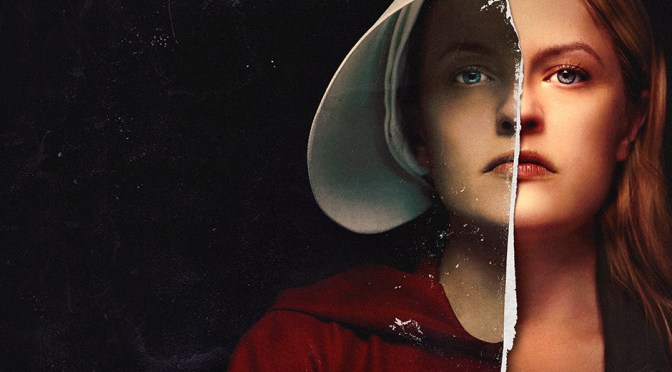
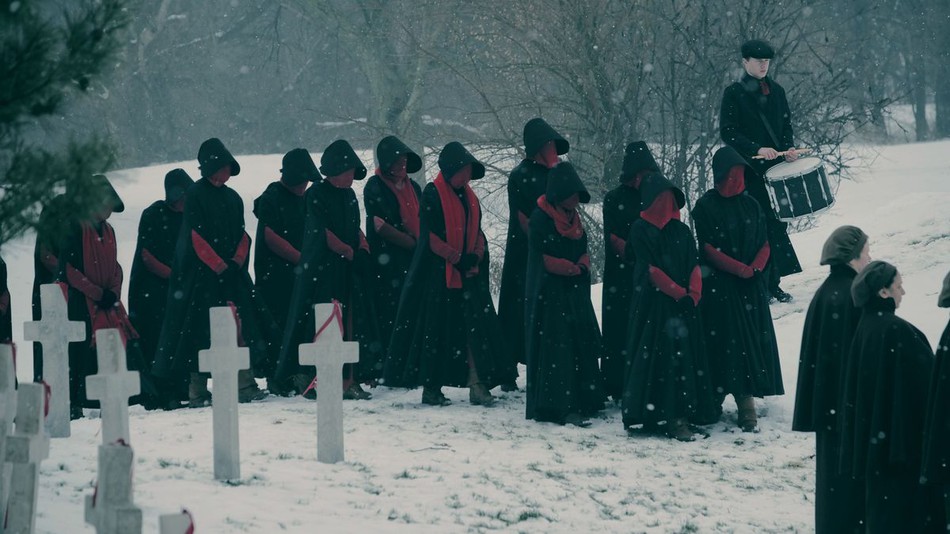
Misery, fascism and oppression have never been so stylish as in the Margaret Atwood televisual adaptation of her famous novel The Handmaid’s Tale. If you haven’t seen it then the story finds a major part of the U.S.A in the grip of a new, militarized and hierarchical regime following a brutal civil war. This new totalitarian state is called Gilead and is led by power-mad men who utilise religion, torture and weaponry to invoke their barbaric laws. Hang on, that sounds quite familiar!! Could the show be quite close to real life? From a certain perspective there is indeed more reality here than allegory.
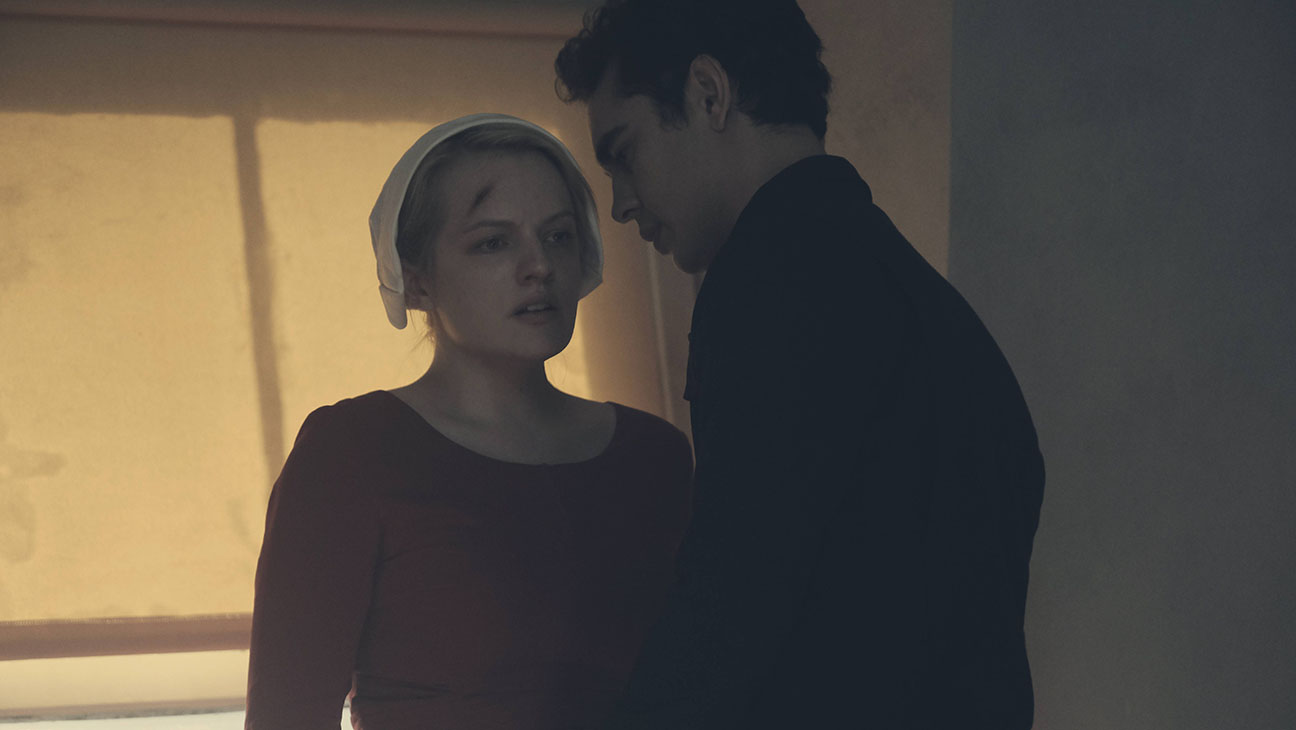
At the centre of the drama are the Handmaids. Due to falling fertility rates only certain women can give birth. Those that still can and considered to be dangerous to the Gilead hierarchy are imprisoned to the leaders’ houses and raped in a ritualistic monthly ordeal. The narrative focusses on the plight of June Osborne – now known as Offred / “Of Fred” – as she deals with having everything stripped away from her. She has no name, no identity, no freedom and above all else has been ripped away from her husband and child; only to be treated no better than a battery hen.
Elisabeth Moss gives an incredible performance as June / Offred. A versatile performer she imbues the complex pathos, strength and fragility required to convey the emotion of events within the story. The second season begins with a now pregnant June escaping from her captors. However, as the series progresses we know that she is not going to get away that easily. Because, this is a harsh drama. It doesn’t just smash home the viciousness of a society which oppresses women, it also illustrates the dangers of allowing fundamentalists to take total control. Executions by hanging and drowning are commonplace; and if you perpetually rebel an individual can be sent to The Colonies for a fate worse than death.
While the themes and events are sometimes difficult to stomach The Handmaid’s Tale is compelling viewing. Be warned though when one is close to a sliver of light at the end of the tunnel, that light is extinguished as darkness pervades. With a brilliant cast that includes Yvonne Strahovski, Joseph Fiennes and the always-excellent Ann Dowd, this is not just powerful storytelling, it’s incredibly interesting to look at too. The maroons, greens, greys, blacks and whites in the colour scheme create a poetic sense of beauty and doom. The direction, editing, lighting and soundtrack serve the narrative expertly as Margaret Atwood’s dystopic future is illustrated skilfully. Ultimately, in Elizabeth Moss’ portrayal of June Osborne we have a heroic and resilient character; one who, amidst all the suffering, is determined to survive and save those she loves. Praise be!
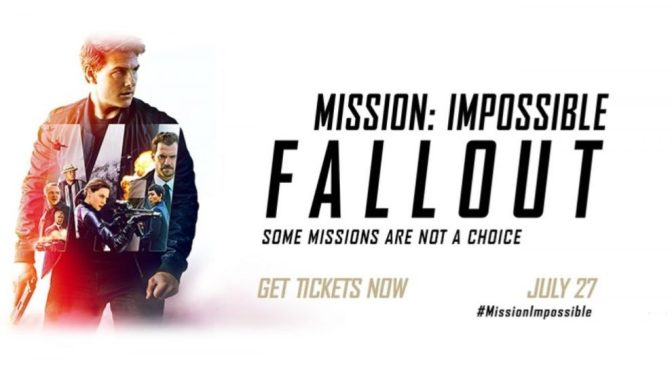
MISSION IMPOSSIBLE BINGO incorporating: FALLOUT (2018) MOVIE REVIEW
I have found it’s difficult to find an original angle when reviewing certain films i.e. franchise movies or sequels. Indeed, unless they are absolutely brilliant I tend not to review them. Therefore, I had no major intention of writing about the new Tom Cruise produced Mission Impossible release, as these films, despite their technical movie-making brilliance, follow a very strict and safe formula. I mean what can I really add critically other than say I enjoyed it or I didn’t. However, it really is such a fantastic blockbuster movie I accepted an impossible mission, of sorts, to create something interesting while reviewing it.
So, here we go: Mission Impossible BINGO! It’s both recognition of the formula but also praise for the latest instalment which had me on the edge of my seat, heart in my mouth and biting my nails throughout. In the context of story it’s very generic but in terms of action, thrills and stunts it gets a Mark of 9 out of 11!
McQUARRIE directs Fallout which is essentially a direct sequel to Rogue Nation. We know his track record as a writer but he’s now proving himself a fantastic director too. I enjoyed Rogue Nation but Fallout raises the stakes with a witty, double-crossing, high octane and explosive movie, which actually improves the clichés of the formula in wonderful fashion.
INGENIOUS double-crossing is at the heart of the original Mission: Impossible television series and the film franchise. This is done through identification theft, impersonation, lies, deceit, scene-shifting, fake walls, and the famous face and voice changing technology.
STUNNING locations feature throughout the franchise. Changing the scenery is a means of tricking us into thinking we haven’t somehow seen this car-chase, foot chase or air chase before. Yet, what Mission: Impossible does brilliantly is take us into existing locations like the CIA Langley Headquarters, The Vatican City and even the Kremlin.
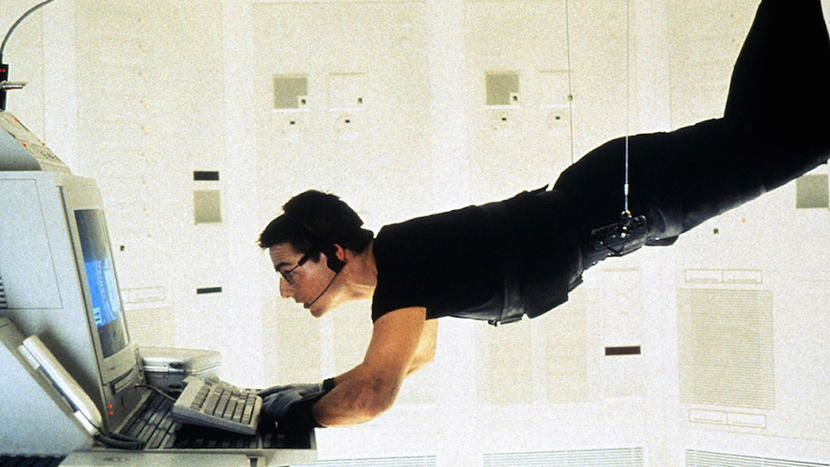
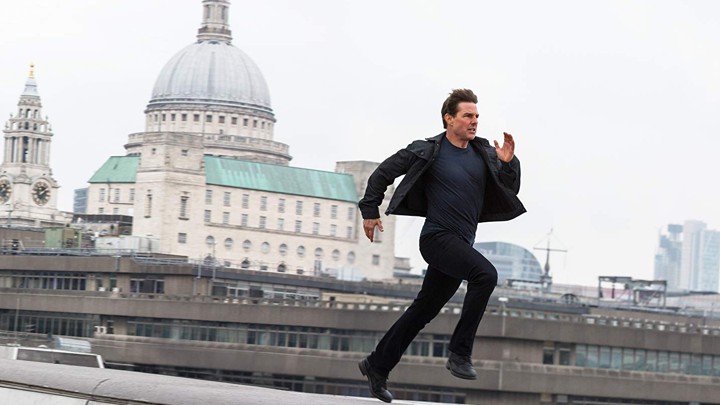
STUNTS and extravagant set-pieces dominate the whole of this franchise. From the original 1996 film’s wire-from-the-ceiling-hanging set-piece downloading a CIA encrypted agent list to the current Fall Out nuke-ticking-time-bomb denouement, Tom Cruise’ has committed some of the most breath-taking and technically brilliant action stunts ever.
ICONIC soundtrack composed by Lalo Schifrin has been often imitated but never a bettered. Those simple but effective notes fire up and immediately you know the action is about to start.
OPPOSING government agents are rife in the original show and film series, as inspired by the devious nature of the East v West “Cold War” from the 1950s onwards. In M: I you’ve got good agents, rogue agents, double agents, triple agents and ghost agents pretending to be good, bad and all of the above.
NEFARIOUS villains, like the Bond films, are necessary to precipitate some evil doings and kick off the plot. My personal favourite was Philip Seymour Hoffman in M:I 3 – as he really was evil. Solomon Lane as played by Sean Harris is cool too and is given some great speeches. His plan to blow up the world isn’t the most original but he has a blast trying it.
IMPOSSIBLE missions are at the heart of the film franchise. I mean the characters are mainly paper thin and the narratives are mainly empty so the gadgets and all manner of ticking time bombs, impenetrable garrisons, bad guys shooting and blowing stuff up; plus the covert interrogations and switcheroos provide the substance to the cinema experience.
MACGUFFIN-LED plots are not the strength of the franchise and on occasions the narratives a threadbare with Ethan chasing something called a “rabbit foot” or stolen nuke heads being the target. But who cares as long as we get to see things blow up.
PLAYFUL humour and one-liners dominate the scripts as a means to punctuate the action. The first three arguably had less gags but with Simon Pegg joining the cast in M:I 4 the joke quota increased and it settled into the a more humour-led vein. Personally, I prefer the serious espionage stuff, but the gags punch up the entertainment value nonetheless.
OUTSTANDING casting always brings a raft of class to these movies. Indeed, despite the style-over-substance nature of the narratives casting heavyweight actors such as: Jon Voight, Vanessa Redgrave, Phillip Seymour Hoffman, Alec Baldwin, Sean Harris, Jean Reno, Ving Rhames, Billy Crudup, Jeremy Renner, Rebecca Ferguson and many more raise the quality of the productions no doubt.
SUBTERFUGE and double-crosses are a major part of the plots. Often we never quite know whose side certain characters are on at any one time. In Rogue Nation and Fallout the troubled spy Ilsa Faust is simultaneously batting for three teams in order to keep herself alive. Such devilish plotting keeps the stories bouncing along, which is why they are never dull.
SPECIAL effects are a major part of M:I, however, what is incredible to that Tom Cruise will strive to make the stunts as real as possible by actually doing them himself. The opening of Rogue Nation and the end of Fallout are absolutely stupendous feats of daring which I would never contemplate. Similarly, bungee jumps, rock-climbing, free-jumping and many other effects-free actions give a very realistic feeling to proceedings.
INCREDIBLY talented directors who have worked on the franchise include: Brian DePalma, Brad Bird, John Woo, Christopher McQuarrie and JJ Abrams bringing their own inimitable styles to the various films and while Woo’s is pretty weak the franchise abides as each film has its own identity, look and feel.
BIG budgets are required to drive the Mission: Impossible film behemoth and while they continue to make the studio billions of revenue long will they continue. The first film cost a whopping $80 million dollars while the Fallout cost a mere $178 million. Although, given Fallout absolutely rocks it’s already made that back and much more besides.
LEAPING, running, driving, diving, swimming, crashing, disguising, fighting, flying, biking, parachuting, moving – you name it the IMF do it at incredible speeds and heights!
ETHAN HUNT as presented by Tom Cruise is a righteous dude fighting the good fight against the evil wrongdoers in the world. His commitment to the cause is unwavering and in defending the innocent against the corrupt goverments, villains and agents of evil. We all root for him as an aspirational action man of the people.
I watch a lot of stuff. It keeps me out of the pub and my liver safe from further harm. In between a July dominated by the World Cup in Russia, over the last few months I’ve been mainly re-watching Star Trek (OST) and catching up with the first two seasons of Mad Men in my downtime. But, in the last month, I decided to have a break from those fine shows and catch up with some movies via Netflix and Sky. I also include some quick reviews of a few films I saw at the cinema too. All reviews are, as usual marked out of eleven.
ALONE IN BERLIN (2016) – NETFLIX
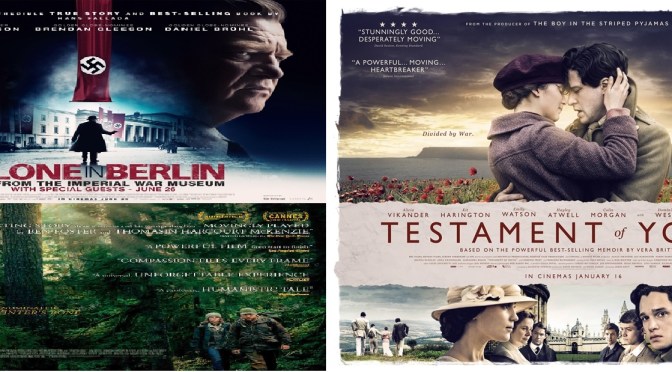
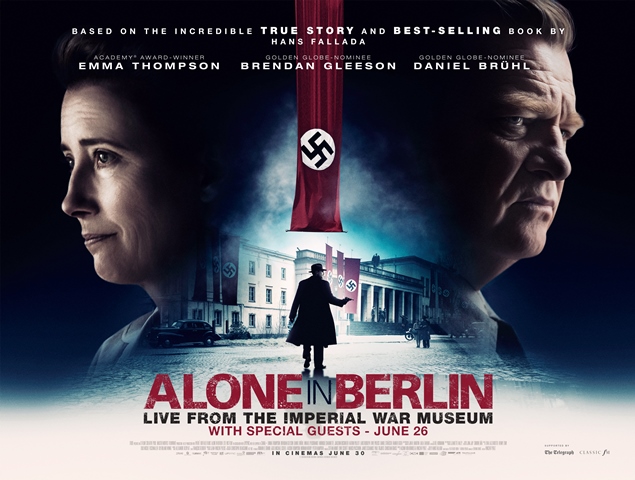
Emma Thompson and Brendan Gleeson give subtle and compelling performances in this excellent WW2 drama. They portray a German couple who have lost their son in the fighting and retaliate by waging a ‘quiet’ war distributing anti-Hitler leaflets.
(Mark: 8 out of 11)
ANON (2018) – SKY CINEMA
Clive Owen stands out in this under-cooked sci-fi drama inspired by Philip K. Dick and Black Mirror. He’s a future cop where crime is contained by point-of-view surveillance techniques. The idea is stronger than execution as it falls apart in the final act. (
Mark: 6 out of 11)
CALL ME BY YOUR NAME (2017) – SKY CINEMA
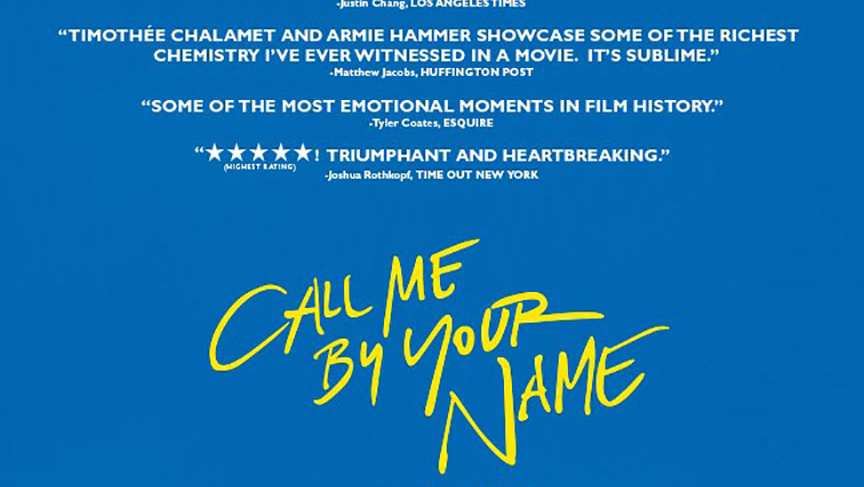
Luca Guadagnino’s direction is exquisite, while Armie Hammer and Timothee Chalamet are exceptional in their portrayal of romance in 1980s Italy. A fantastic soundtrack and beautiful scenery cannot save the characters who I found narcissistic and tedious.
(Mark: 6 out of 11)
CARGO (2018) – NETFLIX
Martin Freeman leads the cast in this Australian horror film which finds his kind father at the mercy of outback zombies. It’s a slow moving film which offers characterization over gore, effective moments of tension and the always dependable Freeman.
(Mark: 7 out of 11)
DEEP WATER HORIZON (2016) – NETFLIX
This is an intelligent disaster movie about one of the biggest oil spills ever. BP’s drilling practices are criticized as the slow-build direction gives way to explosive action at the end. Overall, the excellent cast and script make this a very compelling drama.
(Mark: 7.5 out of 11)
GIFTED (2017) – SKY CINEMA
Chris Evans takes a break from both battling Hydra with an altogether more everyday fight. He plays guardian and uncle to a gifted child (brilliant Mackenna Grace) who finds himself in a bitter custody battle for the child, in a very touching human drama.
(Mark: 7 out of 11)
GODS OF EGYPT (2017) – NETFLIX
This is a really bad attempt at creating a Star Wars like franchise in mythical Egypt. Gerard Butler shouts throughout as though he’d swallowed the Brian Blessed guide to acting! Terrible waste of $150 million and my precious time.
(Mark: 4 out of 11)
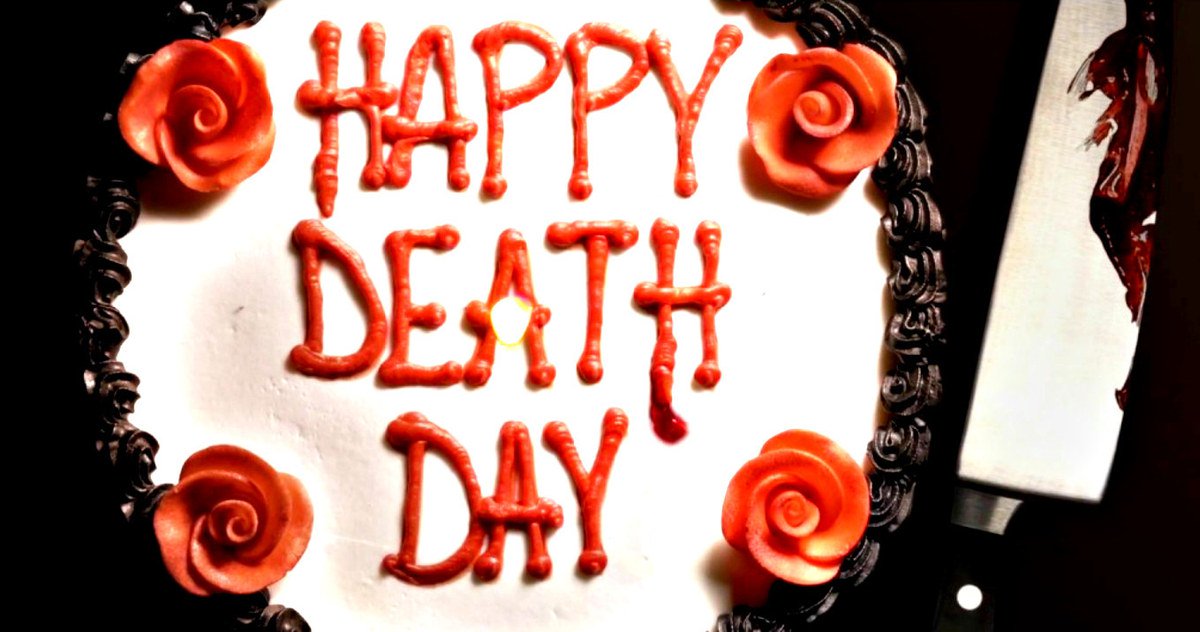
HAPPY DEATH DAY (2017) – SKY CINEMA
Groundhog Day (1993) meets slasher film as College super-brat portrayed by Jessica Rothe finds herself dying again and again in various horrific ways. Turning detective she must solve her own murder in this derivative but well executed horror movie.
(Mark: 7 out of 11)
HITMAN’S BODYGUARD (2017) – NETFLIX
Ryan Reynolds’ cynical performance and Samuel L. Jackson’s sparky turn make this assassin-action-film very watchable. Reynolds has to get Jackson to The Hague to testify against a nasty dictator; cue bullets, car chases and one-liners galore!
In Fallen Kingdom Bryce Dallas Howard and Chris Pratt, once again pits their wits against mighty prehistoric creatures. J. A. Bayona brings a gothic style to the final act but ultimately, despite the incredible effects on show, the narrative feels tired.
(Mark: 6.5 out of 11)
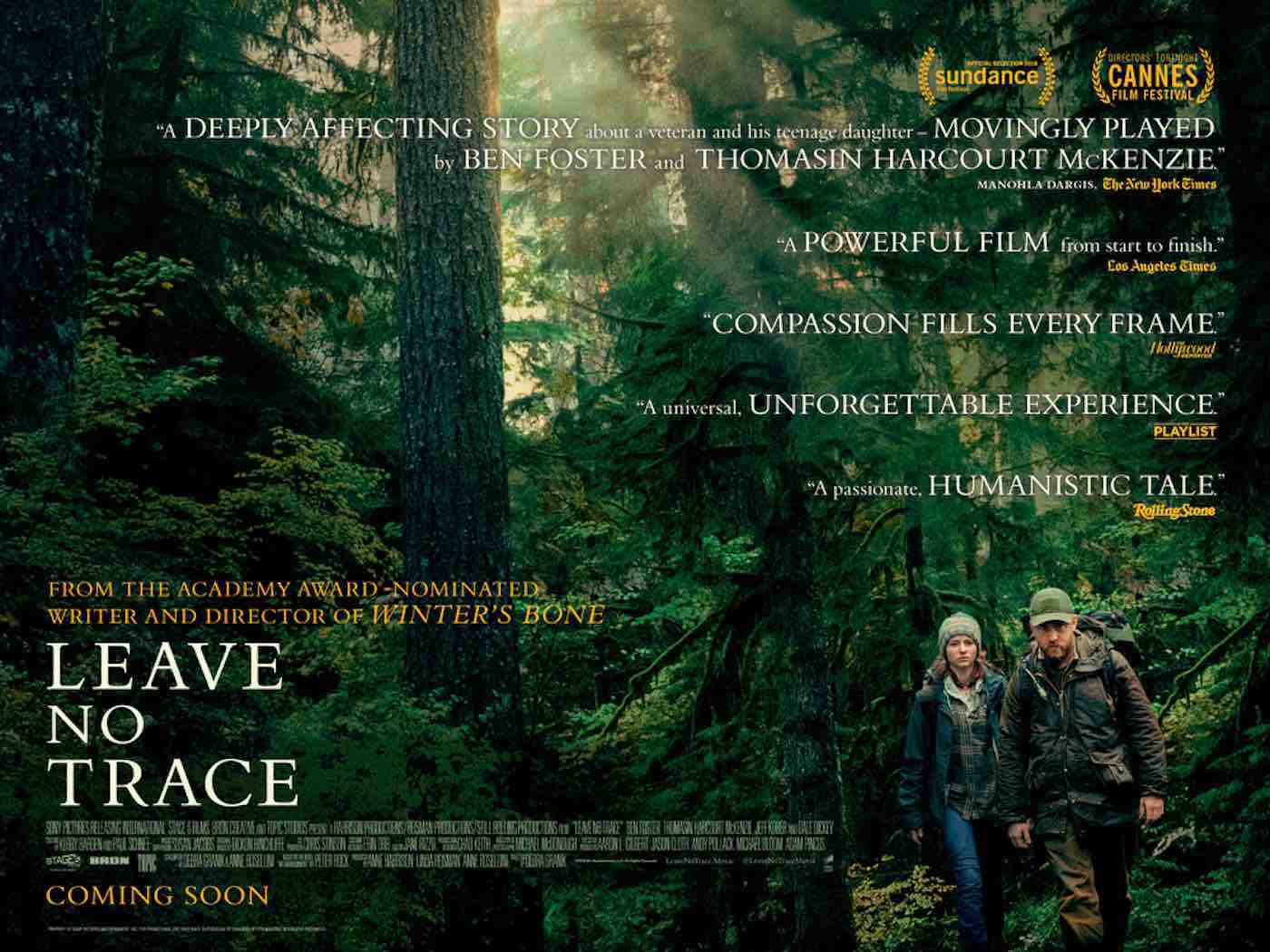
LEAVE NO TRACE (2018) – CLAPHAM PICTUREHOUSE
The intense Ben Foster and brilliant newcomer Thomasin Mackenzie act their hearts out in this subtle family road movie. Opting out of society they play father and daughter attempting to stay ahead of the authorities in a very touching and heartfelt drama.
(Mark: 8.5 out of 11)
THE LIMEHOUSE GOLEM (2017) – NETFLIX
Bill Nighy, Olivia Cooke and Douglas Booth are acting stand-outs in this watchable murder mystery set in Victorian London. The cinematography is impressively moody, however, the narrative runs out of steam by the time the twist kicks in.
(Mark: 7 out of 11)
OCEANS 8 (2018) – ODEON CINEMA
An excellent ensemble cast including: Sandra Bullock, Anne Hathaway, Sarah Paulson, Helena Bonham-Carter etc. cannot save this by-the-numbers heist film. It looks gorgeous but was low on jeopardy and ultimately, I didn’t care about the characters.
(Mark: 6.5 out of 11)
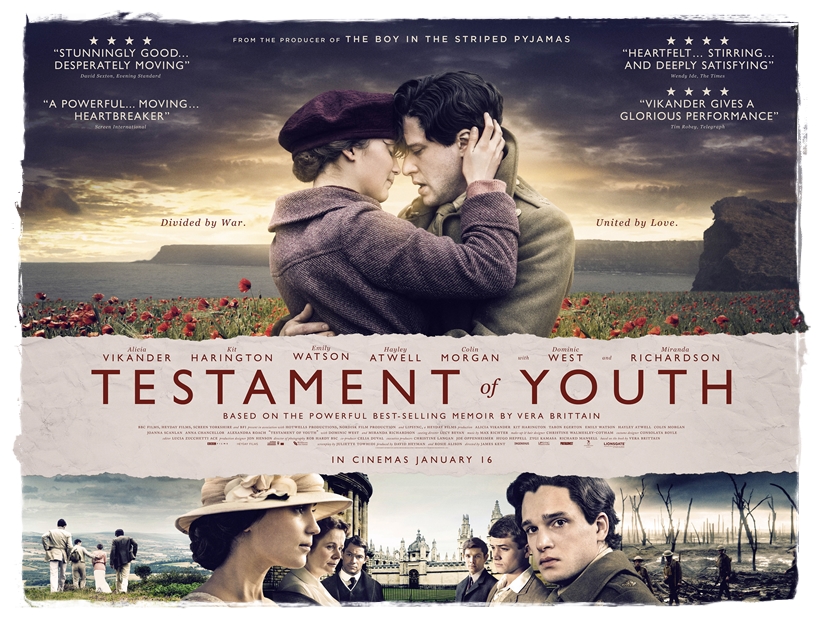
TESTAMENT OF YOUTH (2014) – NETFLIX
Alice Vikander is outstanding in this heart-breaking story of the impact of World War One on Vera Brittain and those she loves. Based on a seminal work of literature, it features themes relating to: war, death, pacifism, violence and the struggle of women combatting everyday prejudice. It’s very touching story, stellar cast and deeply empathetic characters which make it a highly recommended period drama.
(Mark: 9 out of 11)
WHAT HAPPENED TO MONDAY (2018) – NETFLIX
Always interesting Noomi Rapace stars as septuplets in hiding during a dystopic future that allows one child per family. The intriguing premise starts well but gives way to O.T.T violence which detracts a tad from an otherwise entertaining sci-fi film.
Produced by: Jack Binder, Greg Clark, Victoria Hill, Gary Hamilton, Deepak Sikka, Christine Vachon, David Hinojosa, Frank Murray
Starring: Ethan Hawke, Amanda Seyfried, Cedric Kyles, Philip Ettinger
Paul Schrader is one of the greatest writers that has ever committed a career to cinema. He has been involved in the writing of exceptional films including: Taxi Driver (1976), Raging Bull (1980), Last Temptation of Christ (1988), and Bringing Out the Dead (1999), Blue Collar (1978), American Gigolo (1980), Mishima: A Life in Four Chapters (1985), Light Sleeper (1992), Affliction (1997) etc. Of late he’d had some misfires, however, First Reformed, is a devastating return to form for Schrader.
Tapping into the structure and themes of arguably his greatest work, Taxi Driver (1976), we find Ethan Hawke portraying New York chaplain, Reverend Ernst Toller. He is a complex, haunted and sad man, yet instilled with a strong sense of duty and commitment to his dwindling congregation. He keeps a journal to record his thoughts and these are delivered via a devastating voice-over. Hawke’s voice staggers across the images delivering a combination of existential pleas for understanding and an intelligent questioning of the world around him. Toller’s depression or malaise is not helped by his alcoholism and illness spreading through his body. Thus, Schrader and Hawke create a very empathetic character, out of sync and in grief but very likable to his peers and flock.
When Amanda Seyfried’s local mum-to-be Mary comes to see him about her troubled husband, Michael, Toller agrees to speak with him about his concerns for the world and the damage humans are inflicting on the environment. When the drama arrives you just feel every agonising moment through Hawke’s beautifully realised character. Just watching Ethan Hawke in a room is enough for me as he is such a nuanced and clever actor. Schrader frames Toller in doorways, rooms, shadows, mirrors and pulpits, pushing him into spaces and trapping him. The sparse nature of the sets also acts as a symbol of Toller’s emptiness and feeling of despair at the world. Yet, at no time does he question his faith per se. The film certainly has an air of that but the big indictment is the horror we have perpetuated upon God’s Earth; challenging whether we deserve this beautiful planet.
Ultimately, this is quintessential Paul Schrader. Taking a broken individual in the midst of a life crisis and attempting to find salvation or redemption. Whereas Taxi Driver (1976) was, in part, about Travis Bickle cleaning up the streets of New York, Ernst Toller finds a desire to clean up the corporate and capitalist industrial processes which are destroying the Earth. While First Reformed’sending is not as explosive or cathartic as Taxi Driver it paradoxically creates hope for a fascinating character nonetheless. While he may not be able to save the Earth, Reverend Toller, may somehow be able to save himself.
In my continued desire to avoid perpetual and dysfunctional alcoholism, while saving money and contemplating the meaning of existence, I often fill up my hours watching quality television dramas. Here are some reviews of shows I have caught up with over the last few months, with the usual Screenwash marks out of eleven.
THE ALIENIST (2018) – NETFLIX
Based on Caleb Carr’s best-selling novel of the same name, The Alienist, while feeling very familiar has enough style and acting quality to make it worth recommending. Set in the grimy streets of New York circa mid-1890s the period setting and production design exquisitely juxtaposes the filth and squalor of the underclasses with the opulence of the wealthy. Dakota Fanning, Luke Evans and Daniel Bruhl are uniformly excellent as an unlikely trio of “criminologists” who, on invite from the Chief of Police, investigate the ritualistic murders of young, poor kids in the ghettos. Adapted by, among others by the very talented Cary Joji Fukunaga, Eric Roth and Hossein Amini, this is overall a compelling, gruesome and hypnotic genre drama which entertains throughout its ten episode running time.
(Mark: 8.5 out of 11)
HIT AND MISS (2012) – SKY ATLANTIC
I missed this gritty drama the first time round from Sky when released in 2012 and it certainly pushes boundaries of gender politics within a genre setting. Created by the prolific British writer Paul Abbott it stars Chloe Sevigny as a hit-woman with a secret. Sevigny’s complex character Mia is in fact, a pre-op trans-gender person, living a lone-wolf existence working for Peter Wight’s fixer character. Her anonymous contract-killing life is interrupted when she is thrown into a surrogate mother situation and that’s when the real drama begins. This is not a programme for the faint-hearted with lashings of physical and sexual violence but the excellent cast, notably the outstanding Sevigny, drive this edgy mix of family and thriller genres with compelling power.
(Mark: 8 out of 11)
LIAR (2017) – ITV
This ITV drama is founded on the tantalisingly tricky premise of a “she said, he said” date rape case. It is to the testament of the writers, director and actors that the first three episodes provided absorbing suspense as to who is or who isn’t telling the truth. It begins with a primary school teacher, Laura, portrayed with nervy zeal by Joanne Froggatt, accepting a date with handsome surgeon, Andrew Earlham. They seem like a perfect couple but the following day Laura accuses him of rape. The drama comes very much from whether he is guilty and whether she has made it up. Star of Hollywood movies and US TV shows, Ioan Gruffudd, returns to British TV to play Earlham with a charming charisma which makes you question whether he could do such a thing. Halfway through the series though, the show becomes something altogether more sinister. Without wishing to give anything away I can recommend Liar for handling such a delicate subject well, while at the same time creating a powerful and suspenseful narrative throughout.
(Mark: 8 out of 11)
PATRICK MELROSE (2018) – SKY ATLANTIC
Oh, Benedict, Benedict! I love you so! Yet again I witnessed another masterclass in acting from Mr Cumberbatch as he shows all variants of emotional range in this high quality character study. The series is adapted from Edward St Aubyn’s semi-autobiographical books of the same name. Moreover, the structure is interesting in that each of the five episodes focus on different periods of Melrose’ privileged, yet tortuous, existence. We open with a drug-addled Patrick high on smack and then follow a frantic dash to New York to pick up his fathers’ ashes. Initially, Patrick is selfish, biting, wasted and full of fear and self-loathing. In fact he is not likeable at all. However, the first episode then delivers the gut-wrenching truth about the characters’ past and a truly harrowing event at the hands of his tyrannical father. The dramatic glue of the whole series is provided by Patrick’s memories of his fathers’ terrible behaviour – portrayed with rotten humanity by Hugo Weaving. Later episodes find Patrick battling addictions, his mothers’ negative do-gooding, starting a family and just trying to do what most of us do: hold it together emotionally in the face of the slings and arrows life throws at us. Full of complex emotional moments, brilliant acting and stinging one-liners, this is television of the highest order.
(Mark: 9.5 out of 11)
SAVE ME (2017) – SKY ATLANTIC
Written by and starring the magnetic British actor Lenny James, this urban crime thriller boasts an exceptional cast and addictive narrative. James takes a performance risk casting himself and a low-life chancer called Nelly, who is suddenly the suspect in the kidnapping of a daughter he hardly knows. Nelly is an ex-con-alcoholic-love-rat who gets by on his charisma and street smarts but still manages to aggravate those around him. When his teenage daughter goes missing he becomes an unlikely amateur detective, attempting some form of redemption having just signed her over to his ex-wife years before. The familiar kidnapping storyline kind of runs out of steam over six episodes, however, James and his brilliant cast including: Stephen Graham, Suranne Jones, Susan Lynch, Kerry Godliman and Jason Flemyng all excel. I also loved the gritty council estate setting and the authentic nature of the characters really drove the story forward.
BILLIONS (2016 – ) – SEASON 3 – SHOWTIME TV REVIEW
Created by: Brian Koppelman, David Levien, Andrew Ross Sorkin
Starring: Paul Giamatti, Damian Lewis, Maggie Siff, Malin Åkerman, Toby Leonard Moore, David Costabile, Condola Rashād, Asia Kate Dillon, Jeffrey DeMunn
Distributor: Showtime Network
**MAY CONTAIN SPOILERS**
After experiencing the dizzying, serpentine narrative cul-de-sacs and mazes of Westworld Season 2, I was grateful to drink in the relative comfort of some genre drama that actually made sense. I mean I don’t mind working hard to gain pleasure from the TV viewing but non-linearity for the sake of it, or because the writers are so self-aware, they believe it is demanded of them irks me somewhat. The writers of Billions on the other hand rely on: good old proper plotting; sharp and witty dialogue; well-rounded archetypal characters; fantastic scenery-chewing performances; and an uber-ensemble cast of television and cinema actors to die for.
Once again, Season 3 posits a similar question to the last two: how do you make the rich and privileged empathetic? Well, firstly you have the aforementioned brilliant cast of vintage screen actors, notably: Paul Giamatti, Damian Lewis, Maggie Siff, David Constabile, Jeffery DeMunn, Malin Akerman, plus exceptional newcomers such as Asia Kate Dillon; and finally parachute in veteran warhorses like John Malkovich and Clancy Brown. Secondly, you make these greedy and power-hungry legal and financial based individuals brilliant at everything. Thus, pleasure is derived from the characters trying to out-brilliant and out-do themselves. In Season 3, the writers manage to find some more exceptional ways which the characters can fuck each other over.
The first two seasons saw Giamatti’s Attorney General, Chuck Rhodes try and take down financial demon of Wall Street, Bobby Axelrod. Watching these two rich-privileged-masters-of-universe-types ripping each other apart from a legal, family and financial perspective is absolutely riveting drama. I’m not always down with the fast-paced nature of the economic markets but essentially you don’t have to be because the writing always puts the human drama first before the jargon. Season 3 followed in a similar vein to the previous two and contained a very interesting structure. The writing continued to be whip-cracking funny and twisted and the plots were a joy; full of arch Machiavellian machinations galore. The twists around episodes six and seven were absolutely brilliant and I was gripped. The final few episodes then manoeuvred the characters like chess pieces, carefully laying the foundations for what promises to be a monumental, melodramatic and mesmerising Season 4.
Written by: Russell T Davies – Based on A Very English Scandal by John Preston
Starring: Hugh Grant, Ben Whishaw, Monica Dolan, Alex Jennings, Blake Harrison, Eve Myles, Patricia Hodge etc.
Composer(s): Murray Gold
Production Company: BBC
**MAY CONTAIN SPOILERS**
I’ve never been a fan of politicians. They are a necessary evil. Perhaps I shouldn’t blight a whole raft of people who may, in their hearts, believe they are trying to do well for their country. But, I just cannot help feeling there is something not quite right with someone who wants to be in control or lead or rule. I’m of the view that power does corrupt the individual and even though they may begin with great altruistic tendencies they will, ultimately, be poisoned by the job. Or worse than that they have sociopathic tendencies and the prestige of being voted in will feed their greed and lust for control. How does one explain the amount of wars and conflicts there are? Humanity is greatly flawed and the leaders of the so-called free world are more flawed than most.
But, what alternative is there to the capitalist system we have? Running a country and leading millions of various people must be tough; and difficult decisions must be made everyday. Many have tried the commune lifestyle and socialism has also led, in the Soviet Union and China for example, and, to dictatorial regimes replete with fear, repression and murder. Not that the West hasn’t had its fair share of Dictators and sociopathic leaders. General Franco in Spain is one such fascistic leader and our own Iron Lady, Margaret Thatcher, hiding within the illusion of democracy, crushed Union leaders, working class lives and whole industrial communities. As such, crooked and nefarious politicians are often a staple of film and television shows. A case in point is the BBC’s recent adaptation of John Preston’s book, A Very English Scandal.
This strange true life tale focussed on the Liberal party leader Jeremy Thorpe and his relationship with a troubled young man called Norman Scott. What first starts off as an illicit but touching love story soon becomes a desperate, twisted and darkly amusing black comedy of insane proportions. First off, Thorpe and Scott are portrayed with absolute brilliance by Hugh Grant and Ben Whishaw. Both sterling film actors they bring gravitas, sparkling chemistry and humour to their respective roles; while Alex Jennings, Adrian Scarborough, Eve Myles and Patricia Hodge also excel in supporting roles. Furthermore, acclaimed director Stephen Frears ties the strands of Russell T. Davies brilliant script, expertly switching between comedy and heightened drama, without losing tonal control.
Set against the backdrop of English Parliament and the United Kingdom’s homophobic laws which outlawed gay sex, Jeremy Thorpe, is presented as an honourable man at first. He champions workers’ rights and lambasts the policy of Apartheid in the House of Commons. He has to hide his homosexuality though due to the oppressive legal system and the fact that, as a politician in the public eye, this would seriously harm his ambition to become Prime Minister. When he meets Ben Whishaw’s highly strung stable lad he immediately falls for him and they begin a secret affair. The relationship goes wrong and Thorpe moves on to become the leader of his political party, but an ever increasingly unstable Scott, just won’t go away. That’s when things begin to go awry for Thorpe. Scott won’t take a pay-off and Thorpe won’t give him the National Insurance Card, Scott hilariously demands.
So, like Henry II demanding, “Someone rid me of this meddlesome priest”, he allegedly, as per the script, takes a more sinister route. I won’t spoil it but the events which are presented are both funny and shocking and have to be witnessed to be believed. The privileged Jeremy Thorpe, garners some empathy due to having to hide his sexuality, however, his subsequent decisions to shut Scott down, as presented in this fascinating tale, are shown to be the actions of a spoilt, desperate and sad man wielding power over someone less fortunate. They say absolute power corrupts absolutely but as shown in A Very English Scandal it also leads to incredible poor decisions by individuals from the ruling classes. Indeed, the main reason I dislike and distrust politicians in general is they can and should afford to be better behaved and more compassionate than those they lead.
Produced by: Kevin Frakes, Ridley Scott, Buddy Patrick
Written by: Ari Aster
Starring: Toni Collette, Alex Wolff, Milly Shapiro, Ann Dowd, Gabriel Byrne
Music by: Colin Stetson
Cinematography: Pawel Pogorzelski
**MAY CONTAIN SPOILERS**
I’m tempted to do two reviews of this movie. Because there’s a minority part of me that feels its bravura and beautifully crafted horror film; but the majority part just could not get over the illogical and surreal elements which unhinge the carefully plotted family tragedy it promised to be. Nonetheless, the writer and director Ari Aster is clearly an ultra-talented filmmaker who deserves much praise for creating a series of impressively creepy scenes throughout. Still, he does throw a lot of ideas at the wall hoping they stick so many critics will probably love Hereditary, unfortunately it lost me some way through due to a major plot and tonal turn which, while foreshadowed, did not really make any emotional sense.
The story begins with the Graham family mourning the death of Annie Graham’s (Toni Collette) mother. From beginning to the end Collette’s portrayal is absolutely incredible and she deserves any awards that are coming to her. Indeed, Collette anchors the film with moving and incredibly dramatic performance. Her character is very empathetic suffering tragedy after tragedy and attempting to come to terms with the devastation life brings. She is ably supported by Gabriel Byrne as her husband; while Alex Wolff and Milly Shapiro offer excellent support as their troubled kids. Shapiro especially is well cast as the unstable teenage girl who may or may not have some darker force within her.
The film begins slowly and creeps along for forty minutes or so building dread and atmosphere. Collette has some fine speeches about grief and family relationships and this is where the writing is very strong. These scenes showcase Collette’s acting ability before the action takes a vicious twist with one grandstanding horror moment half-way through. This is where, in my view, the film suddenly started to become lop-sided and full of debateable plot-holes. Don’t get me wrong, if you read the film as a supernatural fantasy full of surreal and dream logic like the cinema of Luis Bunuel and David Lynch, you can swallow much of what happens in the final act. Moreover, symbolically and thematically Hereditary is very strong with issues relating to grief and dysfunctional family relationship very well explored. However, due to a ridiculous final act where the film moves away from this my empathy for the family was lost in a number of wildly over-the-top scenes, which while scary, made little sense in my humble opinion.
Hereditary (2018) is a “Mother” of a horror film!! Indeed, it has much in common with last year’s divisive work of cinema directed by Darren Aronofsky called Mother (2017). Like Mother (2017) it is a brilliantly directed horror story with great acting throughout, that alas, falls apart at the end with narrative illogic, plot-holes and a laughable denouement. It’s a shame because the first half of Hereditary is beautifully set up. The visual style involving miniatures, shadows, weird dolls’ head and bird decapitations is creepy and very impressive. However, the filmmaker’s fantastic work is destabilised by a narrative desire to twist the film into something pretty crazy. Yet, Ari Aster deserves much praise for taking risks in the horror genre and his and Collette’s craft are of the highest order; at least until the ending.
There are so many films released at the cinema each year that it’s impossible to catch them all. Unfortunately, for me, and billions across the world that damned thing called employment gets in the way. Nonetheless, there are many other avenues to catch up with movies and SKY CINEMA is one such route. So, here are some reviews of films I have caught up with recently on SKY, with the usual marks out of eleven.
**MAY CONTAIN SPOILERS**
AFTER THE STORM (2016)
This Japanese family drama is slow moving but quietly unfolds in a compelling fashion. Former prize-winning novelist, Ryota (Hiroshi Abe), is a gambling addict “researching” his next book and making ends meet with private detective work. He tries to become a better son and father but his hereditary flaws and addiction haunt him. That’s about it for Hirokazu Kore-eda’s character drama which features some excellent dialogue and a wonderful acting performance from Ryota’s mother, portrayed by Kirin Kiki. (Mark: 8.5 out of 11)
ATOMIC BLONDE (2017)
Charlize Theron portrays a sullen yet kick-ass spy in this style-over-substance-action-thriller. Directed by David Leitch, who also helmed John Wick 2 (2016), rather amusingly doesn’t even have the depth of Keanu Reeves’ B-movie-assassin-classics. Adapted from the comic book novel The Coldest City (2012) and set in late 1980s Berlin, it uses the unstable politics of the time loosely as a means to hang a slender narrative on. This essentially is all rocking soundtrack, kinetic action, and sexy fighting with NO story. Theron and co-star James McAvoy do their best with the spy McGuffins but it’s main redeeming feature is a barnstorming “one-take” fight scene in the middle of the film. Now THAT rocks! (Mark: 7 out of 11)
THE FATE OF THE FURIOUS (2017)
Charlize Theron pops up again in eighth film of the franchise, this time as cyber-baddie hell-bent on doing something bad for some heinous reason. Anyway, her fiendish plot is just an excuse to blow up cars, planes, jails, roads, buildings, and submarines in the usual explosive fashion. Vin Diesel, Jason Statham, Michelle Rodriguez, Tyrese Gibson, Dwayne “The Rock” Johnson and the rest of the team (minus Paul Walker R.I.P) are all back trying to stop her. There’s something both obscene and incredibly satisfying witnessing stunts and action this over-the-top! I mean the carnage present in the final-submarine-versus-vehicle-set-piece is absolutely breath-taking and its worth watching the film for that alone. (Mark: 7.5 out of 11)
MAUDIE (2016)
Since her striking performance in Mike Leigh’s excellent character piece Happy Go Lucky (2008), Sally Hawkins has been carving out quite the number of brilliant acting roles. Perhaps overshadowed by the success of the big budget monster/love story The Shape of Water (2017), the low-budget Maudie features another stunning Hawkins turn. She is quietly powerful in the role of Nova Scotia painter Maud Dowling. Maud came to mild prominence for her painting in the late 1960s and became somewhat of a cult treasure. Hawkins and Ethan Hawke steal the acting honours as the unlikely husband and wife, as Aisling Walsh directs a fine tribute to a small woman with a massive artistic talent. (Mark: 8.5 out of 11)
SHOT CALLER (2017)
This is a hard-boiled and brutal crime thriller which moves very slowly but with highly confident direction. Ric Roman Waugh has marshalled a very decent B-movie with Game of Thrones Nikolaj Coster-Waldaj excelling in the muscular lead role. He portrays a banker sent down for manslaughter who suddenly finds himself at the mercy of white supremacist gangs. Rather than lay down and get screwed he jumps straight in and sets in motion a gruesome set of events. Jon Bernthal pops up as a hard-piped criminal while Lake Bell is excellent as the anti-hero’s long-suffering wife. You need some patience but ultimately the ending pays off in an enjoyable, if incredibly contrived, finale. (Mark: 7.5 out of 11)
ROUGH NIGHT (2017)
This ridiculous over-the-top mixture of sex, crime and comedy rips off Very Bad Things (1998) and The Hangover (2009), with a smattering of Weekend at Bernie’s (1989). Having said that I really enjoyed it despite the incredibly broad comedy and implausible nature of the plot which takes five buddies on a Bachelorette party and throws a dead hooker into the mix. Zoe Kravitz, Scarlet Johannsson, Kate McKinnon, Illana Glazer and Jillian Bell, while slumming it in this often-filthy material, commit to their roles with ludicrous abandon. While very derivative I couldn’t help but laugh on several occasions, most notably at Ty Burrell and Demi Moore as the lascivious “sex-people” neighbours. (Mark: 7 out of 11)
Screenplay by: Ian McEwan (Based on: On Chesil Beach by Ian McEwan)
Starring: Saoirse Ronan, Billy Howle, Emily Watson, Anne-Marie Duff, Samuel West, Adrian Scarborough
Cinematography: Sean Bobbitt
**MAY CONTAIN SPOILERS**
I watch a lot of films. I also write screenplays. Indeed, over the last twenty-five years I have studied and read many “how to” write screenplay courses, books, and articles. One of the major rules of screenwriting, as opposed to radio and television writing is to SHOW and not tell. Deliver your story via the images, performance and shot composition rather than obvious dialogue which spells everything out. As a writer of incredible talent Ian McEwan has, along with director Dominic Cooke and their editor, created an intriguing story of lost love and romance. It flashes forward and back between the past and present beautifully and certainly shows rather than tells the story in a less than obvious fashion. In fact, for me it was ultimately TOO subtle in delivery and the emotional ramifications of certain events are lost in the subtext.
The story begins in the 1960s as newlyweds, Florence and Edward, nervously entwine on their wedding day. As portrayed by the imperious Saoirse Ronan and compelling Billy Howle we are immediately empathetic of their situation and time. Because traditionally, unlike the more sexualised mores of today, religion and social convention would dictate that the couple were more likely to be virgins. Therefore the nervous glances and small-talk slowly build a sexual tension creating an incredibly awkward and embarrassing mid-point moment between the characters. McEwan’s script also flashes back to the past establishing how the characters met. Edward is a lower-middle class boy from a rural background while Florence’s family are more upper-middle class capitalists. As presented in other McEwan works class tensions also propel the drama as Florence’s family look down on Edward somewhat.
There is a lot of depth within the characterisations notably from Ann-Marie McDuff as Edward’s unfortunate mother. Although, at times I wasn’t sure how her mental condition was linked to the themes of the piece, the performance of the actor alone was fascinating throughout. Ultimately, it’s a film about love, loss and terrible secrets; notably how past events can haunt the present. However, in choosing to bury the big reveal within a blink-and-you-miss-it flashback, the poetic editing, in my opinion, took away from the dramatic power and potential catharsis in denouement. On occasions telling us as well as showing us can empower an audience to feel even more for the characters.
Dominic Cooke marshals the film with an assured hand as befits an experienced theatre director. Ronan and Howle give brilliant performances. In fact, I don’t think there is a better and more consistent young actor than Saoirse Ronan. In films such as: Atonement (2007), Hanna (2011), Brooklyn (2015), Lady Bird (2017) and now On Chesil Beach (2017), she has proved herself capable of capturing depth and emotional power with her performances. Ronan and her romantic counterpart, Howle, make the film worthy of your attention even if I was left mildly bewildered, valiantly trying to work out why their characters’ relationship was doomed to fail.