Tag Archives: Coralie Fargeat

Cinema Review: The Substance (2024) – A Dark Exploration of Identity

THE SUBSTANCE (2024)

Directed by Coralie Fargeat

Written by Coralie Fargeat

Produced by: Coralie Fargeat, Tim Bevan and Eric Fellner

Main Cast: Demi Moore, Margaret Qualley and Dennis Quaid

Cinematography by Benjamin Kracun

*** MAY CONTAIN SPOILERS ***
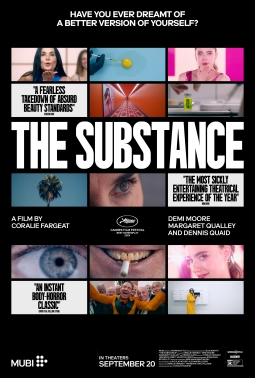


The Substance (2024), directed by Coralie Fargeat, is a visually striking and visceral film that pushes the boundaries of body horror and psychological terror. Fargeat, known for her raw and relentless style in Revenge (2017), once again delivers an unforgettable experience by weaving references to classic literature and horror cinema into a narrative that is at once familiar and entirely original.

Demi Moore portrays a former Hollywood star, Elizabeth Sparkle, now relegated to doing a mildy successful cable TV aerobics show. However, Dennis Quaid’s oily production executive is on the lookout for younger talent. Elizabeth soon finds herself on the media scrapheap. Desperate to regain her youth and career, Elizabeth is drawn to the hypnotic promise of a new product called ‘The Substance.’

Before you can say, “Dorian Gray”, Elizabeth is lured to a strange white room full of lockers and has committed to the process. Similar to Gremlins (1984), there are rules to follow. As she follows the steps and injects the potions, Elizabeth goes through a painful and incredibly impactful transformation process. She literally gives birth to a young and beautiful alter ego called, Sue (Margaret Qualley). Elizabeth and Sue then get seven days each to live their life before they have to swap back. What could go wrong?
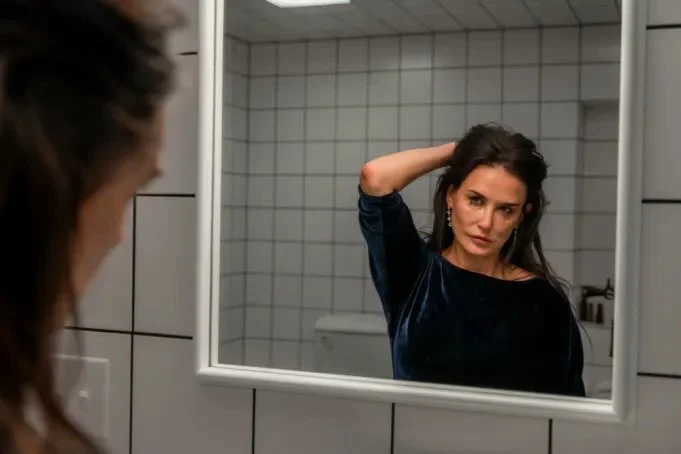


The film’s core themes draw heavily from Robert Louis Stevenson’s Dr. Jekyll and Mr. Hyde, exploring duality, identity, and the monstrous potential hidden within human nature. Like Stevenson’s tale of inner conflict, The Substance delves into the consequences of scientific ambition. It investigates moral transgression but with a modern, feminist twist. Fargeat’s use of body horror, particularly in the transformation sequences, echoes the grotesque, unsettling work of David Cronenberg. The nightmarish atmosphere and surreal visuals are reminiscent of David Lynch’s unsettling dream logic. This is notably seen in Eraserhead (1977) and Mulholland Drive (2001).

The film also pays homage to John Carpenter’s The Thing (1982), with its transmogrifying frights, sense of creeping paranoia and rising conflict. But rather than a group of men fighting each other Elizabeth and Sue turn on each other over ownership of their physical existence and Hollywood status. The final act descends into hellish and bloody satire echoing Peter Jackson’s Braindead (1992), with gore galore. Moreover, Stanley Kubrick’s influence is palpable in the film’s meticulous framing, production design and tension-building. The climactic body-morphing scenes, however, most clearly nod to Brian Yuzna’s Society (1989), with its grotesque depictions of class and conformity, fused with Fargeat’s unique vision of female empowerment, revenge and resistance.

The Substance (2024) feels like a bigger budget film in look and style, but you soon realise the minimal number of sets used and a lack of crowd scenes, finds the narrative effectively becoming a two-hander in the middle act by focusing on Sue and Elizabeth’s internal retaliatory vindictiveness. There are some amazing framing, colour design and cinematographic choices as showers become tombs to trap the protagonists. The book-ended Hollywood star montage and returning final shots are imaginative and unforgettable. Got to say that Demi Moore, as an actress taking on a role of an aging and neurotic former star is genius casting. While Qualley delivers a sexually charged and energetic performance, it is Moore who carries the weight of the complex themes as Elizabeth’s journey dives deeper into the stuff of nightmares.

Overall, The Substance (2024) is a postmodern classic and a film that honors its influences while forging its own path. Fargeat uses these references to enrich the narrative, creating a damned ugly and beautiful satire on those seeking narcissistic perfection through unnatural means, ultimately paying the price of those seeking eternal youth and fame.

Mark: 9 out of 11


SHUDDER HORROR FILM REVIEWS – EXTREME!

SHUDDER HORROR FILM REVIEWS – EXTREME!

I’m continuing the Shudder film review residency here on my site with this post. However, as I watched so many horror films on the channel recently, I have decided to break them down into categories. This one is called Extreme!

Essentially the films reviewed here are — because of their content, style or both — prime examples of nasty, violent, sickening and in some cases extremely depraved horror movies. So, be warned do not watch these films, unless you have a strong emotional constitution and actually enjoy witnessing graphic scenes of gore, sex and bloody mayhem.

For your information, the films are reviewed in order of my rating, which as usual is out of eleven.


REVENGE (2017) – DIRECTED BY CORALIE FARGEAT

Featuring a B-movie rape and revenge plot, this exploitation story is raised way above its subject matter due to ultra-stylish direction, gorgeous cinematography and a compelling lead performance by Matilda Lutz. She portrays Jen, an aspiring actress, who is on a weekend getaway with handsome boyfriend (cheating husband), Richard (Kevin Janssens). He seems very well off as their break takes place at a stunning isolated villa location. However, things go awry when two of his hunting buddies turn up, and one, Stan (Vincent Colombe) attacks Jen while Richard is out. From then on events twist from incredibly bad to worse for Jen, and she finds herself being hunted down in the blazing heat of the desert. The film looks absolutely incredible with amazing photography and colour design. Overall, what it lacks in story and characterisation though, it more than makes up for in stunning action, searing violence and a powerful critique of toxic masculinity.

Mark: 8 out of 11


TERRIFIER (2016) – DIRECTED BY DAMIEN LEONE

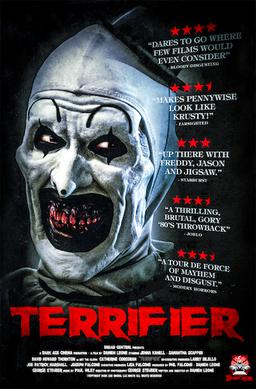
I saw this horror film appear in a post on the YouTube channel What Culture Horror. So, the story of a demented clown who never speaks and slashes people to death on Halloween definitely piqued my interest. It’s both extremely violent and low-budget, having been made for around $100,000. However, it is in fact impressively shot and edited for such a small amount of money. The gory effects are amazingly effective too, summoning up memories of 1980’s prosthetic film effects. There is no real subtext or thematic strength, but I was pretty tense and sickened throughout. Moreover, the clown called Art is a memorably monstrous creation. He kills without reason and purely for his own entertainment. Nihilistic in tone, the director sure knows his horror and delights in presenting many sick ways of murdering his characters. Thus, if you like disembowelling, strangulation, burning, beheading and other gruesome movie deaths then, Terrifier (2016), is worth watching from behind the safety of the sofa.

Mark: 7.5 out of 11


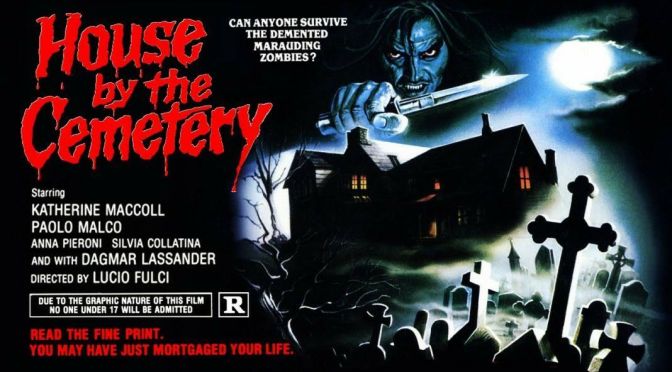
CITY OF THE LIVING DEAD (1980) / THE HOUSE BY THE CEMETERY (1981) – DIRECTED BY LUCIO FULCI

Filmmaker, Lucio Fulci, is often found lurking in the shadow of Italian horror filmmakers such as Mario Bava and Dario Argento, however, he truly knows how to frighten and sicken the life out of an audience. So much so he has been given the nickname, ‘Godfather of Gore’. As well as directing many films, notably, Zombie Flesh Eaters (1979) and The New York Ripper (1982), he is infamous for his “Gates of Hell” trilogy which included: City of the Living Dead (1980), The House By the Cemetery (1981) and The Beyond (1981). I re-watched the first two recently and while not as terrifying as when I saw them in the past, they still have the power to shock. While lacking coherent plots, containing pretty bad acting and some chronically dreadful dubbing in places, paradoxically Fulci’s films can arguably be considered surreal horror classics. They may not make any narrative sense, but his ability to create stunningly violent set-pieces is legendary. Memorable scenes include: the spewing of intestines, crawling maggots, hanging priests, drilled brains, chopped heads and monsters rising from basements and graves. Such imagery and dreaded moments — all set to a creepy synth soundtrack — make Fulci’s movies unsettling viewing experiences.

Mark: 7 out of 11


ISLAND OF DEATH (1976) – DIRECTED BY NICO MASTORAKIS

Not only is this one of the sickest films I have seen, it is also one of the most appalling I have sat through. Having said that, that is in fact what Greek director Mastorakis, based on what I’ve read, set out to do. The story, if you can call it that, focusses on a couple called Christopher (Robert Behling) and Celia (Jane Lyle) who go on a sex-driven-kill-crazy-honeymoon-rampage on the Greek island of Mykonos. If you can get past the couple having sex in a phone booth while telephoning his mother, and stomach Christopher raping a goat before killing it, then do watch the rest of this conveyor belt of pornographic sex and violence. By the end, I was stunned to silence at how sick the film was.

Mark: 1 out of 11


TETSUO – THE IRON MAN (1989) – DIRECTED BY SHINYA TSUKAMOTO

Lauded as a low-budget Japanese extreme body horror cult classic, Tetsuo: The Iron Man (1989), is either the work of a genius or a complete madman. Filmmaker, Shinya Tsukamoto, deserves so much praise for literally making most of the film in his own house and paying for it out of his own pocket. Yet, the thumping industrial soundtrack, jump-cutting-stop-motion style and story of metal invading the body, soul and mind of various characters was too f*cked-up, even for me. I know it gets mentioned as a work of genius, but it was frankly unwatchable. Thankfully, it’s only sixty-seven minutes of hell to get through.

Unmarked!