Tag Archives: Eli Bush

Cinema Review: Marty Supreme (2025) – a breathless anti-hero journey driven by purpose, anxiety and adrenaline!

Cinema Review: Marty Supreme (2025)

Directed by Josh Safdie

Written by Ronald Bronstein and Josh Safdie

Produced by Josh Safdie, Ronald Bronstein, Eli Bush, Anthony Katagas
and Timothée Chalamet


Main cast: Timothée Chalamet, Gwyneth Paltrow, Odessa A’zion, Kevin O’Leary, Tyler Okonma, Abel Ferrara, Fran Drescher, Sandra Bernhard, etc.

Cinematography Darius Khondji

Music by: Daniel Lopatin



Anxiety cinema, though always a part of film history, has seen a surge in prominence in recent years, with directors like Gaspar Noé, the Safdie brothers, Sean Baker and Ari Aster leading the charge. These filmmakers specialize in creating films that push audiences to their emotional limits, heightening tension and discomfort without offering the cathartic release often found in more traditional thrillers or suspense films by the likes of DePalma, Hitchcock, and Spielberg. Rather than resolving the anxiety with a tidy ending or a moment of relief, these films leave viewers on edge, their blood pressure elevated, and their minds unsettled, reflecting the growing cultural sense of unease and existential dread.

It’s important to note that it would appear, with the release of the frantic Marty Supreme (2025), it is Josh Safdie and Ronald Bronstein, not Benny Safdie, who could be seen to be the driving forces behind the anxiety-driven films like Good Time (2017) and Uncut Gems (2019). Their collaborative work has come to define the frantic, high-pressure style of modern anxiety cinema. In contrast, Benny Safdie’s more recent work, The Smashing Machine (2025), highlights a shift toward more authentic and subtle character development, offering a quieter, more understated take on human drama. While Josh and Bronstein continue to escalate tension to dizzying heights, Benny’s approach focuses on exploring deeper, more introspective emotional journeys.

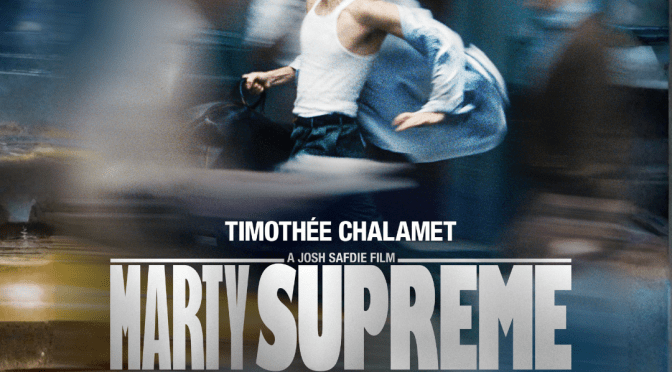
So, Marty Supreme (2025), is it any good? Let’s just say that this isn’t a Christmas or feelgood film, so I can only think the marketing team are being ironic with the poster tagline ‘Dream Big – Christmas!’ This is a 1952 period set anti-heroic-rites-of-passage rollercoaster journey profiling Marty Mauser (Timothée Chalamet), a New York shoe salesman with dreams of hitting the big time as a world champion table-tennis player. But rather than being characterised as a Rocky-style underdog sporting personality who the audience can root for, Marty (loosely based on real-life Marty Reisman), is in fact a fast-talking-arrogant-crisis-addicted-confidence-trickster and womaniser who is not averse to “friendly” armed robbery to get what he wants. Oh, by the way, Marty is also a phenomenal table-tennis player.
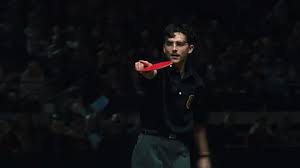


Having previously cast Robert Pattinson in Good Time (2017) and Adam Sandler in Uncut Gems (2019) as their disaster-prone, masculine leads, Josh Safdie and Ronald Bronstein took a new direction in Marty Supreme (2025) by casting Timothée Chalamet. Known for his charisma and commitment, as showcased most recently in Wonka (2023) and A Complete Unknown (2024), Chalamet brings an entirely new energy to the table. As Marty, he is nothing short of a force of nature—physically commanding as a table tennis player, yet intellectually and verbally dominating the screen. His performance captivates with a magnetic presence, delivering lines with such intensity and precision that he becomes impossible to look away from. Chalamet’s portrayal of Marty is both memorable and transformative, showcasing his versatility as an actor who can take on the manic, chaotic energy required by a character in a Safdie-Bronstein film while adding a unique layer of depth and intrigue.

Marty’s journey represents a fascinating emotional dialectic, one that leaves the audience both drawn to and repelled by his behaviour. While I didn’t necessarily enjoy his character arc, that’s exactly what makes Chalamet’s portrayal so compelling. Marty is, in many ways, his own worst enemy—he can’t follow rules, he’s a liar, and he cheats to get ahead. Yet, his raw talent and unwavering sense of purpose give him an undeniable charisma, pulling the audience in even as his decisions spiral into reckless, life-threatening situations. The character’s hustle, constant scheming, and pursuit of personal gain lead him into a series of humiliating, violent confrontations that highlight his self-destructive tendencies.

Marty’s a deeply flawed person desperately trying to make something of himself. But he also makes his own bad luck through poor decision-making. Whether it’s falling through a hotel ceiling in a bath; retrieving a missing dog for a psychopathic gangster; locking horns with the table tennis authorities and the uber-businessman he’s seeking patronship from; fighting a cuckolded neighbour whose wife, Rachel Mizler (Odessa A’zion) he possibly loves – not forgetting the scintillating table tennis games – the film is a litany of combative and panic-attack inducing set-pieces. The emotional tension lies in watching Marty repeatedly sabotage his own potential, a cycle of ups and downs that plays out as a cautionary tale. Marty’s journey doesn’t just depict failure; it explores the emotional complexity of someone trapped in their own worst impulses.

Marty Supreme (2025) stands as a masterpiece of filmmaking, with creative choices that not only subvert expectations but elevate the entire storytelling experience. From its striking cinematography to the anachronistic 1980s soundtrack, every visual and auditory detail feels meticulously crafted to immerse the audience in the world of Marty Mauser. The gritty, authentic production design brings a raw realism that grounds the film, while the ensemble cast—many of whom are quirky non-actors—brings an undeniable energy and authenticity to the narrative. In conclusion, the collaboration between Chalamet, Josh Safdie and Ronald Bronstein, and the entire cast and crew gave me both a nervous breakdown and an unforgettable cinematic experience.

Mark: 9.5 out of 11


Cinema Review: The Smashing Machine (2025) – an authentic portrait of a MMA fighter that hits big!

Cinema Review: The Smashing Machine (2025)

Directed by Benny Safdie

Written by Benny Safdie

Based on documentary The Smashing Machine: The Life and Times of Extreme Fighter – Mark Kerr by John Hyams

Produced by Benny Safdie, Dwayne Johnson, Eli Bush, Hiram Garcia, Dany Garcia & David Koplan

Main cast: Dwayne Johnson, Emily Blunt, Ryan Bader, Bas Rutten, Oleksandr Usyk etc.

*** MAY CONTAIN SPOILERS ***


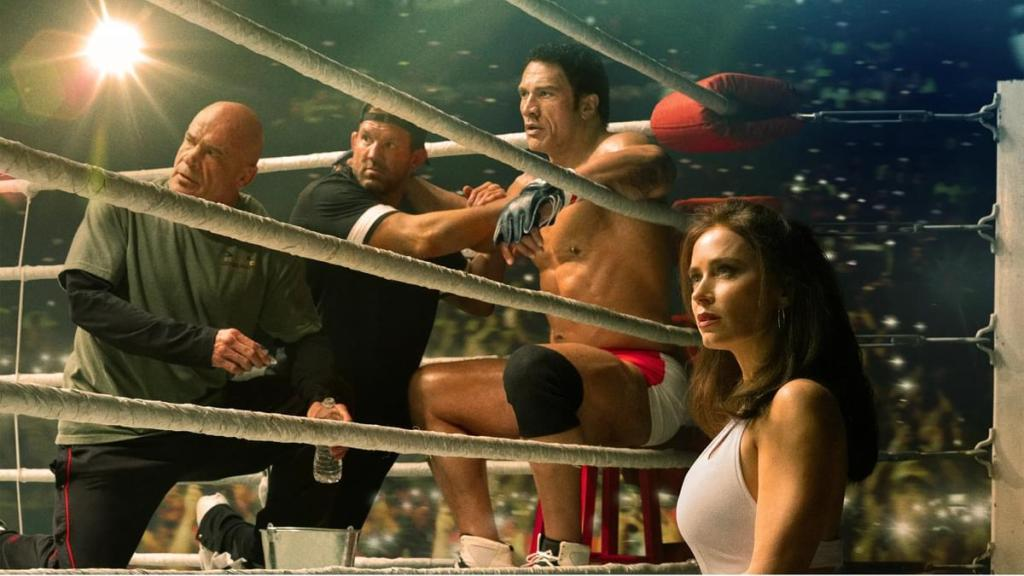
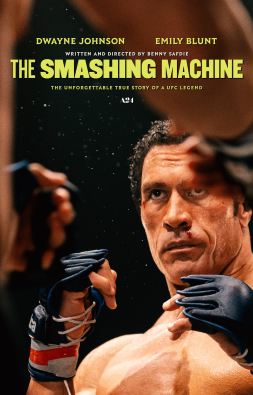
Benny Safdie’s The Smashing Machine (2025) is a bruising, compassionate, and unvarnished portrait of a man torn between physical dominance and emotional fragility. Centered on a three-year stretch (early 2000s) in the dramatic life of MMA pioneer Mark Kerr, the film captures both the bone-rattling intensity of the ring and the private turmoil of a fighter whose greatest battles unfold far from the crowd’s roar.

Dwayne Johnson delivers a revelatory performance as Kerr, casting aside his blockbuster charisma to reveal deep vulnerability and conflict. His portrayal is raw, unguarded, and humane—showing a man both addicted to the high of combat and trapped by the pain that follows. The film traces Kerr’s tumultuous relationship with Dawn Staples (played with nuance and sensitivity by Emily Blunt.) Together they find emotional truth in every scene, exploring the strain that MMA fighting, addiction, mental health, fear-of-losing, obsession and self-doubt place on intimacy.


The fight sequences are stunningly authentic, shot with kinetic immediacy and documentary realism. Safdie immerses the audience in the grit and chaos of early MMA, where glory was fleeting and paydays were meager compared to the sport’s modern era. Supporting performances from real fighters Ryan Bader and Oleksandr Usyk lend further credibility, grounding the film in the texture of lived experience.

Safdie’s direction is as intense and uncompromising as his subject. He resists the traditional rise-and-fall sports narrative, opting instead for a slice-of-life, near-documentary approach that prizes authenticity over heart-pounding drama. If the conflict surrounding Kerr’s addiction, rehab, and Dawn’s own mental health struggles feels under-explored, that restraint is also what makes the film feel so painfully real.

Inspired by the documentary, The Life and Times of Extreme Fighter – Mark Kerr by John Hyams, The Smashing Machine (2025) isn’t a conventional sports movie—it’s a portrait of survival, identity, addiction and the brutal intersection of ambition and vulnerability. Unflinching and deeply human, it cements Johnson’s performance as the best of his career, and confirms Safdie’s gift for finding poetry in the MMA fight scene. Ultimately, the film works best as a tribute to the trailblazing strength and passion of the fighter, Mark Kerr. The fight game is a crazy, tough business and it’s heartening to see, especially in the final scenes, that Kerr survived such battles and lived to breathe another day.

Mark: 8 out of 11


FX /BBC TV REVIEW – DEVS (2020) – ONE OF THE BEST TV EXPERIENCES OF 2020!

FX / BBC TV REVIEW – DEVS (2020)

Created, written and directed by Alex Garland

Executive producers: Alex Garland, Andrew Macdonald, Allon Reich, Eli Bush, Scott Rudin, Garrett Basch

Cast: Sonoya Mizuno, Nick Offerman, Jin Ha, Zach Grenier, Alison Pill, Stephen McKinlay Henderson, Cailee Spaeny, Karl Glusman, Jefferson Hall, Liz Carr, Janet Mock, Aimee Mullins, Linnea Berthelsen etc.

Cinematography: Rob Hardy

Composers: Ben Salisbury, Geoff Barrow, The Insects

Distribution / Screening Platform: FX / Hulu / BBC


*** MAY CONTAIN SPOILERS ***


“I read more about science than anything else, and it started with two things. One was getting my head around this principle of determinism, which basically says that everything that happens in the world is based on cause and effect. . . One is that it takes away free will, but the other is that if you are at a computer powerful enough, you could use determinism to predict the future and understand the past.” Alex Garland – Creator of Devs


Alex Garland has an impressive literary, cinema and now televisual curriculum vitae. He gained acclaim as the writer of the novel, The Beach, before moving onto screenwriting duties with fine films such as: 28 Days Later (2002), Sunshine (2007), Never Let Me Go (2010), and Dredd (2012).  He made his directorial debut with Ex Machina (2014), which earned him an Academy Award nomination for Best Original Screenplay. His second film, Annihilation (2018), garnered further acclaim, so much so, FX bypassed a pilot and went straight to series for his latest science fiction narrative, Devs (2020).

While I am a massive fan of Garland’s work, I wasn’t too enamoured of Annihilation (2018). I found it brilliantly made with some fantastic concepts and incredible moments, yet overall it was too slowly paced. With the eight superlative episodes of Devs (2020), Garland has kept the meditative pace of Annihilation (2018), but also delivered a story which really connected with me this time. With Devs (2020) he has successfully merged a compelling technological espionage plot to an intelligent exploration of philosophical thought and behaviour. Moreover, Garland presents a complex group of themes and characters relating to Silicon Valley tech firms and how their work could control individuals, companies, governments, society as a whole, and actual time itself.


Set now in San Francisco, the narrative opens with two employees of the Amaya Corporation, Lily Chan (Sonoya Mizuno) and Sergei Pavlov (Karl Glusman), attending work. Sergei has a big presentation to pitch to Amaya CEO, Forest (Nick Offerman) and chief designer, Katie (Alison Pill). It goes well and Sergei is invited to work on the mysterious DEVS project. At DEVS he finds wondrous halo-style lighting in the woods and an incredibly expensive set of buildings, capsules, platforms, workstations and screens. Dominating the landscape also is a gigantic model of a young girl (Forest’s daughter, Amaya) who looms over the company and the San Franciscan horizon. These spectacular props, sets and locations are complimented by impressive cinematography from Rob Hardy throughout the eight episodes.

Sergei’s tenure at DEVS does not last long though as he goes missing. Lily, who was in a loving relationship with Sergei, is distraught and, with the help of ex-CIA head of security, Kenton (Zach Grenier), attempts to locate him. When Sergei turns up dead from an apparent suicide, Lily is convinced there is a conspiracy occurring in the Amaya company so begins a dangerous investigation. Even more intriguing, however, is the work that is occurring at DEVS itself. Led by Forest’s desire to “resurrect” his deceased daughter, this complex computer programme can somehow view events from the past, recreated via particle-driven software and projected on huge screens. Using this application the developers and programmers are attempting to determine the future from what has occurred in the past. If they can determine the future they may be able to control it. Mind blown yet? Safe to say, Lily’s investigation into Sergei’s death and the DEVS system become inextricably linked as the drama unfolds. As such, the drama works well as a conspiracy thriller as well as thoughtful sci-fi as Garland punctuates the brooding pace with some crushing stunts and brutal murder set-pieces.

I’ll be honest, the technological side of Devs (2020) was outside my knowledge repertoire as I do not comprehend coding or programming jargon. Nonetheless, I did understand what was occurring in the narrative as it was presented in a clear and digestible fashion. Unlike say the most recent seasons of HBO’s Westworld, which tied itself in knots with looping and over-lapping timelines, Alex Garland’s deft script, excellent direction and fantastic cast make Devs‘ (2020) complex science and tech theories comprehensible throughout. While Garland is dealing with theories relating to free will and deterministic cause and effect, the elegant structure, both linear and with flashbacks, builds a gripping narrative which maintains emotional impact for the characters and the choices they must make. Indeed, Lily Chan is a very empathetic leading protagonist and Sonoya Mizuno gives a compellingly magnetic acting portrayal. It was also fascinating to see Nick Offerman outside of his Parks and Recreation ‘Ron Swanson’ persona playing a highly driven and grieving father. Thus, to conclude, if you enjoy clever, meditative and Kubrickian style television in the science-fiction genre, then you should definitely use your free will and be determined to watch Devs (2020).

Mark: 9.5 out of 11


UNCUT GEMS (2019) – CINEMA REVIEW

UNCUT GEMS (2019) – CINEMA REVIEW

Directors: Benny Safdie & Josh Safdie

Produced by: Scott Rudin, Eli Bush, Sebastian Bear-McClard

Written by: Ronald Bronstein, Josh Safdie, Benny Safdie

Cast: Adam Sandler, Lakeith Stanfield, Julia Fox, Kevin Garnett, Idina Menzel, Eric Bogosian, Judd Hirsh etc.

Cinematography: Darius Khondji

**MAY CONTAIN SPOILERS**


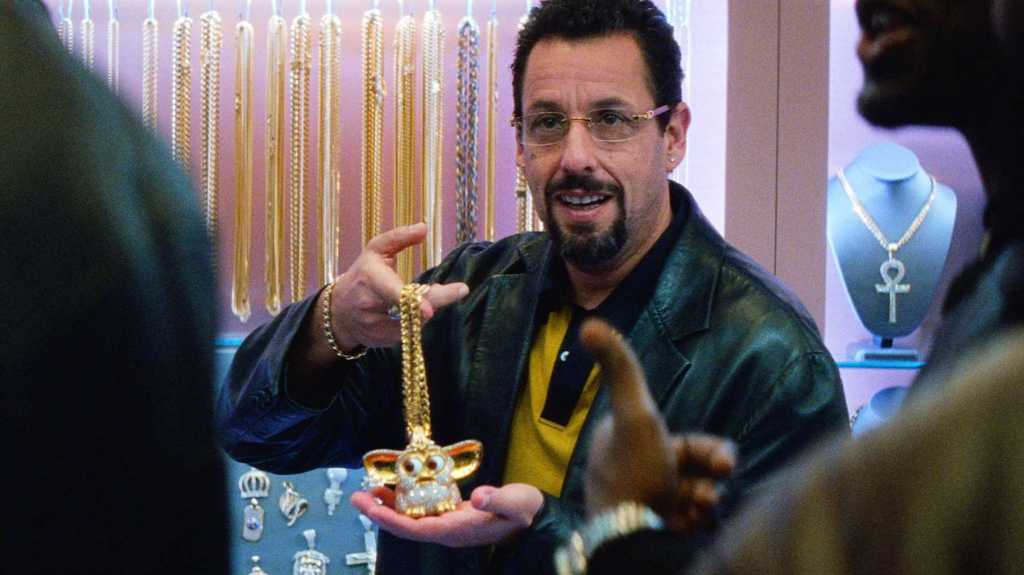
This is a film about an arsehole. Aptly enough we are introduced to the main protagonist, Howard Ratner (Adam Sandler), as he has a rectal examination of his colon and other extremities. From here on we descend into the mired cesspool that is Howard’s dysfunctional business, family, love and extra-curricular activities. He is, on the surface, a successful businessman selling jewellery, watches and gems within New York’s Diamond district. Alas, he is also a degenerate gambler who is being chased by all manner of shark-like money lenders. Most hungry of all is Eric Bogosian’s Arno, who also happens to be Howard’s brother-in-law.

So, we find ourselves in the company of a thoroughly unedifying character such as Howard. Yet, in Adam Sandler’s brilliant performance and searing direction by the Safdie Brothers, you get caught up in his latest cynical money-making plan to sell an uncut opal rock from Ethiopia at auction. The rock itself becomes — reminiscent of Guy Ritchie’s Snatch (2000) — a metaphorically blood-stained McGuffin that drags us into the underbelly of New York’s sports, pawnbroker, bookmaker, entertainment and loan shark territories. Aside from Howard’s wife and children everyone is looking for luck and a buck. Everyone’s a hustler. Everyone talks and shouts and swears over each other, creating a sense of panic throughout many scenes of deal-making and deal-breaking.


Opening with two visually very different internal examinations that involve “mining”, the Safdie brothers film Uncut Gems (2019), is a stylish and rampant anxiety inducing character study and thriller. The plot, which in itself, is quite straightforward, is wrapped in a series of heart-sweating gambles, twists and double-crosses. Supporting Sandler’s fine central performance, the Safdie Brothers find acting gold with Lakeith Stanfield’s memorable supporting turn, plus basketball legend, Kevin Garnett brilliantly playing himself! Allied to this, you also get a rogue’s gallery of personalities straight out of the local New York jewellery area itself. These characters add a further dirty authenticity to the already chaotic urban environment.

Like the Safdie Brothers previous film, the ironically titled, Good Time (2017), we are once again introduced to a set of morally repugnant characters who, rather than root for, you are dragged down into their disturbing lifestyle choices and increasingly poor decisions. Howard himself is an unrelenting addict, his own worst enemy and a whirlwind of broken promises. But, I must admit I was gripped throughout due to overwhelmingly brilliant style, cinematography, editing, direction, darkly funny script and acting performances. My only criticism is that for all the black humour, bone-breaking violence and heart-sweating suspense, the film could have easily been 15 minutes shorter. I like a lot of plot and action, but at times the narrative was over-loaded with characters and scenes that could have been chopped. Lastly, it’s great to witness Adam Sandler taking another risky role, even if Howard Ratner is fundamentally an arsehole from the probing start to the very bitter end.

Mark: 8.5 out of 11