Tag Archives: Graham Broadbent

CINEMA REVIEW: ALL OF US STRANGERS (2023)

CINEMA REVIEW: ALL OF US STRANGERS (2023)

Directed by Andrew Haigh

Written by Andrew Haigh

Based on Strangers by Taichi Yamada

Produced by: Graham Broadbent, Peter Czernin and Sarah Harvey

Main cast: Andrew Scott, Paul Mescal, Jamie Bell, Claire Foy etc.

Cinematography by Jamie D. Ramsay


Andrew Haigh is a director who has slowly built an impressive body of work over the last decade or so. I haven’t seen his first two low-budget features but have watched films 45 Years (2015), Lean on Pete (2017) and the recent brutal TV drama, The North Water (2021). Together they show Haigh to be a director capable of delivering drama of devastating power. His latest independent film, All of Us Strangers (2023) is arguably his best film to date deserving of all the awards coming its way.

Andrew Scott portrays Adam, a lonely screenwriter, who lives in a London newbuild block of flats where he seems to be the only occupant. Struggling with writer’s block he spends his days and nights remembering his parents, Mum (Claire Foy) and Dad (Jamie Bell.) Seeking inspiration for his work he revisits his childhood home in Sanderstead, Croydon during a fascinating trip down memory lane. Surprised one night by drunken neighbour, Harry (Paul Mescal), knocking at his door, Adam rebuffs Harry at first. However, the two latterly begin a love affair, with this relationship intertwined with Adam’s visits to his former home.


I won’t say anymore as I believe this is a film which benefits from knowing as little as possible, but it is safe to say that All of Us Strangers (2023) is one of the most emotionally cathartic films I have seen for some time. Even my frozen heart began to melt as I experienced Adam’s journey into the past and his attempts to find love and peace. Andrew Scott, under Haigh’s expert direction, gives an astonishing performance. Like his co-star Mescal was in Aftersun (2022), Scott just has that innate ability to convey sheer meaning from a look or the slightest of gestures. Obviously, the script and characterization provide an appreciable weight of feeling in Adam’s story, one that Haigh exerts real control over. Further, Mescal himself is excellent too, once again cementing his status as one of the best actors around.

On a low budget with just a handful of brilliant actors, Andrew Haigh demonstrates that less is indeed more. But while the locations and cast are minimal the emotional landscapes are painted on an expansive cinematic canvas. Grief, love, death, relationships and family are universal themes that are explored with fresh method by Haigh, as he delivers a film of mature power. With impactful performances, direction, cinematography, city locations and soundtrack, All of Us Strangers (2023) is a brilliant love story about loss. But, paradoxically, I didn’t feel empty or downbeat by the end, I actually felt full and lifted. 
Mark: 9.5 out of 11


CINEMA REVIEW: THE BANSHEES OF INISHERIN (2022)

CINEMA REVIEW: THE BANSHEES OF INISHERIN (2022)

Written and Directed by Martin McDonagh

Produced by: Graham Broadbent, Peter Czernin & Martin McDonagh

Main Cast: Colin Farrell, Brendan Gleeson, Kerry Condon, Barry Keoghan, etc.

Cinematography: Ben Davis

Edited by: Mikkel E. G. Nielsen

Music by: Carter Burwell

*** MAY CONTAIN SPOILERS ***


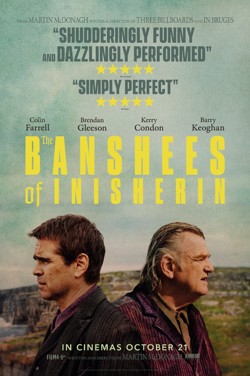
The Banshees of Inisherin (2022) is Martin McDonagh’s latest cinematic masterpiece. Not only is it one of the best films of the year he has, as with Three Billboards Outside Ebbing, Missouri (2017), constructed one of the most formidable screenplays of many a year. As a playwright McDonagh has won many awards for his works. His debut film, In Bruges (2008), was a deceptively simple story of two hitmen on the run which, with rich thematic power, became a darkly hilarious existential cult classic. His follow-up Seven Psychopaths (2012), a heady mix of criminals versus writers in a meta-fictional Hollywood-based narrative was brilliantly written and acted, if slightly lacking thematic clarity. Like Three Billboards Outside Ebbing, Missouri (2017), The Banshees of Inisherin (2022) is a highly emotional human drama which contains intelligent allegory, incredible characterization, and cracking dialogue.

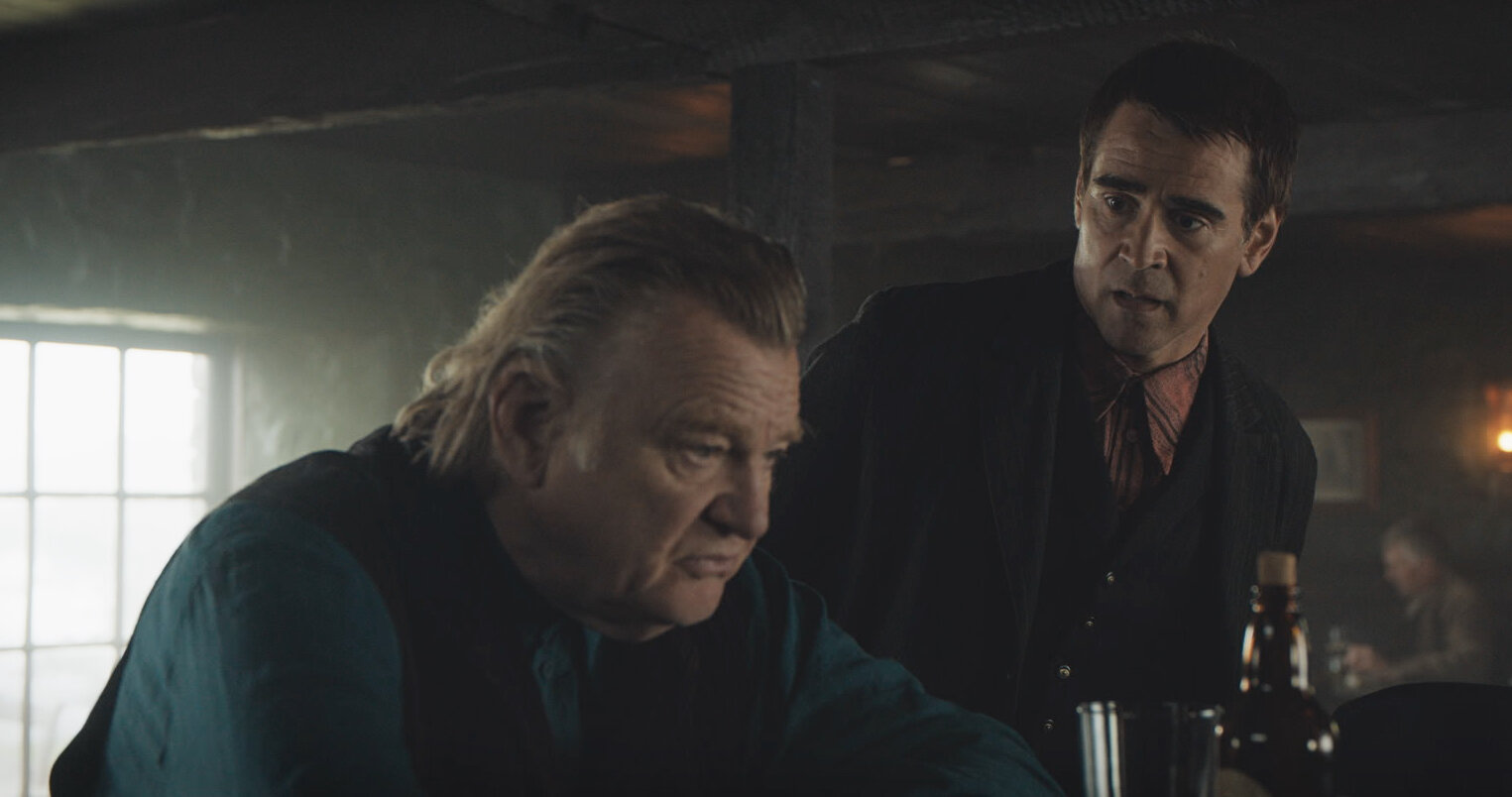
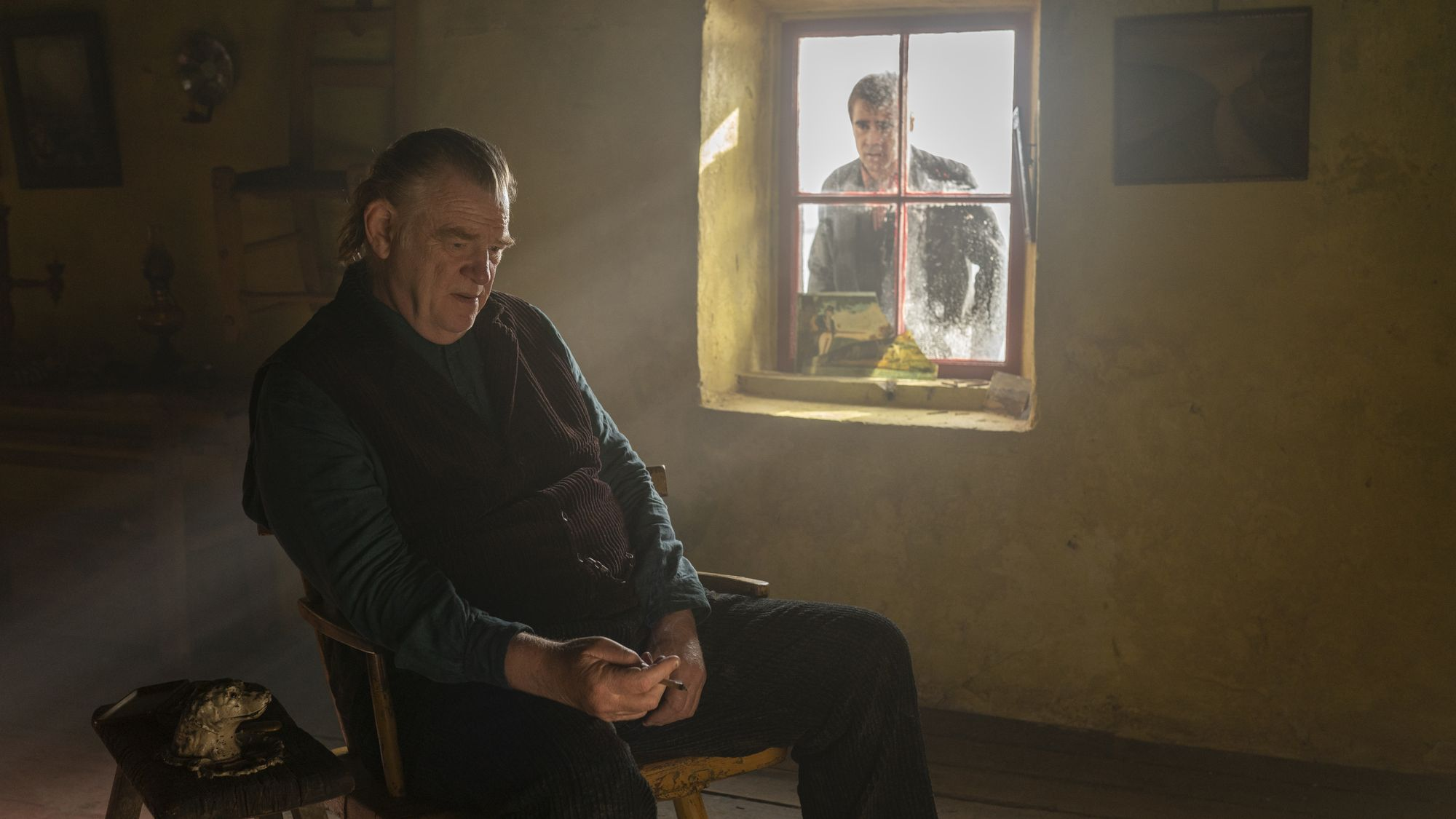
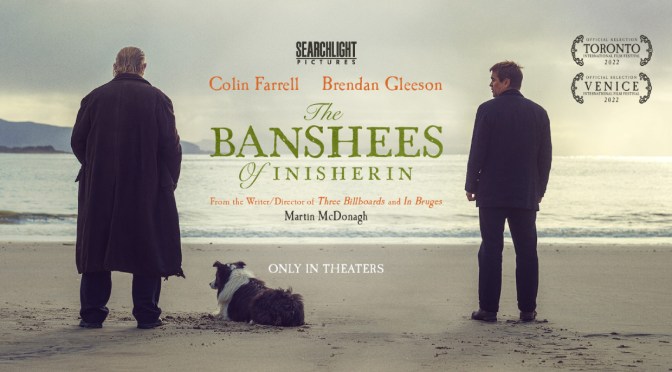
Set in 1923 on an island off of Southern Ireland called aptly Inisherin, the film opens by focussing on genial everyman farmer, Pádraic Súilleabháin (Colin Farrell) and his daily routine. After tending to his animals, he usually calls for his friend, Colm Doherty (Brendan Gleeson) to go to the island pub, the J.J. Devine or Jonjo’s. In England there is an idiom called, “sending someone to Coventry.” This means to ignore or ostracize an individual or individuals. So, basically Colm chooses to do this to his long-standing friend, Pádraic. This shunning completely bemuses Pádraic and despite Colm’s pleading for Pádraic to respect his wishes, he continually seeks an answer to his former friend’s decision.


After this intriguing premise is established, what follows is a tremendously original, darkly funny and emotionally penetrating succession of scenes. The exchanges between the two characters begins as bickering but then descends into some seriously disturbing acts of recrimination. Attempting to make them see sense are various eccentric characters on the island who provide many witty and absurd exchanges that McDonagh specialises in. Further, Pádraic’s sister Siobhán (Kerry Condon) is almost the one voice of reason as the feud escalates. As she tries to diffuse the conflict, even Barry Keoghan’s young idiot, Dominic Kearney, the initial comic relief in the film, attempts to make these two men see sense.

Visually, The Banshees of Inisherin (2022), is incredibly rich. The territory displays gorgeously photographed shots of the rocks, the sea, the stone roads and the lush green countryside. But while there is a sense of expanse and freedom initially, the feeling of isolation pervades. As the story continues the characters feel more and more segregated by the sea and their own or other’s decisions. None more so than Farrell’s Pádraic. A simple man who just wants to do his work and get drunk with his friend, he finds he is sequestered by Colm’s desire to self-isolate and concentrate on his music. Here, Farrell and Gleeson give tremendous character work. Farrell especially has rarely been better as Pádraic’s attitude turns initially from shock to bitterness over the journey of the narrative.


A film director’s job is for me about making key creative choices. Martin McDonagh makes brilliant choices while working from his own exceptional script. I loved everything about The Banshees of Inisherin (2022). The look, the performances, the pacing, the locations and Carter Burwell’s phenomenal score are absolutely first class. I haven’t even mentioned Barry Keoghan’s memorable supporting turn. He surely is one of the most naturally gifted actors of his generation. Not to forget other striking characters in the ensemble such as the creepy, Mrs McCormick (Sheila Flitton), an old harridan who acts as a portent for death on the island.

Martin McDonagh expertly combines a superb ear for dialogue, a psychologically absorbing analysis of the human condition with elements from Waiting For Godot and Channel Four situation comedy, Father Ted. Above all else, The Banshees of Inisherin (2022) is a darkly, spectacular cinematic experience which works on many levels. On one level it is about the isolation of island life and its inhabitants. On another it’s about the death of a friendship. While on yet another level it is about the analogous absurdity of civil war and how conflict can start for the merest of reasons. While the best cinema is certainly about showing and not telling, McDonagh proves again that dialogue-driven films can produce cinematic theatre, comedy and tragedy of the highest order.

Mark: 10 out of 11


“CINEMA” REVIEW: EMMA (2020)

“CINEMA” REVIEW: EMMA (2020)

Directed by: Autumn de Wilde

Produced by: Tim Bevan, Eric Fellner, Graham Broadbent, Pete Czernin

Screenplay by: Eleanor Catton

Based on: Emma by Jane Austen

Cast: Anya Taylor-Joy, Johnny Flynn, Josh O’Connor, Callum Turner, Mia Goth, Miranda Hart, Bill Nighy, etc.

Music by: Isobel Waller-Bridge, David Schweitzer

Cinematography: Christopher Blauvelt

**** MAY CONTAIN SPOILERS ****


With society and humanity constantly battered by recessions, pandemics, stock market crashes, famine, war, greed, prejudice, hatred, social media conflict, computer hacking, crime, exploitation, depression, addiction and any other number of apocalyptic threats, you can always rely on a good old-fashioned Jane Austen adaptation to create an escape from such woes. While I’m not a huge fan of Ms. Austen’s literary works, due mainly to ignorance on my part, I certainly recognise her genius as a storyteller. Indeed, she virtually single-handedly created, way back in the early 19th century, her own genre of romantic comedy in the Georgian-Regency period.

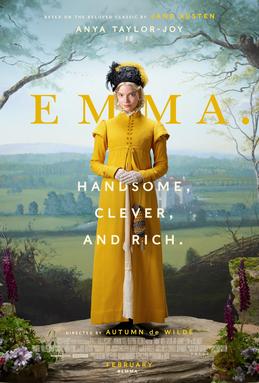
Emma was her fourth completed novel and released in 1815. It concerns the titular heroine, Emma Woodhouse. She is well-off, clever and someone who enjoys matchmaking and manipulating affairs of the heart. There have been many adaptations of the book on TV and film and aside from the loose Hollywood remake, Clueless (1995), I had not seen any of them. I only got roped into watching the latest version of, Emma (2020), directed by Autumn De Wilde, with Anya Taylor-Joy and Johnny Flynn in the leads, because my wife insisted on it. In marriage one must make sacrifices and compromises, so as it was our anniversary, I agreed to watch the film at home under “Cinema Rules.” I’m most glad I did too as I found it an extremely light but frothy work of entertainment.


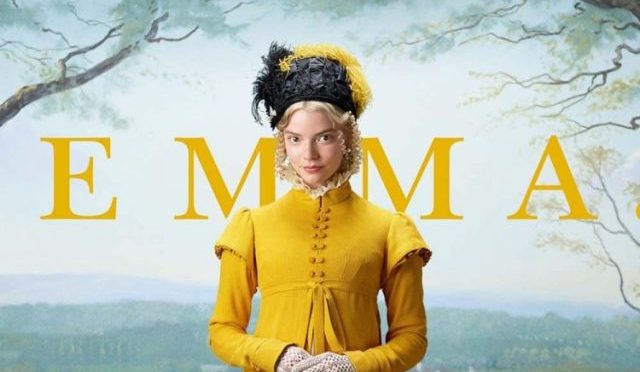
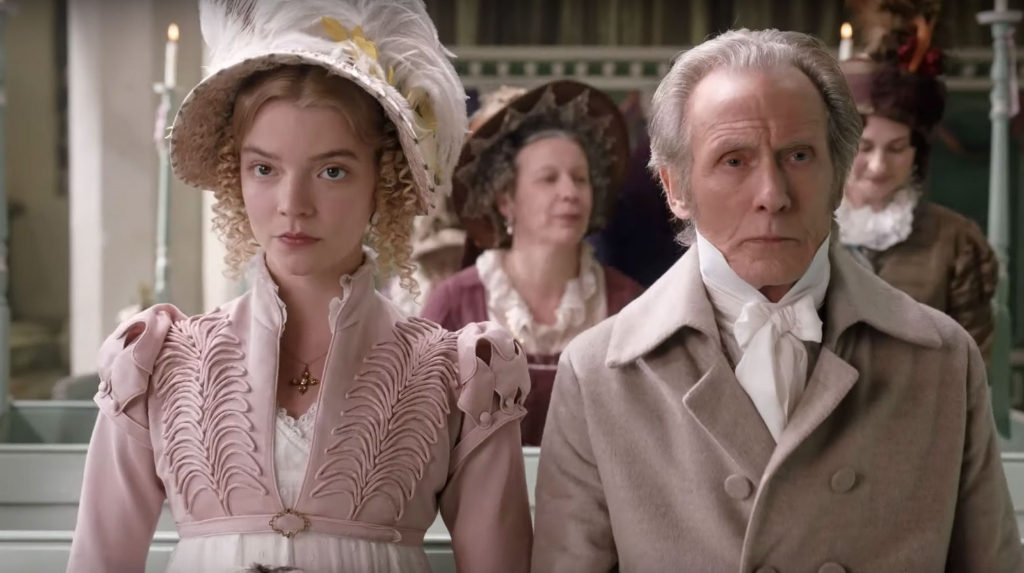
As I had little knowledge of the book I went into the narrative of Emma (2020) unburdened by scanning the differences between novel and film. At two hours in length one expects there to be some omissions, however, I would not have noticed. What I did gather was that this was a bright and very attractive looking production. The costumes, props, landscapes and interior locations were all deftly presented with vibrant colour design. Likewise, the cinematography, camera movement and editing are also delivered very sharply. This lends the literary adaptation a cinematic pace, splendour and verve which I wholly enjoyed. Furthermore, the appealing cast are wrangled impressively too. Anya Taylor-Joy, as the energetic schemer Emma, is technically very gifted. She brings a metronomic pulse to the screen and her chemistry with Johnny Flynn really resonates. Flynn, who I really rate as an actor, imbued his character, Knightly, with both warmth and likeable fortitude. In supporting roles Bill Nighy brings his usual class to proceedings, while Josh O’Connor steals the early scenes with his hilarious turn as an eccentric young vicar.

Let’s be honest though, the story and characters are a bit of a lightweight soufflé that could collapse under close scrutiny. I mean we are really in first world problems throughout as Emma attempts to pair her young ward, portrayed by the lovely Mia Goth, with the vicar, only to find such attempts backfire, ultimately spiralling out of her control. As such one could find Emma quite annoying, immature and emotionally stunted. That, though, is where Austen’s strength of writing memorable characters really shines through. Because Emma is someone who, while potentially unlikeable, eventually learns her lesson and changes her controlling ways. Lastly, with a tremendously attractive cast and production, some mild complexity of character and finally Jane Austen’s singing wit and dialogue, Emma (2020), overall, offers a delectable frisson of escapist cinema.

Mark: 8 out of 11