
Tag Archives: heroin

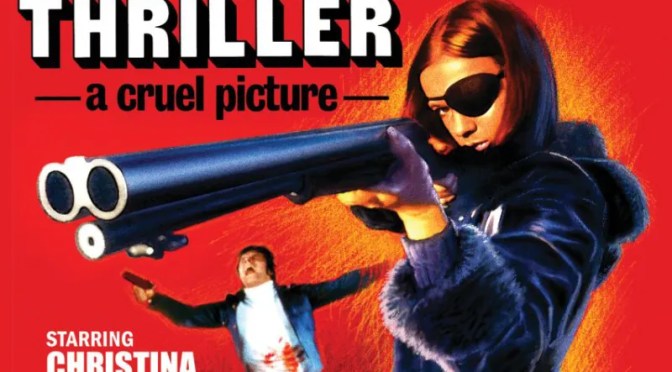
Cult Film Review: Thriller – A Cruel Picture (1974) – a shocking blend of X-rated exploitation and arthouse filmmaking!

Cult Film Review: Thriller – A Cruel Picture (1974)

Directed by Alex Fridolinski

Screenplay by Alex Fridolinski

Produced by Bo Arne Vibenius

Main cast: Christina Lindberg, Heinz Hopf, Despina Tomazani, etc.

Cinematography by Andreas Bellis

Edited by Brian Wikström

**Viewer discretion is advised – this film contains scenes that many will find disturbing**
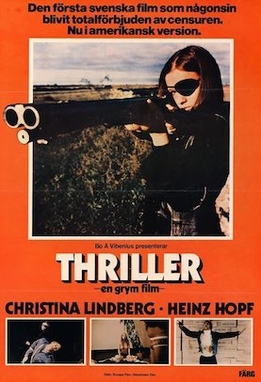


Thriller – A Cruel Picture (1973) (Swedish: Thriller – en grym film) is a 1973 Swedish exploitation film from writer-director Bo Arne Vibenius, working under the pseudonym Alex Fridolinski, starring Christina Lindberg and Heinz Hopf. Infamous for its unflinching depictions of sexual violence, drug abuse, and degradation, the film charts the ordeal of a mute young woman who is coerced into heroin addiction and forced into prostitution before embarking on a brutal campaign of revenge against her tormentors.

Released in the United States in a heavily cut version by American International Pictures—under lurid alternate titles such as They Call Her One Eye, Hooker’s Revenge, and The Swedish Vice-Girl—the film has earned a reputation as a deeply disturbing and confrontational work. Its graphic content and relentless tone make it a challenging and potentially distressing viewing experience, best avoided by those sensitive to extreme subject matter.

Unsurprisingly, due to the violent scenes, on-screen drug use, nudity and also inclusion of hardcore pornography, Thriller – A Cruel Picture (1973) was either banned outright or heavily censored on release. I had heard so much about this film on various YouTube videos expounding the shocking nature of the themes and scenes. Allied to this, Quentin Tarantino has also “championed” the movie and it’s star, Christina Lindberg. With this in mind the film I got tempted and purchased the recent Blu Ray version released in the UK. This version DOES NOT, thankfully, include the pornographic scenes which were filmed by the director with a Swedish couple who did live sex shows.

So, is Thriller – A Cruel Picture (1973) actually any good? Well, it is safe to say that it is a relentlessly harsh watch. That said, it would be unfair to dismiss the film outright as mere grindhouse provocation. Vibenius employs striking stylistic flourishes that elevate certain sequences into something oddly hypnotic. Most famously, the extended slow-motion shotgun reprisals—henchmen blasted backwards in balletic, almost operatic fashion—are staged with a visual patience that borders on the surreal. These, as well as the lengthy final act car pursuit sequence, are technically memorable, even as their brutality remains confronting.
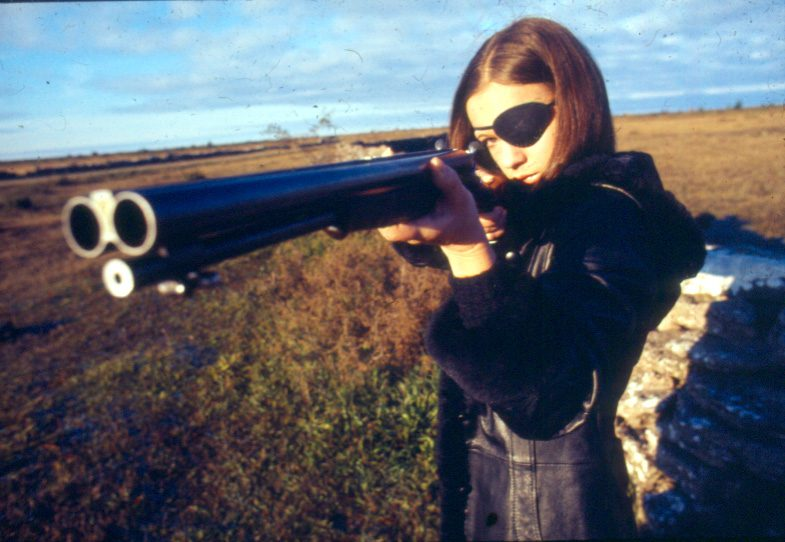


Where the film becomes almost nightmarish is in its internal logic. Once Madeline (Christina Lindberg) is captured and brutalized by the sadistic drug dealer Tony (Heinz Hopf), the narrative takes on a dreamlike, disjointed quality. Despite being forcibly addicted to heroin, she somehow manages to train herself in hand-to-hand combat, driving, and sharpshooting—preparing an elaborate revenge while still under the grip of addiction. The plotting feels less realistic than hallucinatory, as though the film operates on the logic of trauma and fantasy rather than grounded cause and effect.

A great deal of the film’s lasting impact rests on the striking screen presence of Christina Lindberg, as well as her character’s grim journey. Already known internationally in the late 1960s and early 1970s for her work as an erotic actress and glamour model, Lindberg brings an arresting, almost statuesque quality to the role. Her icy stare—especially once framed by the now-iconic eyepatch—gives the character a mythic, comic-book intensity. At the same time, the creative decision to render her character mute inevitably shapes how that performance is perceived. Silence becomes a stylistic device, amplifying the film’s cold and detached tone. The director’s choice to sidestep the demands of more dialogue-heavy dramatic scenes actually works in the film’s favour.

Overall, Thriller – A Cruel Picture (1973) is a film that oscillates between exploitation rawness and stark, almost avant-garde stylization. For hardened genre enthusiasts, it may be a grim curiosity with undeniable visual audacity. For many others, however, its graphic content and relentless tone will make it a deeply uncomfortable, even distressing experience. Proceed carefully.


CLASSIC FILM REVIEW: ONCE UPON A TIME IN AMERICA (1984)

CLASSIC FILM REVIEW: ONCE UPON A TIME IN AMERICA (1984)

Directed by: Sergio Leone

Produced by: Arnon Milchan

Screenplay by: Sergio Leone, Leonardo Benvenuti, Piero De Bernardi, Enrico Medioli, Franco Arcalli, Franco Ferrini

Based on: The Hoods by Harry Grey

Cast: Robert De Niro, James Woods, William Forsythe, Jennifer Connelly, Elizabeth McGovern, Joe Pesci, Burt Young, Tuesday Weld, Treat Williams, William Forsythe, Richard Bright, James Hayden, Brian Bloom, William Forsythe, Adrian Curran, Darlanne Fluegel. Larry Rapp, Mike Monetti, Richard Foronji, Robert Harper, Dutch Miller, Gerard Murphy, Amy Ryder, Julie Cohen etc.  

Music: Ennio Morricone

Cinematography: Tonino Delli Colli


***CONTAINS PLOT SPOILERS***


If you were, like me, thoroughly absorbed by Martin Scorsese’s recent directorial gangster epic, The Irishman (2019), you should definitely check out another incredible gangster drama, Once Upon A Time in America (1984). It is directed by acclaimed Italian filmmaker, Sergio Leone, he of “Spaghetti Western” fame. Indeed, Once Upon A Time in America (1984), was the first feature film he’d made since A Fistful of Dynamite (1971). Sadly, it was to be his final film.

With a director’s cut running at a behemoth 250 minutes and original theatrical release lasting 229 minutes, Once Upon A Time in America (1984), is certainly a marathon viewing experience and fitting epitaph to Leone’s cinematic craft. Yet, the film rarely feels over-long or slow because there are so many memorable scenes, fascinatingly complex characterisations, incredible intrigue and enough narrative density present to satisfy any audience member with the patience to let it absorb you. Structurally, the film is epic in nature too as it cross-cuts between three, arguably four, separate timelines in: 1918, the 1920’s, the 1930’s and 1968. Interestingly, I watched it via Amazon Prime in two sittings and is so long even the original ‘Intermission’ card remains.


Leone and his amazing production cast and crew took almost a year to film Once Upon A Time in America (1984). It’s reported to have had somewhere between eight to ten hours of footage on completion. He originally wanted to release it as a two-part epic, but the studio insisted it was distributed as one film. The almost-four hour theatrical release was received to great critical acclaim in Europe, however, a severely chopped down 139-minute version was put out in America. It was a critical and box office bomb. American critics however, lauded the European version, lamenting the non-release of Leone’s full cinematic vision.

For a filmmaker who was drawn to stories set in the America, Leone would generally film in European studios and locations. While some exteriors for Once Upon A Time in America (1984) were shot on location in Florida and New York, many of the interiors were recreated in Rome’s Cinecitta. Furthermore, a Manhattan restaurant was built in Venice, and incredibly, Grand Central Station was rendered at part of the Gare du Nord in Paris. Having said that, Once Upon A Time in America (1984), is so carefully and exquisitely designed and filmed, you would not notice. While possessing more than an air of European arthouse sensibilities, the film, based on a novel called The Hoods, represents Leone’s and his co-screenwriter’s tarnished vision of the American dream. Most significantly is the theme of a loss of innocence. 1920’s New York is presented through the eyes of these Jewish working-class children, many of them sons and daughter of migrants from Europe. These are tough times and the story explores the collision between young innocence and adult corruption by society and humanity. Once Upon A Time in America (1984) is also a story about friendship, loyalty, passion and crime.


The narrative revolves around the lives of young gang of Jewish friends growing up in Brooklyn called: Noodles, Max, Patsy, Cockeye and little Dominic. It’s majestic storytelling of the highest quality as we flit between past, present, now and future. Robert DeNiro’s older Noodles reminisces both from 1930 and 1968. There is a sense that he may be projecting from the hazy and drug-addled glow of an opium den. That is open to interpretation though. Thematically, the framework hangs a history of childhood friendships, juxtaposing it with the same people as adults and their victories, losses and betrayals. Further themes include: love, lust, greed, crime, broken relationships, Prohibition, union corruption; as well as focusing on the rise of mobsters in American society.

Noodles as portrayed by an imperious Robert DeNiro is calm on the outside, however, his often-rash actions show him as impetuous, emotional and wild on the inside. James Woods’ Max is much more careful, calculating and ice-cold in his business. But the two forge a friendship as teenagers which continues in adulthood. Their childhood gang subsequently becomes a renowned bootlegging and criminal outfit. Leone does not ask us to like or find sympathy for the characters, but rather respect that they are a product of a ruthless era. Sure, they could have got day jobs, but they decide to become criminals and very successful they are too. Even after Noodles gets out of jail for killing a rival, Max has saved a place for him in their illegal liquor trades. Only later does the true deception occur. Ultimately, while their stories are incredibly compelling, these men are violent lawbreakers who spill blood, bribe, threaten, kill and rape, all in an attempt to rise up the ladder of the American capitalist system.

I don’t want to spoil any more of the story, but safe to say the cast in this classic film are amazing. Along with DeNiro and Woods’ brutally convincing performances a whole host of young and older actors are directed beautifully by Leone’s careful hand. The standouts for me are Jennifer Connelly in a very early role. She portrays the younger Deborah, while Elizabeth McGovern is the older version of the same character. Connelly is a picture of angelic innocence and Noodles is smitten with her from the beginning. It’s sad therefore that when the adult Noodles’ is rejected by Deborah, his reaction is both toxic and unforgiveable.


Undeniably, sex and violence are powerful features in Once Upon A Time in America (1984). Sex especially is rarely, if at all, romantic or part of loving relationship. There are two brutal rape scenes in the adult years. Even when they are kids the character of younger Peggy is shown to use her promiscuity as a weapon to blackmail a police officer. There are some tender moments though, notably during the scene where young Patsy seeks to lose his virginity with Peggy. Her payment would be a cream cake, but Brian eats the cake and saves his innocence. Yet such scenes are fleeting as mob rule, violent robberies, fiery death and murder ultimately dominate the character’s bloody existences.

As I say, the actors all give memorable performances and the supporting cast including the likes of Treat Williams, Danny Aiello, Tuesday Weld and Joe Pesci are extremely strong too. A special mention to James Hayden who portrays the older Patsy. He doesn’t have the most dialogue compared to the characters of Max and Noodles; however, he has a quiet power which steals many scenes via strength of personality. The fact that Hayden died of a heroin overdose, in 1983, after completing filming only adds to the cult of tragedy. Dead at 30 years of age, James Hayden never got to see any completed version of Once Upon A Time in America (1984).

Given this review is getting near epic proportions itself I will begin to wrap up by heaping praise on the incredible production design. The costumes, locations, vehicles, props and era are slavishly and beautifully recreated. So much so you can almost smell the smoke as it drifts up from the Brooklyn streets. Moreover, the film is superbly photographed by Tonino Delli Colli. The music! I haven’t even mentioned the sumptuous score by the legendary Ennio Morricone. His score is a masterful symphony of haunting laments for loss of love, friendship, loyalty and life. Much indeed like Once Upon A Time in America (1984) itself, as a whole. In conclusion, if you haven’t seen it, I urge you to do so in the knowledge that Sergio Leone has transplanted that same brutally elegant vision of the Wild West to the American gangster genre with unforgettable emotional resonance and power.