Tag Archives: Humanity

Cinema Review: After the Hunt (2025) – a compelling exploration of #MeToo and #Cancel Culture polemics!

Cinema Review: After the Hunt (2025)

Directed by Luca Guadagnino

Written by: Nora Garrett


Produced by: Brian Grazer, Allan Mandelbaum, Luca Guadagnino

Main Cast: Julia Roberts, Ayo Edebiri, Andrew Garfield, Michael Stuhlbarg, Chloë Sevigny, Thaddea Graham, etc.

Cinematography Malik Hassan Sayeed

*** MAY CONTAIN SPOILERS ***
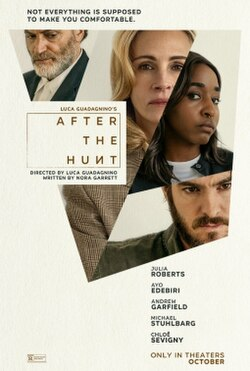


After the Hunt (2025), the latest work from Luca Guadagnino, further cements the director’s reputation as one of contemporary cinema’s most assured chroniclers of morally fraught, emotionally layered human drama. Having already proven his commanding directorial touch with Call Me by Your Name (2017) and Challengers (2024), plus a superior-than-the-original Suspiria (2018), Guadagnino again, from an insightful screenplay by Nora Garrett, demonstrates an uncanny ability to draw out great performances and create a sense of first world suspense that feels both sensual and cerebral.

Set within the hallowed halls of Yale University, After the Hunt (2025) delves into the ramifications of power, privilege, and academic integrity when allegations of sexual assault surface against a lauded professor, played by Andrew Garfield. The film positions itself within a lineage of stories interrogating abuses of power within established and esteemed hierarchies — in much the same way that Doubt (2008) examined such tensions within the church, and Tár (2022) explored them in the rarefied world of classical music. Guadagnino’s film strives for a similar level of psychological and thematic complexity, exploring how institutional prestige and human frailties often shield misconduct and complicity.
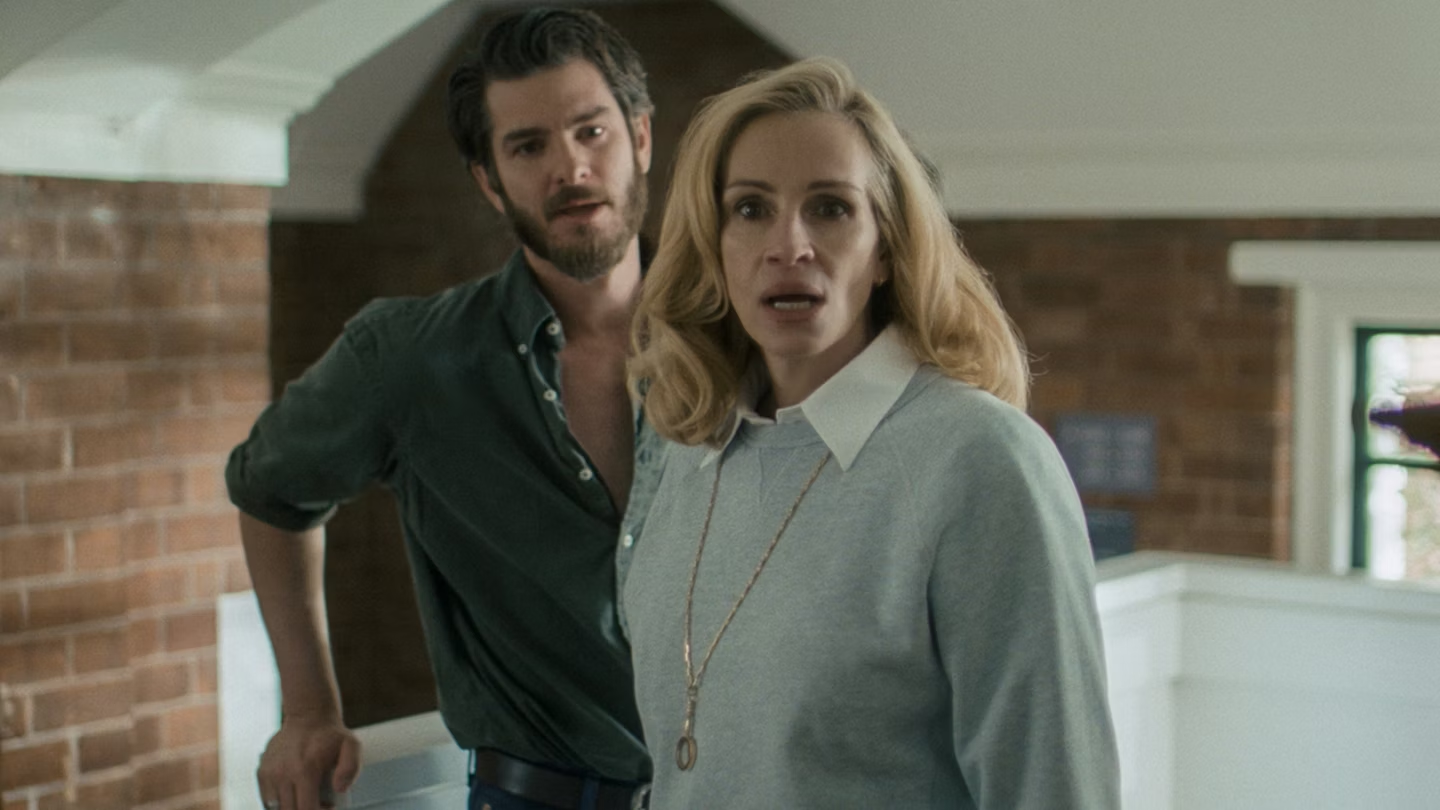


The main drama arrives after a dinner party hosted by philosophy professor Alma Imhoff (Julia Roberts) and her psychiatrist husband, Frederik Imhoff (Michael Stuhlbarg). Also present at the party are Alma’s colleague and longtime friend Hank Gibson (Andrew Garfield), who is also up for tenure, and Alma’s star PhD student Maggie Resnick (Ayo Edebiri). After the party, Maggie accuses a drunken Hank of sexual assault after he walks her home. Alma finds herself caught between loyalty to her friend and colleague, her own desire for academic tenure and her obligation as mentor to Maggie. Meanwhile, Alma’s own secrets—her illness and a youthful relationship situation that occurred as a teenager—begin to surface.

What follows is an intriguing and quite gripping drama about a series of flawed characters who may or may not make, depending on your viewpoint, good, bad, or terrible decisions. The acting is absorbing from the ensemble led by Roberts, with Stuhlbarg and Chloe Sevigny being the resident scene stealers. I frequently found myself drawn into the story as it navigates socially and culturally challenging situations, notably the “she said-he said” assault accusation and aftermath. However, the screenplay occasionally falters, particularly in its middle act. Thus despite the thematic suspense the plot omission such as a lack of criminal enquiry, plus the moment in which Garfield’s character is abruptly dismissed without any formal inquiry undercuts the film’s credibility and emotional momentum. For a story concerned with systems of accountability and institutional procedure, this narrative oversight was difficult for me to overlook.

Even so, After the Hunt (2025) remains an engrossing and well-crafted drama that showcases Guadagnino’s continuing fascination with human pride, weakness and moral ambiguity. Adroitly, there are a number of cheeky nods to cancel culture with the Woody Allen font-style credits and Morrissey / The Smiths songs featuring on the soundtrack. Yet, overall, and perhaps due to a lack of a cathartic ending, the story may have worked better as a stage play. Ultimately, it may not wield the same searing power as Doubt (2008) or Tár (2022), but it stands as another testament to Guadagnino’s skill as a go-to director for mature, provocative, and emotionally intelligent cinema.
Mark: 7 out of 11


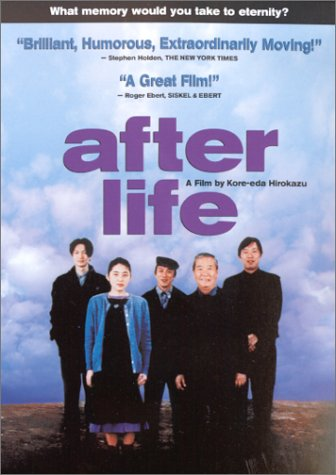
Hirokazu Kore-eda Film Reviews: AFTER LIFE (1998) and BROKER (2022)

BROKER (2022)

Directed and written by Hirokazu Kore-eda

Produced by Eugene Lee

Cast: Song Kang-ho, Gang Dong-won, Bae Doona, Lee Ji-eun
and Lee Joo-young.

Cinematography: Hong Kyung-pyo


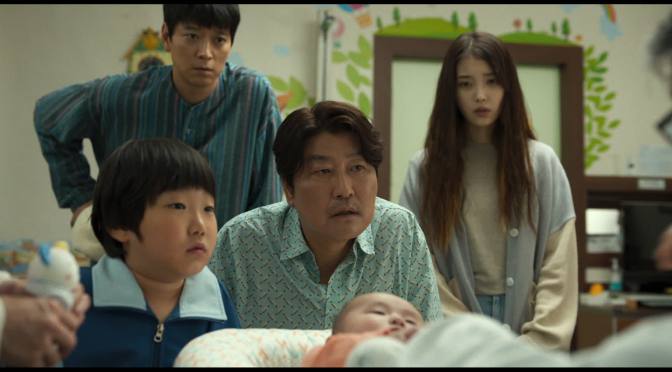
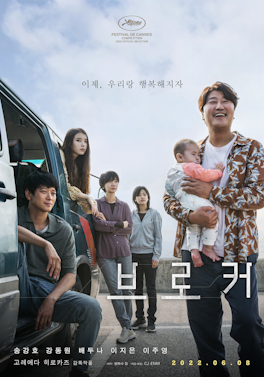
Arguably Japanese director’s Hirokazu Kore-eda’s most accessible film to date is the slice-of-life comedy-drama, BROKER (2022). Elements of Little Miss Sunshine (2006) meets Parasite (2019) meets Juno (2007) as kind-of-likeable and empathetic criminals create a dysfunctional family unit around stealing orphans and finding them families to makes ends meet. Lighter than many of his other brilliant human dramas, there is much to savour here from one of the best filmmakers working today.

There’s a lot going on in Broker (2022) as the duo of Sang-hyeon (Song Kang-ho) and Dong-soo (Gang Dong-won) work a grift of taking the unwanted babies, a police thriller involving murder, an impromptu road movie in a camper van, a cute kid looking for a surrogate father and a mother, Moon So-young (Lee Ji-eun) battling the dilemma of whether to sell or keep her child. A lesser filmmaker could have struggled balancing the many story, character and tonal shifts but Kore-eda manages it with aplomb.

Broker (2022) arguably has too many intertwining subplots though, as it strives to redeem all of the complex characters, but the wonderfully believable performances and brilliant screenplay really grabs you and rarely lets you go. Kore-eda’s direction is, as usual, masterly and assured as he balances the various tones confidently. Overall, this film makes you laugh, cry and is really moving as it highlights that family units can be lovingly born of collective experience, as well as blood.

Mark: 9 out of 11


AFTER LIFE (1998)

Directed and written by Hirokazu Kore-eda

Produced by Masayuki Akieda, Shiho Sato

Cast: Arata Iura, Erika Oda, Susumu Terajima, Sayaka Yoshino, Takashi Naito, Kei Tani, etc.

Cinematography Yutaka Yamazaki


What a delightful, surreal and beautiful film. AFTER LIFE (1998), is easily one of the most imaginative and human films I have watched in a long time. It is set in an administrative centre somewhere between the realms of life and death. Here the staff of the office, kind of social workers, welcome recently deceased people and ask them to recall their life and choose a single memory. After which the filmmaking staff will recreate the memory, shoot this scene and the souls will be able to re-experience this moment forever in heaven.

To me this is a mind-blowing concept for a feature film and I am surprised that it has not been remade (and probably ruined) by Hollywood for either cinema or TV. What makes it so great is, that despite the high concept idea, the design and delivery is so down-to-earth. The offices where events confirmed are not presented with any of the usual angelic or heavenly cliches. Instead, Hirokazu Kore-eda, of which this is only his second feature film, and his production team, decide that the after-life is an unglamorous place run by kindly bureaucrats.

One of the many strengths of After Life (1998) lies with the human representations, both the people who have passed and the office angels who counsel them. The love, humour and emotion derived from the various interviews given by many of the characters are full of joy, sadness and longing. Along with the soulful characters coming to terms with their recent passing, the narrative also focuses on two “young” counsellors, Takashi (Arata Iura) and Shiori (Erika Oda), who must overcome their personal conflicts while helping others. Overall, After Life (1998) builds slowly and beautifully weaves so many fantastic human stories. When the filmed memories are revealed my heart melted, as Kore-eda delivers cinematic moments that will stay with one eternally.

Mark: 10 out of 11


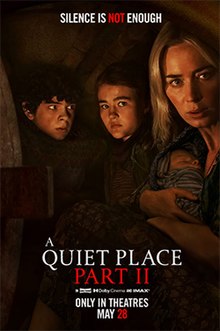
CINEMA REVIEW: A QUIET PLACE PART II (2021)

CINEMA REVIEW: A QUIET PLACE PART II (2021)

Directed by: John Krasinski

Produced by: Michael Bay, Andrew Form, Brad Fuller, John Krasinski

Written by: John Krasinski

Based on characters created by Bryan Woods and Scott Beck

Cast: Emily Blunt, Cillian Murphy, Millicent Simmonds, Noah Jupe, Djimon Hounsou and John Krasinski

Music by: Marco Beltrami

Cinematography: Polly Morgan

*** MAY CONTAIN SPOILERS ***


Ah, the difficult second album. Well, how do you follow up a genuine classic horror thriller such as A Quiet Place (2018)? I mean, it had everything, including a simple but devastating premise and an imaginative set of rules for the monstrous dangers facing the Abbott family. With hardly any fanfare or major marketing campaign the original film really got audiences flexing their “word-of-mouth” muscles. Throughout  A Quiet Place (2018) my heart was literally living in my mouth, as my fingers and knuckles clenched and whitened during the whole tense escapade. Plus, Emily Blunt and John Krasinski’s “every-couple” and their three children brought a believable humanity to the characters, with Blunt especially on phenomenal form in her reaction and character work.

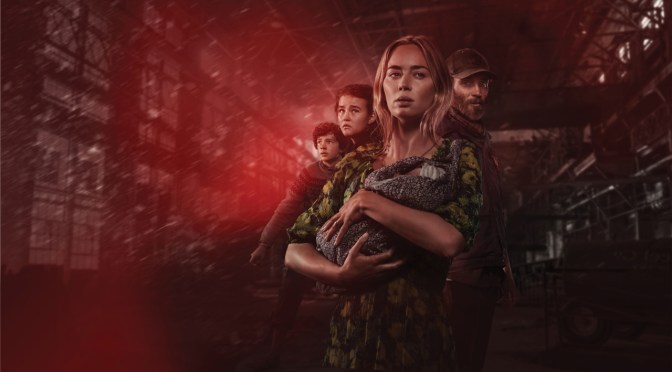
The sequel opens with a prequel sequence which illuminates how the world descended into chaos. Sadly, and not surprisingly, we only get a short time with John Krasinski’s action-dad, Lee Abbott, before he dives back behind the camera to direct this rattlingly good and highly tense horror/sci-fi mash-up. Thus, the weight of part two is left with Emily Blunt, Millicent Simmonds and the less effective, Noah Jupe character. Once again, the trio, plus baby, rely on dead silence in an attempt to remain uneaten by the blind-but-deadly alien creatures hellbent on making Earth’s inhabitants lunch. Along the way they bump into an apparent loner, Emmett, portrayed by Cillian Murphy. His jaded, shell of a man, hides a tragic secret and the last thing he wants is other people around to attract more devourers.


The story develops as the relationship between the Abbott’s and Emmett, while initially distrusting, becomes less hostile. However, he still wants them gone, much to Emily Blunt’s frustration. After all, any good mother wants to protect her children, as evacuating the factory setting could mean certain death. I have to admit I felt Emily Blunt’s major acting talents were not as well utilised as the first film. Indeed, it was Simmonds’ character, Regan, who had more development and heroic moments. It is Regan who is determined to discover a way out from the dark recesses of the filthy basement and clanking pipes. She may be foolhardy to some, but Regan has guts and makes important life-changing decisions for her family. Simmonds is compelling as she gives another mature performance in the role.

Overall, A Quiet Place – Part 2 (2021) is not as much as a surprise as the original film. How could it be?! I mean we now know what defeats the monsters, yet that doesn’t stop them being fierce predators and foes. Moreover, the use of sound design that was so brilliant in the first film is presented equally superbly in the sequel. While the film lacks for a decent plotline, as anyone who has their fill of zombie apocalypse films could testify, there remains some incredibly exciting chases and well directed set-pieces. Krasinski clearly had the Spielberg playbook to hand and that is certainly not a criticism, because I think he is definitely a talent to keeps tabs on. Thus, as my first film back at the cinema after yet another lockdown, I can definitely recommend A Quiet Place – Part 2 (2021), to take one’s mind off the horrors of real life for ninety-odd pulsating minutes.

Mark 8.5 out of 11


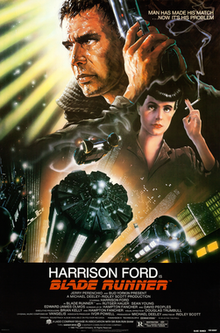
CLASSIC MOVIE SCENES #13 – BLADERUNNER (1982) – “TEARS IN THE RAIN.”

CLASSIC MOVIE SCENES #13 – BLADERUNNER (1982) – “TEARS IN THE RAIN.”

Directed by: Ridley Scott

Produced by: Michael Deeley

Screenplay by: Hampton Fancher and David Webb Peoples – based on the novel, Do Androids Dream of Electric Sheep by Philip K. Dick

Cast: Harrison Ford, Rutger Hauer, Sean Young, Daryl Hannah, James Edward Olmos etc.

Cinematography: Jordan Cronenworth

Music: Vangelis

*** CONTAINS MASSIVE SPOILERS ***


Philip K. Dick’s dense, dystopic and futuristic novel, Do Androids Dream of Electric Sheep (1968), is an ugly, beautiful, depressing, obtuse, hypnotic skip-through-treacle read full of incredible concepts relating to: Artificial Intelligence; robot technology; android simulacra; animal husbandry; apocalyptic disease; virtual reality/empathy mood tech; extinguished humanity; and ultimately, of course, mortality and death. The fact that Hampton Fancher and David Webb Peoples were able to fashion a workable screenplay for Ridley Scott to direct is a creative miracle. Moreover, it is testament to the writing and Scott’s incredible production team that, Bladerunner (1982), is held in such high esteem among cinema fans now.

The original Bladerunnerdespite bombing at the box office and subsequently going through a number of cuts, re-cuts, final cuts and re-re-re-releases, has become a bona fide science fiction cinema classic. I watched the original theatrical version recently and despite the deadpan Harrison Ford voiceover and spurious, tacked on “happy” ending, it actually has a lot going for it. Obviously the ‘Unicorn Dream’ re-edits released under the guidance of Ridley Scott are the purer versions but the film holds up notably because of Ford’s gruff, depressive and world-weary performance as Rick Deckard; the imperious psychopathy of Rutger Hauer as android assassin Roy Batty; Scott’s glorious tech noir rendition of our desecrated future; as well as the evocation of Philip K Dick’s thematic existential power.

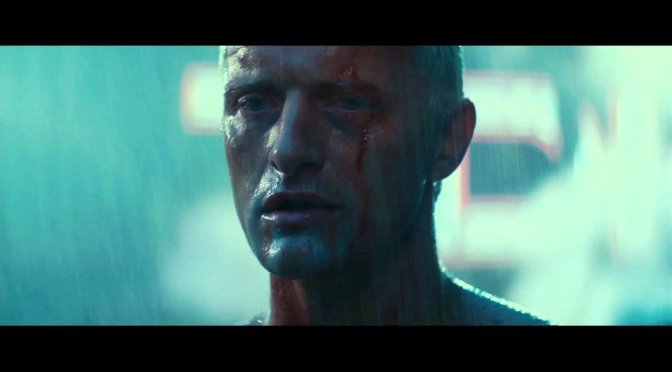
Such existential power is demonstrated in one of the final scenes where Batty has pushed Deckard to the edge of a building and death. The rain falls and the majestic soundtrack swells. A stripped down Batty, rather than let Deckard die, saves his life. It’s an ambiguous decision, but one of redemption for a replicant that is more used to delivering death. Perhaps, it proves that Batty does indeed have human qualities and Deckard will take up the cause. Delivering one final heartfound speech, Batty regales and laments the beautiful things he has seen. But they are gone – just like tears in the rain. It is a moving epitaph and amazing end to an incredible science-fiction classic. Batty closes down for good, but his demise and Hauer’s incredible performance will live long in the memory.


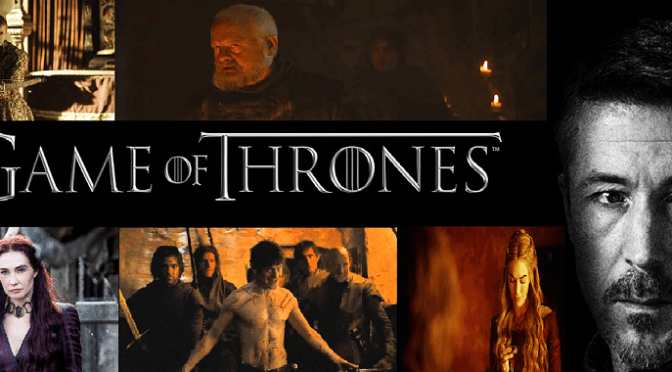
SIX OF THE BEST #8 – GAME OF THRONES’ MOST EVIL VILLAINS

SIX OF THE BEST #8 – GAME OF THRONES’ MOST EVIL VILLAINS

I’ve been enjoying the hell out of re-watching all the seasons of Game of Thrones and once again I take a look at six of the best things from HBO’s adaptation of George R.R. Martin’s amazing literary fantasy epics!  Game of Thrones has its fair share of nasty pieces of work so here, in my opinion, are the worst of the lot!

**CONTAINS MASSIVE SPOILERS – SEASONS 1 – 6**

CERSEI LANNISTER – LENA HEADEY

The quote, “Hell hath no fury like a woman scorned” was never more appropriate where Cersei Lannister is concerned. Brilliantly portrayed by Lena Headey her spite and evil is borne out of a sense of injustice; having been overlooked for leadership due to her gender by her father and the sexist nature of the time. This, I think, is forgivable if she wasn’t so bitter and twisted towards the likes of Tyrion (Peter Dinklage), Sansa Stark (Sophie Turner) and Margaery Tyrell (Nathalie Dormer) and didn’t openly revel in their suffering. Her plots aren’t always successful though because having given power to the ‘Faith Militant’ her plan backfired and she had to do the ‘Walk of Shame’. Having said that her revenge on the High Sparrow and his lot for this was, you have to hand it to her, explosive and devilishly realised.

CRASTER – ROBERT PUGH

Craster was Wildling pig of a man who was not only raping his own daughters for pleasure but using the male offspring as White Walker sacrifices in order to maintain his own safety. I understand that in desperate times desperate measures are required but to incestuously rape your own kin and farm them off to the deadly enemy takes the cake. Ultimately, he got his bloody comeuppance at the hands of another violent thug, the double-knifed traitor Karl Tanner (Burn Gorman). Having said that Tanner was just as vicious and having taken Craster’s Keep, he got a sword through the mouth from the heroic Jon Snow (Kit Harrington).

JOFFREY LANNISTER – JACK GLEASON

This snivelling-out-of-incest-born-cowardly-prick was a complete arsehole from the first episode. In true pantomime villain style, you could hear the screams of delight across the TV audience when he was poisoned at his own wedding in Season 4. He bullied all those around him that were weaker including the much maligned Sansa Stark and butchered prostitutes without a care in the world. What made this sister-brother-bastard-offspring even more odious is he was a complete coward too. He bottled it at the Battle of Blackwater and when he had the chance to show mercy for Ned Stark, gave the order for his decapitation. What a c—t!

LORD PETYR BAELISH – AIDEN GILLEN

With the voice of a hypnotic snake ‘Littlefinger’ is a very dangerous man indeed. In fact, he’s arguably the most evil of the lot as his plotting is virtually invisible and yet done in plain sight. A true Machiavellian he manipulates everyone using spies, soldiers, servants and prostitutes to do his watching and listening. His crimes are legion and include:  turning on Ned Stark to favour the Lannister’s; helping the Tyrell’s poison Joffrey to turn on the Lannister’s; pushing madwoman Lady Lysa Arryn to her death through the Moon Door to benefit himself; gaining Sansa Stark’s trust before finagling her into marrying the complete bastard Ramsay Bolton; and then turning on the Bolton family by taking the Knights of the Vale to defeat them. In short: he’s a brilliant and fiendish tactician up to the end of Season 6 that is, when he finds further rivals stopping his path to the Iron Throne.

MELISANDRE THE RED WOMAN – CARICE VAN HOUTEN

The Red Woman is a constant threat to all characters throughout the seasons of the show. She uses her committed fervour to the Lord of the Light, and her sexual wares,  to suck the life out of the people around her and bring bloody death to others. Essentially a human embodiment of the Succubus creature she gets her claws into Stannis Baratheon (Stephen Dillane) and convinces him the fire has named him the one and true King. Only after Stannis’ daughter is burnt at the stake as a sacrifice and Stannis is killed in the Battle for Winterfell does she admit she may have got it wrong?!? Having previously killed Renley Baratheon with black magic;  leech-raped Gendry (Joe Dempsie) for his blood; done for Stannis; she then turns her attention to Jon Snow. Indeed, even though she had brought him back to life he banishes her for the witch and jinx that she is.

RAMSAY BOLTON – IWAN RHEON

Beginning in some ways like a Northern Joffrey, the bastard Ramsay Snow was introduced as a possible ally to Theon Greyjoy (Alfie Allen), only to sneakily turn the tables and in fact reveal himself to be Theon’s captor. Unlike Joffrey he is cunning, as he proved getting information out of Theon, and actually a fierce fighter and killer. While he genuinely backs up his psychopathy with violent acts his means of killing people is gruesome to say the least. The Bolton’s do not take prisoners and instead skin their foes alive. While Ramsay delights in not only feeding his enemies to the dogs and sexually humiliating poor Sansa, he also cut Theon’s cock off in one of the most sickening acts of violence. In a TV show that is always imaginatively near-the-knuckle when it comes to torture this was utterly sickening. Sansa’s revenge on Ramsay has to be one of the most satisfying moments in the show’s history.