
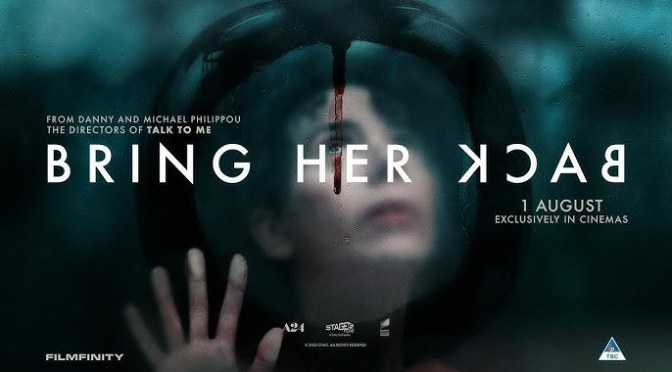
Cinema Review: Bring Her Back (2025)
Directed by Danny and Michael Philippou
Written by Danny Philippou and Bill Hinzman
Produced by Samantha Jennings, Kristina Ceyton
Cast: Billy Barratt, Sora Wong, Jonah Wren Phillips, Sally Hawkins, Sally-Anne Upton, etc.
Cinematography by Aaron McLisky
*** MAY CONTAIN SPOILERS ***

It’s become something of a cliché to lament the state of theatrical cinema: superhero fatigue, endless sequels, spin-offs and reboots, streaming overflow. Original stories—particularly in multiplexes—feel increasingly rare. Yet one genre has bucked the trend and, against all industry logic, placed original visions front and centre: horror. In an era of IP dominance, horror’s persistence as the great innovator is growing. It thrives on shadows, but in today’s cinema landscape, it’s also the brightest light.
Across the last few years, titles like Barbarian (2022), Pearl (2022), Skinamarink (2022), Nope (2022), Talk to Me (2023), Infinity Pool (2023), When Evil Lurks (2023), Late Night With the Devil (2023), Totally Killer (2023), Heretic (2024), Longlegs (2024), Sinners (2025), and the soon-to-be-reviewed, Weapons (2025) have proved again and again that audiences crave fresh nightmares. Even 28 Years Later (2025), though technically part of an ongoing series, represents a rare franchise event grounded less in brand synergy than in directorial reinvention and raw cultural appetite.
Unlike superhero spectacles or sci-fi epics, horror thrives on modest budgets and audacious ideas. A film like Skinamarink (2022), shot for a reported $15,000, can turn experimental textures into a viral theatrical moment. Personally, I found this film difficult to digest, however, the more commercial, Talk to Me (2023), made for $4.5 million, earned nearly twenty times that worldwide. These aren’t just hits; they’re validations of originality as a business model.

Horror is also a proving ground where young or unexpected filmmakers leap into the cultural spotlight. Zach Cregger (Barbarian (2022) twisted narrative structure into something memorable. The Philippou brothers Talk to Me (2023) translated YouTube viral adrenaline into terrifying cinematic language. But, what of their latest film, Bring Her Back (2025)? Well, for me they have surpassed their debut feature not only in genuinely sickening moments of dread, but also in terms of powerfully emotional horror scenes.
The narrative of Bring Her Back (2025) begins as it means to go on with a rapidly series of unsettling scenes. After discovering their father dead in the shower, 17-year-old Andy (Billy Barratt) and his partially sighted step-sister Piper (Sora Wong) are placed in the care of Laura (Sally Hawkins). Laura is an eccentric former counselor living on the outskirts of town and suffered the loss of her teenage daughter to drowning. In her home, the siblings encounter Oliver (Jonah Wren Phillips), a mute foster boy who seems terrified of the house’s locked outhouse. Andy eventually realizes Laura’s obsessive behaviour is far more threatening than he could imagine and they are all in danger.
Like Toni Collette in Hereditary (2018) and Lupita Nyong’o in Us (2019), Sally Hawkins delivers a powerfully intense performance that pushes horror into the realm of high drama. She carries the film with raw, nerve-shredding vulnerability, shifting from fragile grief to volcanic fury with startling precision. Every gesture—whether a whispered plea or a full-bodied breakdown—feels lived-in and emotionally scalding, grounding the supernatural terror in something painfully human. Also, Billy Barratt and newcomer Sora Wong offer excellent support as the in-peril ‘Hansel and Gretel’ siblings. Barratt is especially good carrying the audience’s fearful perspective.

The Philippou brothers draw on a potent brew of horror traditions—satanic ritual, grief, abduction, parental abandonment, and matriarchal hysteria—to craft Bring Her Back, a haunting and gut-wrenching descent into obsession. The film thrives on its willingness to plunge into emotional extremity, channeling raw pain into sequences of near-operatic dread. Several knife-in-the-teeth jolts of terror punctuate the story, as everyday necessities such as water, food and parental love are twisted into deathly hazards.
While the script occasionally wavers and certain narrative and backstory elements required sharpening, the thematic and emotional core remains undeniable. At its best, Bring Her Back (2025) isn’t just another exercise in occult horror—it’s a powerful study of grieving obsession, of the lengths people will go to fill a void that cannot be healed. The result is a film that lingers, not only for its shocks but for the raw ache that underpins them.



 The Cinema Fix presents