Tag Archives: Malachi Kirby

Cinema Review: Project Hail Mary (2026) – the end of the world has rarely been so much fun and bromantic!

Cinema Review: Project Hail Mary (2026)

Directed by Phil Lord & Christopher Miller

Screenplay by Drew Goddard

Based on Project Hail Mary by Andy Weir

Produced by Amy Pascal, Ryan Gosling, Phil Lord, Christopher Miller, Aditya Sood, Rachel O’Connor, Andy Weir, etc.

Main Cast: Ryan Gosling, Sandra Hüller, James Ortiz, Lionel Boyce, Ken Leung, Malachi Kirby, etc.

Cinematography by Greig Fraser

*** MAY CONTAIN SPOILERS ***
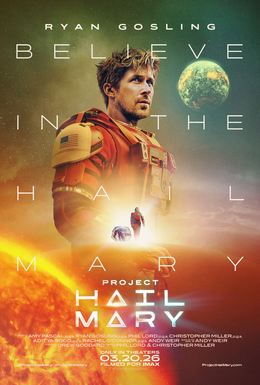


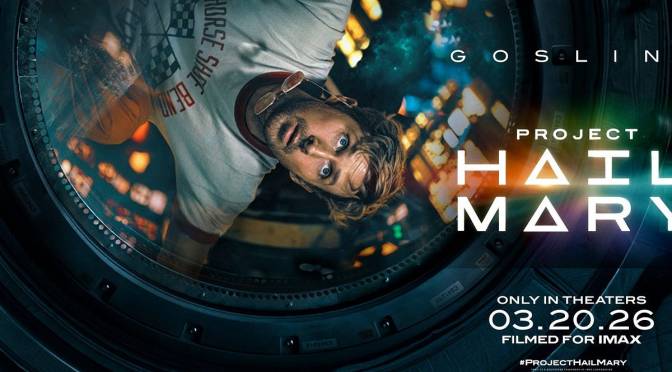
There’s a version of Project Hail Mary (2026) that could have been cold, clinical, and overly procedural—a hard sci-fi puzzle box drifting in the vacuum of its own cleverness. Instead, what Christopher Miller and Phil Lord deliver is something far more disarming: a big-hearted, funny, surprisingly emotional crowd-pleaser that turns the apocalypse into an oddly uplifting experience.

Adapted by Drew Goddard from Andy Weir’s novel, the film follows Ryland Grace (a perfectly cast Ryan Gosling), who awakens alone aboard a spacecraft with no memory of who he is or why he’s there. The early stretches lean into disorientation—Gosling playing confusion with a twitchy, almost comic anxiety—but as Grace pieces together his past, the film cleverly shifts into a dual-track narrative: one part interstellar survival story, one part Earthbound scientific scramble to stop a cosmic catastrophe.

Gosling is the film’s main weapon. He plays Grace not as a conventional hero, but as a reluctant participant—anxious, self-deprecating, and often hilariously out of his depth. His charm keeps the exposition buoyant, especially as the film dives into dense scientific concepts. Where the story could feel heavy, Gosling makes it breezy and Project Hail Mary (2026) is certainly more emotionally stimulating than the dreadful action thriller The Gray Man (2022) and the weak remake, The Fall Guy (2024).
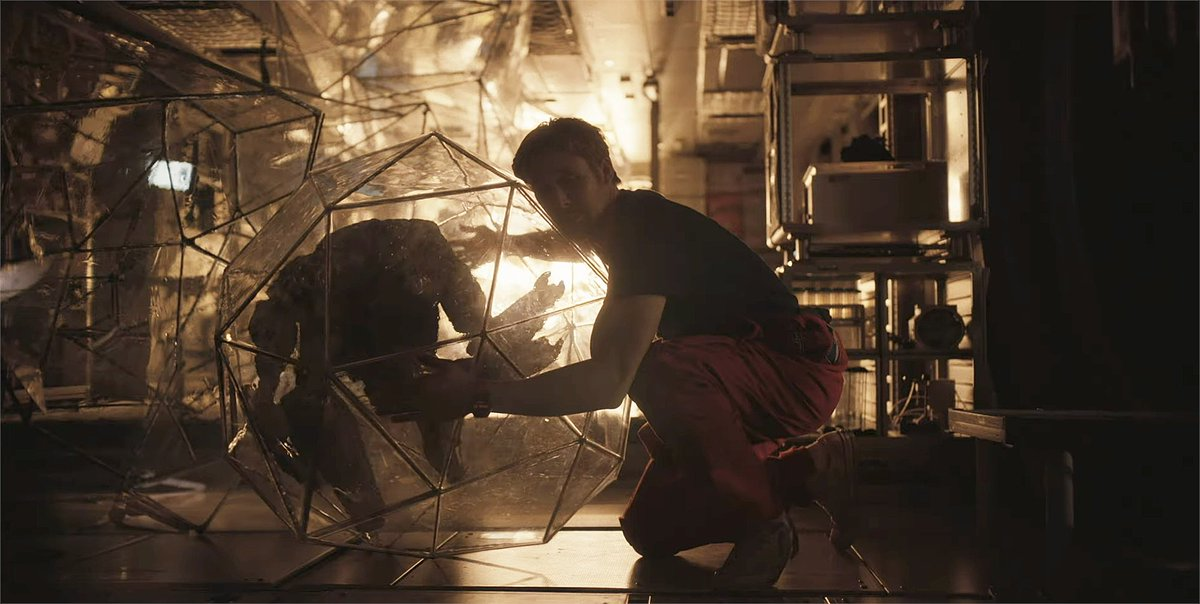


But the film’s most unexpected triumph is its central relationship: a deeply entertaining and genuinely moving “bromance” between Grace and an alien Xeonite – christened Rocky – he encounters in deep space. What begins as cautious interaction evolves into one of the most delightful interspecies friendships in recent sci-fi. Their communication—built from math, sound, and trial-and-error—becomes a source of both comedy and emotional resonance. It’s rare to see a blockbuster hinge so successfully on companionship rather than conflict, and the film is all the better for it.

Visually, Project Hail Mary (2026) is spectacular without being overwhelming. Lord and Miller balance scale with clarity; the vastness of space never drowns the intimacy of the story. The alien design is inventive, the astrophysical phenomena are rendered with awe-inspiring detail, and yet the film always remains grounded in character. It’s science-forward filmmaking that never forgets to entertain. Back on Earth, Sandra Hüller provides the film’s emotional anchor. Her performance carries a quiet intensity, grounding the global stakes in something human and immediate. Where the space sequences soar, her scenes remind us what’s at risk—and why it matters.

Goddard’s script is sharp, witty, and structurally satisfactory. It juggles timelines, scientific jargon, and character development with impressive ease, finding humour in the bleakest situations without undercutting the stakes. There’s a rhythmic confidence to the storytelling that keeps the film propulsive even as it pauses for introspection. What ultimately makes Project Hail Mary (2026) stand out, though, is its tone. This is, unmistakably, a feel-good end-of-the-world movie. It finds optimism not in denying catastrophe, but in confronting it with curiosity, cooperation, and friendship. By the time the credits roll, what lingers isn’t just the spectacle or the science—it’s the warmth. A book and film about extinction becomes, improbably, a story about connection.

Mark: 8.5 out of 11

BBC FILM REVIEW: MANGROVE (2020)

BBC FILM REVIEW: MANGROVE (2020)

Directed by: Steve McQueen

Produced by: Anita Overland, Michael Elliot

Screenplay by: Steve McQueen, Alastair Siddons

Cast: Letitia Wright, Shaun Parkes, Malachi Kirby, Rochenda Sandall, Nathaniel Martello-White, Richie Campbell, Alex Jennings, Jack Lowden, Darren Braithwaite, Sam Spruell, Samuel West, Llewella Gideon, Jodhi May, Gary Beadle, Jumayn Hunter, Duane Facey-Pearson, etc.

Music by: Mica Levi

Cinematography: Shabier Kirchner

Original Network: shown on the BBC as part of the Small Axe anthology

***CONTAINS HISTORICAL SPOILERS***


“So, if you are the big tree… We are the small axe… Ready to cut you down… To cut you down…” — Bob Marley song, Small Axe


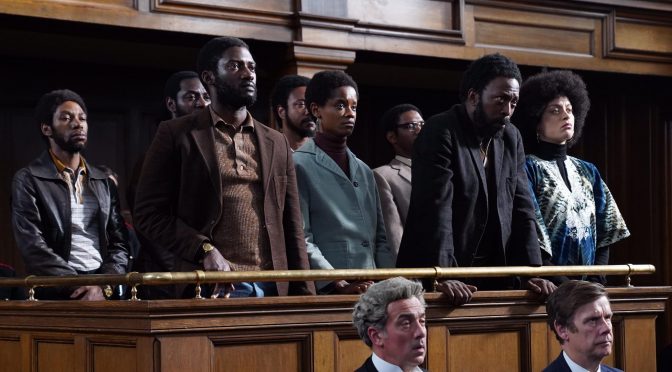
You wait for a thought-provoking courtroom drama about individuals battling an oppressive legal system and end up watching two in two days. It wasn’t a specific plan to follow up my viewing of The Trial of the Chicago Seven (2020), by watching Steve McQueen’s majestic adaptation of the ‘Mangrove Nine’ narrative, but it was most certainly historically and culturally serendipitous. However, while Aaron Sorkin’s entertaining distillation of the 1968-1969 events, which occurred at the Democratic National Convention and subsequently in the U.S. courts, were delivered in an irreverent and satirical style, Steve McQueen’s approach to the systematic racism and brutality of the police force and legal battle which followed in Mangrove (2020), is treated with far more intensity and power.

Mangrove (2020) is the first in a set of five films curated, written and directed by Steve McQueen, in what has become known as the ‘Small Axe’ anthology. It premiered at the London Film Festival in 2020, before being released on the BBC television network. The aim of the ultra-talented McQueen, and his writers, cast and crew is to reflect important historical figures and events from West Indian culture in the 1960s, 1970s and 1980s. Mangrove (2020) centres on the trial of the ‘Mangrove 9’, namely Frank Crichlow, Darcus Howe, Althea Jones-Lecointe, Barbara Beese, Rupert Boyce, Rhodan Gordon, Anthony Innis, Rothwell Kentish; and Godfrey Millett. They were seen as leaders of protests which occurred in August 1970, that resulted in battles with police on the Notting Hill streets. While original charges were thrown out by a magistrate, the then Director of Public Prosecutions decided the case should go to court in 1971.


The excellent screenplay by McQueen and his co-writer Alastair Siddons expertly establishes the era and setting of the story. Similarly, the production design perfectly captures the look of late 1960’s West London. Shaun Parkes’ portrayal of Frank Critchlow is both moving and influential in drawing the viewer into the character’s desires and culture. Critchlow opens the Mangrove Restaurant in 1968 with a longing to establish a place that serves West Indian food; and provide a meeting place within the community. Alas, due to the heavy-handed approach by the police in the area, led mercilessly by Sam Spruell’s P. C. Frank Pulley, Critchlow’s dream is left in tatters by constant raids and arrests. It is the Metropolitan Police’s belief that the Mangrove Restaurant is a hive of criminal activity and drug use. No drugs were found during these raids, thus Critchlow filed charges himself of unlawful arrest. Eventually, Critchlow, Howe, Jones-Lecointe and others became involved in marching and protesting at what they saw as clear racial prejudice by the police.

My emotions while watching the events unfold, from the clashes with police to the subsequence court case, was that it is tragic that there was such violence and division between people of the Commonwealth and the authorities. After all, West Indians were invited by the British Government to come to here in the 1950’s, to help rebuild post-war Britain. Obviously, not all British people rejected them, however, clearly there was an incredible amount of racism and abuse, here illustrated by the police’s horrific attitude in Mangrove (2020). Thus, Steve McQueen and his exceptional cast deserve all the plaudits coming their way in bringing such a vital legal case to the screens. The Mangrove 9’s case is emblematic of the horror of ignorance that has occurred in British history and that we must continue to stamp out vitriolic actions based purely on cultural difference and the colour of an individual’s skin. In representing such important events and individuals moreover, Steve McQueen has delivered one of the most powerful films of 2020.

Mark: 10 out of 11