Tag Archives: Mark Ruffalo

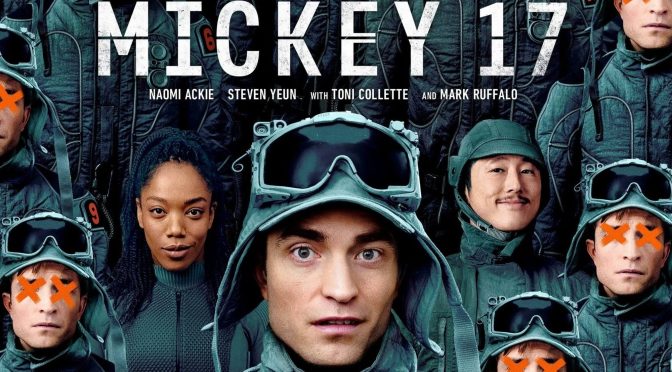
Cinema Review: Mickey 17 (2025) – a multi-faceted sci-fi adaptation that leaves one drunk, but somehow still thirsty!

Directed by Bong Joon Ho

Screenplay by Bong Joon Ho – Based on Mickey 7 by Edward Ashton


Produced by Dede Gardner, Jeremy Kleiner, Bong Joon Ho and Dooho Choi

Main Cast: Robert Pattinson, Naomi Ackie, Steven Yeun, Toni Collette, Mark Ruffalo, Patsy Ferran, Cameron Britton, Daniel Henshall, Anamaria Vartolomei, etc.

Cinematography by Darius Khondji
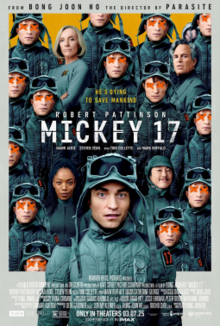


Bong Joon Ho’s adaptation of Mickey 7, the 2022 sci-fi novel by Edward Ashton, showcases a compelling convergence of the director’s distinctive thematic interests with the novel’s narrative. Known for his ability to blend genre elements with incisive social commentary, Bong’s version of Mickey 7, now titled Mickey 17 (2025) is a comedic, at-times-crazy and imaginative sci-fi film exploring human resilience, class struggles, scientific malpractice, environmental abuse, genocidal terra-forming, plus the existential impact of technology within the workplace.

Robert Pattinson is the eponymous Mickey, a “disposable” worker sent on perilous missions to terra-form a distant planet, with his life repeatedly put in danger only for him to be replaced if he dies. This directly ties into Bong’s recurring exploration of human resilience in the face of dehumanizing systems, something seen in his earlier films, such as Snowpiercer (2013) and Okja (2017). Bong’s protagonists are often ordinary people facing systems designed to strip away their individuality, and Mickey’s repeated resurrections emphasize the fragility of life within these systems.

Another prominent theme in Bong’s films is the exploration of class and social inequality. In Parasite (2019), he delved into the gap between the wealthy Park family and the impoverished Kim family, using the home as a microcosm of societal hierarchies. In Mickey 17 (2025), the corporate-driven space mission echoes the exploitation seen in these films. Mickey’s status as an expendable worker mirrors the broader economic systems that exploit individuals for labour without regard for their well-being. The fact that Mickey is repeatedly discarded without consequence is an unsettling reflection of how capitalist structures often devalue human life for the sake of profit.

Bong has always critiqued the alienation of labour, especially how working-class individuals are treated as replaceable cogs in the machine. In Mickey 17 (2025), this theme is amplified as Mickey’s life is literally expendable, offering a stark commentary on the commodification of labour within the context of futuristic colonization. The struggle for survival and dignity, against an uncaring corporate entity, will likely resonate with themes Bong has previously explored. Likewise, in Memories of Murder (2003), the search for truth is tied to the characters’ understanding of themselves and their roles in society. Such societal and existential crises fit perfectly with Bong’s broader thematic preoccupation with the fragility of the human experience in the face of overwhelming, often oppressive, external forces. The question remains: is Mickey 17 (2025) any good?
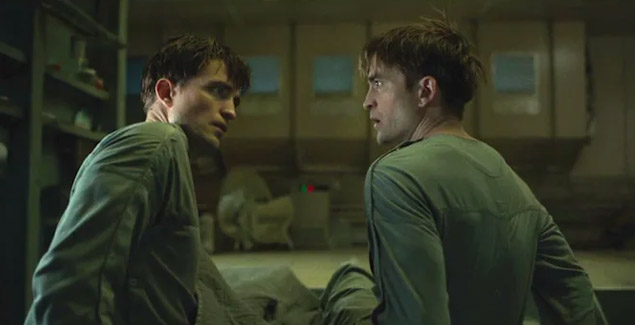


Robert Pattinson, who plays various versions of the titular character Mickey, brings his signature range of brooding intensity and offbeat charisma to the role. His performance is a key part of what makes the film such an intriguing watch. Pattinson excels in portraying Mickey’s emotional journey—a man repeatedly resurrected after dying in increasingly perilous circumstances, struggling with his own identity, and questioning the morality of the system that disposes of him so easily. However, Pattinson’s performance also contributes to the film’s unevenness. While his portrayal is captivating, the character’s arc and motivations can occasionally feel too vague or inconsistent, leading to moments where it’s unclear whether Mickey is supposed to be a tragic figure, a comic relief, or something in between.

The visual effects in Mickey 17 (2025) are nothing short of stunning. Bong Joon Ho, along with his team, creates a visually immersive universe, blending futuristic technology, the planet landscapes of Niflheim, quirky alien creatures and mind-bending visuals to evoke a sense of awe. The digital photo-copying resurrection process that Mickey undergoes is a feat of visual storytelling, with the film using cutting-edge effects to show Mickey’s multiple deaths and resurrections in creative and striking ways. The film’s alien planet, with its strange, luminous terrain and exotic creatures, also adds a surreal and fantastical quality to the narrative. Indeed, the theme of environmental and indigenous protection is vital, but does eventually clash with that of the existential worker.

Where Mickey 17 (2025) truly shines—and stumbles—is in its wacky, unpredictable storytelling. Bong Joon Ho has always been a director unafraid to blend genres and tones, and here he creates a narrative that swings wildly between dark comedy, sci-fi absurdity, and existential dread. One moment, you’re laughing at Mickey’s off-kilter interactions with his fellow colonists, and the next, the film veers into dark, serious territory as Mickey grapples with his own mortality and the ethical dilemmas of his existence. Moreover, the film’s narrative structure itself is erratic. There are moments where the plot careers off course, lost in the chaos of its high-concept premise.

As Robert Pattinson’s charismatic, multi-faceted performance anchors the film, the performances of Mark Ruffalo and Toni Collette—as the grotesque antagonists—topple the tone too far into bad theatre. Finally, Bong Joon Ho’s trademark brilliance is evident throughout, but Mickey 17 (2025) ultimately suffers from the very risk-taking that makes it unique. It’s a thrilling, uneven ride that fascinates, frustrates, makes one laugh and leaves you with a lot to think about—once the space dust has settled. Perhaps I should have had what Bong Joon Ho and his production team were drinking before I watched it. If so, I should certainly of made it a double!

Mark 7.5 out of 11


CINEMA REVIEW: POOR THINGS (2023)

CINEMA REVIEW: POOR THINGS (2023)

Directed by Yorgos Lanthimos

Screenplay by Tony McNamara


Based on Poor Things: Episodes from the Early Life of Archibald McCandless M.D., Scottish Public Health Officer by Alasdair Gray

Produced by Ed Guiney, Andrew Lowe, Yorgos Lanthimos and Emma Stone

Main cast: Emma Stone, Mark Ruffalo, Willem Dafoe, Ramy Youssef, Christopher Abbott, Kathryn Hunter and Jerrod Carmichael.

Cinematography by Robbie Ryan


*** MAY CONTAIN SPOILERS ***


I have now seen all of Greek filmmaker Yorgos Lanthimos’ most recent directorial works, namely: Dogtooth (2009), Alps (2011), The Lobster (2015), The Killing of a Sacred Deer (2017), and The Favourite (2018). Collectively they defy conventional film styles and tropes to deliver absurd, surreal, funny, disturbing, thought-provoking, erotic and imaginative visions of human behaviour. Also, let’s not forget the writers too; so kudos to his writing partner Efthymis Filippou, and latterly Tony McNamara, who have combined with Lanthimos to create such memorable cinematic offerings.

The director’s early lower-budget dysfunctional comedy-dramas such as Dogtooth (2009), and Alps (2011) are unforgettably strange films to experience. They feature uncomfortable depictions of family, sex, death and relationships. While offbeat, you sense they are from the mind of a filmmaker seeking to provoke thought rather than exploit. While equally dark and strange The Lobster (2015) is clearly more comedic, even though it probes strange love, fascism and violence within romantic relationships. Further, in The Killing of a Sacred Deer (2017), Lanthimos and Filippou, in Godardian fashion, constantly called attention to cinema form; especially with a strangely effective form of anti-acting within the arguably more conventional revenge narrative. Whereas in The Favourite (2018), Lanthimos’ delivered a unique period satire, with the language and behaviour of the characters often crude and shocking. His visual choices are always fascinating, with his use of the fish-eye lens creating a distorted effect that made the characters seem trapped by their surroundings and circumstances.


With the success of The Favourite (2018), both critically and commercially, Lanthimos has of late been given an increased budget, reported as $35 million. His bold choice, along with screenwriter Tony McNamara is to adapt award-winning novel, Poor Things: Episodes from the Early Life of Archibald McCandless M.D., Scottish Public Health Officer by Alasdair Gray has produced by far the most originally conceived and fantastic genre-bending comedy, drama, horror, rites of passage and salacious film of many a year. If there is a more bizarre, enthralling and enjoyable film of 2024, than Poor Things (2023) then this will be a most excellent year for cinema releases.

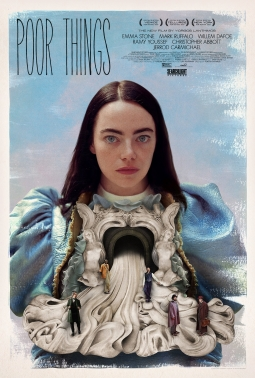
Set in Victorian London, we are introduced to the rather eccentric household of Dr Godwin “God” Baxter, an expert but secretive surgeon whose home hides bizarre animal experiments, and the beautiful but frankly odd human specimen, Bella Baxter (Emma Stone). Entering this weird abode of pig-hens and goose-dogs, comes innocent medical student, Max McCandless (Remy Youseef). “God” asks Max to assist with the childlike Bella’s development, charting her daily physical, speech and mental growth. Now, if you think the chimeric beast experiments are disturbing then brace yourself for the events of Bella’s ‘Frankensteinesque’ happenstance. I am not going to spoil it here, but it truly is a fantastic concept as invented by the author, Alasdair Gray, to contemplate. I was teetering on the fence with the film until this stunning reveal was given, but then I was committed to this medical oddity.


The first act finds Bella developing her speech, emotions and intelligence, as if a young child growing within this woman’s body. Bella also locates her libido and begins experimenting with her lust to great pleasure. Here Lanthimos continues exploring the themes of previous films with sex not only a natural expression of humans, but also an act used to control and drive people mad. Enter Mark Ruffalo’s caddish lawyer, Duncan Wedderburn who spirits a willing and rebellious Bella on a European trip. One where she truly discovers and satisfies her continual carnal desire or “furious jumping” as she hilariously calls it. Bella’s rites of passage, frankness and rapid growth threatens Duncan’s masculine insecurities and he finds it difficult to control her. Here the hilarious screenplay shows Bella and Duncan becoming more and more fraught until she craves further independence from his cloying envy. The central theme of Bella overcoming the chains of controlling masculinity dominates right up until the extremely dark final act.

While there is a lot of sex and nudity in this film, I felt that Lanthimos balances the exploitative nature of such material by contextualising it within Bella’s fascinating character arc. Emma Stone also provides a complex performance, funny and moving, as the woman-child discovering her mind, body, soul and the world. Ruffalo is particularly over-the-top as the sneaky but pathetic reprobate, Wedderburn. While Remy Youssef’s young medical student adds some compassionate balance within the ensemble, Willem Dafoe gives his customary brilliant turn as the tragic man of science. He himself had his childhood tainted by a father determined to use Godwin Baxter as a human guinea pig.

With a spectacular production design that employs a rich palette of colours, sets, lighting and immaculately furnished rooms, Lanthimos, stamps his authorial style along with genius cinematographer Robbie and his array of lens. Such creative choices evolve a spectacularly hyper-real vision of Victoriana. Indeed, the form and style coalesce with the content and themes in Poor Things (2023) to create what could already be the favourite film of my year. The screenplay dares to provoke the audience with gender political, sociological, historical and hysterical analysis as Yorgos Lanthimos again proves himself to be one of the most original filmmakers of his generation. Owing much to the imagination of Alasdair Gray’s source book, this is a shocking and explicit Frankenstein’s monster of a film. Lastly, it had me consistently thinking and laughing throughout, testifying to the power of family, however dysfunctional that Victorian household may be.

Mark: 10 out of 11


DARK WATERS (2019) – CINEMA REVIEW

DARK WATERS (2019) – CINEMA REVIEW

Directed by: Todd Haynes

Produced by: Mark Ruffalo, Christine Vachon, Pamela Koffler

Screenplay: Mario Correa, Matthew Michael Carnahan

Based on “The Lawyer Who Became DuPont’s Worst Nightmare” by Nathaniel Rich

Cast: Mark Ruffalo, Anne Hathaway, Tim Robbins, Bill Camp, Victor Garber, Bill Pullman, William Jackson Harper, Mare Winningham etc.

Cinematography: Edward Lachman

**MAY CONTAIN SPOILERS**


Every now and then one watches a film you kind of wish you hadn’t. Not because it is bad, quite the contrary with director’s Todd Haynes’ legal drama, Dark Waters (2019). No, you wish you hadn’t watched it because it unveils a tragic series of events relating to environmental, corporate, chemical, legal and human corruption. I prefer to possess hope that human beings can be trusted to do the right thing. However, based on this story that is definitely not the case. Moreover, given the information revealed about huge corporation, DuPont, and their environmental procedures, it’s a damning indictment against corporate greed and community murder.

A two-hour film is certainly not long enough to do justice to a story which has taken decades to unfold and cost the lives of many people and animals, while irreparably damaging the environment in the process. However, it effectively bullet points the crimes of the DuPont conglomeration in a riveting fashion. At the heart of it is corporate lawyer, Robert Bilott, here portrayed by the always excellent, Mark Ruffalo. Beginning circa 1998, Bilott, is approached by farmer Wilbur Tennant (Bill Camp) whose livestock have died or been culled due to tumours and other cancerous illnesses. Bilott who is usually employed to act as a lawyer FOR the big companies, investigates further. Subsequently he uncovers something rotten in the state of West Virginia.


Mark Ruffalo as Bilott inhabits an intelligent, caring and dogged man, driven by his desire to see justice for Wilbur Tennant and the people of Parkersburg. It’s often remarked Ruffalo would make a great Columbo; and like that famous fictional TV detective, Bilott never ever gives up. This is even in the face of years and years of environmental tests, litigation, DuPont’s dirty legal tactics and hundreds of court appearances. Anne Hathaway as his wife Sarah Bilott is also good, although her role is slightly underwritten. Bill Camp impresses though in his turn as the exasperated farmer whose life and livestock has been destroyed by synthetic chemical waste dumped into adjacent land.

Like A Class Action (1991), A Civil Action (1998) and Erin Brockovich (2000), this film rarely transcends the genre conventions of the legal drama. There are moments where it leans toward the conspiracy thriller elements of say, The Insider (1999). Bilott’s family life almost crumbles and he becomes paranoid that their lives are in danger from chemicals and DuPont. Overall though, the film’s strength is in the conveyance of the legal proceedings and agony of a community impacted by corporate negligence. Moreover, I was seriously in awe at the diligence Bilott showed in wading through the reams of legal paperwork.

Ultimately, this is a consistently solid narrative with Bilott’s resolute determination providing a sturdy spine throughout. It was slightly surprising to see the film was directed by American arthouse auteur, Todd Haynes. Nonetheless, it is not about making poetic cinema, but rather presenting a powerful environmental message that highlights the murderous avarice of DuPont. Haynes and his cinematographer inject some creative technique in the lighting style. Murky, shadowed and opaque, the cinematography match the dark recesses of the system Bilott fights against. Lastly, Ruffalo, as he did in Foxcatcher (2014) wrestles with the DuPont family, only this time with a wholly different conclusion.

Mark: 8.5 out of 11


MARVEL AVENGERS: ENDGAME (2019) – MOVIE REVIEW

MARVEL AVENGERS: ENDGAME (2019) – MOVIE REVIEW

Directed by: Anthony Russo & Joe Russo

Produced by: Kevin Feige

Screenplay: Christopher Markus and Stephen McFeely

Based on The Avengers by Stan Lee & Jack Kirby

Starring: Robert Downey Jnr, Chris Evans, Mark Ruffalo, Chris Hemsworth, Scarlett Johansson, Jeremy Renner, Don Cheadle, Paul Rudd, Brie Larson, Karen Gillan, Danai Gurira, Bradley Cooper, Josh Brolin and many, many more.

Music by: Alan Silvestri

Cinematography: Trent Opaloch

Edited by: Jeffrey Ford and Matthew Schmidt

Production Company: Marvel Studios

**RELATIVELY SPOILER FREE REVIEW**

So, we are finally here; assembled and ready to experience the last battle in this particular phase of Marvel films. Twenty-two movies released over an eleven year period now culminate in the adroitly named: Avengers: Endgame. While they may have all the money in the multiverse backing their superhero endeavours, Marvel deserve much credit for releasing so many great films within the eleven year cycle. Yes, of course many have followed a tried and tested genre formula, however, their legion of production staff, producers, directors, writers and actors did whatever it took to entertain the public.

This final film was set up perfectly by what preceded. I mean, the dust had not even settled at the end of Infinity War, and I, along with many others, were agog at the crushing defeat suffered by our heroes and Earth, at the click of Thanos’ finger and thumb. Thanos had achieved the impossible and obtained the six soul stones and eradicated fifty per cent of the population. This tragic genocide included many of the Avengers we had grown to root for and Endgame begins where its predecessor finished. Here we find a depleted and dejected Avengers team on Earth and a barely surviving Tony Stark in space facing the abyss. Collectively they are hurting, grieving and feeling vengeful.

The sombre and angry tone to the opening of the film was something I was drawn to. Emotionally it made sense to, within the first hour, colour the film with a slower, mournful pace and darker mood. This is encapsulated in the character of Hawkeye, who is using his special set of skills for destructive and nihilistic purposes. Similarly, Thor is twisted into a self-pitying anti-god; and this plays out with both surprise and humour. Of course, the remaining Avengers are not going to lie down for three hours in a reflective study of sorrow. Because, they want their friends and the population of Earth back; and they will do whatever it takes to achieve this goal.

The middle part of the film is where the narrative really gathers pace. Once Stark, Bruce Banner and Scott Lang/Ant Man discover a means with which to somehow alter the tragic events, we are thrown into many imaginative and entertaining set-pieces. I was so pleased Paul Rudd was back as Ant-Man in a key role. He is such a likeable and funny actor who always brings sharp comedy timing and warmth to his roles. Further, like Lang, Karen Gillen as Nebula, while seemingly a secondary character, plays an important role in Endgame. In more ways than one Nebula becomes a vital cog in the intricate and multi-stranded plotting.

The various Avengers including the aforementioned and: Black Widow, Captain America, War Machine and Rocket etc. all splinter to different places in order to achieve their mission. Here the film really finds a perfect pace and stride, delivering a series of brilliant action scenes. Indeed, Endgame is full of brilliant cross-cutting call-backs to the previous Marvel films; presenting a multitude of ‘Easter Egg’ or inter-textual moments.

Safe to say the action unfurls rapidly but the writers also have the confidence to slow the pace and allow several key emotional moments for certain characters. But, mostly there is action and fighting and humour and just so many memorable moments of a light and dark tone. My personal favourite was during Captain America’s mission; this plot strand just sang and hit so many high notes.

I am striving hard to avoid spoilers here, so all I can add is that the Marvel production team deserve so much credit for bringing this multi-stranded story home in such a thrilling fashion. I just loved the direction they took it in regard to the temporal, spatial and universal narrative choices. They assembled, pushed and pulled the formula in certain ways which surprised and kept the characters vibrant and fresh. The tonal balance was positive and only ever slightly threatened to slip into parody; mostly with Chris Hemsworth’s depressed rendition of Thor. My only gripe was I felt Brie Larson’s effervescent Captain Marvel was sadly under-used.

Unsurprisingly, the final gigantic battle sequences were expected but still delivered on a massive scale. Thanos is, and was, a mighty enemy and the last war against him and his hordes were full of epic surprise, pulsating action and heartfelt emotion. Undeniably, it was a most spectacular and moving climax. Thus, overall, I am actually shocked at how much I enjoyed a bunch of superheroes made of computer pixels larking about on a big screen. Maybe, however, given the time, money and energy spent over the last eleven years by the filmmakers and audience alike, it was, like Thanos, inevitable!

Mark: 9.5 out of 11

AVENGERS: INFINITY WAR (2018) – MOVIE REVIEW

AVENGERS: INFINITY WAR (2018) – MOVIE REVIEW

Directed by: Anthony Russo, Joe Russo

Produced by: Kevin Feige

Screenplay by: Christopher Markus, Stephen McFeely

Based on: The Avengers by Stan Lee, Jack Kirby

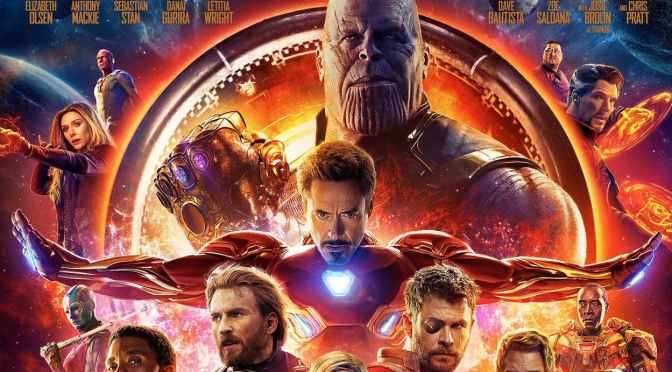
Starring:  Robert Downey Jr., Chris Hemsworth, Mark Ruffalo, Chris Evans, Scarlett Johansson, Benedict Cumberbatch, Don Cheadle, Tom Holland, Chadwick Boseman, Paul Bettany, Elizabeth Olsen, Anthony Mackie, Sebastian Stan, Danai Gurira, Letitia Wright, Dave Bautista,  Zoe Saldana. Josh Brolin, Chris Pratt etc.

**SPOILER FREE**

marvel_studios_avengers_infinity_war_official_trailer_7

The reward for Marvel fans and cinemagoers committed to watching every single film – from Iron Man (2008) to Black Panther (2018) – is a gigantic, breath-taking, explosive, colourful, dark, epic, fantastical end-game blockbuster. Unless you have been stuck on a desert island or on a digital detox, Infinity War (2018) is the culmination of decades of comic-book and cinema storytelling coming to a head in one incredible feat of spectacle and super-hero conflict.

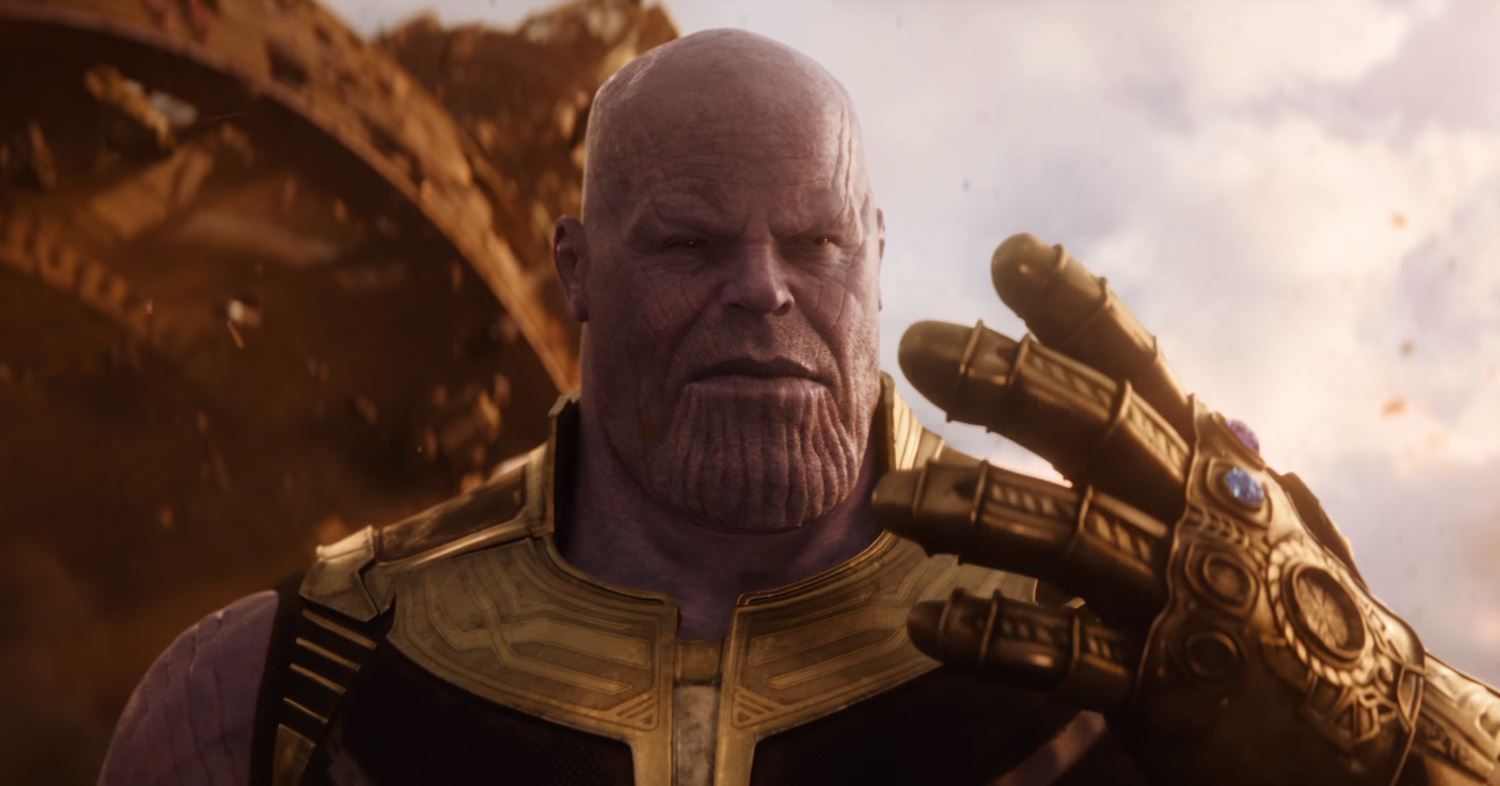
The film opens pretty much immediately after the end of Thor: Ragnarok (2017). The Titan Thanos (Josh Brolin) has hunted down Thor, Loki and the Hulk in order to obtain the Tesseract and the Infinity Stone within it. In fact, he is after all six Infinity Stones in order to gain twisted, yet in his mind, logical control over the Universe by killing half its inhabitants. Thanos’ characterization as a villain is given the most narrative power throughout and via him we get some nuance and subtext.

avengers-infinity-war-01

While brilliantly rendered, in look, by the army of special effects, and performance by Brolin, I kind of felt we were missing an element of mania and a committed statement of intent. I knew why Thanos was doing what he was doing but aside from an opening speech about destiny his mission lacked the political or social context compared to say that of Hydra from The Winter Soldier (2014) or Erik Killmonger from Black Panther (2018).  Nonetheless, lack of political context is a mild gripe because spectacle in terms of power and storytelling is what Infinity War is all about.

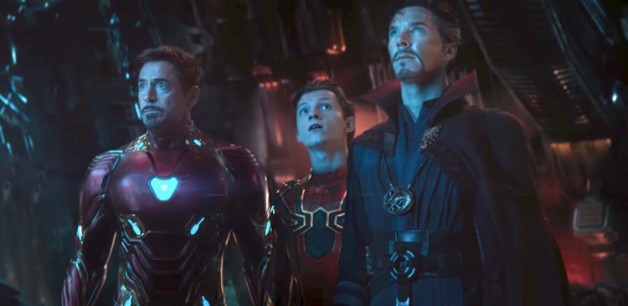
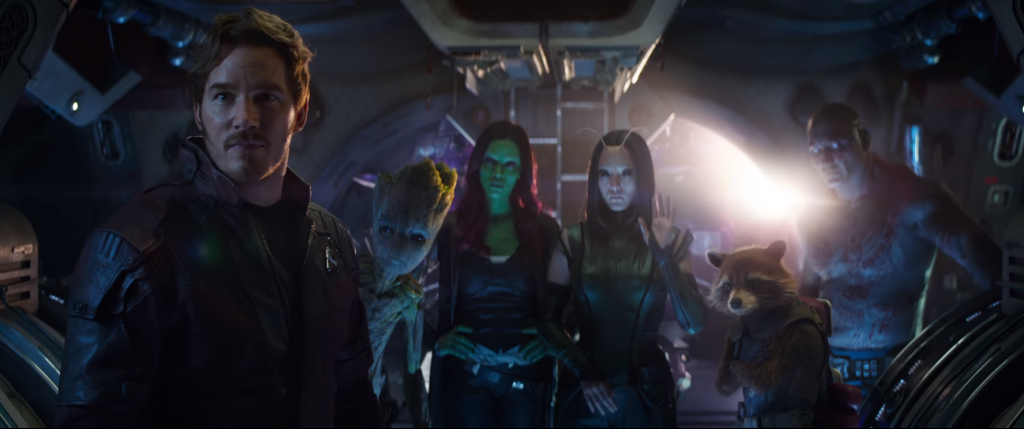
Thanos’ quest for domination was still a pretty decent structure to hang the story beats on and the writers should be applauded for trying to create a rounded super-villain. Because, allied with the incredible set-pieces and locations across the various galaxies, a major strength of Infinity War’s screenplay was the pace, power and interplay between the multiverse of characters and plot strands which were fantastically juggled by the directorial and editorial teams. This was epic storytelling, not just in length, but in scope. As we cut between Dr Strange, Iron Man and Spiderman on their particularly deadly mission; we also cut between Thor, The Guardians of the Galaxy, Vision, Wanda the Scarlet Witch, Captain America and their respective advnetures. There are so many different elements at play there is little breathing space, yet with a whip-smart script full of one-liners any plot deficiencies are masked expertly with perpetual motion and punchlines.

Spider-Man-Iron-Man-Doctor-Strange-Avengers-Infinity-War

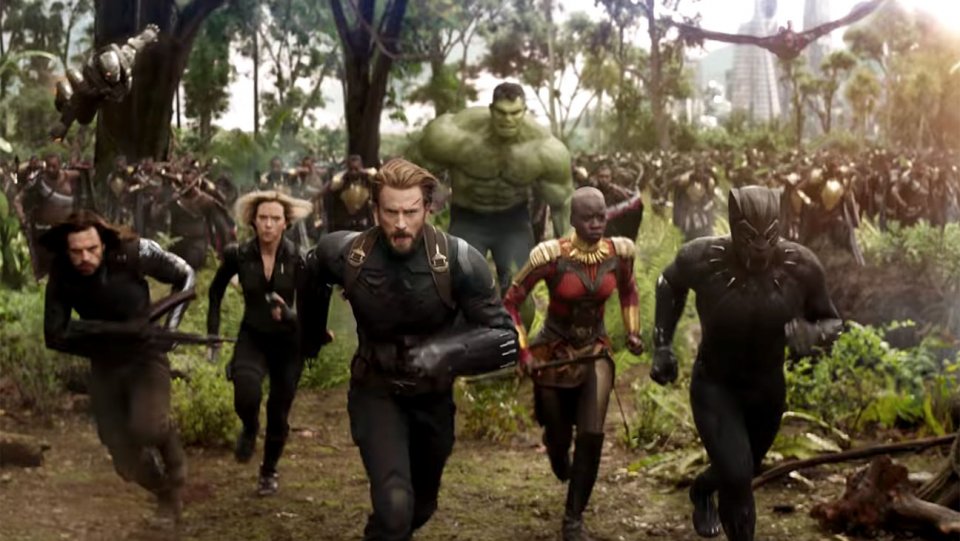
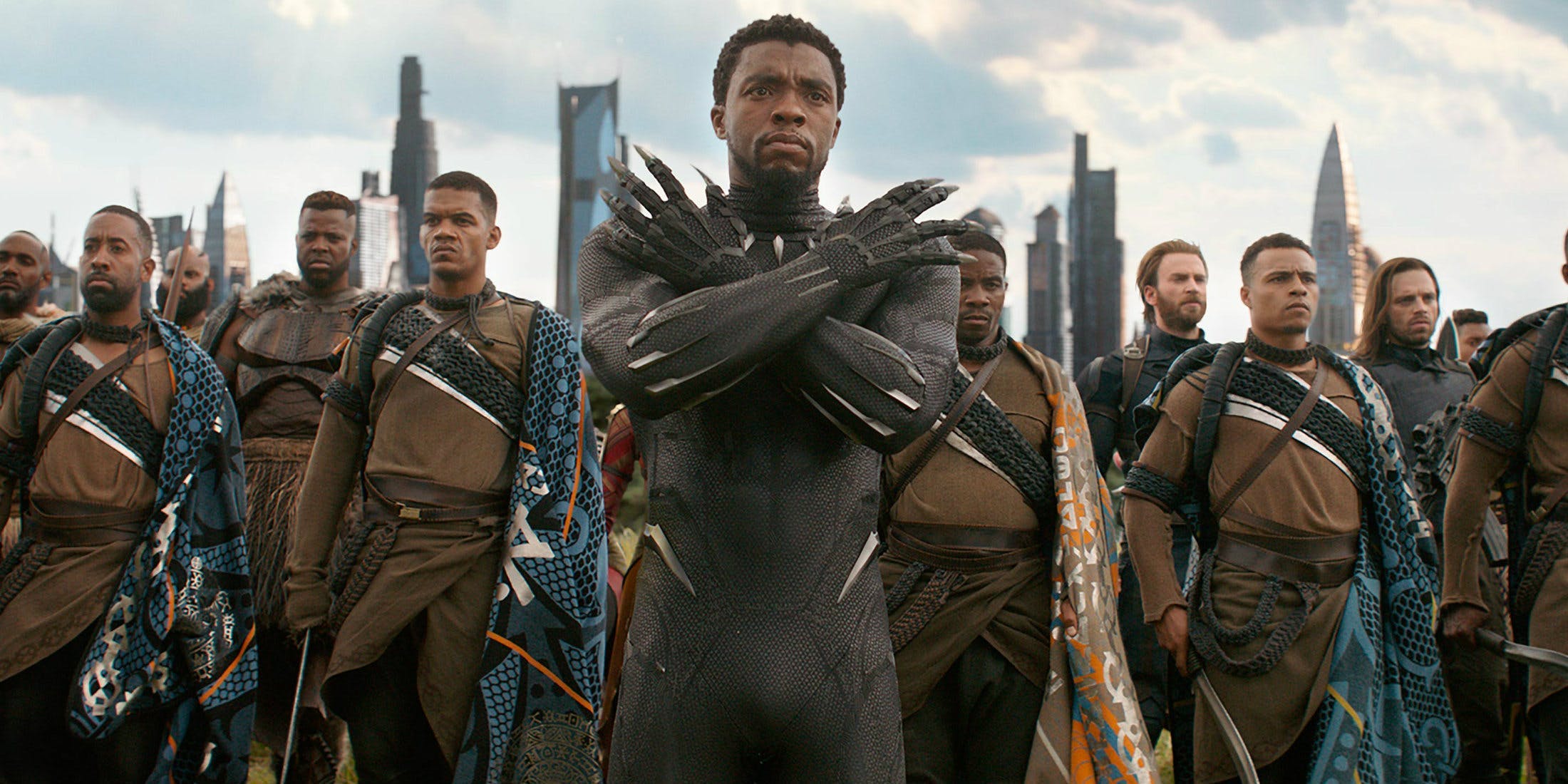
Visually, the film is also extremely strong with bright funky new suits for the Hulk, Tony Stark and Peter Parker. Moreover, the locations in space and on Earth from the dark lands of Vormir to the verdant pastures of Wakanda are rendered beautifully on the screen. All manner of magical weapons, space-ships and military hardware explode and destroy and whizz-bang throughout. There is SO much crammed into the film that it’s a major coup that it worked so well. At one point I felt like I was watching three films in one echoing the great ensemble films I grew up with such as The Great Escape (1963). While the now obligatory end-game battle sequence echoed the likes of: Spartacus (1960), Braveheart (1995), The Return of the Jedi (1985) and more recently HBO’s epic Game of Thrones (2011 – )

Capture-5-1024x429.png

In terms of performance it’s difficult to pick out any one stand-out as the ensemble cast were uniformly impressive. My particular favourites were Benedict Cumberbatch as Dr Strange, Chris Pratt as Peter Quill and Zoe Saldana as Gamora, all giving memorable performances. Saldana’s Gamora arguably had the most powerful moments of stillness and pathos especially in her tragic backstory. Drax (Dave Bautista) and Tom Holland’s Peter Parker nailed their comedic patter too; the former’s deadpan literalism raising many laughs throughout. I also thought the details in look and voice given to Thanos’ Black Order stood out; notably the wonderfully named Proxima Midnight (Carrie Coon) and Corvus Glaive (Michael John Shaw).

Black-Panther-and-Wakanda-army-in-Avengers-Infinity-War-1

In conclusion, Avengers: Infinity War (2018) overall was spectacular blockbuster filmmaking which entertained me thoroughly for over two-and-a-half-hours. It could be argued that the army of special effects technicians, plethora of Disney and Marvel executives, array of Hollywood acting and filmmaking talent and the obscene amount of money spent has churned out YET another soulless super-hero film but wow didn’t they do it in style!!

(Mark: 9.5 out of 11)

MOVIE REVIEW – THOR: RAGNAROK (2017)

MOVIE REVIEW – THOR: RAGNAROK (2017)

**CONTAINS MINIMAL SPOILERS**

The Marvel Franchise bus shows no sign of slowing down and the number of Superhero passengers and routes its taking increases every year. Indeed, I’m wondering which driver (i.e. director) will be the first to get a puncture and crash their respective bus, because even though we are well past saturation point the successful formulae is still sweetly cruising along without the threat of breaking down. Even slightly lesser known heroes such as Dr Strange (2016), Guardians of the Galaxy (2014) and Ant-Man (2015) have all made loads of money, and corny vehicular metaphors aside, surely it is only a matter of time before Marvel’s monopoly on Superhero movie success flails. However, Thor: Ragnarok (2017) is most certainly NOT the film that causes the decline.

Image result for thor ragnarok

The crafty Marvel bosses have kept their products fresh by often changing directors because where DC failed artistically, in my view, was they allowed the hyperbolic effects-driven blockbuster style of Zach Snyder — until the impressive Wonder Woman (2017) that is — to dominate their bombastic releases. Marvel Studios, on the other hand have given reign to arguably more quirky, indie-flavoured filmmakers such as: Joss Whedon, James Gunn and now Taika Waititi to drive their movies forward. Thus, along with the standard heroes-versus-villains-end-of-the-world storylines, massive battle set-pieces and fantastical worlds and characters on show, such directors add an element of humour and characterization to proceedings.

Image result for thor ragnarok helA

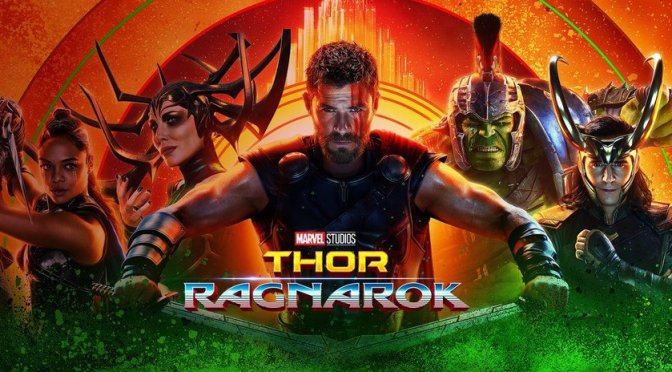
Humour, more than anything, is what Waititi brings to Thor: Ragnarok. This is essentially the first all-out Marvel comedy pitched an octave funnier than Guardians of the Galaxy on the comedic scale; as punchline after punchline reigns down with the power of Thor’s lightning bolts. The opening scene is a case in point where Chris Hemsworth’s sly comic timing is utilised to great impact when facing the demonic Sutur. Hanging upside down and chained, Thor’s momentum swings him around and away as the fiery devil delivers his monologue, only for Thor to ask him to wait until he comes back round again. While covering the exposition in a very funny way the gag also satirizes the clichéd villains’ plot while serving as a wonderful taster for the events to come.

Image result for thor ragnarok surtur

The witty screenplay and lightning pace covers up the familiarity of the story as once again Asgard comes under attack from a hellish force, this time in the guise of the beautiful evil of Hela (Thor’s older sister) portrayed with tremendous gusto by the ultra-talented Cate Blanchett. Usually seen in more serious dramatic roles Blanchett excels as Hela, and arguably is a touch underused until the incredible battle scene at the end. Anthony Hopkins and Tom Hiddleston once again reprise their roles as Odin and Loki respectively; Loki, as usual, getting some great moments to show his dupliticity and mischief. Both Hopkins and Hiddleston take great pleasure to also parody their characters compared to the pitch black seriousness of Thor: The Dark World (2013).

Image result for thor ragnarok HULK

Waititi, the writers and production crew deserve much credit for not only delivering some familiar faces and worlds to the film but also some new ones to freshen it up. I must admit I wish the trailer hadn’t spoilt the appearance halfway through of the “Big Guy” because if I had not known that I would have been amazed at such a twist. Nonetheless, the Hulk does appear and via Mark Ruffalo’s neurotically bemused turn as Bruce Banner we get, amidst all the gladiatorial mayhem, a cracking buddy story too. Moreover, Tessa Thompson as a hard-drinking-hard-fighting “Scrapper 142” (with a hidden past) is another sterling addition to the ensemble and the visuals which derive from her backstory via flashback are the some of the most impressive I have seen all year.  Jeff Goldblum as a wacky but dangerous Space Dictator and the hilarious Taika Waititi as a wise-cracking Kronan (a rock-looking dude!?) almost steal the show too.

Image result for thor ragnarok hela valkyrie

As he showed with Eagle versus Shark (2007), What We Do In the Shadows (2013) and the exceptionally funny and touching, The Hunt for the Wilderpeople (2016), Waititi is a very talented filmmaker and he has brought his love of eccentric characterization and comedic ability to great effect within the Marvel Universe. Thor: Ragnarok is a riotous mix of stunning visuals, booming rock music, huge battles, family wars, smashing punchlines and hilarious performances. Arguably the comedy sidelines the drama and tonally the film is uneven in places and compared to the magical and hallucinatory world of Dr Strange it is not as satisfying in terms of the whole world and vision created. Nonetheless, as comic book adaptations go it is one of the most entertaining Marvel sequels to date.

(Mark: 9 out of 11)