Tag Archives: montage

Cinema Review: One Battle After Another (2025) – an exhilarating revolutionary romp that lacks the depth of those films it attempts to emulate!

Cinema Review: One Battle After Another (2025)

Directed by Paul Thomas Anderson

Written by Paul Thomas Anderson

Inspired by Vineland by Thomas Pynchon

Produced by Adam Somner, Sara Murphy, Paul Thomas Anderson

Main Cast: Leonardo DiCaprio, Sean Penn, Benicio del Toro, Regina Hall, Teyana Taylor, Chase Infiniti, Wood Harris, Tony Goldwyn, Kevin Tighe, Shayna McHayle, etc.

Cinematography by Michael Bauman

Music by Jonny Greenwood

*** CONTAINS SPOILERS ***
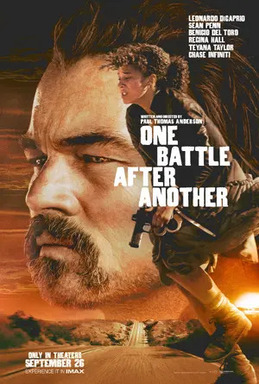


It’s a brave filmmaker that quotes one of the greatest revolutionary films of all time during it’s runtime, namely Battle of Algiers (1966). But Paul Thomas Anderson’s formidable cinematic career more than earns him the right to quote a film as towering as The Battle of Algiers (1966) in his latest release One Battle After Another (2025).

Across works like Boogie Nights (1997) and Magnolia (1999), he has demonstrated a mastery of ensemble storytelling and emotional crescendo; with Punch-Drunk Love (2002) he revealed a gift for intimate, offbeat romance; and in There Will Be Blood (2007) and Phantom Thread (2017) he proved himself one of the most rigorous visual stylists and psychological dramatists of his generation. Such a body of work grants him the authority to converse with cinema’s political masterpieces, even if his more recent Licorice Pizza (2021) felt comparatively diffuse and lacking in urgency. His filmography, at its strongest, stands as evidence of a filmmaker deeply attuned to the legacies and possibilities of the medium.

Having said that, Gillo Pontecorvo’s The Battle of Algiers (1966) wields revolutionary power through its raw immediacy, embedding viewers in the lived experience of anti-colonial struggle with a documentary-like realism that blurs the line between record and re-creation. By contrast, Anderson’s One Battle After Another (2025) approaches revolution less as lived history than as a cinematic genre to be emulated, drawing on the tropes and textures of upheaval without grounding itself in the direct urgency of political struggle. Where Pontecorvo conjures revolution as something happening before our eyes, Anderson refracts it through the prism of style, making revolution as much a matter of aesthetic construction as lived reality. It is during its lengthy running time extremely entertaining though.
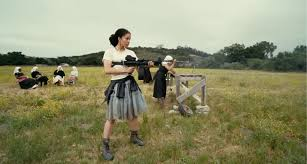


The opening hour is fast-paced and crams in a lot of action and personality. It establishes a fine ensemble cast, strong characters, striking palette and compelling themes which bring to life Anderson’s sharply written and fantastically filmed screenplay. The narrative focuses on “Ghetto” Pat Calhoun (Leonardo DiCaprio) and Perfidia Beverly Hills (Teyana Taylor), lovers and leaders of the far-left French 75, who storm detention centres, bomb banks, and sabotage power grids, while their soon-to-become nemesis—Officer Steven Lockjaw (Sean Penn)—becomes erotically obsessed with Perfidia, sparing her life when he catches her planting a bomb in exchange for a sexually masochistic tryst. Thus, begins a warped love/hate triangle and rivalry which provides the backbone for the action.

The second hour pivots sharply after establishing Perfidia as a commanding revolutionary presence. The focus pulls to her daughter, Willa (Chase Infiniti), some sixteen years later, now living off the grid and avoiding all but the most basic technology out of fear of surveillance. ‘Pothead’ Pat, has withered into a paranoid and barely functioning stoner-alcoholic, leaving Willa to emerge as the steadier, more mentally resilient figure in their fractured household. The film undeniably suffers from the absence of Perfidia’s charisma and drive, yet it regains momentum when the now Colonel Lockjaw revives his obsessive pursuit, setting the stage for a tense reconfiguration of the story’s revolutionary stakes.

The acting in One Battle After Another (2025) crackles with intensity, led by standout turns from Taylor, Penn, and crafty scene-stealer, Benicio Del Toro. Further, Anderson’s casting team find some amazing supporting military personnel who deliver with uncanny authenticity. Sean Penn’s performance as a swaggering officer radiates brute masculinity—his very walk and gait dripping with testosterone and worthy of awards consideration on their own. Leonardo DiCaprio, meanwhile, folds another eccentric, messy, and deeply contradictory figure into his already remarkable CV, a creation that resonates with the layered complexity of his recent work in Scorsese’s Killers of the Flower Moon (2023). He is actually far more hilarious here, as demonstrated in his desperate attempts to overcome the revolutionary helpline he calls for instructions.

Overall, One Battle After Another (2025) works best as a searing, darkly funny revolutionary black comedy, blending sexual, military, conspiracy, and social politics into a heady mix of action, crime, road movie, and romance tropes. The result is a wildly entertaining visual and musical feast, even if it stops short of delivering true socio-political depth. While the film’s closing stretch leans into deliberate plot ambiguities that complicate its resolution, Anderson ultimately serves up a combative cinematic blast—stylish, sharp, and exhilarating—if just shy of a bona fide classic.

Mark: 8.5 out of 11


CINEMA REVIEW: EVERYTHING, EVERYWHERE, ALL AT ONCE (2022)

CINEMA REVIEW: EVERYTHING, EVERYWHERE, ALL AT ONCE (2022)

Directed by: Dan Kwan & Daniel Scheinert

Written by: Dan Kwan & Daniel Scheinert

Produced by: Anthony Russo, Joe Russo, Mike Larocca, Dan Kwan, Daniel Scheinert, Jonathan Wang, Michelle Yeoh, etc.

Cast: Michelle Yeoh, Stephanie Hsu, Ke Huy Quan, Jenny Slate, Harry Shum Jr., James Hong, Jamie Lee Curtis, etc.

Cinematography: Larkin Seiple

Editor: Paul Rogers

*** CONTAINS MILD SPOILERS ***


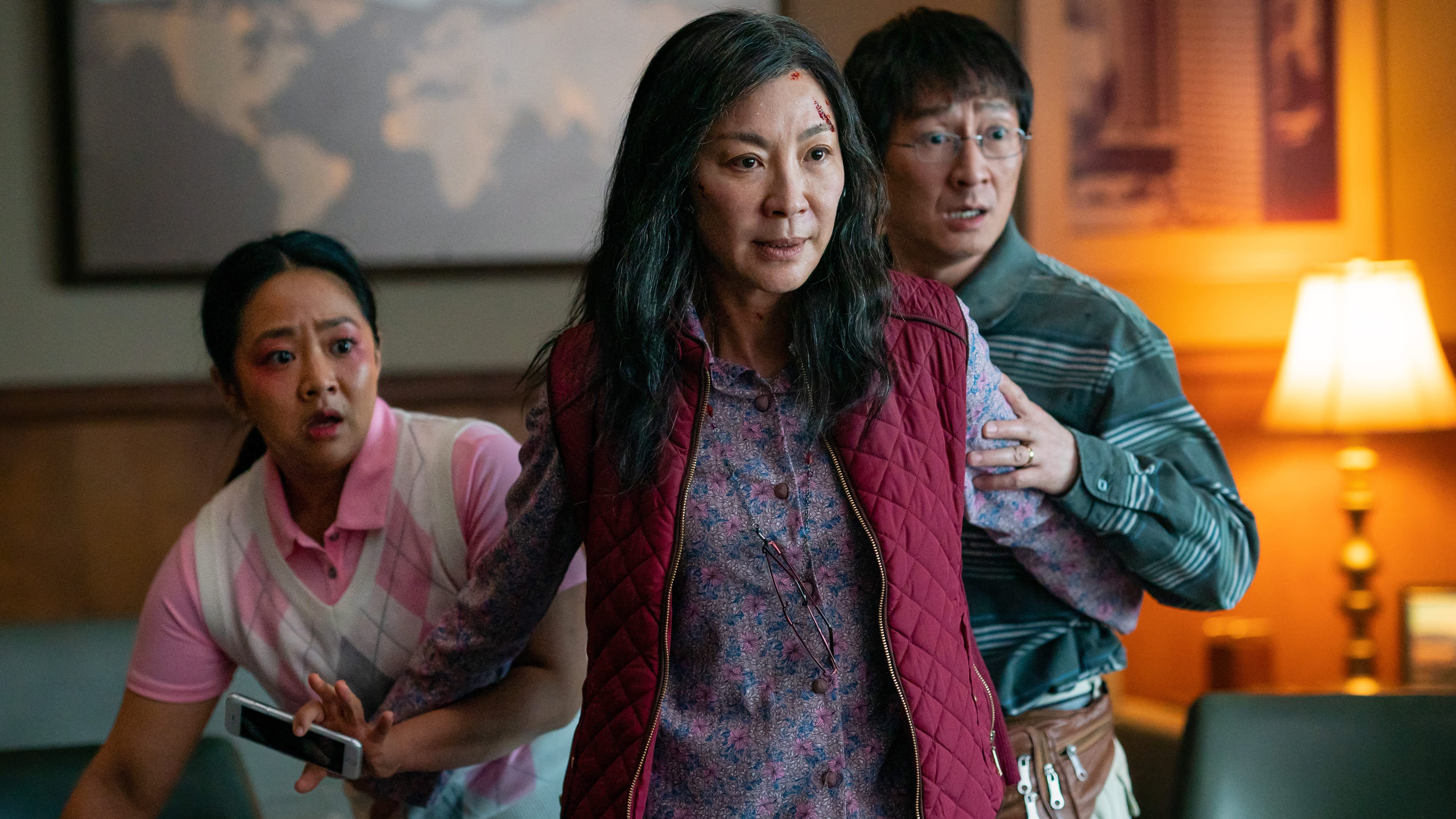
Wow, where does one start when reviewing Dan Kwan and Daniel Scheinert’s highly entertaining and genre-colliding film, Everything, Everywhere, All at Once (2022)? Well, let’s start inward and work outwards. Thus, overall, it is one of the most exhilarating cinema releases of the year. Michelle Yeoh gives a spectacular series of performances as middle-aged wife, mother, business person, actor, chef, martial artist, sign-flipper, lesbian pianist, planet saviour, and rock named simultaneously Evelyn Wang, Evelyn Wang, Evelyn Wang, Evelyn Wang and yet more Evelyn Wang’s. Yes, if you didn’t know this is another multiverse narrative, but arguably the best and most fun of the lot.

Spinning a plot that could be pitched as Crouching Matrix, Hidden Beauty the relentless Everything, Everywhere, All at Once (2022) has a seriously insane story and series of crazy, funny set-pieces throughout, with the filmmakers throwing drama, science-fiction, kung-fu, horror, comedy, rites-of-passage, romance, surrealism, and kitchen sink genres at the page and screen in a riotous visual and aural feast. I mean what other films deliver a talking raccoon, giant dildo fight and homage to Stanley Kubrick into the creative mixer. And that’s just for starters. I could say more but don’t want to spoil all the spectacular surprises on show. Safe to say, I won’t look at a bagel the same after watching this devastating cinematic smorgasbord. Word of warning the tone of this film smash cuts all over the place, and while I could find fault with this, the sheer pace, imagination and diversity of the concepts did not just win me over, but smashed me into submission.


But what the hell is the story, Paul? Oh yes, there is a narrative core and spine with which to hang the madness on. I said I was going outwards didn’t I? So, Michelle Yeoh, Evelyn, is married to Waymond (Ke Huy Quan) and their relationship is slowly cooling like campfire embers. The family business is in financial strife and as the launderette struggles, Evelyn finds herself being audited by the I.R.S. Adding to these woes are stressful relationships with her daughter, Joy (Stephanie Hsu) and elderly father, Gong Gong (James Hong), thus Evelyn’s mid-life is not so much in crisis as about to explode. She needs a miracle. An escape. A means with which to resolve and work through her issues. But this reality bites. Hard. Thankfully, this isn’t real life. It is cinema. And there are alternatives universes. Many alternative Evelyn’s in fact. But is this Evelyn the chosen one? So a journey of identity and discovery begins. Will Evelyn save herself? Will Evelyn save the world(s)? And does it even matter?

I would probably need to watch Everything, Everywhere, All at Once (2022) again to see if the myriad of plot concepts actually make sense. My instinct was that the writers were in control and deliberately out of control with their material. Throwing punchlines, taking risks, improvising and not so much pushing but burning many, many envelopes. Yet, they have found a rock in Michelle Yeoh to build their multi-stranded narratives and themes around. She superbly anchors the film allowing the filmmakers to simultaneously explore the meaning of life, identity and existence in two-hours-or-so of exhilarating cinemas. Yeoh deserves award nominations galore for the energy, strength and emotion shown within the many lives of Evelyn Wang. It was also terrific too to see Ke Huy Quan return to a prominent movie role. He is so likeable and funny. Please never retire again!

Lastly, kudos to Dan Kwan and Daniel Scheinert for delivering one of the most extraordinary films about ordinary people of the year. They potentially could have shaved some minutes of the runtime for pace. Because, by the time yet another smashing fight scene had finished I was almost too exhausted to feel at one with the final act familial reconciliation. But, Kwan and Scheinert succeed with Everything, Everywhere, All at Once (2022) because as well as a machine-gun splattering of hilarious ideas and gags combined with some pretty lofty themes, this film ultimately has a hell of a heart. More than one; a multiverse of hearts in fact. All beating as one.

Mark: 9 out of 11


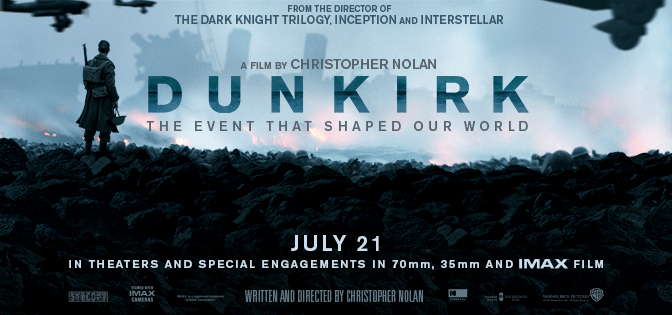
DUNKIRK (2017) – CINEMA REVIEW

DUNKIRK (2017) – CINEMA REVIEW

**CONTAINS MILD SPOILERS**

Firstly, the evacuation of Dunkirk, France, during World War II was simply put one of the most incredible acts of survival and escape achieved. From the historical articles and documentaries I have read and seen the Allies were on the ropes and pinned back by the German army causing 400,000 beaten, starving and bedraggled human beings to be trapped on the beach waiting desperately for rescue.  It’s no spoiler to state that many brave people enabled that rescue creating that well-known phrase “Dunkirk spirit” to enter our vocabulary.

dunkirk_1

Put yourself in that position for even just a minute and the fear drains one cold and feeling so lucky that I will never have to feel that threatened. These are people, young soldiers fighting against a fascistic foe who are backed into a corner and whose lives are about to be extinguished. So, think about that when you wake up in the morning because Christopher Nolan’s epic film, as do many other films, books and television shows about the war, give your life meaning about how lucky we are to not have to live through that. Count your blessings you’re not in a war and the life we live has relative freedom.

These and many more emotions flashed through my being while experiencing the incredible epic that master director Nolan and team have delivered via Dunkirk. Throwing us immediately into the action we are shown the hell of war from three perspectives: land, sea and air. Nolan works from a simpler focus and premise compared to his other works and this makes it all the more powerful an experience. Where films such as Inception (2010), Interstellar (2014) and Memento (2000) had complex, shifting narratives relying on heavy exposition, grand concepts and plot twists, Dunkirk deals with one simple sterling idea: survival!

dunkirk7

I found the whole experience immersive and pulsating from a cinematic perspective. Christopher Nolan, and his production team, have in the: editing, cinematography, composition, colour, acting, framing, sound, score and movement created pure and poetic cinema. From the safety of my comfy seat I felt real danger, peril and claustrophobia. The narratives’ drive comes from fragmented moments of fear and blasts of explosive danger. The impressionistic style was full of scenes containing quiet doom as well as noisy, confusing and fiery terror. Even the smallest situation such as the locking of a cabin door takes on great significance, sending a chill down the spine. As the enemy closes in from above and below and water fills the screen and lungs of our heroes, then death moves in for the kill.

Nolan eschews the solid build-up of traditional characterisation to create emotion through the visual form with a chopping style which serves to heighten the panic. There are so many haunting images as men and boys are stuck behind doors and ships and in boats and underwater and in the air and on moles and piers, compressed, suffocating and unable to breath as bullets, torpedoes and bombs pepper their souls. The coruscating soundscape, montage and hypnotic score from Hans Zimmer only add to the dread within the non-stop action. The dialogue is spare and at times muffled as character development is also sacrificed due to the compressed timeline. Yet, for me, empathy was garnered through verisimilitude, form and style rather than a conventional storytelling and a simplistic three-act transformational arc.

hardy_dunkirk

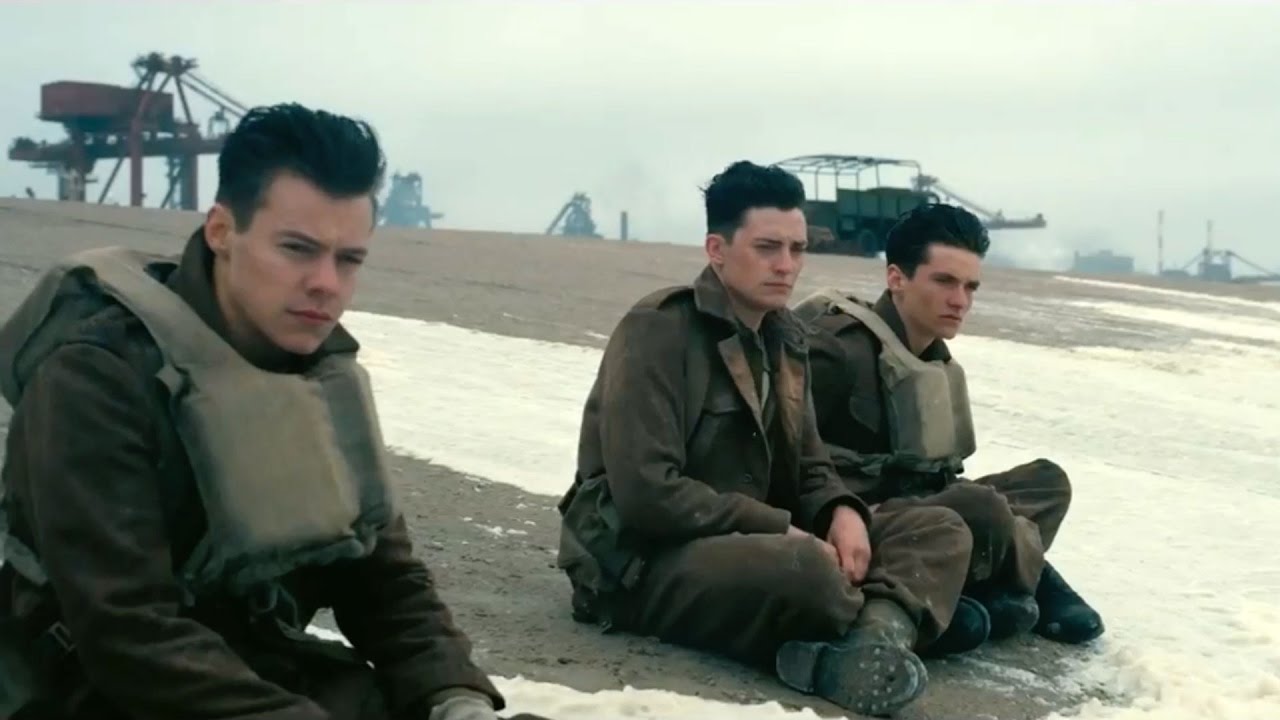
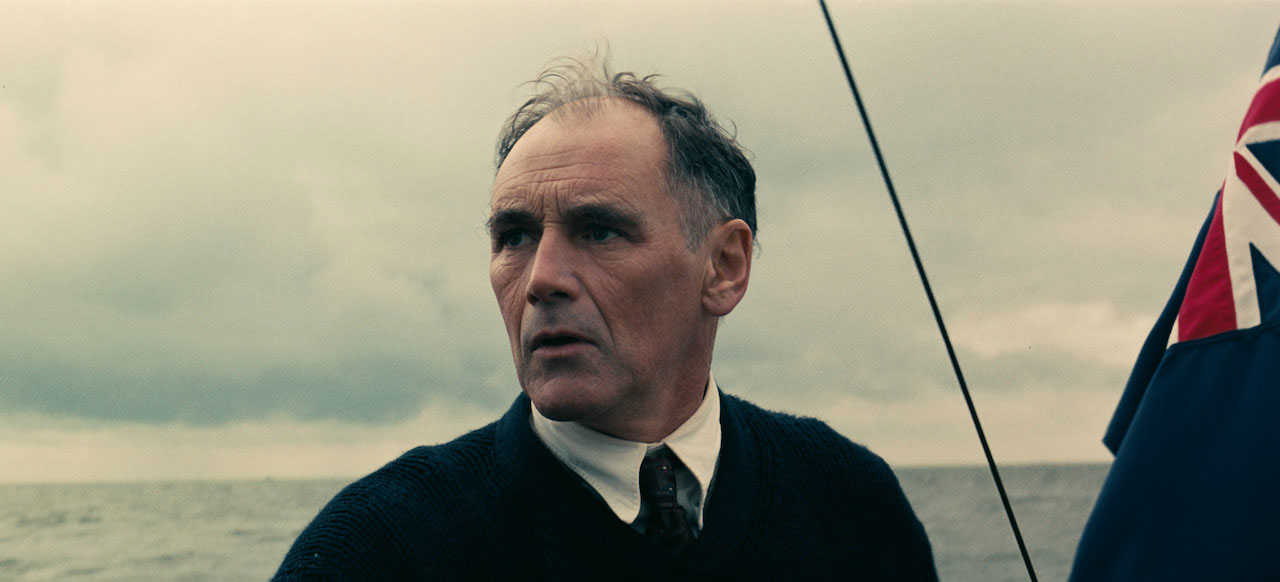
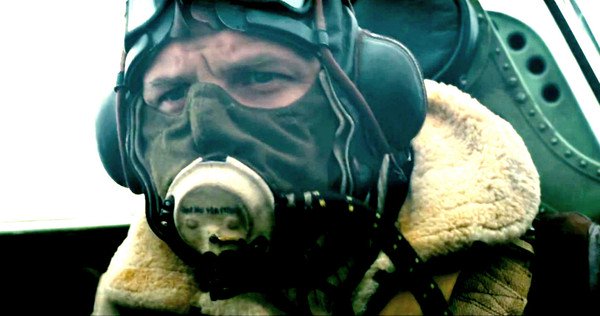
The characters are archetypes but serve the story very well. Kenneth Branagh’s noble sea Commander brings gravitas while Mark Rylance brings a naturalistic humility to the stalwart and duty bound Mr Dawson. Aneurin Barnard’s silent soldier allows his haunting eyes to dominate, while the pathos emitting from Barry Keoghan’s young George is incredibly powerful. Fionn Whitehead and Harry Styles, while inexperienced actors, represent the palpable fear any young man would exhibit when faced with certain death. Tom Hardy adds star quality in his role of RAF pilot, Farrier, and the image at the end of his plane burning in the sunset is indelibly etched in my mind.

But, overall the film belongs to the masterful direction of Christopher Nolan who, in delivering 106 minutes of pure dramatic exhilaration demonstrates he is more than just a genre filmmaker but a cinematic artist echoing the works of Sergei Eisenstein, Martin Scorsese and Stanley Kubrick within this war and disaster film masterpiece. Dunkirk was a savage defeat for the Allies but it rallied the nation against the enemy and Nolan has produced a film that stands as a worthy tribute to those who lost their lives and those brave people who survived.

(Mark: 10 out of 11)