Tag Archives: ritual

Cinema Review: Him (2025) – find blood, sweat, and meltdowns galore in this visceral NFL thriller!

Cinema Review: Him (2025)

Directed by Justin Tipping

Written by Skip Bronkie, Zack Akers & Justin Tipping

Produced by Jordan Peele, Win Rosenfeld, Ian Cooper & Jamal Watson

Main cast: Marlon Wayans, Tyriq Withers, Julia Fox, Tim Heidecker, Jim Jeffries, Maurice Greene etc.

Cinematography by Kira Kelly

** MAY CONTAIN SPOILERS **



“In modern slang, “Him” is used to signify a person who is considered a standout or a “star” in their field, often in sports or entertainment.” — Google search result.


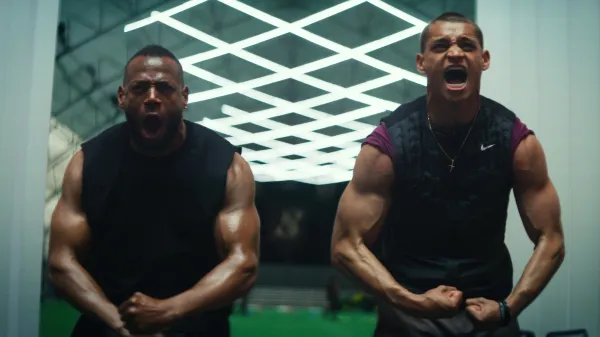
Him (2025) is a visually arresting and thematically potent descent into the underbelly of American athletic obsession — a pitch-black thriller that trades stadium lights for the strobe of psychological torment. Centered on Cameron “Cam” Cade, a young quarterback hungry to dethrone San Antonio Saviors’ reigning legend Isaiah White (a commanding Marlon Wayans), the film begins as a standard sports drama and swiftly morphs into something far darker. Director Justin Tipping captures the suffocating intensity of modern competition with a painter’s eye — sweat, blood, and neon collide in every frame, turning locker rooms and training fields into cathedrals of self-destruction.

As Cam endures Isaiah’s brutal “boot camp,” the film exposes the rot beneath the rhetoric of greatness. Fear, humiliation, and violence dominate the regimen, transforming mentorship into a form of ritualized hazing. Themes of steroid abuse, distorted masculinity, and father-son guilt weave through the story like poison veins. The omnipresence of social media — the constant surveillance, the demand for curated perfection — amplifies the claustrophobia. In its best moments, Him (2025) feels like a nightmarish hallucination of ambition, where performance and identity blur until nothing human remains.


Yet for all its kinetic power and aesthetic daring, Him (2025) stumbles when it comes to coherence. The screenplay rushes through emotional beats, failing to give its characters space to breathe or evolve. Key relationships and motivations are truncated by editing that favours rapid cuts over logic — the film’s pulse races, but its heart falters. The result is an experience that dazzles visually but feels narratively hollow, more like a hypnotic music video than a fully realized character study. Indeed, the ending drops the ball most of all. The nightmarish satire culminates in a bloodbath which, while visually powerful, feels like something more twisted and subtle would have served Cam’s character arc better.

Overall, there’s no denying Him (2025) and its impact as a cinematic spectacle, with Wayans and Withers delivering standout performances. Its imagery lingers — bodies breaking under fluorescent light, cheers warping into screams — as does its commentary on the performative nature of modern masculinity, crazy fan worship, monetization of athletes and sporting sacrifice. If only the script matched its visuals, Him (2025), might have stood shoulder to shoulder with the psychological thrillers it so clearly reveres.
Mark: 6.5 out of 11


Cinema Review: Weapons (2025) – a finely constructed horror mystery!

Cinema Review: Weapons (2025)

Directed by Zach Cregger

Written by Zach Cregger

Produced by Zach Cregger, Roy Lee, Miri Yoon, J. D. Lifshitz, Raphael Margules, etc.

Main Cast: Josh Brolin, Julia Garner, Alden Ehrenreich, Austin Abrams, Cary Christopher, Benedict Wong and Amy Madigan.

Cinematography by Larkin Seiple

*** MAY CONTAIN SPOILERS ***


Zach Cregger’s Barbarian (2022) was an intriguing feature debut that captivated viewers with a suspenseful, tension-filled first half, expertly building a sense of dread and mystery. The film begins with a seemingly simple premise — a woman arrives at an Airbnb, only to find it double-booked — but what starts as a quiet psychological thriller quickly takes an unexpected turn. As the plot unfolds, the sense of unease grows, drawing viewers deeper into its web of secrets.

However, the second half of the film ventures into increasingly bizarre and chaotic territory, unravelling into a frankly insane series of twists and reveals. While it might initially seem like a more grounded thriller, Barbarian (2022) pushed the boundaries of genre, diving head first into over-the-top absurdity. It’s a thrilling ride that keeps you on the edge of your seat, even if the madness of the final act leaves you both bewildered and entertained. In some ways Cregger’s follow-up Weapons (2025) shares such structural and thematic similarities with his first film, however, it is a much more controlled and impactful mystery. Until the end.

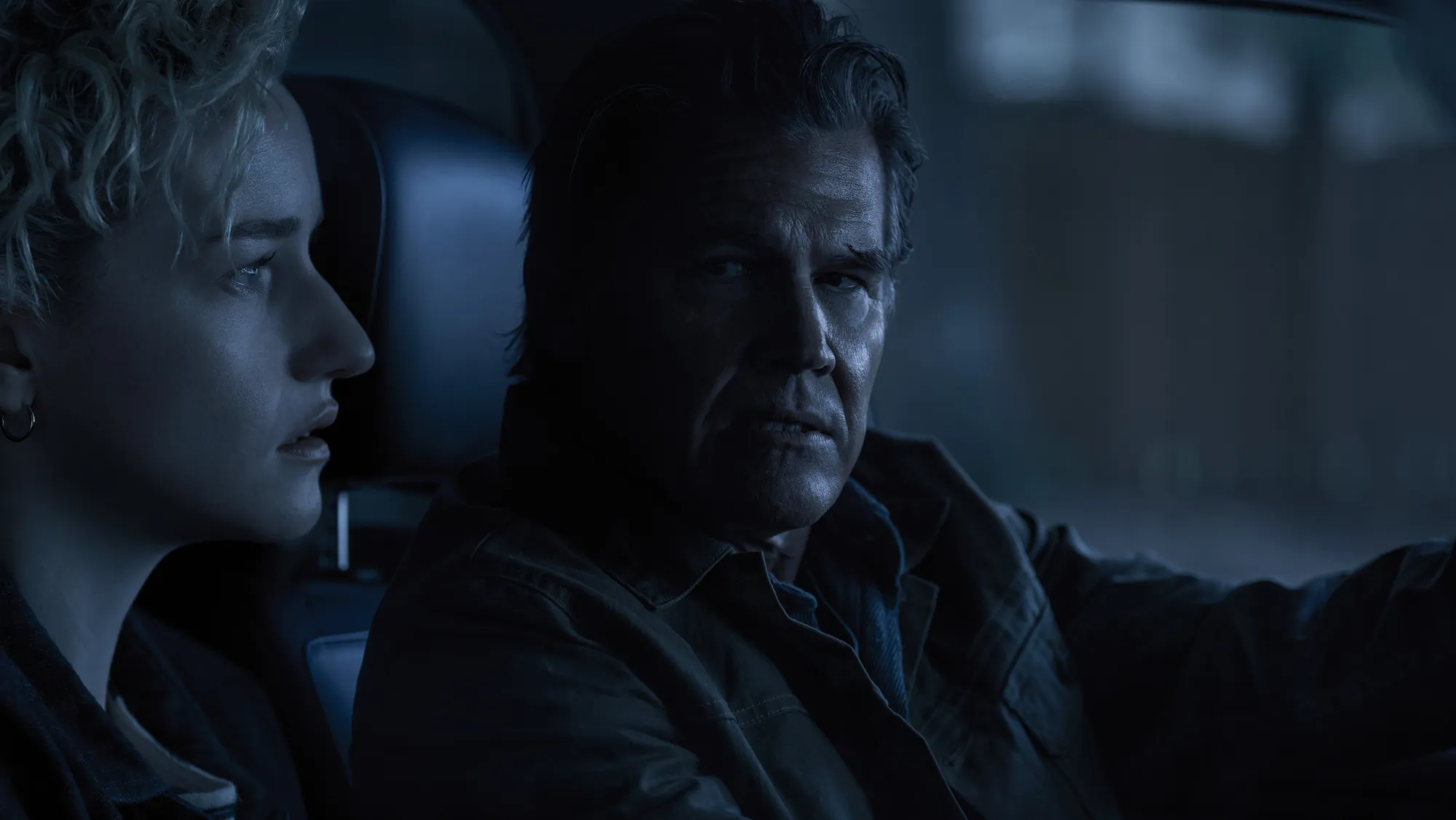
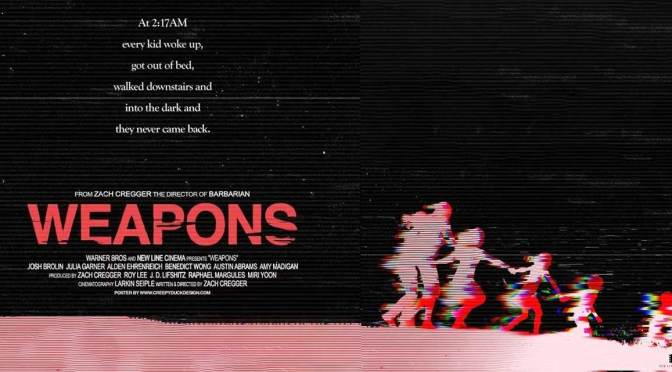
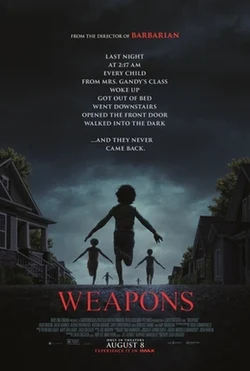
Weapons (2025) immediately hooks viewers with the mystery of the seventeen children going missing in the town of Maybrook. This instantly draws us into a world brimming with tension and unanswered questions. The authorities investigation into their disappearance soon stalls and how the townsfolk react becomes the central thread, gradually unraveling a complex, carefully structured narrative. Thus, Cregger’s postmodern fairy-tale unfolds through the eyes of various interconnected characters, each of whom brings a unique perspective and layer to the plot.


Josh Brolin plays Archer Graff, a father grieving the disappearance of his son Matthew, one of the missing children. His portrayal is poignant, balancing grief with a desperate need for answers, and his journey pushes the narrative forward with a personal stake in the outcome. Next, Julia Garner’s Justine Gandy, a dedicated teacher, adds another emotional dimension. She’s devastated when she discovers that nearly all of her students have vanished without a trace, with the exception of Alex Lilly (played by Cary Christopher), the only child from her class who remains. Justine’s struggle to find out what happened to her students, coupled with her own crumbling personal life and alcoholism, make her a compelling protagonist.

Other characters include Alden Ehrenreich’s Paul Morgan, a troubled police officer with his own set of demons, is a reluctant ally to Justine. Their past relationship adds a layer of tension as they navigate the growing sense of danger and urgency surrounding the missing children. Then, Austin Abrams brings a sense of raw, chaotic energy to James, a homeless drug addict and burglar whose past intersects with the mystery in unexpected ways. Lastly, Benedict Wong plays Marcus Miller, the school principal, who serves as an important figure in Justine’s quest for answers. Though sympathetic to her, Marcus is often caught between his professional responsibilities and the mounting pressure of the situation.

Weapons (2025) masterfully weaves its non-linear narrative with a striking array of tense, spine-chilling moments that keep audiences on edge throughout. As the plot unfolds through intersecting character arcs, the film expertly intersperses surprising scares, thrilling foot chases, and creepy locations, all while pulling you deeper into its twisting mystery. The jumps in time and the interconnected storylines create a sense of disorientation that builds forces viewers to constantly question what’s real and what isn’t.

Each character’s journey is filled with psychological unease and physical danger, leading to some genuinely heart-pounding sequences. Meanwhile, the eerie, claustrophobic settings—ranging from decaying homes to ominous, unfamiliar spaces—serve as perfect backdrops for the increasing horror. These moments contribute to the growing sense that something monstrous is lurking just beneath the surface, waiting to break free. Further, the film also plays with ambiguity, surreal dreams and unreliable narrators, allowing characters’ perspectives to fracture.

However, similar to Barbarian (2022), Weapons (2025) takes a tonal right-turn in the final moments, descending into all-out mania and Savini-style gore. The reveal of the matriarchal menace, who emerges as a central ‘Pied Piper’ type villain, feels somewhat unearned, undermining the narrative choices before. The ending also didn’t quite fully connect with the deeper themes or subtext of the film that were promised in the set-up. Yet, despite such inconsistencies Cregger’s Weapons (2025) has been marketed incredibly well and as has deservedly done great box-office business. Lastly, Creggers is a very talented filmmaker and his second film remains a smartly written and gripping ride filled with tension, scares, and that insane final act.

Mark 8.5 out of 11


FILMS THAT GOT AWAY #1 – REVIEW – SUSPIRIA (2018)

SUSPIRIA (2018) – FILM REVIEW

Directed by: Luca Guadagnino

Produced by: Marco Morabito, Brad Fischer, Luca Guadagnino, Silvia Venturini, Francesco Melzi d’Eril, William Sherak, Gabriele Moratti

Screenplay by: David Kajganich – Based on Suspiria (1977) by Dario Argento and Dari Nicolodi

Cast: Dakota Johnson, Tilda Swinton, Mia Goth, Angela Winkler, Ingrid Caven, Elena Fokina, Chloe Grace Moretz, Malgosia Bela, Lutz Ebersdorf, Jessica Harper etc.

Music by: Thom Yorke

Cinematography: Sayombhu Mukdeeprom

**MAY CONTAIN SPOILERS**

There are so many films released that it is virtually impossible to see them all. Plus, even if you didn’t have to work to earn a damned wage or physically need sleep you still wouldn’t be able to watch everything at the cinema. More specifically though, we may choose NOT to go to see a film on the big screen for certain reasons. Collectively, I consider these movies to be “one’s that got away!”

Thus, in a new section called, unsurprisingly, FILMS THAT GOT AWAY, I will be reviewing films which I missed first time round at the cinema and have subsequently caught up with on Sky, Amazon, Netflix, Blu-Ray or even good old-fashioned terrestrial television. I will consider the film critically as entertainment and why I missed it first time round. As usual the film will be marked out of eleven.

When the UK release of Suspiria (2018) was announced there were many reasons I was immediately put off from wanting to see it. Firstly, despite having watched it three times, I genuinely could not stand the original Dario Argento film. I know people consider it a horror classic; however, I think story wise, it’s a bad film. It’s neither scary from an emotional point-of-view or actually makes any sense logically. I know it’s meant to be based on surreal and nightmarish imagery, montage and performance, but the story or characters did not connect with me. The colour design, gore and soundtrack are outstanding but, overall, I felt I was trapped watching the manic outpourings of an Italian psychopath.

The second reason I did not want to watch it is I haven’t always got on with Luca Guadagnino’s cinematic works. Don’t get me wrong, he is a brilliant filmmaker. However, I find him an indulgent artist whose tone, pace and direction seems haphazard. Of the films I have seen, I Am Love (2009) was a brilliant character study, anchored by a stunning Tilda Swinton performance. But A Bigger Splash (2011) and Call Me By Your Name (2017), were expertly constructed but indulgent and over-rated travelogues littered with narcissistic bores. Nonetheless, I really liked Suspiria (2018). It is almost, but for Guadagnino’s typical excesses, a horror masterpiece.

Set in 1977 (when the original was released), at the height of the Cold War in divided Germany, Suspiria, is a heady mix of rites of passage, cold war and horror genres. There are many narrative strands with which the screenplay, by David Kajganich, attempts to balance. Further, we also have personal, political, religious, artistic, gender and communal themes prevalent through the story. While it’s an ensemble cast the focus is Dakota Johnson’s Susie. She is a young aspiring dancer, from an Amish background, who joins the world-famous Markos dance company. In the process she is determined to impress Tilda Swinton’s commanding mentor. The parallel narrative involves psychiatrist Dr Josef Klemperer and his investigation into a missing patient (Chloe Grace Moretz); who also happens to be a dancer from the troupe.

As the story unfolds Susie proves herself an incredibly powerful dancer. At the same time, it is revealed that the elders and teachers of the dance group are hiding a sinister secret with darkness and ritual to the bloody fore. Memorable dance sequences full of beauty, energy and gore dominate, with Dakota Johnson giving an impressively physical acting portrayal. I also liked the nuanced control within her character as she grows stronger with each dance. Meanwhile, further dark events occur as Dr Klemperer’s investigations draw him closer to the troupe’s shadowy doors.

As I said, Suspiria is almost a horror masterpiece. The filmmaking, cinematography, art direction, choreography and score by Thom Yorke all collide to create an incredibly tense and terrifying experience. Moreover, while I was fully committed to the characters in the dance troupe and Susie’s movement up the ranks, the choice to juxtapose the socio-political events seemed to belong in another film. The religious context and notions of family and matriarchal dominance were incredibly powerful too and served the horror well. However, Guadagnino, in my humble view should have shaved some scenes from the running time. While I much prefer this film to the Argento original, a further edit for pace would have made this even better. Nonetheless, it had me riveted throughout through the sheer quality of filmmaking. I was incredibly impressed by the melding of dance and death. Indeed, the final orgiastic ritual with buckets of blood, decapitations and gnarled monsters was supernaturally unforgettable.

Mark: 9 out of 11

MIDSOMMAR (2019) – CINEMA REVIEW – AMAZING FILMMAKING LET DOWN BY WEAK STORYTELLING!

MIDSOMMAR (2019) – CINEMA REVIEW

Written and directed by: Ari Aster

Produced by: Lars Knudsen, Patrik Andersson

Cast: Florence Pugh, Jack Reynor, William Jackson Harper, Vilhelm Blomgren, Will Poulter etc.

Music: The Haxen Cloak

Cinematography: Pawel Pogorzelski

**MAY CONTAIN SPOILERS**

Midsommar (2019), is ultra-talented filmmaker Ari Aster’s second feature film. His first Hereditary (2018), was two-thirds domestic horror masterpiece and one-third insane, symbolic, nonsensical and demonic denouement. Both films have a lot in common. Both have communes or cults at the centre led by strong matriarchal figures. Both find seemingly innocent characters suffering from grief being lured to a fateful demise. Both have incredibly rich visual systems full of striking imagery, sudden violence and mythological folklore. Both, especially Midsommar (2019), are overlong, pretentious and indulgent B-movie stories masquerading as art.

I have to say, and I am not coming from simply a mainstream perspective, Ari Aster is a film artist. However, unlike many great film artists he has, in my opinion, not managed to marry his vision with coherent and emotionally powerful storytelling. Midsommar, for example, takes an age to kick its narrative into gear and when it finally gets started it drags and drags and drags. How many long, drifting tracking master shots can you abide? How many drawn-out-so-pleased-with-myself takes do you have the patience for? Well, get a strong coffee because when the story cries out for pace, Aster puts the brakes on, marvelling in his own indulgent genius. I might add that a plethora of characters screaming and crying does not make good drama either, unless there is sufficient context.

The narrative is very simple. In a nutshell, it’s Eli Roth’s Hostel (2005) meets British horror classic The Wicker Man (1973). Florence Pugh, Jack Reynor, William Jackson Harper and Will Poulter are college students who take a summer break to experience a communal pageant in rural Sweden. While they are PHD students they are not particularly intelligent given the choices they make later in the film.

Moreover, aside from Pugh’s grief-stricken Dani, the script doesn’t particularly imbue them with much in the way of empathetic characterisation. Indeed, the film relies on Pugh’s dominant performance to create emotion for our protagonists. Aside from providing some comic relief there is no actual point to Will Poulter’s character at all. Lastly, there is some absolutely terrible dialogue throughout this film too.

As the film crawls along slowly, it’s reliant on the music to inform us we’re meant to be scared. Then when the gore does kick in during a particularly shocking ritual, I was almost falling asleep. Don’t get me wrong the production design is flawless with an amazing setting and incredible concepts from Aster. The death and torture scenes are particularly memorable. However, the overall pace and rhythm of the film is so bloody slow I just did not care about anyone by the end.

I don’t mind methodical films establishing dread and psychological fear, but I think Aster has been watching too many Kubrick films. Aster seems to believe slow equals art. What Kubrick did though was usually to have characters that were engaging. They may not have been likeable, but Kubrick’s characters hit you in the heart and mind. Not since The Blair Witch Project (1999) have I wanted such dumb characters (Pugh aside) to die so painfully in a horror film. Likewise, the characters in the Swedish commune are mere ciphers of Aster’s fantasy horror and two-dimensional at best.

Visually stunning Midsommar (2019), will no doubt impress critics and other reviewers. However, at nearly two-and-a-half hours it’s an indulgent-arty-collage-of-film-masquerading-as-therapy. The ending was so loopy that the audience I was with were laughing at how ridiculous it was. Perhaps that was the filmmakers’ aim, but I’m not so sure. Yes, I get that this is meant to be allegorical and symbolic about grief and guilt and religion and a relationship break-up and fate and cultural differences. Furthermore, I get the intellectual depth of the themes on show, but Aster tortures the audience as much as his characters. Mostly, it just doesn’t take so long to tell this kind of derivative narrative, however beautiful and artistic the film is presented.

Mark: 6 out of 11