Amazon Prime Film Review: Kneecap (2024) – Irish rap rebels substitute words-for-bombs in riotous youth-in-revolt triumph!

Amazon Prime Film Review: Kneecap (2024)

Directed by Rich Peppiatt

Screenplay by Rich Peppiatt

Story by Rich Peppiatt, Liam Óg Ó hAnnaidh, Naoise Ó Cairealláin, JJ Ó Dochartaigh

Produced by Jack Tarling and Trevor Birney

Main cast: Naoise Ó Cairealláin, Liam Óg Ó hAnnaidh, JJ Ó Dochartaigh, Josie Walker, Fionnuala Flaherty, Jessica Reynolds, Adam Best, Simone Kirby, Michael Fassbender, etc.

Cinematography by Ryan Kernaghan

*** MAY CONTAIN SPOILERS ***
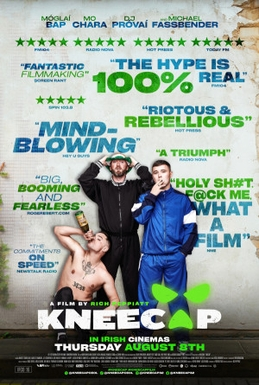


The 2024 film Kneecap is a riotous, politically charged portrait of youth in revolt, channeling the raw energy of punk and hip-hop into a uniquely Irish-language rebellion. Starring the real-life Belfast rap trio—Mo Chara, Móglaí Bap, and DJ Próvaí—as fictionalized versions of themselves, the film blends anarchic humour, biting satire, rites of passage, and cultural defiance to tell the story of how a group of working-class misfits wove their frustrations into musical gold.

Set in post-Troubles West Belfast, the film captures the lingering scars of British occupation and the generational trauma it left behind. Liam (Mo Chara) and Naoise (Móglaí Bap) are introduced as small-time drug dealers navigating poverty, police harassment, and fractured families. Their lives take a turn when JJ Ó Dochartaigh, a disillusioned Irish-language teacher, discovers their lyrical talents and joins them as DJ Próvaí. Together, they form the eponymous group, an Irish-language rap group that weaponizes music as a form of cultural resistance.

The film is unapologetically rebellious, using the Irish language not just as a means of communication but as a symbol of defiance. Arlo (Michael Fassbender), Naoise’s father and a former republican paramilitary, encapsulates this sentiment when he declares, “Every word of Irish spoken is a bullet fired for Irish freedom” . This philosophy permeates the group’s music, which tackles issues like British colonialism, drug culture, and the complexities of identity in a divided society.



Kneecap (2024), while a bold and electric celebration of youth rebellion arguably overstretches itself emotionally by attempting to cover too many themes at once. In its ambition to be both a political statement and a coming-of-age tale, a musical odyssey and a generational cry for recognition, the film occasionally dilutes its emotional impact. As the film juggles a multitude of weighty themes: the trauma of post-Troubles Northern Ireland, the fight for Irish-language preservation, the drug culture plaguing working-class communities, the fractured nature of family life, absent fathers and mothers, and the burden of political legacy. Add to this the rise of a rap group in an unexpected cultural context, and the film becomes a whirlwind of ideas competing for attention. The result is a film that sometimes feels like it’s racing to say everything at once, rather than letting its most resonant emotional threads breathe.

Nonetheless, director and co-writer, Rich Peppiatt, displays strong visual flair evoking the urban vibrancy of Trainspotting (1996) and underdog musical joy of The Commitments (1991). It helps that the film is often fucking hilarious. Plus, I realise it’s a raw reflection of their life choices, I could take or leave the perpetual scenes of gratuitous drug-taking. At the same time, the film doesn’t shy away from the gritty realities of its setting. It portrays the trio’s clashes with radical republican groups, their run-ins with the police, and the family and romantic struggles that come with their newfound fame.

Amidst the chaos, Kneecap (2024) maintains a sense of humour and humanity, offering a nuanced look at the power of art to challenge the status quo and inspire change. In essence, Kneecap is a ballsy and risk-taking celebration of rebellion, a testament to the enduring power of language and music as tools of resistance, and a vivid portrayal of youth challenging the remnants of a colonial past and a country attempting to find peace and identity after centuries of conflict.

Mark: 8.5 out of 11


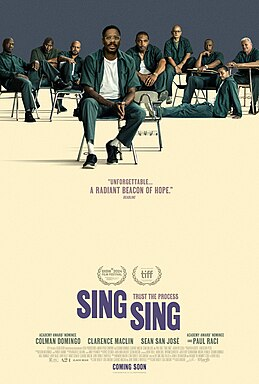
Amazon Prime Film Review: Sing Sing (2023) – displays the redemptive power of art and performance!

Amazon Prime Film Review: Sing Sing (2023)

Directed by Greg Kwedar

Screenplay by Clint Bentley & Greg Kwedar

Story by Clint Bentley, Greg Kwedar, Clarence Maclin & John “Divine G” Whitfield

Based on “The Sing Sing Follies” by John H. Richardson and Breakin’ the Mummy’s Code by Brent Buell

Produced by Clint Bentley, Greg Kwedar & Monique Walton

Main cast: Colman Domingo, Clarence Maclin, Sean San José,
Paul Raci, Sharon Washington, Jon-Adrian “JJ” Velazquez, Patrick “Preme” Griffin, Sean “Dino” Johnson, Miguel Valentin and more.


Cinematography by Pat Scola


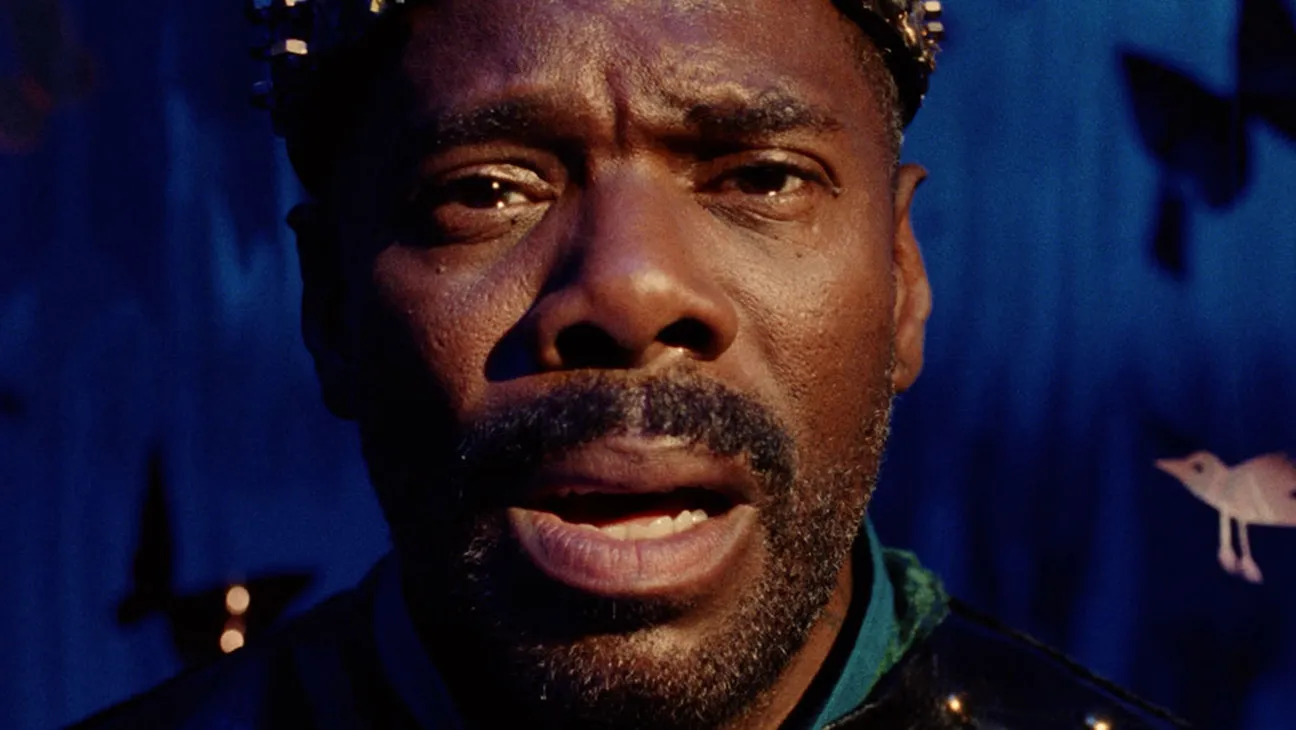
Sing Sing (2023) is a powerful prison drama directed by Greg Kwedar, based on the real-life Rehabilitation Through the Arts (RTA) program at New York’s Sing Sing Correctional Facility. The film follows John “Divine G” Whitfield (portrayed by Colman Domingo), a wrongfully convicted man who finds purpose and transformation through participation in a prison theatre group. As the group prepares to stage an original comedy, tensions arise, particularly between Divine G and a new, skeptical member, Clarence “Divine Eye” Maclin (played by himself).

The reported $2 million budget for the prison-based theatrical drama Sing Sing (2023) underscores a powerful truth in filmmaking: emotional impact and narrative power are not dictated by the size of a production’s budget. In an industry often dominated by multi-million dollar spectacles and high-concept visual effects, Sing Sing (2023) stands out as a reminder that authenticity, performance, and purposeful storytelling can achieve more than sheer spending ever could. In this way, the film charts a path forward for filmmakers: it shows that profound emotional connection comes not from lavish resources but from the courage to tell deeply human stories with clarity, care, and conviction.

By investing modestly but wisely—prioritizing casting choices, intimate direction, and a grounded script—the filmmakers harness the emotional gravity of the story itself. Featuring real formerly incarcerated individuals alongside professional actors, the film creates a resonance that can’t be manufactured with money alone. The restraint in budget mirrors the thematic focus of the film: confinement, transformation, and human dignity. There’s a raw, stripped-down sincerity in Sing Sing (2023) that aligns with its financial humility, allowing viewers to focus not on spectacle but on spirit.


At the heart of the film is Colman Domingo majestic performance. Without question he is one of the most enthralling actors working today. With a presence that radiates both gravitas and vulnerability, he has the rare ability to inhabit characters so fully that they feel less like performances and more like revelations. In Sing Sing, his work is restrained, generous, and deeply moving—serving not just as a lead, but as a quiet conduit for the emotional power of those around him. It’s the kind of performance that reminds you what acting is for.

There’s a grounded nobility to Domingo’s recent choices—films that matter, that uplift overlooked voices, and that seek to transform rather than simply entertain. In an era where so many talented actors get absorbed into the ever-expanding Disneyverse or other IP-driven machines, one can only hope that Domingo continues on this path. His gifts are too profound, too precise, to be flattened into quips and CGI battles. He belongs in films like Sing Sing (2023) where the stakes are human and the impact is lasting.

Directed with subtle power by Greg Kwedar he delivers a drama of transcendent creative expression as the inmates forge deep bonds, confront personal demons and change societal perceptions. Featuring performances by both professional actors and real-life formerly incarcerated individuals, Sing Sing (2023) offers an authentic and moving exploration of redemption, resilience, and the transformative power of art. Of course not all of them are innocent and are guilty. The film does not apologise for their crimes or glamourise them, but allows these men to find light amidst the darkness; a spiritual and cultural escape from the walls and bars which surround them.

Mark: 9 out of 11


Cinema Review: Sinners (2025) – a blazing, bold and bloody blues opera!

Cinema Review: Sinners (2025)

Directed by Ryan Coogler

Written by Ryan Coogler

Produced by Zinzi Coogler, Sev Ohanian, Ryan Coogler

Main cast: Michael B. Jordan, Hailee Steinfeld, Miles Caton, Jack O’Connell, Wunmi Mosaku, Jayme Lawson, Omar Miller, Delroy Lindo, etc.

Cinematography by Autumn Durald Arkapaw


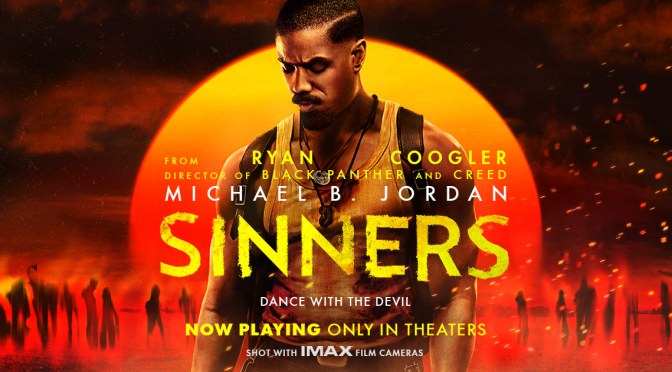
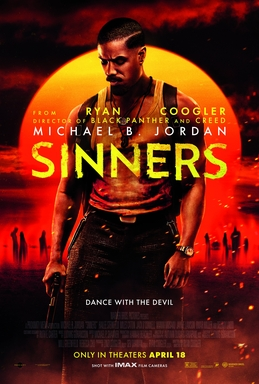
After the bleakly lustful vision of Robert Eggers’ Nosferatu (2024) — a film steeped in shadow, dread, and tragic sensuality — Ryan Coogler offers a wildly different, electrifying take on the vampire mythos: a bold, colourful, and deeply soulful experience that pulses with life even as it drinks from the dead. Where Eggers lingers in gothic majesty, with Sinners (2025), Coogler surges forward with kinetic energy, blending grind-house thrills and emotional depth with From Dusk Till Dawn-style narrative turns.

Coogler’s film is set in the richly textured American South of the 1930s, a world still nursing the scars of the Great War and on the cusp of social upheaval. Into this volatile landscape, he drops the muscular Michael B. Jordan as twin war veterans turned Chicago gangsters, Smoke and Stack — men who carry both physical and spiritual wounds from the trenches — now repurposed as businessman looking to set up a juke joint. These characters feel reminiscent of the working class anti-heroes of Peaky Blinders, their emotional trauma rendered in everything from flickering glances to bursts of brutal, operatic violence. The twins have ghosts of the past and present to battle including relationship issues with Stack’s ex-girlfriend, Mary (Hailee Steinfeld), as well as Smoke’s painful reunion with his wife, Annie (Wunmi Mosaku).

Sinners (2025) plot is muscular and sinewy, establishing the characters impressively before shifting the moody Southern gothic tale into an all-out genre-bender. The film contains a fine ensemble cast knitting a series of substantial supporting characters each with their own personalities, humour and wants. The most striking is Miles Caton as the twins’ cousin, Sammie “Preacher Boy” Moore, a young blues musician with an incredible ability, that proves to be a somewhat dangerous talent. Delroy Lindo also throws in another memorable performance as the ebullient pianist, Delta Slim. With the first night’s festivities in full swing three mysterious strangers appear from the near dark, desiring to be let in. Their leader is charismatic Remmick (Jack O’Connell) and he has more than partying in mind.


Visually, Coogler lets his imagination loose, notably in a memorable cross-generational musical montage that literally burns up the cinema screen. Gone is the shadow-heavy monochrome of Eggers; in its place is a palette of dusk reds, moonlit silvers, and deep bayou greens. The film pulses with colour, sex, motion, and sweat. Blood flows, but it never feels gratuitous — it feels earned, ritualistic, even sacramental. But what ultimately makes Coogler’s film so potent is its soul. Amid the genre thrills and gore, there’s a beating heart full of soul. These vampires are not romanticised, nor merely feared; they are hungry creatures. Coogler gives them back their humanity, and in doing so, reanimates the genre with urgency.

Music is where the film truly soars. Coogler and his production team, attuned to the cultural pulse, curate a soundtrack that fuses Delta blues, Appalachian folk, and early jazz into a feverish, ghostly soundscape. There are scenes where the music alone tells the story: a backwoods funeral scored by a bone-dry slide guitar; a juke joint confrontation where the rhythm of violence matches the stomp of the blues; a haunting lullaby sung by Remmick the migrant vampire that channels generations of sorrow. It is music as memory, as resistance, as raw emotional texture.

Sinners (2025) is not just a vampire film. It’s a blues opera. A folk horror elegy. A pulpy, poignant, and powerfully visceral story about the things that haunt us, and how we fight to keep our humanity intact. What begins as a slow-burning period drama smolders into a blood-soaked explosion of action and moral reckoning. Coogler even delivers a Klan-blasting and redemptive shoot-out final act set-piece. Lastly, in Coogler’s hands, the vampire becomes more than a monster; it’s a metaphor for trauma, addiction, religion, racism, and survival. Coogler reclaims the myth for a new generation, one shaped by history, crime, grief, music, and spiritual struggle, delivering a genre masterpiece that bites deep and lingers long after the lights come up.

Mark: 9.5 out of 11


Apple TV+ Film Reviews – Part Two

Apple TV+ Film Reviews – Part Two

As is standard procedure when one creates a part one of a series, the logical and linear progression is to have a part two. So, having watched the majority of the AppleTV+ films currently streaming I now move onto part two. The first set of reviews can be found here:


Coda (2021)

For some unknown alphabetical amnesia I forgot to include this Oscar -winning film in the first set of reviews, so I rectify that omission now. Arguably one of the best films on the platform, it is simultaneously a feelgood, tearjerker and a Save-the-Cat-screenplay-template-box-ticker hitting wholly familiar beats and a well-trodden genre path. Nonetheless, it is a terrifically entertaining, moving, funny and heart-warming story which, on reflection kind of surprisingly won the Academy Award for best film. I personally think another remake West Side Story (2021) was a far more scintillating work of cinema, but hey what do I know? My original review of Coda (2021) can be found below. Mark: 9 out of 11.


Ghosted (2023)

Of late Chris Evans has been choosing roles, as with Red One (2024), that go against the Alpha-heroic persona of Captain America. Unfortunately, Knives Out (2019) aside, the results are average at best. Aside from a series of amusing cameos in the middle act, not even the alluring Ana De Armas can save this clunky AI-written-spy-romance. With better scripting and direction this attractive action fluff could’ve been almost bearable. I remember when Dexter Fletcher made really good low-budget indie films like Wild Bill (2011). Mark: 5 out of 11.


The Gorge (2025)

I really enjoyed this big-budget-romantic-monster shoot-em up. I need to watch it again sober before deciding if it is going to make my top films of the year list or did I love it because I was drunk. Miles Teller and Anya Taylor-Joy revel in fine on-screen chemistry as the physical and symbolic divide provides no barrier to their lustful wants. My full review can be found below. Mark: 8.5 out of 11.


The Greatest Beer Run Ever (2022)

Likeable every-guy, Chickie Donohue (Zac Efron), has the crazy notion of hand delivering beer to his buddies fighting in Vietnam. But his naïve morale-boosting trip soon becomes an eye-opening and perspective changing nightmare. There’s a really good dramatic character arc in this historical 1968-set “road” movie but the comedic tone dilutes the overall catharsis of the journey. Efron is full of energy while the formidable presence of Russell Crowe is memorable if woefully under-used. Mark: 7 out of 11.


Greyhound (2020)

A fast-paced and technically impressive WW2 film with Tom Hanks portraying the Commander of a destroyer battling to survive an enemy onslaught amidst a part of the sea called ‘the Black Pit’. It’s been a while since I watched this but recall it being a solid suspense thriller with great production design and effects, although a little light on meaty character development. Mark: 7 out of 11.


The Instigators (2024)

Matt Damon and Casey Affleck team up once again for this underdog heist film which tries to be funny and dramatic, but misses the nuanced tone a director like Steven Soderbergh can deliver. I kind of enjoyed this because I like Damon, Affleck and Hong Chau, but many scenes suffer from the sense the actors are “improvising” and rewriting the script as they go along. Also, why can’t we have some proper 1970’s hard-boiled crime films like Sam Peckinpah and David Mamet used to deliver. Not all robbery films have to have one-liners throughout. Mark: 6 out of 11.


Killers of the Flower Moon (2023)

My critical feelings of Martin Scorsese’s most recent epic did not shift on the second watch. This profile of the horrors that befall the Osage people after they have struck oil remains compelling. Indeed the film contains powerful themes relating to the greed, power and psychopathy of the white man, but focusing the main thrust of the narrative from their perspective creates a skewed and oddly unimpactful viewing experience. Of course, Scorsese’s filmmaking expertise shines through and the performances are terrific. Mark: 8 out of 11. My full review is here:


Luck (2022)

I felt more than a tad unlucky after watching this animated misfire which didn’t work on any level. I know hundreds of crafts-people worked hard creating this, but why not spend a bit more time on the script. Or film another script altogether. The fact that the budget for this film is reported to be $140 million and there are people starving in the world is a travesty against humanity. Mark: 3 out off 11.


Napoleon (2023)

I haven’t had the spiritual gumption to re-watch this messy biopic from Joaquin Phoenix and Ridley Scott. There’s a four-hour directorial version to contemplate watching too. Oh, if only Stanley Kubrick had made his version. My original review is below. Mark: 7 out of 11


Palmer (2021)

Justin Timberlake again proves himself an adept leading man, having successfully graduated from the Disney-groomed production line he started out on. Palmer (2021) is overall a well-acted and directed redemptive crime drama, which also tackles themes relating to gender nonconformity to differentiate the well worn “parolee-trying-to-go-straight” narrative. Mark: 7 out of 11.


Sharper (2023)

Sharper (2023), directed by Benjamin Caron, skillfully uses classic con artist film tropes to craft a layered and compelling drama. By blending familiar elements of the genre with sleek cinematography and a nonlinear narrative, the film elevates itself above typical heist fare and leans into character-driven storytelling. The terrific cast, notably Julianne Moore, have fun with a genre script containing emotional depth, deliberate pacing, and decent characterisation. Mark: 7.5 out of 11.


Tetris (2023)

Tetris (2023), directed by Jon S. Baird, turns the unlikely origin story of a video game into a surprisingly engaging Cold War-era techno-thriller—at least for a while. Rooted in real historical tensions, the film smartly weaves espionage, corporate greed, and political paranoia into the story of how a simple puzzle game became a global phenomenon. However, its descent into exaggerated action sequences, particularly the climactic chase, turns it into something closer to parody than period drama. It’s a film that ultimately undercuts the suspense by choosing spectacle over substance. Mark: 7 out of 11