Cinema Review: The Bride (2026) – impressive visuals and Jessie Buckley’s stunning performance cannot resuscitate a patchy and holey screenplay!

Cinema Review: The Bride (2026)

Directed by Maggie Gyllenhaal

Written by Maggie Gyllenhaal

Based on Frankenstein; or, The Modern Prometheus
by Mary Shelley


Produced by: Maggie Gyllenhaal, Emma Tillinger Koskoff, Talia Kleinhendler, Osnat Handelsman-Keren, etc.

Main cast: Jessie Buckley, Christian Bale, Peter Sarsgaard,
Annette Bening, Penelope Cruz, Jake Gyllenhaal, etc.


Cinematography by Lawrence Sher

** May Contain Spoilers **


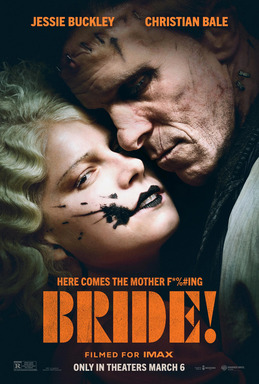
Maggie Gyllenhaal’s THE BRIDE! (2026) is a film bursting with ideas—sometimes thrillingly so, sometimes to its own detriment. Drawing inspiration from Bride of Frankenstein (1935) and ultimately Mary Shelley’s seminal novel, Frankenstein, Gyllenhaal transplants the myth into a Gothic vision of 1930s Depression-era America, filtered through the anarchic spirit of outlaw cinema like Bonnie and Clyde (1967) and Natural Born Killers (1994). The result is frequently intoxicating. The film opens with an inspired flourish—Mary Shelley herself narrating from beyond the grave—immediately signalling the director’s playful ambition. Visually, the film is extraordinary: lavish period design, smoky Gothic textures, and a lurid romanticism that feels both classic Hollywood and defiantly post-modern.

At the centre of the mayhem is Jessie Buckley, delivering yet another unforgettable performance. Her ‘Bride’ is feral, seductive, and volatile—an electrifying feminist creature of impulses and contradictions. Buckley plays her with a kind of joyous unpredictability, veering between danger, sexuality, and sudden jolts of manic dialogue that feel almost Tourette-like in their intensity. Opposite her, Christian Bale lends gravitas as her monstrous partner, and together they rampage across a mythicised America in a lovers-on-the-run narrative that often feels gleefully unhinged.


Yet for all its invention, THE BRIDE! (2026) often collapses under the sheer weight of its ambitions. Gyllenhaal’s screenplay seems determined to juggle too many ideas at once—meta-narration, Gothic tragedy, outlaw romance, and genre pastiche—without giving any one of them the structural discipline they require. The direction follows suit, veering between tones so abruptly that the film begins to feel atonal rather than daring. Key twists arrive with little groundwork, leaving major emotional beats feeling strangely hollow.

By the final act, the film’s wild energy begins to resemble narrative confusion. Plot holes emerge, character motivations blur, and revelations arrive as pure payoff without the careful setup that might have made them land. It leaves an odd lingering question: was this an $80 million piece of audacious cinematic art, or an extravagant misfire? Perhaps it is a little of both—a fascinating, chaotic vision whose brilliance flashes intermittently through the fog of its own excess.

Mark: 6 out of 11


Cinema Review: The Testament of Ann Lee (2026) – a transcendental Amanda Seyfried performance illuminates the screen.

Cinema Review: The Testament of Ann Lee (2026)

Directed by Mona Fastvold

Written by Mona Fastvold & Brady Corbet

Produced by: Andrew Morrison, Joshua Horsfield, Viktória Petrányi, Mona Fastvold, Brady Corbet, Gregory Jankilevitsch, Klaudia Śmieja-Rostworowska, Lillian LaSalle, Mark Lampert, etc.

Main cast: Amanda Seyfried, Thomasin McKenzie, Lewis Pullman, Stacy Martin, Tim Blake Nelson, Christopher Abbott, etc.

Cinematography by William Rexer

** MAY CONTAIN SPOILERS **


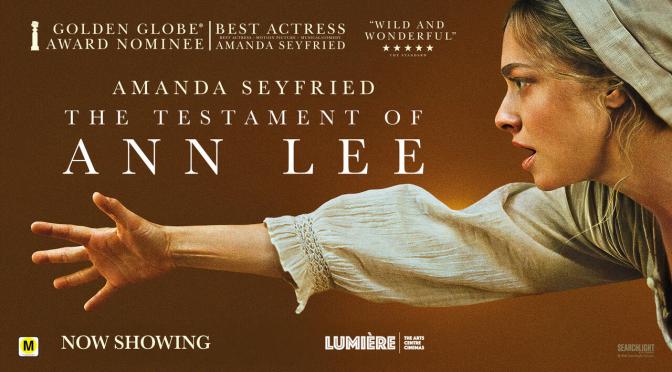
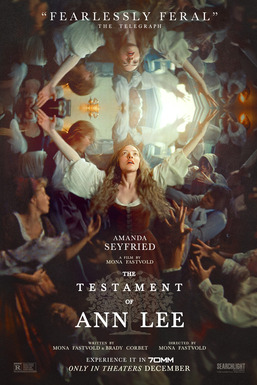
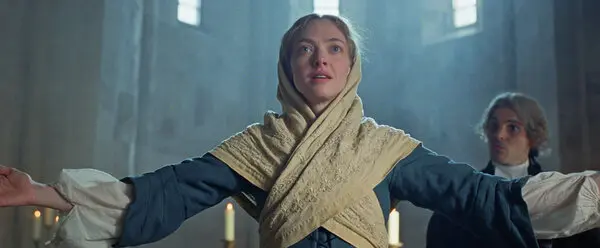
The Testament of Ann Lee (2025), directed by Mona Fastvold and co-written with Brady Corbet, is an ambitious historical musical drama that explores the life of Ann Lee, the charismatic 18th-century founder of the Shaker religious movement. With Amanda Seyfried at its centre, the film approaches Lee less as a traditional saintly figure and more as a woman shaped by trauma, conviction, and spiritual fervour. Fastvold’s direction leans heavily into atmosphere, presenting Lee’s rise to spiritual leadership as something both mystical and deeply human. The result is a film that feels reverent yet curious, as if studying a figure whose faith borders on mania.

Amanda Seyfried delivers an extraordinary performance that anchors the entire film. She plays Ann Lee with an intense interiority—equal parts fragile and formidable—capturing the fervent certainty of a woman who believes she has been chosen for a divine purpose. Seyfried’s physicality, particularly in the film’s musical and ritual sequences, gives Lee a magnetic presence that makes it easy to understand why followers might be drawn to her. It’s the kind of performance that lingers long after the film ends, and it stands as one of Seyfried’s most committed and transformative roles.


Visually, The Testament of Ann Lee (2025), is stunning. The film’s cinematography and production design immerse viewers in the harsh textures of 18th-century religious life, favouring natural light, muted palettes, and a palpable sense of dirt, wood, and candle smoke. The musical sequences—staged as ecstatic communal expressions of faith—are beautifully choreographed and filmed, capturing the hypnotic rhythms of Shaker worship. Yet while these moments are striking, they begin to feel somewhat repetitive as the film progresses, emphasizing mood over narrative momentum.

For viewers fascinated by charismatic religious figures or the psychology of belief, the film offers a compelling entry point. As someone not particularly religious but drawn to stories of spiritual zeal and cult-like devotion, I found the story initially captivating. Still, Ann Lee’s narrative arc ultimately feels less dramatically satisfying than the film’s aesthetic ambitions might suggest. Rather than a searing drama or a definitive testament to a heroic religious figure, The Testament of Ann Lee (2025), settles into something quieter: a haunting, beautifully crafted piece of moving art that observes its subject with reverence but stops just short of fully interrogating her legacy.

Mark: 7 out of 11


Cinema Review: Wasteman (2026) – a brutal British prison drama with two intense lead performances!

Cinema Review: Wasteman (2026)

Directed by Cal McMau

Screenplay by Hunter Andrews & Eoin Doran

Produced by Sophia Gibber, Myles Payne, Philip Barantini & Samantha Beddoe

Main cast: David Jonsson, Tom Blyth, Corin Silva, Alex Hassell, Paul Hilton, etc.

Cinematography by Lorenzo Levrini

Edited by James A. Demetriou

*** MAY CONTAIN SPOILERS ***


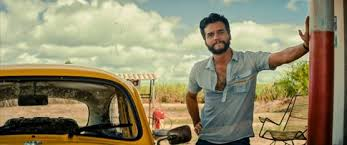
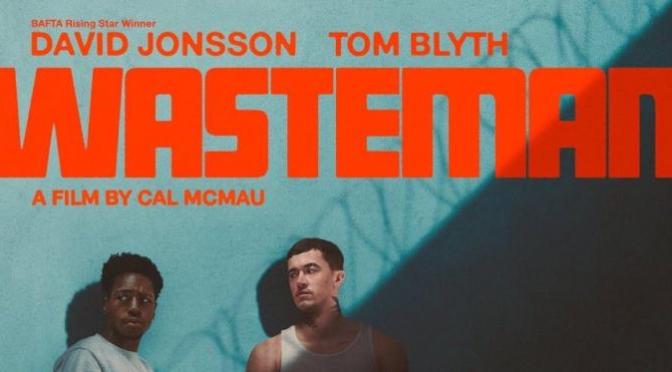
Wasteman (2026) presents another opportunity for David Jonsson to showcase his ample acting abilities. He first stole hearts with under-stated charm in low-budget rom-com, Rye Lane (2023), then proved he could spar at a higher-budgeted level in, Alien: Romulus (2024). He then delivered another strong performance in, The Long Walk (2025), further cementing his instinct for emotionally grounded genre work. Across romance, horror, drama and dystopian thriller, Jonsson doesn’t just adapt — he deepens.

In Wasteman (2026) his character. Taylor, is an inmate close to getting out having served a lengthy sentence. He must keep out of trouble in order to get a successful release. However, that proves difficult when a new cellmate, Dee (Tom Blyth) muscles his way into his four-walled existence. The narrative conflict and tension is built on a stark clash of personalities. Taylor is quiet, cautious, and emotionally guarded — a man who keeps his head down in prison, desperate to survive. He avoids confrontation and moves through the system almost invisibly, shaped by drug addiction, guilt and the need for redemption.

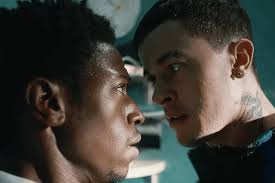
Dee, on the other hand, is the complete opposite: loud, aggressive, and unmistakably alpha. He walks into the prison with dominance in his bones, quickly asserting control through intimidation, charisma, and violence. Where Taylor retreats, Dee advances desiring to take over the prison wing. Where Taylor stays silent, Dee provokes the other drug dealers on their floor stealing their trade. Their dynamic becomes the film’s central pressure point — a volatile relationship between a man trying to disappear and another who refuses to be anything but the most powerful person in the room.


Prison dramas are always enthralling as the characters are trapped like caged animals. Further, where there is masculinity, ego and mental fragility, violence is likely to follow. There are a number of fearful scenes and harsh encounters that raise the heart rate, especially between Dee and his prison rivals. Taylor tries to navigate the war but unfortunately gets dragged into a series of highly brutal battles. Dee also strives to manipulate Taylor too with a carrot and stick approach. How Taylor extricates himself from this dangerous situation proves very suspenseful.

Overall, Wasteman (2026) is not for the faint-hearted. Director, Cal McMau and his cinematographer, Lorenzo Levrini, make the most of the crammed jails, using big-close-ups to get in the face of the characters and audience with searing intensity. Moreover, the interspersing of vertical phone 9:16 aspect ratio shots also heightens the verisimilitude, giving it a raw documentary style. Finally, the end pivot of Taylor and Dee’s power struggle provides a subtle narrative conclusion rewarding David Jonsson and Tom Blyth tour-de-force performances with a cathartic and memorable denouement.

Mark: 8.5 out of 11


Cult Film Review: American Movie (1999) – a bittersweet documentary profiling the ups and downs of a low-budget filmmaker!

Cult Film Review: American Movie (1999)

Directed by Chris Smith

Produced by Sarah Price & Chris Smith

Main “Cast”: Mark Borchardt and Mike Schank

Cinematography by Chris Smith

Edited by Barry Poltermann & Jun Diaz

Music by Mike Schank

*** MAY CONTAIN SPOILERS ***


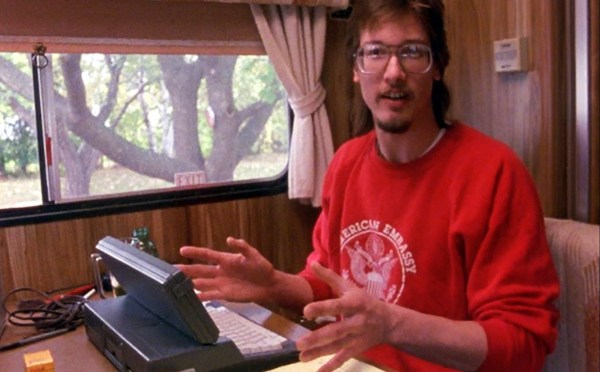
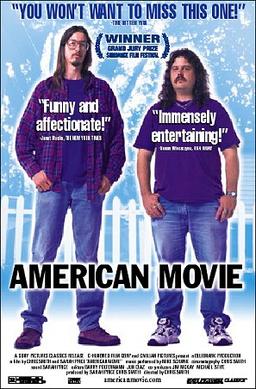
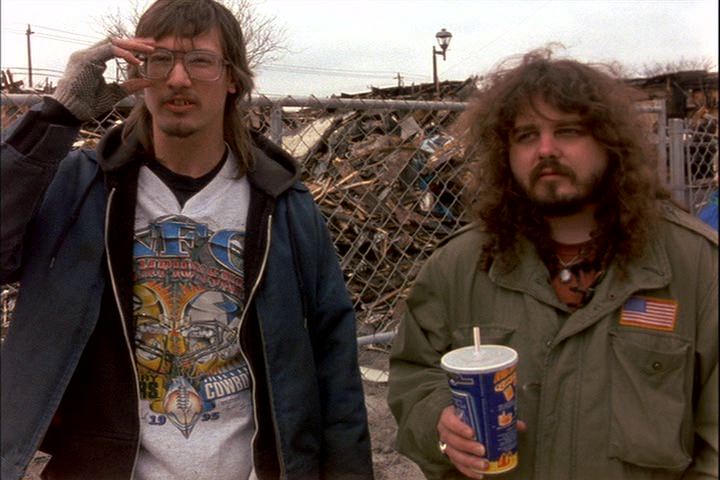
Given I am a low-budget filmmaker myself I am amazed I had never seen, American Movie (1999) before. Thankfully The Nickel Cinema in London screened it at the weekend and I really enjoyed it. Filmed between 1995 and 1997, this cult classic documentary American Movie (1999) chronicles Borchardt’s heroic, chaotic, and deeply Midwestern quest to finish his indie horror short Coven (pronounced ‘COH-ven’, and yes, he will correct you). The short is meant to raise money for his real passion project, a feature called Northwestern. But first? He has to survive reality. And reality is brutal.

Mark has not just zero money; zero organization; a rotating cast of confused friends and relatives as crew; functioning alcoholism; mounting debts, but also has the gift of the gab and a never ending passion for filmmaking. What unfolds is less “behind-the-scenes documentary” and more Shakespearean comedy AND tragedy staged in Milwaukee houses, static caravans, cars, junkyards and local woods.

Borchardt is equal parts Ed Wood and tortured auteur — passionately explaining his artistic vision one minute, begging his elderly uncle for production money and picking up his editing assistant from prison the next. His crew ranges from loyal-but-clueless to openly skeptical, yet somehow the production lurches forward. Barely.


The documentary crew shot over 90 hours of 16mm footage, capturing every awkward take, every blown line, and every moment of Mark’s delusional optimism. We watch as Coven repeatedly derails thanks to bad planning, worse luck, and the universal law that says: if something can go wrong on an indie film set, it absolutely will. But here’s the twist — it’s weirdly inspiring. Because underneath the chaos is something pure: a guy who just refuses to stop making movies. No money. No resources. No safety net. Just pure passion and obsession.

What’s most hilarious is the double act comedy exchanges between Mark and his best friend and Mike Schank. Mike, a very capable musician, has a permanent grin and the look of an acid-trip casualty, yet almost-perfect comedy timing. He clearly loves Mark’s passion and helps as best he can. I was sad to read Mike had passed away in 2022 from cancer.

If you stumbled into American Movie (1999) blind, you’d swear it was a proto-sitcom about delusional dreamers armed with a battered 16mm camera, a camcorder and misplaced confidence — a spiritual ancestor to Trailer Park Boys and It’s Always Sunny in Philadelphia. It plays like a painfully funny hangout comedy about a self-proclaimed auteur and his band of well-meaning screw-ups trying — and repeatedly failing — to make something “serious.” The arguments are petty, the ambition is sky-high, and the incompetence is operatic. You laugh, you cringe, and somewhere along the way you realize this isn’t scripted chaos — it’s just raw, unfiltered obsession captured on camera.

Mark: 9 out of 11