Tag Archives: 1980S

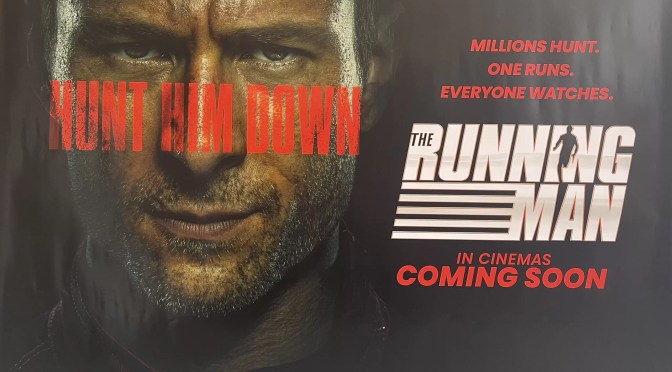
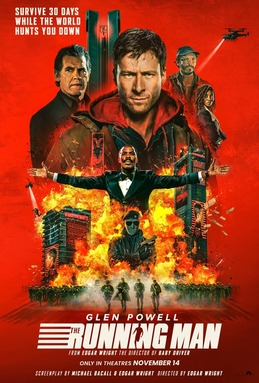
Cinema Review: The Running Man (2025) – Edgar Wright – a decent cardio cinema workout that breaks into intermittent sprints!

Cinema Review: The Running Man (2025)

Directed by Edgar Wright

Screenplay by Michael Bacall & Edgar Wright – Based on The Running Man by Stephen King

Produced by Simon Kinberg, Nira Park & Edgar Wright

Main Cast: Glen Powell, William H. Macy, Lee Pace, Michael Cera, Emilia Jones, Daniel Ezra, Jayme Lawson, Sean Hayes, Colman Domingo and Josh Brolin, etc.

Cinematography by Chung-hoon Chung

*** MAY CONTAIN SPOILERS ***


As a fan of Edgar Wright’s stylish, kinetic direction, the camp cult charm of the original Arnold Schwarzenegger 1980’s action romp, and of course Stephen King’s sharp literary concepts, I went into The Running Man (2025) with high hopes. The film certainly starts brilliantly where Wright unloads a barrage of inventive visual gags, flashy transitions, and razor-clean action choreography. The set-pieces are spectacular from the outset, and when the film is firing on all cylinders, it’s exactly the sort of propulsive, high-concept entertainment you’d expect from this creative cocktail.

It remains a fantastic concept with a near-future game-show rewarding contestants with great wealth as long as they survive a month on the run and are not killed by all manner of uber-mercenaries chasing them. But as a whole the script and tone never quite settle. As such, the film wavers between being a comedy-actioner and a revolutionary dystopic thriller. It can be both, but here the shifts feel abrupt and under-cooked. The last forty-five minutes and final act especially drag, weighed down by a new character who is introduced mainly to witness Richards (Glen Powell) strike back at his foes, without adding much thematic or emotional heft. Emilia Jones does okay but her character should’ve entered the story much earlier—ideally as one of the contestants—so her eventual role feels earned rather than tacked on.


Powell is solid, charming, and physically believable in the role, but he’s not (at least yet) a true blockbuster star—more a handsome, reliable leading actor as demonstrated in the excellent, Hit Man (2024). I couldn’t help but imagine someone like Lee Pace in the part. Instead he is playing the lead henchmen. Pace is an actor with the gravitas and presence to anchor the story’s darker undercurrents and sell the rebellion with more weight. Indeed, Pace, Michael Cera, Colman Domingo, and Josh Brolin bring depth and texture to The Running Man (2025), each grounding the film’s wild energy with sharply defined performances. Pace delivers charismatic menace, while the underused Cera adds an unexpected nervy humour that sharpens the satire. Domingo, as always, lends personality as the show host, and Brolin rounds it out with rugged corporate authority that makes the world feel dangerous.

Ultimately, even Wright’s trademark ADHD-fueled visual dynamism can’t fully rescue a script that overreaches in ambition. Thus, The Running Man (2025) could have been truly great if it had taken just a little more time to breathe—letting its world, its fears, and its people settle in before the chaos kicked off. Beneath the neon splatter and bombastic satire is a sharp idea about media, violence, voyeurism, and manipulation, but the film races past its own potential. With a touch more patience to build tension, deepen the stakes, and let us actually care about the characters caught in the spectacle, its dystopia might have hit harder, felt richer, and lingered longer after the credits rolled. Still, the craft and energy make it an intermittently thrilling ride—just one that needed sharper focus to become the definitive The Running Man (2025) adaptation fans were hoping for.

Mark: 7 out of 11


BFI PLAYER FILM REVIEWS: THE BEASTS (2022) and THE QUIET GIRL (2022)

BFI PLAYER FILM REVIEWS: THE BEASTS (2022) and THE QUIET GIRL (2022)

I watched DUNE: Part II (2024) at the cinema but was not drawn to write a review of that masterly sci-fi-behemoth and technical marvel, such was the life-draining and utterly emotionless lack of reaction on my behalf. Instead, for my latest reviews I have chosen lower budget films, in comparison, which offer compelling characters and drama which made me feel and think something.


THE BEASTS (2022)

Directed by: Rodrigo Sorogoyen

Written by: Isabel Peña and Rodrigo Sorogoyen

Main Cast: Denis Ménochet, Marina Foïs, Luis Zahera, Diego Anido,
Marie Colomb
etc.

Multiple Goya award-winning drama The Beasts (2022) is an intelligent and muscular drama that reminded me of the equally compelling Jean de Florette (1987) and Only the Animals (2019). The latter also starred the sizable talent that is Denis Ménochet. Here he inhabits the character of former teacher, Antoine Denis, who along with his wife, Olga (Marina Foïs) have taken to renovating properties and farming eco-vegetables in the area of Galicia, Spain.

Honest and hardworking the Denis’ are unfortunately considered outsiders and a threat to the locals, notably the brutish Anta brothers, led by the menacing Xan (Luis Zahera). The conflict is exacerbated as Xan blames them for losing his family money when the Denis’ blocked the sale of land to a wind energy company. Luis Zahera provides a formidable performance as the intimidating bully who begins by poisoning their water before moving onto even more vile and threatening acts.

The theme of city academics versus rural folk is explored with intensity, at times evoking Sam Peckinpah’s more exploitational film, Straw Dogs (1971). But rather than containing an explosive and violent ending, The Beasts (2022) delivers a more slow-burn, riveting and moving denouement. Superbly directed, filmed, and acted throughout, this is a fine work of cinema, only let down for me, by a final act which could not deliver on the highline suspense and tension established in the first two.

Mark: 8.5 out of 11


THE QUIET GIRL / An Cailín Ciúin (2022)

Directed by Colm Bairéad

Screenplay by Colm Bairéad – Based on Foster
by Claire Keegan

Produced by Cleona Ní Chrualaoí

Main cast: Carrie Crowley, Andrew Bennett, Catherine Clinch, Michael Patric, Kate Nic Chonaonaigh etc.

Not only is this 1980’s set Gaelic drama about a quiet girl, it is very much a quiet film that is quietly devastating in mood and emotion. Centred around nine-year old, Cait (Catherine Clinch), she is a neglected outsider, and one of many siblings to a pregnant-again mother and horrible father. Worried about being able to cope, her mum “fosters” Cait to distant cousins, Eibhlín (Carrie Crowley) and Sean Kinsella while she is in the latter stages of pregnancy. Thus begins a meditative forming of a heartfelt relationship between the girl and the Kinsellas.

Initially the film’s narrative unfolds very slowly, being light on pace and exposition, but deft in mood and feeling. There is a certain poetry in the lighting and framing against the beautiful countryside landscapes. The Kinsellas and Cait, while reserved on the outside, are hiding strong emotions and even more powerful secrets. Colm Bairéad’s confident screenplay slowly reveals certain enigmas, but still plays his story cards close to his chest. Yet, the warmth of the leading characters and the interpretive dramatic subtext expertly pulls you into their lives, rather than distance you from them.

The Quiet Girl (2022) broke box office records for the opening weekend of an Irish-language film and became the highest-grossing Irish-language film of all time. Further, it received 11 nominations at the 18th Irish Film & Television Awards (IFTAs) in March 2022, and won in seven categories. It’s no surprise given the quality of the writing, photography, acting and direction that the film has achieved such accolades. Indeed, Catherine Clinch as Cait is a phenomenon. By the end I defy anyone not to be moved by the heart wrenching final scenes, as the film ultimately proves less is most certainly more.

Mark: 9 out of 11


CINEMA REVIEW: THE IRON CLAW (2023)

CINEMA REVIEW: THE IRON CLAW (2023)

Directed by Sean Durkin

Written by Sean Durkin

Produced by: Tessa Ross, Juliette Howell, Sean Durkin, Angus Lamont, Derrin Schlesinger

Cast: Zac Efron, Jeremy Allen White, Harris Dickinson, Maura Tierney, Stanley Simons, Holt McCallany and Lily James.

Cinematography: Mátyás Erdély

*** CONTAINS SPOILERS ***


According to research on the internet the biggest killer of men in the UK under fifty-years of age is suicide. Nationally and locally seventy-five percent of those that die by suicide are men, with the highest numbers being forty-five to fifty-four years of age. In the USA, reports show suicide is the second leading cause of death among Americans ages ten to thirty-four, and the fourth leading cause of death in the thirty-five to fifty-four age group. I personally have known two close male friends who have taken their own lives in the last decade.

In addition, mortality rates for professional wrestlers are reportedly up to 2.9 times greater than the rate for men in the wider United States population. Statistics also show that the early deaths of professional wrestlers were significantly higher than that of athletes in other sports. Potentially due to the consistent mental and physical detriment as well as a proclivity toward higher rates of cardiovascular disease, depression and drug addiction. Thus, with this in mind, Sean Durkin’s film, The Iron Claw (2023), a profile of the Von Erich family, while full of exciting wrestling action, is NOT one of those generic feelgood underdog sports dramas. It is however a complex exploration of masculinity, familial pressure, sports politics, suicide, grief, religion, addiction, love, and the resilience of the human spirit.


A prologue establishes Jack “Fritz” Von Erich (Holt McCallany) as an uncompromising professional wrestler in the 1960s with a signature move called the ‘Iron Claw.’ A number of years later Von Erich Snr. is a wrestling promoter who runs successful WCCW events in Texas. His unique selling point for the shows is that he has four sons, Kevin (Zac Efron), Kerry (Jeremy Allen White), David (Harris Dickinson) and Mike (Stanley Simons), who throughout the narrative, all test themselves to the limit in the wrestling ring.

While it is certainly a strong ensemble cast, the main focus of Durkin’s compelling screenplay is Zac Efron’s, Kevin. A strong, fast and muscular athlete in the ring, Kevin, however, is not a confident personality out of it. He, and his brothers, live in the shadow of his domineering father, who controls and dictates to those around him. Jack’s resentment at not winning the NWA Worlds Heavyweight Championship during his career, and dissatisfaction at the politics of the higher-ups in wrestling, has made him a bitter, angry man. Thus, the theme of toxic masculinity bleeds throughout the story as Jack keeps his sons, and wife (Maura Tierney), under control. Therefore The Iron Claw (2023) is not just a signature wrestling move, but also the means with which the Von Erich family are treated by Jack.

There are moments of glory in the ring for the brothers, notably Kevin, Kerry and David in The Iron Claw (2023). Indeed the wrestling action is often pulsating and Durkin does include several genre-pleasing action montages. But, tragedy is never far away from the Von Erich family. Kevin even tells his wife-to-be, Pam (Lily James) that he believes the family are cursed. She dismisses this, but given what occurs during the film and the heartbreak which befalls the brothers, you begin to think he may be right. As Kevin, Zac Efron gives an incredibly moving performance as the brother seeking love, success and family community. Lastly, I truly disliked Sean Durkin’s last film The Nest (2020), as it said very little about people I did not care about. The Iron Claw (2023), on the other hand, says so much about people I was emotionally rooting for, with Kevin Von Erich in particularly admirable as he showed ultimate fighting spirit by surviving such unforgiving loss.

Mark: 9 out of 11


CULT MOVIE REVIEW: XTRO (1982)

CULT MOVIE REVIEW: XTRO (1982)

Directed by: Harry Bromley Davenport

Screenplay by: Harry Bromley Davenport, Michel Perry, Iain Cassie, Robert Smith

Story by: Harry Bromley Davenport, Michel Perry

Produced by: Mark Forstater

Cast: Bernice Stegers, Philip Sayer, Simon Nash, Maryam d’Abo, Danny Brainin etc.

Cinematography: John Metcalfe

*** MAY CONTAIN SPOILERS ***


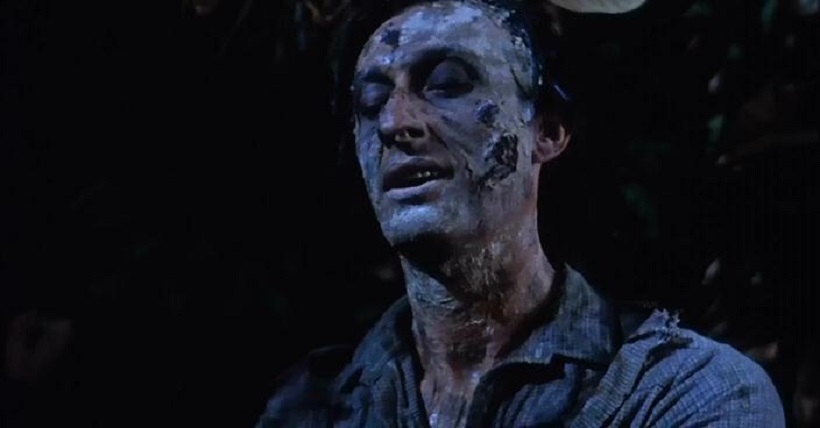
Being a fan of the horror genre never fails to spring surprises, especially if you also love trashy-B-movie-exploitation-video-nasties too. Because what often occurs is a hidden or buried or previously banned film will reanimate and be located on one of the many streaming platforms we have today. I am both surprised and even more joyous if I find I have never even seen the said film. This is certainly the case with low-budget alien monster film, XTRO (1982).

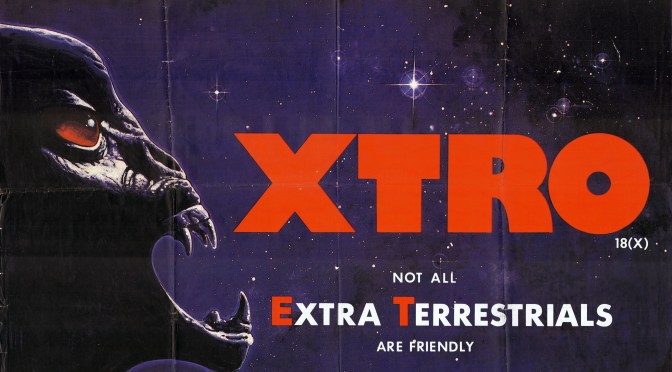
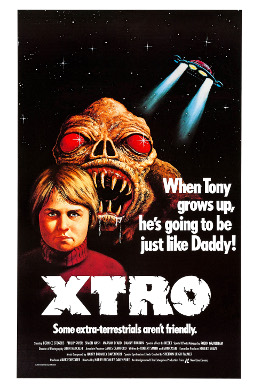
There I was pressing play via Amazon Prime, thinking it was another schlocky American indie I had missed from yesteryear, only to discover Xtro (1982) is actually a bizarre British film which twists and riffs on the box office hit that was ET: Extra Terrestrial (1982). Xtro (1982), directed by Harry Bromley Davenport, is not a comforting family science fiction drama like its more famous counterpart though. Instead, it is a gory sci-fi shocker with many outrageously violent set-pieces and a budget lower than E.T.’s lunch bill.


Critically damned at the time, Xtro (1982), when released on home video in 1983, was subject to a prosecution case in relation to British obscenity laws and labelled a “video-nasty”. Watching it now I have to admit it is quite shocking still, but the practical effects are so gloriously over-the-top they are more humorous than sickening. Having said that there are some memorably gruesome moments involving alien births, crazy clowns, a live “Action Man” doll, weird space eggs, and transformative man-into-monster effects.

The film doesn’t hang about establishing character but propels, from the opening scene of a father playing in the garden with his son, straight into the disappearing parent plot. The father (Philip Sayers) vanishes without a trace and three years later his wife (Bernice Stegers) and son are attempting to repair their lives. Yet, the boy is suffering horrific nightmares when suddenly his father reappears attempting to reconcile. The familial drama within the script itself could have been further developed to some emotional impact. However, while Bernice Stegers gives a decent dramatic performance, the film soon descends into a mix of surreal and insane set-pieces, combined with the father’s metamorphosis into something from another world.

There’s much to like and much to loathe about, Xtro (1982), notably the gratuitous nudity sprinkled throughout. Yet, if you are drawn to exploitational B-movies there is much sick entertainment to be found in the blend of impressive practical effects and creature moments. Philip Sayer and Bernice Stegers keep the shlocky elements of the plot in check with sane acting performances and despite some eccentric writing throughout Harry Bromley Davenport and his team have delivered an out-of-this-world bona fide B-movie cult classic.


SKY CINEMA REVIEW: MINARI (2020)

SKY CINEMA REVIEW: MINARI (2020)

Directed by Lee Isaac Chung

Written by Lee Isaac Chung

Produced by: Dede Gardner, Jeremy Kleiner, Christina Oh

Cast: Steven Yeun, Han Ye-ri, Alan Kim, Noel Kate Cho, Youn Yuh-jung, Will Patton, etc.

Cinematography: Lachlan Milne

Music by: Emile Messeri

*** MAY CONTAIN SPOILERS ***


See the source image

I missed Minari (2020) at the cinema. Which is a shame because out of all the Oscar-nominated films from earlier in the year it is now my favourite. Further, it should certainly have won the best film award. (Note: I have yet to see The Father (2020).) It has the heart and warmth and realistic hope that eventual winner, Nomadland (2020) lacked. Chloe Zhao’s powerful character study was arguably too meditative and glacially paced, without any real diversion from the plodding repetition of monotonous existence. I love slice-of-life and character-driven work, but I want some drama too. While Minari (2020) has certain meditative qualities, writer-director Lee Isaac Chung has crafted a supeb cinematic memoir of tender power and emotion.

Set in 1983, Minari (2020), centres around the Yi family. They had been working in California, but have moved to Arkansas to farm the land. The father, Jacob (Steven Yuen) dreams of growing produce to sell to fellow Korean businesses. However, the farm and static caravan he has purchased is remote with no guarantee of water to ripen the fruits and vegetables. Jacob must either pay exorbitant prices from the water company or find a natural spring underground. Alas, rain rarely threatens the Arkansas plains.

Jacob’s wife, Monica (Han Ye-ri) hates the caravan and does not share his farming dream. This marital conflict drives the much of the narrative as the two argue constantly. Monica is especially angry that her young son, David (Alan Kim) is so far from a hospital. The boy has a heart condition and like any good mother she consistently worries. Their teenage daughter, Anne (Noel Kate Cho) is too young to be a full-time caregiver to David while Jacob and Monica support themselves working at a local chicken factory. To placate Monica, Jacob brings grandmother, Soon-ja (Youn Yuh-jung) to the farm for support. Here a beautiful and funny parallel plot begins as David and his grandmother’s relationship comes to the fore.


See the source image

I watched Minari (2020) on a Sunday morning at home, relaxed and cosy, filled with breakfast and coffee. I loved experiencing the film. The music wondrously supports the beautiful photography that illuminates the green and wheats that fill the lens’ gorgeous palette. Like the masterpiece, Parasite (2019), Minari (2020) represents a working-class family striving to stay together and survive in difficult times. The main difference though is the Yi family were doing it with honest hard graft rather that grifting, ducking and diving. The Yi’s connect with nature and the land rather than skimming the city and the rich. I really rooted for the Yi’s. Jacob’s desires and battles to find water reminded me of the equally moving French classic, Jean De Florette (1986).

Minari (2020) doesn’t take the obvious route of making the Arkansas locals racists who rail against the Yi’s. While there are some scenes involving cultural clashes, much of the drama and humour derives from the families interactions with each other. Indeed, the scenes where David antagonises his unconventional grandmother are hilarious. Youn Yuh-jung as the elderly matriarch is fantastic, deservedly winning a best supporting actress role at the Oscars. Moreover, Lee Isaac Chung gets a miraculous performance from child actor, Alan Kim. Special mention for a busy, but nuanced portrayal of a troubled but helpful worker, Paul, by Will Patton. His deeply pious character could have easily been made an antagonist, but Chung ensures he is another relatable human being in a film full of them.

Mark: 9.5 out of 11


HORROR OBSCURA FILM REVIEWS – HALLOWEEN 2021 SPECIAL!

HORROR OBSCURA FILM REVIEWS

Halloween is slowly creeping out of the fog and shadows. It’s a time of the year where horror films come to the fore. Personally, I watch horror all the year round, but it’s always fun when the genre pulls focus on the cultural calendar.

Rather than concentrate on current horror film releases, I thought it would be interesting to seek out chillers that are a tad less known. So, I had a scan through Amazon and Shudder screening platforms and unearthed several cult horror gems worth catching.

Some of these films come from the 1980’s period which encompassed the “video-nasty” era in the United Kingdom. With the advent of home video technology, the government suddenly got frightened about bloody and exploitational films and desired control. Censoring seventy-two titles and banning a flurry of films actually made people want to watch them more. This caused the government’s policy to backfire as people clamoured to watch “pirate” video versions of such films. In fact, it was in the living room watching forbidden films and the old Universal black-and-white classics where my true love of horror cinema began.

The following films may not have been banned at the time, but I was intrigued by how many of the titles I missed seeing on first release. Aside from Ben (1972), When A Stranger Calls (1979) and Phantasm (1979), I hadn’t seen the other titles. Therefore, if you’re looking for obscure horror films to watch then delve deep into the Amazon library. They have a fine feast of 1970’s and 1980’s fear inducing fare, many of them which were on the infamous “video-nasty” list. Dare you watch them!?


THE CAT OF NINE TAILS (1971)

An early Dario Argento giallo finds a blind puzzle-maker (Karl Malden) and dogged reporter (James Franciscus) investigating murders at a genetics lab. Aside from a couple of scary set-pieces, notably in a graveyard, it neither works as a detective nor horror story. It is however beautifully filmed with a vibrant restoration. (Mark: 6 out of 11)

CHUD (1984)

As the Nuclear Regulatory Commission track down missing toxic waste the New York homeless population are becoming victims to something monstrous in the sewers. An energetic sci-fi-horror hybrid combining a schlocky plot with socio-environmental themes. It’s not bad and actually quite funny, with early roles for John Heard and Daniel Stern whose acting raises the overall quality. (Mark: 6 out of 11)

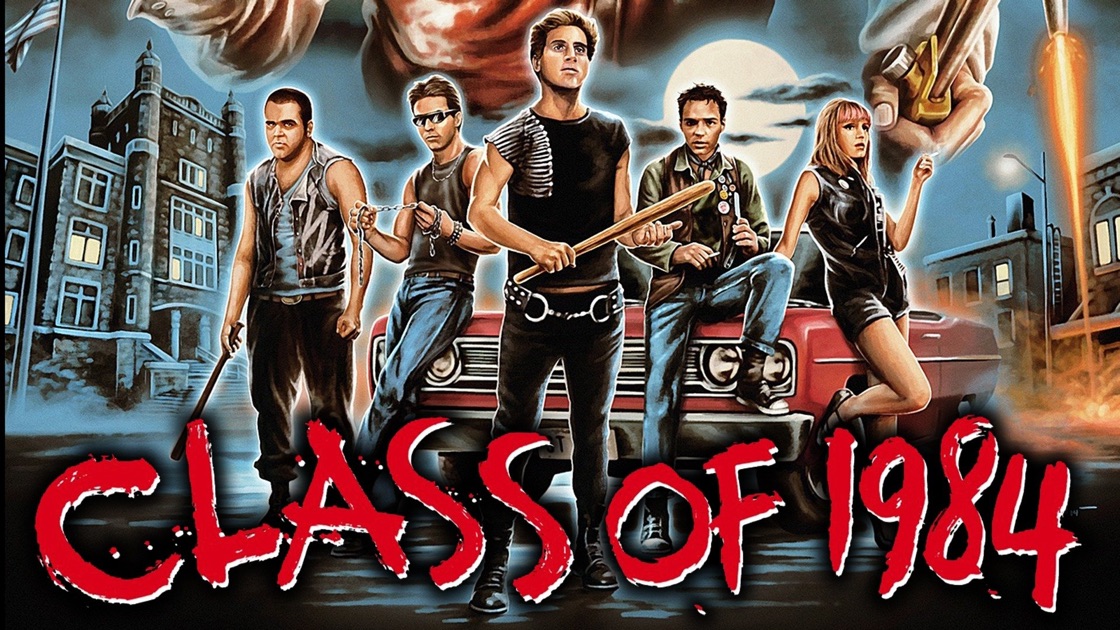
CLASS OF 1984 (1982)

I remember school kids raving about this film when I was twelve. I really wanted to see it, but could never find it in the video shop or from the “pirate” video guy. The plot merges The Blackboard Jungle (1955) with Death Wish (1974), as Perry King’s music teacher attempts to soothe the savage beast of a gang of nasty punk students. He fails and the final act revenge-driven rampage is fantastically inventive and gory. Latterly famous director, a young Tim Van Patten, portrays the psychotic, Peter Stegman, with vicious zeal. A true exploitational classic. (Mark: 8 out of 11).

HELL NIGHT (1981)

This is one of those films I had never even heard of. With a sizeable budget of $1.4 million dollars for a slasher film, it concerns four college students, including a grown-up Linda Blair, spending the night in a creepy house as part of an initiation ritual. Unfortunately, there’s a psychotic killer about hellbent on hunting them down. We’ve seen it all before, but it was nicely filmed and had decent humour. Overlong but way better than I thought it would be. (Mark: 7 out of 11)

PHANTASM II (1988)

I reviewed the remastered version of Don Coscarelli’s low-budget masterpiece here, but only just got round to watching the sequel. Phantasm II (1988) had a bigger budget and suffers from some stodgy plotting. The re-casting of Mike with James Le Gros in the role throws you. Yet, once Mike and Reggie fight with the Tall Man (inimitable Angus Scrimm), the razor-sharp spheres and the hooded monsters, the film finds real pace. Coscarelli blows-up a lot of stuff and ramps up the weaponry, but the sequel lacks the twisted magic of the original must-watch horror fantasy, Phantasm (1979). (Mark: 6.5 out of 11)


TERROR TRAIN (1980)

Another unknown mini-gem I found on Amazon. This Canadian slasher film is, you guessed it, set on a train and finds, yes you guessed it again, college students getting picked off one-by-one by a vengeful psycho. Notable for a really good plot which gives the killer empathy and understandable motivation, it also stars everyone’s favourite final girl, Jamie Lee Curtis. With disguise and magic prevalent in the themes, David Copperfield also appears in a neat role. Highly entertaining with a killer twist. (Mark: 8 out of 11)

WHEN A STRANGER CALLS (1979)

Inspired by a famous urban legend, Fred Walton’s chilling suspense thriller has one of the most nail-biting opening twenty minutes in horror cinema. Carol Kane is the babysitter terrorized by a series of tense phone calls from a mystery ringer. From that terrifying start the story falters slightly as it focusses on Charles Durning’s obsessive search for the unhinged man. Only when Kane rejoins the film some years later does the horror rise up again in a truly frightening denouement. (Mark: 8.5 out of 11)

WILLARD (1971) / BEN (1972)

This was an odd one because I knew and seen the sequel Ben (1972) when I was a younger. Little did I realise the original Willard (1971) had been released the year before and became a sleeper box-office hit. Bruce Davison is excellent as the introvert, Willard, who is bullied at work by his aggressive boss, Ernest Borgnine. Only when, and take a deep breath here, Willard trains an army of rats does he gain confidence to take on the world. It’s a weird film that actually works because of Willard’s fascinating character arc and Davison’s nuanced performance. (Mark: 8 out of 11)

The follow-up Ben (1972) focusses on Willard’s alpha rat, Ben, and his friendship with lonely kid, Danny. The sequel really raises the rat count and there appears to be thousands of them in their dirty lair. Danny is a likeable kid who suffers from a serious illness that prevents him from going out. Why he would make friends with a killer rat though is still frankly nuts! A lack of thrills and goofy premise make it difficult to recommend, and is more famous for the classic Michael Jackson hit called, surprisingly enough, Ben. (Mark: 6 out of 11)


CLASSIC FILM REVIEW – SCARFACE (1983) – YOUTUBE VIDEO

CLASSIC FILM REVIEW – SCARFACE (1983) – YOUTUBE VIDEO

The Cinema Fix is a website for all film and TV lovers everywhere. It’s a mix of reviews, articles, essays, news and thoughts on new and classic releases. It is intended to be honest, irreverent, funny and hopefully intelligent. I also have a YouTube channel with loads of short films and video articles. Check it out here.

I have just created a new video article. It’s a review of the classic gangster film, Scarface (1983). You can read it here or check out the video below.


CREDITS

This video article is a fun and educational piece reviewing one of our favourite gangster films ever.

Written by: Paul Laight
Narrated by: Melissa Zajk
Music Produced by : Aries Beats
Promoted by : CRFC

The copyright of the images and trailers are those of the film studio. I do not own any of the images or films.

Film/Trailer clips credits:

Scarface (1983)
Directed: by Brian DePalma
Produced by: Martin Bregman
Written by: Oliver Stone.
Distributed by: Universal Pictures

Check out our other sites:

www.fixfilms.co.uk
www.youtube.com/c/FixFilmsLtd


FILMS THAT GOT AWAY #11 – HOUNDS OF LOVE (2016)

FILMS THAT GOT AWAY #11 – HOUNDS OF LOVE (2016)

Written and Directed by: Ben Young

Produced by: Melissa Kelly

Cast: Emma Booth, Ashleigh Cummings, Stephen Curry, Harris Gilbertson, Susie Porter, Damian De Montemas, etc.

Music by: Dan Luscombe

Cinematography: Michael McDermott

Edited by: Merlin Eden

*** MAY CONTAIN SPOILERS ***


Where narratives relating to rape, abduction, and serial killers are concerned, a filmmaker can tread a fine line between lurid exploitation and absorbing suspense and drama. Low budget B-movies are replete with stories of death, sexual assault and crazed murderers. Some overstep the mark becoming notorious beacons of bad taste. Many horror fans love the exploitational nature of “video nasties”, seeking out films like: Cannibal Holocaust (1980), A Serbian Film (2010), I Spit on Your Grave (1978), Driller Killer (1979), Texas Chainsaw Massacre (1974) and The Last House on the Left (1972), to name but a few. The latter two films directed by horror maestros Tobe Hooper and Wes Craven are arguably exceptional visions of terror which transcend their horror genre subject matter. Similarly, Ben Young’s The Hounds of Love (2016), in my view, represents the evil of human beings without exploiting the actors or audience.

While it may not be as gory on-screen as the films mentioned above, The Hounds of Love (2016), does offer a shattering and sickening set of images and sounds within these savage set of events. Set in Perth, Australia during 1987, this is a disturbing and all too realistic horror story. It opens with a majestic set of slow-motion shots from the point-of-view of suburban couple, Evelyn White (Emma Booth) and John White (Stephen Curry). They sit in their vehicle as the sun hazes and watch teenage girls playing netball in the school yard. They are stalking their next victim; patiently waiting to lure another unsuspecting soul into their nefariously sadistic crimes. Stylistically impressive, but at the same time incredibly unnerving, Ben Young skilfully establishes the canvas on which he will paint further horrors.


Having fed their violent and sexual lust with the opening victim, we are then introduced to their next. Vicki Moloney (Ashleigh Cummings) is a rebellious teenager who is smarting from her parents recent split. Acting with both charisma and defiance, Vicki is slightly annoying, yet empathetic. Obviously, she does not deserve the ordeal she is about to experience at the hands of the Whites. The sequence which finds them cajoling her into their clutches is so tense and had me screaming at the screen, “No!!!! Get out!!!” What follows then, as Vicki becomes a prisoner, is a series of heart-pounding and distressing scenes which raise the stakes to unbearable tension. Ashleigh Cummings performance is absolutely compelling as “final girl”, Vicki. She takes a potentially one-dimensional casualty and imbues her with fight, guile, pain, distress, intelligence and determination. No surprise therefore that she won a Best acting debut award at the Venice Film Festival.

Cummings performance is not the only one which impacts the story greatly. Emma Booth’s complex portrayal of Evelyn is quite startling. This is a character who is permanently on-the-edge and desperate to please her evil partner, John. Systematically controlled and bullied, there is no excuse for Evelyn’s part in the kidnappings and torture of these young girls. But, it is clear to see that toxic masculinity has, over the years contributed to her mental and emotional collapse. Booth’s persistently fraught acting is all bag-of-bones and shredded nerves. It is via Evelyn’s imploding emotional state that Vicki is able to attempt to turn her against John’s venal influence.

Ultimately, one could say this is an exploitation film in terms of theme and story. However, it feels different than the many B-movie serial killer films I have seen. I felt like I was in the hands of a filmmaker who was determined to explore the nature of sadistic relationships in a risky, but intelligent manner. The acting, cinematography, direction and haunting soundtrack all contribute to make this a highly effective psychological thriller. Of course, there are many which may feel differently and that the film has its cake and eats it in term of violence and sexual perversion. Yet, we never actually see much of the cake. Unlike many of the films I mention in the opening paragraph, the audience only see the build-up and aftermath of the crimes. Indeed, what we don’t see on screen is more frightening than what we do. That, overall, is what sets The Hounds of Love (2016) apart from many other films dealing with these unpalatable themes and subjects.

Mark: 9 out of 11


CLASSIC FILM REVIEW: SCARFACE (1983)

CLASSIC FILM REVIEW: SCARFACE (1983)

Directed by: Brian DePalma

Produced by: Martin Bregman

Screenplay by: Oliver Stone

Cast: Al Pacino, Steven Bauer, Michelle Pfeiffer, Robert Loggia, F. Murry Abraham, Mary Elizabeth Mastrantonio, Paul Shenar etc.

Music: Giorgio Moroder

Cinematography: John A. Alonzo


*** CONTAINS SPOILERS ***


“I always tell the truth, even when I lie! so, say good night to the bad guy!” Tony Montana


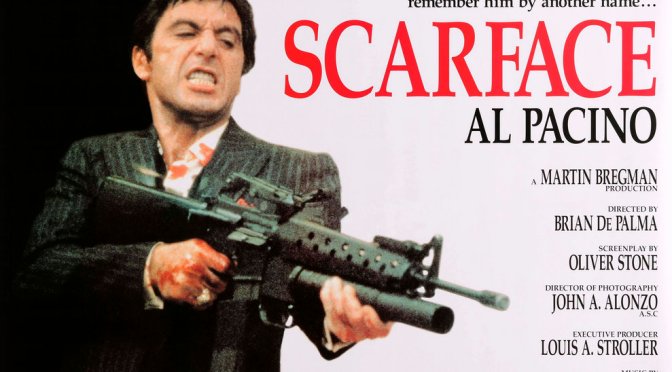
While Al Pacino is rightly lauded in the critically acclaimed Godfather Trilogy, as quietly menacing Michael Corleone, I think his spectacular performance as Tony Montana in Scarface (1983), is nothing short of cinematic gold. Tony Montana is a monstrous symbol of 1980’s excess and neo-capitalism. A product of social deprivation and cold war division. In this world, greed is not just good, but a driving force behind an evil empire which believes the extreme is only halfway. Tony Montana is small in size but big on gesture, colour and voice, both an anti-hero and villain for the eighties era. Moreover, for me, Tony Montana is the most iconic gangster ever committed to celluloid.

With a combustible screenplay written by Oliver Stone, Scarface (1983), is a cocaine driven and incendiary viewing experience. Stone himself is reported to have been battling cocaine addiction while writing it and this shows in the over-the-top world on screen. Everything is ramped up to eleven, including: the violence, shouting, swearing, shooting, politicking, drug-taking, sex, killing, avarice, money-making and corruption. There isn’t one redeemable character in the whole film. Everyone is corrupt. Actually, Tony’s mother tries her best to stay away from the darkness that follows Tony. His sister Gina (Mary Elizabeth Mastrantonio) seems pure, but is ultimately drawn into Tony’s incestuous glue, precipitated by her dangerous liaison with Manny (Steven Bauer).


“In this country, you gotta make the money first. Then when you get the money, you get the power. Then when you get the power, then you get the women.” – Tony Montana


How 'Scarface' Transformed the Way Cubans Were Perceived in the US

Directed with operatic and kinetic power by Brian DePalma, I have to say that Scarface (1983) is probably my favourite gangster film of all time. That isn’t to say it’s the best. That is Scorsese’s masterpiece Goodfellas (1990). But I just love this film because DePalma and Stone and Pacino revel in excess, violence and tragedy. It also contains some very dark humour too. Tony Montana is horrific, but also very funny. Georgio Moroder’s brooding synthesised score pocks the Miami streets, clubs, beaches, Bolivian boltholes, and in the final hour, Tony’s fortified mansion. I love the artificial backdrops featuring palm trees and sun because their fakeness symbolises the delusory world of the characters. Indeed, even the back-projection shots used when driving add to the illusion. The characters business foundations are built on white sand, a powder which ultimately blows away in the wind.

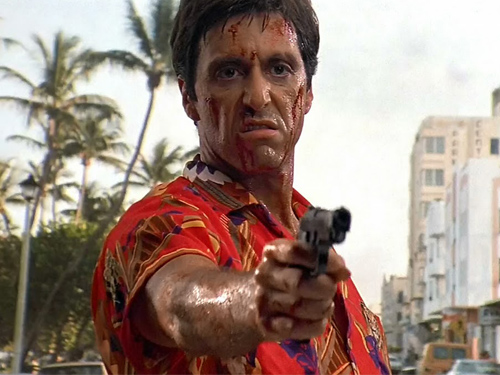
DePalma is the best director of a cinematic set-piece since Hitchcock. That isn’t to say he’s the best director ever per se, but rather someone who just creates so many well-conceived and memorable scenes. The infamous chainsaw scene, the killing of Frank (Robert Loggia), Tony’s bitter monologue in the restaurant, and the explosive “say hello to my little friend” ending, are just a few of the jaw-dropping moments in this epic crime drama. DePalma also gets incredible performances from all the cast. Pacino obviously blows the doors off as the tough, paranoiac, angry, greedy and hyperbolic Montana. The then, mostly unknown, Michelle Pfeiffer is equally impressive as the coke-fuelled ice-queen, Elvira, who becomes Tony’s vampiric and soulless wife.

Stone’s scenery-crunching script obviously owes much to the original film version of Scarface (1932), co-written by, among others, W. R. Bennett and Ben Hecht and directed by Howard Hawks. The structure is remarkably similar charting the rise and fall of the “political refugee” from Cuba, Tony Montana. It’s a genius stroke by Stone to transplant the exodus of Cubans to America and at the same time, echo the rise of the gangster during the prohibition era of the original film. But, instead of booze, the drug of choice is cocaine. This war on drugs is bloody and unforgiving. As the money and narcotics mount up, so do the victims. Complicit with the criminals are law enforcement, South American dictators and U.S. Government officials. Stone makes many political barbs, but never preaches at the expense of the narrative. Capitalism, the law and American foreign policy has never been more ruthless than here in Scarface (1983). As the oft-seen slogan says, ‘The World is Yours’, but tragically these characters don’t live long enough to enjoy it.


“Every day above ground is a good day.” – Tony Montana


MEMORABLE FILM CHARACTERS #1 – SARAH CONNOR

MEMORABLE FILM CHARACTERS #1 – SARAH CONNOR


**CONTAINS SPOILERS**


Having briefly explored what makes up film character personas in this article here, I thought it would be fun to start a new feature which looks at memorable film characters. So, with Terminator: Dark Fate (2019) in the cinema, I wanted to look at one of the greatest character narrative arcs ever in my opinion. When I say character arc, I am talking of the transformation of a character throughout a film or films. Because for me, the arc of Sarah Connor is absolutely brilliant.

I haven’t seen Terminator: Dark Fate (2019), as for me, the Terminator franchise is a spent force narratively speaking. I’m sure it’s a great spectacle, but I am more interested in speaking about James Cameron’s first two genre masterpieces. I am specifically intrigued by Sarah Connor movement from timid waitress to hardcore rebel fighter. Thus, Lena Headey and Emilia Clarke’s turns as the character are ignored here.


The genius of James Cameron’s original film The Terminator (1984) is how it is both simple and complex at the same time. It takes time travel tropes, which while very familiar today, were extremely fresh and exciting back in the 1980s. Mashing up ideas from literary science fiction, Star Trek , The Twilight Zone and films like Westworld (1973), Cameron gave us one of the greatest bad guys and heroines ever committed to film. Plus, he did it all on a $7 million budget!!

At the heart of the sci-fi, war and thriller genres is an intriguing character study and even a love story. The Terminator (1984) introduces Sarah Connor as a waitress who is having a bad day. It’s about to get worse. She has been murdered and it’s on TV. Well, it’s not her, but someone with the same name as her. Very quickly she is confronted by a man from the future, Kyle Reese (Michael Biehn), claiming she is the mother of the person who will be a future saviour. How do you process THAT?!? Mind blown!!


Kyle Reese and Sarah Connor then find themselves pursued by a futuristic cyborg (Arnold Schwarzenegger), hell bent on her destruction. Here she learns more and more about the future and how machines will take control, but her son, John, will lead the resistance. Thus, over the course of the film, as Sarah learns about her fate, the audience learns too. Sarah begins as a conduit and passive, before transforming slowly into an aggressive and battle-hardened fighter.

When the events of Terminator 2: Judgement Day (1991), come around we meet a whole different kind of Sarah Connor. She has transformed into a muscular and angry revolutionary. Not surprisingly, her narratives about future robots and the apocalypse find her sectioned. But, we know she is telling the truth. Moreover, due to her toughness, guile and resourcefulness, she is now very capable. No four walls will hold Sarah Connor.

Finally, Linda Hamilton’s performance must be praised too. In the first film she is a small character, quiet, likeable and lacking confidence. Over the course of the two films her physical, mental and emotional transformation is very impressively rendered. Cameron’s writing and Hamilton’s commitment to the role make Sarah Connor a highly memorable film character for me.