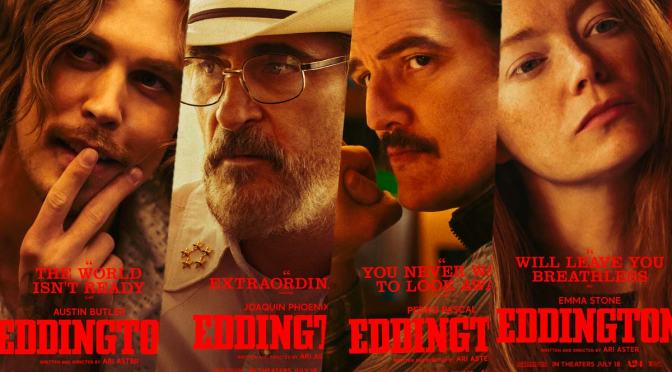
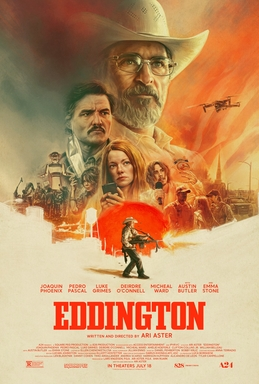
Main Cast: Joaquin Phoenix, Pedro Pascal, Luke Grimes, Deirdre O’Connell, Micheal Ward, Austin Butler and Emma Stone. Cinematography by Darius Khondji
*** MAY CONTAIN SPOILERS ***
Ari Aster’s first two horror films, Hereditary (2018) and Midsommar (2019) were rightly critically acclaimed and delivered at the box office too. His third film Beau is Afraid (2023) was a flop when compared and in my view not surprising. The film was arguably, depending on your view, a hilarious, risk-taking arthouse tragi-comedy or a self-indulgent act of egregious career self-sabotage. Safe to say I did not enjoy it, so approached the latest A24-produced film of Aster’s,Eddington (2025), with emotional caution.
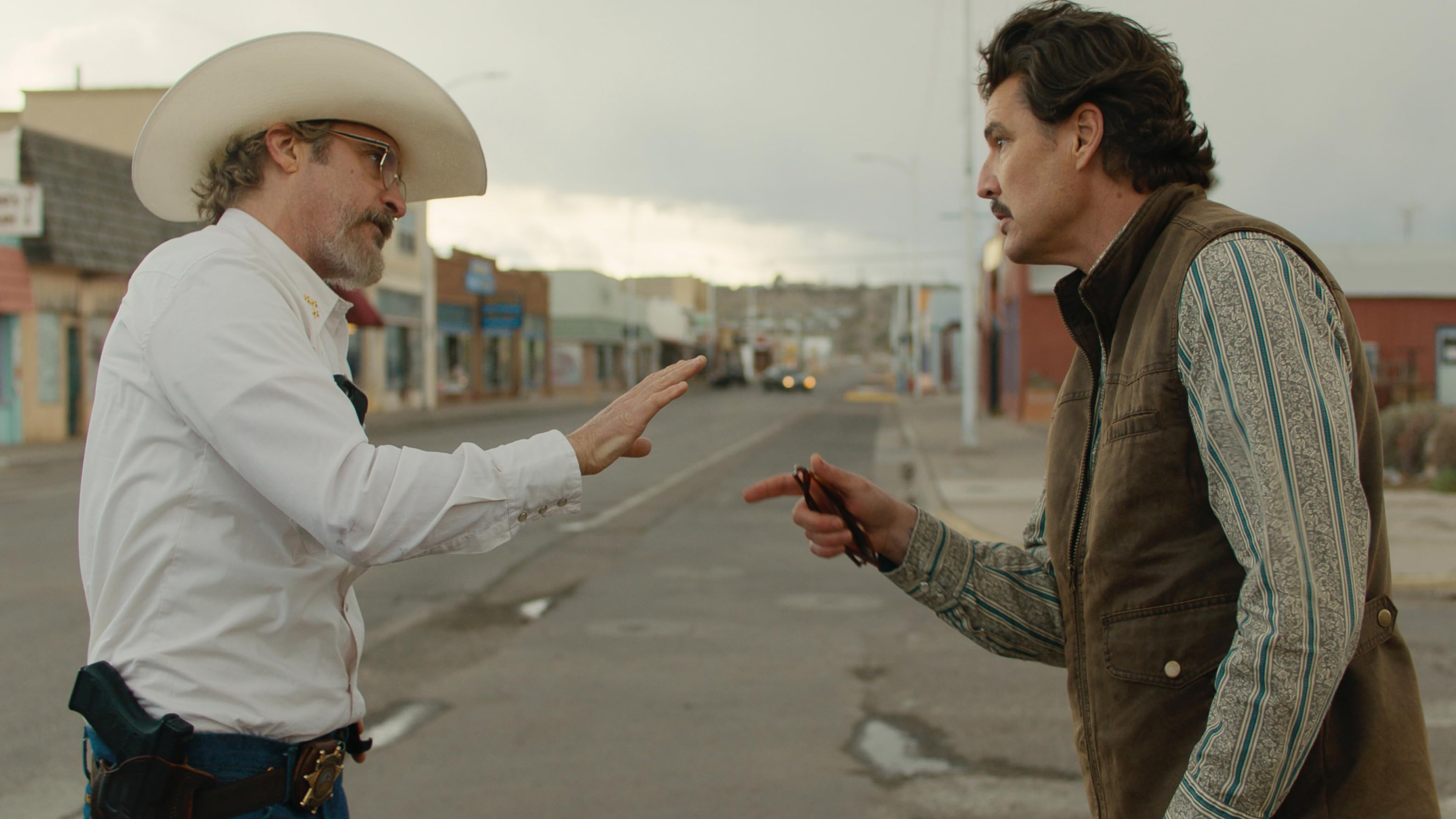
Thankfully Aster’s screenplay, characters and all-round production of Eddington (2025), are far more accessible and focused than his third feature. Pedro Pascal and Joaquin Phoenix anchor Eddington (2025) superbly, as Aster delivers a blistering small-town allegory that uses a public health crisis as the spark for something far larger. What begins with Mayor Ted Garcia (Pascal) dutifully following the Governor’s lockdown orders quickly escalates when Sheriff Joe Cross (Phoenix) refuses to comply and runs for Mayor himself. This casts the town and people into a conflict that mirrors America’s own political division.
Phoenix brings his trademark intensity to Sheriff Cross, whose defiance feels equal parts principled and unhinged, while Pascal’s Mayor, revealed to be a corporate puppet, balances him as a leader losing grip on his authority. Thus, Eddington (2025) is a powerful film whose strength lies in the performances and a brave, intelligent screenplay which asks many questions. The main issues I had were under-developed character arcs for Emma Stone’s and Austin Butler’s characters. Further, as in previous films Aster relies heavily on left-field plot turns, which go more for shock, rather than understandable character development. Indeed, the final act Western-style shootout, while incredibly exciting, seems out-of-sync with the thoughtful build-up and drama established in the first hour.
Ultimately, Director Ari Aster resists turning Eddington (2025) into just a COVID-era-morality tale; instead, the film confidently threads together a powerful mix of left and right-wing US politics, toxic masculinity, historical sexual abuse, conspiracy and alternative theories, cultish religious fervour, white saviour virtue-signalling, homegrown terrorism, algorithmic influence of social media, and the creeping threat of corporate greed. Each theme and subplot fold back into the central question: who really controls the narrative in modern America or is it a nation spiraling out of control toward inevitable civil war? The result is a tense, unsettling portrait of a town—and a country—at war with itself.
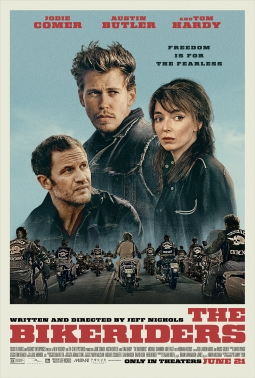
Screenplay by Jeff Nichols (Based on The Bikeriders by Danny Lyon)
Produced by Sarah Green, Brian Kavanaugh-Jones and Arnon Milchan
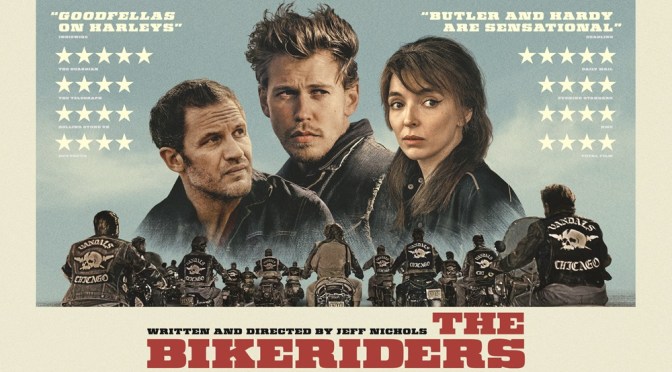
Main Cast: Jodie Comer, Austin Butler, Tom Hardy, Michael Shannon, Mike Faist, Norman Reedus, Boydf Holbrook etc.
Cinematography by Adam Stone
*** MAY CONTAIN SPOILERS ***
Set in the mid-sixties, the biopic The Bikeriders(2023), centres on a bike club (or what we could be considered a ‘Hell’s Angel’ gang of the era) called ‘The Vandals.’ Started by Tom Hardy’s, leader Johnny, as a motorbike racing club, it develops into a social place for men to meet and play and look cool and party and fight. More significantly, ‘The Vandals’ club allows the men to gain a sense of authority and identity within the shifting state of America during the 1960’s. The terrific ensemble cast includes Austin Butler as moody Benny, plus his sparky narrator wife, Jodie Comer, as Kathy. All are very good, yet there is something lacking thematically and in terms of plot.
Story-wise The Bikeriders(2023), is more like a verbal and pictorial diary with Comer’s affected Chicago accent gluing the various events together without reaching a height of dramatic satisfaction. Butler and Hardy are really cool and moody, echoing visitations of James Dean and Marlon Brando, respectively. But there needed to be more differentiation in their characters as TWO strong and silent types created a dramatic vacuum for me. Classic scene stealers such as Michael Shannon, Boyd Holbrook and Norman Reedus do add colour and charisma. I kind of wanted more of those guys because they had strong personalities, and actually spoke! Meanwhile, the props, costumes, production design and cinematography are all brilliantly rendered, clothing the film in an authentic and gritty sense of style.
Ultimately, the nostalgic, “anti-hero” driven period drama, so well delivered by Martin Scorsese over the years gets another solid run-out in The Bikeriders (2023) from the talented filmmaker, Jeff Nichols. Whereas Scorsese brings incendiary cinematic fireworks and complex tales of morality to your face, mind and heart, Nichols is a more under-stated director. He presents his stories and characters without too much push, with the audience having to lean in to catch the whispers of drama. That isn’t to say The Bikeriders (2023) doesn’t have action, racing, fighting, crashes, and blood, but the characters are lacking a powerful narrative engine to drive the strong performances forward. Plus, the themes of loss, war, and masculinity in crisis needed more gas. The film motors along just fine, but without ever getting into fifth, let alone sixth gear.
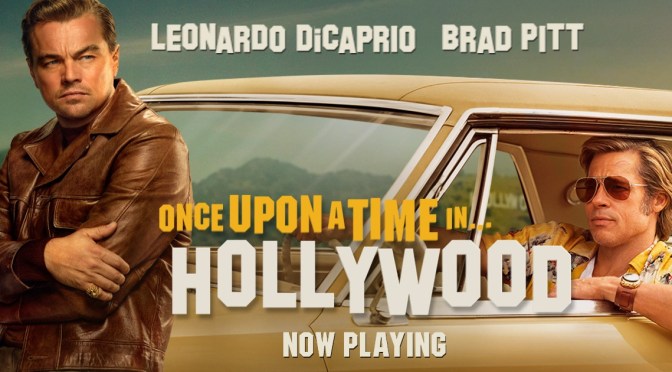
ONCE UPON A TIME IN HOLLYWOOD (2019) – FILM REVIEW
Directed and Written by: Quentin Tarantino
Produced by: David Heyman, Shannon McIntosh, Quentin Tarantino
Cast: Leonardo DiCaprio, Brad Pitt, Margot Robbie, Emile Hirsch, Timothy Olyphant, Margaret Qualley, Austin Butler, Al Pacino, Mike Moh, Bruce Dern, Dakota Fanning, Damien Lewis, Kurt Russell and many, many more.
Cinematography: Robert Richardson
**MAY CONTAIN SPOILERS**
From watching the trailers for Quentin Tarantino’s ninth film, Once Upon A Time in Hollywood (2019), I remember thinking: this looks so cool and I’m glad they haven’t given away much of the story here. Because, I hate those darned trailers which give away the story!
So, you watch Quentin Tarantino’s ninth film and then you realise, after the excessive running time, THERE ISN’T REALLY ANY STORY as such! Okay, DiCaprio’s character suffers an existential career crisis but that’s kind of it. Instead, you get mostly a nigh-on three-hour historical and cultural nostalgia trip down memory lane filtered through the artistic and fetishistic vision of one of cinemas great filmmaking iconoclasts.
Once Upon A Time in Hollywood (2019), is essentially an arthouse character study where you get to hang out with two-and-a-half lead protagonists, plus a whole army of fictional and ‘real’ life supporting characters from the 1969 Hollywood era. Our two main “heroes” are neurotic, alcoholic B-movie actor, Rick Dalton (Leonardo DiCaprio), and tough, handsome and laconic, Cliff Booth (Brad Pitt). The two characters contrast and complement each other perfectly. Moreover, the star quality, chemistry and fine performances of the lead actors bind the movie together amazingly.
Brad Pitt is especially brilliant. His character is not, until the violent ending, given much to do story wise; however, he does it with such charm. He imbues a character who has accepted his place in the world with such easy-going humour and control, it is an absolute joy to watch. It’s an iceberg performance which seems shallow on the surface, but has hidden and unsaid depth. I really wanted to know more about his character, especially what appeared to be a very colourful backstory.
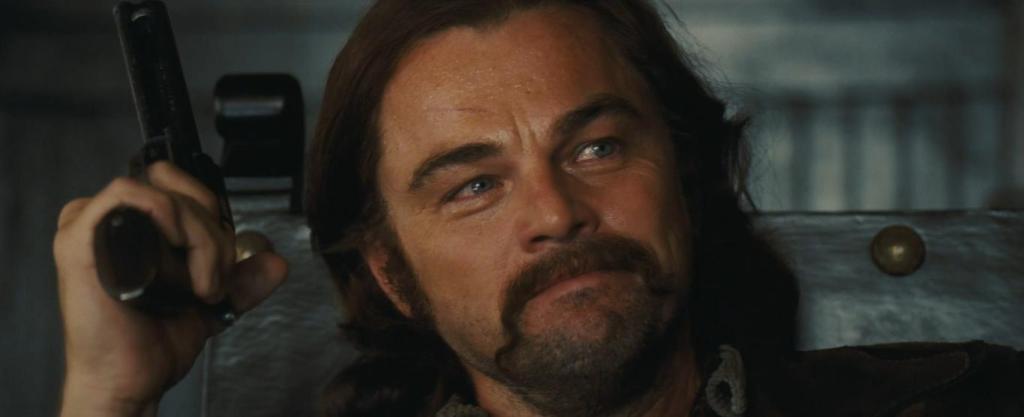
DiCaprio, on the other hand, has the showier performance. Edgy, hungover and insecure due to his characters’ fading Hollywood career, DiCaprio gives another fantastic movie performance. He commits to the Dalton character and features in some wonderful sketches which pay homage and parody B-movies, TV variety shows and old TV Westerns. What I loved was his ability to demonstrate different levels of acting skills. DiCaprio can fuck up Dalton’s acting on set one moment, but then deliver acting on a Shakespearean level the next.
Margot Robbie, who we know is a brilliant actor in her own right, alas, is not afforded the same level of care in regard to the characterisation of Sharon Tate. More of an ornamental character in the film, she looks great going to the cinema, packing a suitcase, driving and generally just being effervescent. Yet, it’s truly is one of the film’s major flaws that it doesn’t make more of Robbie’s acting talent. Even the fantastic ending, which Tarantino, takes incredible liberties with in regard to actual events, finds Tate’s character development unfortunately left bereft of emotion.
Similarly, the Hollywood cameos echoing throughout the films are pure style over substance. For example Steve McQueen, Roman Polanski and Bruce Lee feature but these are mostly inconsequential encounters. The Bruce Lee representation and scene is actually really funny as Cliff Booth and the martial arts star face off in a hilarious flashback. Typically, Tarantino has caused controversy with his Bruce Lee (Mike Moh) rendition. Personally, I respect that people may be offended, however, it’s more comedic and iconoclastic rather than overt racism. After all, this is a fairy-tale vision of Hollywood and not a documentary. Plus, Tarantino knows he’s going to piss people off so it’s obvious he’s playing with people here.
While Bruce Lee’s persona is playfully satirized or racist depending on your point-of-view, Tarantino’s representation of the Manson family is more damning. It’s clear he absolutely hates hippies, especially acid-looped killer hippies. Dalton and Booth represent the old-school, honest Hollywood working class, so are the antithesis of the drop-out youths. The culture clashes between this era and the new flower-power cults is something Tarantino explores. Charles Manson, who barely features, is a ghost-like figure though. Instead, it is the character of Tex (Austin Butler) and the females of the commune who are most prominent.
Margaret Qualley as Pussycat is especially hypnotic in her role. Exuding both sexuality and acid-drenched nihilism, Pussycat is a siren hitcher, luring drivers to symbolically crash against the cliffs. For me, Tarantino should have made way more of the old and new California culture clash themes, as they resonated powerfully when on screen. Plus, the scenes on the commune were actually quite creepy, so more should have been made of this threat from a dramatic perspective. Lastly, the irreverent and violent final act carnage exploits the clashing of these two different cultures, but more could have done throughout to enhance this dynamic.
Overall, Once Upon A Time In Hollywood (2019) is a near three-hour arthouse classic. If you like films about film and TV making, driving, feet, ensemble casts, films within films, cinema-going, Los Angeles, more feet; and hanging with the marvellous DiCaprio and Pitt in a 1969 setting, then you will love this beautifully rendered and lovingly crafted film about Hollywood. Otherwise, you will probably find it a boring, indulgent and style-over-substance folly. Either way you have to admire Tarantino’s exquisitely controlled writing and direction. He certainly does!!
Safe to say though Tarantino will not care either way, because most of his filmic output has made a lot of money at the box office. This has now allowed him the luxury, like that of true cinema artists such as Kubrick, Altman and Antonioni, to make whatever films a studio is prepared to give him the money for. He’s basically making films for himself and doesn’t care if the audience likes it or not.
I personally found myself magnetically drawn to Tarantino’s vision and from a purely filmmaking and artistic perspective I was totally immersed throughout. Having said that, if the incessant driving and shots of dirty feet were cut and Dalton and Booth had been given a proper plot, rather than the thin stranded narrative within the impressive gallery of cameos and set-pieces, I would definitely expect to be writing about one of the best films ever made.




 The Cinema Fix presents