Tag Archives: body horror

Horror film review round-up including: Black Phone 2 (2025), Companion (2025), Good Boy (2024), Presence (2025), Together (2025) and others. . .

Autumn Horror Film Reviews

In the languid drift of autumn, when Halloween’s shadow lengthens and winter begins its slow, expectant inhale, the world seems to slip into a more suggestive register—one where every rustling leaf feels like a whispered omen. It is, of course, the most appropriate season to surrender to the year’s latest horror releases, as though communing with these cinematic phantoms might prepare us—spiritually, aesthetically—for the deeper darkness to come.

Which basically means I have been catching up with some 2025 horror film releases I missed at the cinema during autumn. A couple of these probably warrant more in depth solo reviews, but as I edge closer to old age and the reaper’s scythe, I am economizing somewhat.

*** MAY CONTAIN SPOILERS ***


Black Phone 2 (2025)

Scott Derrickson and co-writer C. Robert Cargill deliver a sequel to The Black Phone (2021) with Mason Thames, Madeleine McGraw, Jeremy Davies, and Ethan Hawke reprising their roles from the first chiller. I actually enjoyed this one more than the original, which despite the clunky set-up, finds the siblings and others trapped in a teen camp hit by a blizzard. They find themselves hunted and haunted by both The Grabber (Hawke) and other ghostly spirits haunting the area. Derrikson throws a lot of horror tropes and the characters (literally in certain scenes) at the walls, and much of it sticks. Having said that, I still don’t think The Grabber is the scariest villain ever committed to screen, despite Hawke’s presence. (Mark: 7.5 out of 11)


Companion (2025)

Companion (2025) feels like Garland’s Ex Machina (2014) colliding elegantly with Fargeat’s feral Revenge (2017)—a sunny day-horror fable that hides its nastiest surprises in plain sight. Its twists are sharp, its aesthetic confident, and its ideas far more ambitious than its modest surface first suggests. I would have admired it even more were it not, on occasions, completely dumb. Plus, the occasional drift into a comedic register undercuts its more incisive moments. The beautiful Sophie Thatcher once again commands the screen with the same riveting presence she brought to Heretic (2024). Mark: 8 out of 11.


Graduation Day (1981)

Thanks to Bobby Carroll’s site for reminding me about slasher film, Graduation Day (1981), as I had completely forgotten about it. High quality kills and gore mask a screenplay which has more nudity than character development. Yet, I am a sucker for these 1980’s exploitation flicks and this is a watchable one. Mark: 6 out of 11


Good Boy (2025)

An low-budget horror film triumph with Ben Leonberg directing his own dog, Indy, a Nova Scotia Duck Tolling Retriever, as the only witness to nasty spirits threatening his owner. The film emerges as a formal tour-de-force, whose meticulous composition and deliberate pacing elevate its simple premise into something unexpectedly resonant. Its visual precision and rhythmic control shape an atmosphere of dread that feels more sculpted than sensational, grounding the film in an emotionally impactful narrative about loyalty, vulnerability, and the unsettling spaces between trust and fear. For all its craft, and impressive animal direction, the film doesn’t quite sustain a relentless menace throughout. But, it remains a memorable feature debut from Leonberg and Indy the dog. Mark: 8.5 out of 11.


Presence (2025)

In Presence (2024), David Koepp and Steven Soderbergh demonstrate just how potent a one-location horror film can be when discipline and imagination converge. The entire piece unfolds like a controlled exhale: a slow-build structure that trusts the audience to lean in, and a drifting, almost contemplative camera that adopts the ghost’s POV to quietly—sometimes imperceptibly—reveal fragments of the story. Instead of overplaying its hand, the film slow-drips its plot elements with an elegance that keeps tension suspended in the air, letting unease pool in the corners of an otherwise ordinary space. By the time it reaches its finale, Presence (2024) delivers not only a surge of emotional and thematic clarity but two genuinely surprising twists—earned, unsettling, and executed with the kind of precision that affirms both writer and directors’ mastery of the form. Mark: 8.5 out of 11.


Restless (2024)

Really good independent British thriller with Lyndsey Marshal as a nurse, Nicky, who finds herself terrorized by 24-hour partying thug neighbours. Writer-director Jed Hart creates great empathy and identification with the situation and it’s a shame decent British films like this get short shrift at the multiplexes. Nicky’s spiral into insomnia-driven madness is compelling as her desperate attempts to sleep give way to vengeance. But the film’s final act tonal turn denies us a full-on descent into suburban hell, for something amenable but unfortunately less twisted. Mark: 7.5 out of 11


The Rule of Jenny Pen (2025)

The Rule of Jenny Pen is an original, weird, and powerful shock of a film — a mash-up of psychological thriller and nursing-home horror that lands far more often than it stumbles. Its greatest strength is, without question, the towering performances at its centre. Geoffrey Rush and John Lithgow, two masters of calibrated gravitas, turn the film’s cat-and-mouse mind game into a gripping acting showcase. Together, they elevate the film’s themes of aging, vulnerability, and institutional neglect into something both unsettling and strangely beautiful. The plotting, however, does get a bit sticky toward the end. The final act jars slightly, causing me confusion in an otherwise tight psychological narrative. Still, even as the story wobbles a tad, the film’s originality, eerie tone, and powerhouse acting keep it compelling. Mark: 8 out of 11


The Woman in the Yard (2025)

The Woman in the Yard (2025) rises on the strength of Danielle Deadwyler’s commanding lead performance. As a mother trying to protect her two children from a funereal spirit lingering in their backyard, Deadwyler grounds the supernatural dread with raw emotional honesty. The child actors match her with a believable, lived-in family dynamic that makes the haunting feel all the more personal. Where the film falters is in its structure. The script leans heavily on crow-barred flashbacks that interrupt rather than enrich the unfolding tension. A more linear approach could have built a stronger emotional momentum, allowing the story’s grief, guilt, and mental illness to accumulate naturally instead of stuttering backward at key moments. (Mark: 6 out of 11)


Together (2025)

Together (2025) gets an immediate boost from the casting of real-life couple Alison Brie and Dave Franco, whose natural chemistry gives the film an authentic emotional core. As a pair trying to rebuild their relationship after moving from the city to a rural small town, they convincingly inhabit the tensions, resentments, and unspoken fears that surface long before the horror does. Their incompatible expectations feel lived-in — and once they tumble into a sinkhole and the strange bodily transformations begin, that emotional groundwork makes the nightmare hit harder.

I loved the trailer for this film, which promised a truly skin-crawling descent into body-horror chaos. The final product, while atmospheric and often engrossing, doesn’t fully deliver on that promise. It pulls back when it could push further, leaving some of the more disgusting, surreal possibilities off-screen. But the ending — bold, surprising and unexpectedly poignant — is a fantastic payoff. Even if the film doesn’t always reach the extremes it teases, Together still manages to leave a memorably twisted impression. Mark: 8.5 out of 11
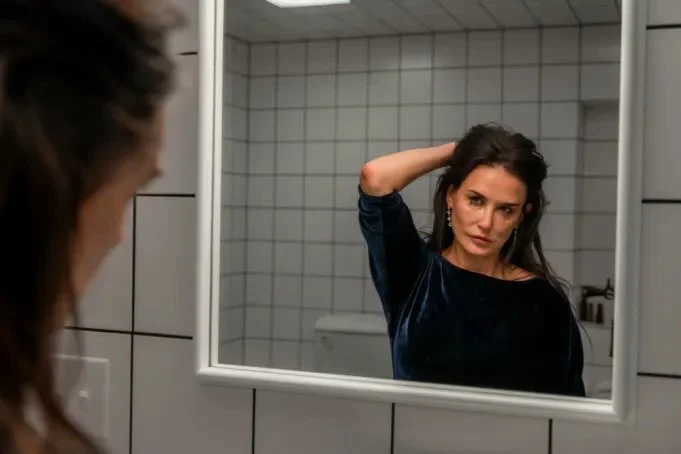
Cinema Review: The Substance (2024) – A Dark Exploration of Identity

THE SUBSTANCE (2024)

Directed by Coralie Fargeat

Written by Coralie Fargeat

Produced by: Coralie Fargeat, Tim Bevan and Eric Fellner

Main Cast: Demi Moore, Margaret Qualley and Dennis Quaid

Cinematography by Benjamin Kracun

*** MAY CONTAIN SPOILERS ***


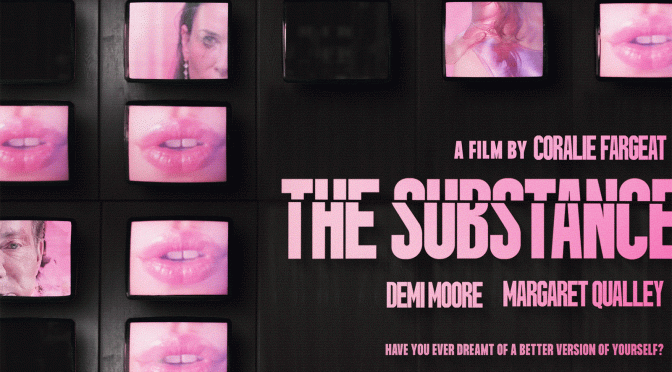
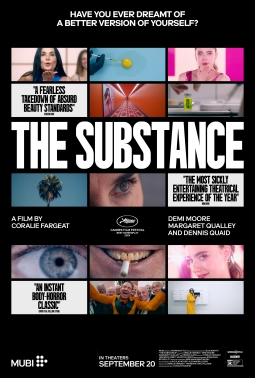
The Substance (2024), directed by Coralie Fargeat, is a visually striking and visceral film that pushes the boundaries of body horror and psychological terror. Fargeat, known for her raw and relentless style in Revenge (2017), once again delivers an unforgettable experience by weaving references to classic literature and horror cinema into a narrative that is at once familiar and entirely original.

Demi Moore portrays a former Hollywood star, Elizabeth Sparkle, now relegated to doing a mildy successful cable TV aerobics show. However, Dennis Quaid’s oily production executive is on the lookout for younger talent. Elizabeth soon finds herself on the media scrapheap. Desperate to regain her youth and career, Elizabeth is drawn to the hypnotic promise of a new product called ‘The Substance.’

Before you can say, “Dorian Gray”, Elizabeth is lured to a strange white room full of lockers and has committed to the process. Similar to Gremlins (1984), there are rules to follow. As she follows the steps and injects the potions, Elizabeth goes through a painful and incredibly impactful transformation process. She literally gives birth to a young and beautiful alter ego called, Sue (Margaret Qualley). Elizabeth and Sue then get seven days each to live their life before they have to swap back. What could go wrong?


The film’s core themes draw heavily from Robert Louis Stevenson’s Dr. Jekyll and Mr. Hyde, exploring duality, identity, and the monstrous potential hidden within human nature. Like Stevenson’s tale of inner conflict, The Substance delves into the consequences of scientific ambition. It investigates moral transgression but with a modern, feminist twist. Fargeat’s use of body horror, particularly in the transformation sequences, echoes the grotesque, unsettling work of David Cronenberg. The nightmarish atmosphere and surreal visuals are reminiscent of David Lynch’s unsettling dream logic. This is notably seen in Eraserhead (1977) and Mulholland Drive (2001).

The film also pays homage to John Carpenter’s The Thing (1982), with its transmogrifying frights, sense of creeping paranoia and rising conflict. But rather than a group of men fighting each other Elizabeth and Sue turn on each other over ownership of their physical existence and Hollywood status. The final act descends into hellish and bloody satire echoing Peter Jackson’s Braindead (1992), with gore galore. Moreover, Stanley Kubrick’s influence is palpable in the film’s meticulous framing, production design and tension-building. The climactic body-morphing scenes, however, most clearly nod to Brian Yuzna’s Society (1989), with its grotesque depictions of class and conformity, fused with Fargeat’s unique vision of female empowerment, revenge and resistance.

The Substance (2024) feels like a bigger budget film in look and style, but you soon realise the minimal number of sets used and a lack of crowd scenes, finds the narrative effectively becoming a two-hander in the middle act by focusing on Sue and Elizabeth’s internal retaliatory vindictiveness. There are some amazing framing, colour design and cinematographic choices as showers become tombs to trap the protagonists. The book-ended Hollywood star montage and returning final shots are imaginative and unforgettable. Got to say that Demi Moore, as an actress taking on a role of an aging and neurotic former star is genius casting. While Qualley delivers a sexually charged and energetic performance, it is Moore who carries the weight of the complex themes as Elizabeth’s journey dives deeper into the stuff of nightmares.

Overall, The Substance (2024) is a postmodern classic and a film that honors its influences while forging its own path. Fargeat uses these references to enrich the narrative, creating a damned ugly and beautiful satire on those seeking narcissistic perfection through unnatural means, ultimately paying the price of those seeking eternal youth and fame.

Mark: 9 out of 11


CULT FILM REVIEW – VIDEODROME (1983)

CULT FILM REVIEW – VIDEODROME (1983)

Written and directed by: David Cronenberg

Produced by: Claude Herroux, Pierre David, Victor Solnicki

Cast: James Woods, Sonja Smits, Deborah Harry, Les Carlson, Jack Creley, Peter Divorsky etc.

Music: Howard Shore

***CONTAINS SPOILERS***


With the lack of cinema-going action, I am now looking at building other review ideas and articles into my blog. I have regular new release reviews, classic film reviews, great ensemble casts and under-rated film reviews. I suppose that’s enough really, but there are some films that don’t quite fit these categories and they are cult movies. How does one define a cult film? It could have been a box-office bomb or be a no-budget gem, be transgressive or have controversial subject matter. Conversely, it could be a video nasty or banned or even an ultra-arthouse film which defies classical filmmaking conventions. More importantly, I do not have to actually like the film for it to qualify as a cult film. It could be a difficult film I am evaluating or re-evaluating from a fan or academic perspective. Lastly, it could just simply be a film that is uncategorizable or so bad it’s bad or so bad it’s good.

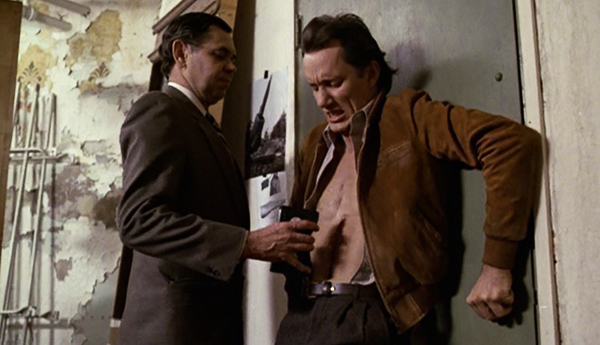
My first review in this category is David Cronenberg’s body-horror film, Videodrome (1983). Now, it may fit the specific rules of an under-rated classic laid down in previous articles, however, Videodrome (1983) is not necessarily a film I love or believe is a classic. It is a remarkably original narrative descent into the hellish and surreal world of demented psychological snuff television. It contains amazing practical special effects by the legend Rick Baker, yet, having re-watched it last week I cannot say it’s a film one can enjoy from an entertainment perspective. Don’t get me wrong, David Cronenberg is a true auteur and genius filmmaker, it’s just Videodrome (1983) is a hallucinatory and disturbing nightmare of a film that works outside the boundaries of usual image systems and narrative conventions. Basically, it’s more a powerful set of concepts and scenarios rather than a simple and satisfying story.

The story opens with anti-heroic, Max Renn (James Woods) as president of CIVIC-TV, seeking new content for his Toronto-based TV channel. Despite Woods’ charisma as an actor he is an expert at playing dominant alpha male types who challenge the audiences’ empathy. He portrays Max with a sleazy charm hunting for, what one may consider, soft-pornographic shows for his station. He’s basically an addict looking to push the walls of taste for his sex-hungry viewers. Max then discovers a channel, via a grainy satellite feed, called Videodrome. It shows unfiltered torture and sexual aggression, and Max becomes determined to tap into that market. At the same time, he begins a sado-masochistic sexual relationship with a radio host, Nikki Brand (Deborah Harry). Soon, these two intense narrative strands entwine and threaten Max’s mind, body and very existence.


Videodrome (1983) is a highly intelligent shocker which explores the nature of television violence, notions of taste and censorship, fears of technological programming, and the mental damage caused by over-exposure to violent pornography. It is an extremely psychologically and physically graphic film to watch. Nevertheless, it is also full of incredible imagery involving on-screen murder, Renn being swallowed by his TV; and also literally transforming into a human video cassette player. While an audience may not like Max Renn as a person, his journey is one that grips with magnetic shock and disgust. As he gets ever closer to the Videodrome channel his downward spiral plays out like a demented morality story, with Max representing the journey of those audience members who lose themselves in the illusory realities of television product. As he begins to lose touch with reality, Max experiences a complete lack of control over his mind and desires, all seemingly controlled by a heinous corporation led by insidious suit, Barry Convex (Leslie Carlson).

Incredibly, David Cronenberg apparently turned down directing The Return of the Jedi (1983) to write and direct this more personal vision of cinema. Could there be two more different films? Nonetheless, while it may not be a film I can easily recommend to those of a sensitive disposition or those who like their horror to have tidy conclusions, Videodrome (1983), retains its relevance and power to this day as a shocking critique of modern media. Hence qualifying it as a cult horror film which pushes all the wrong buttons in the right way.