Screenplay by Samy Burch (Story by Samy Burch and Alex Mechanik)
Produced by Natalie Portman, Sophie Mas, Christine Vachon, Pamela Koffler, Grant S. Johnson, Tyler W. Konney, Jessica Elbaum and Will Ferrell.
Main Cast: Natalie Portman, Julianne Moore, Charles Melton, Cory Michael Smith, Elizabeth Yu, etc.
Cinematography by Christopher Blauvelt
*** MAY CONTAIN SPOILERS ***
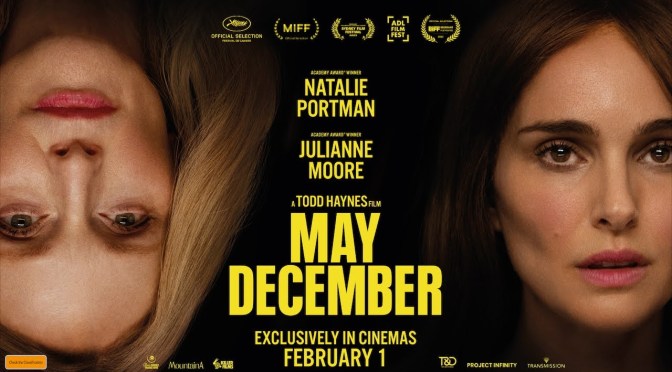
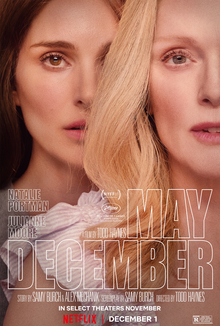
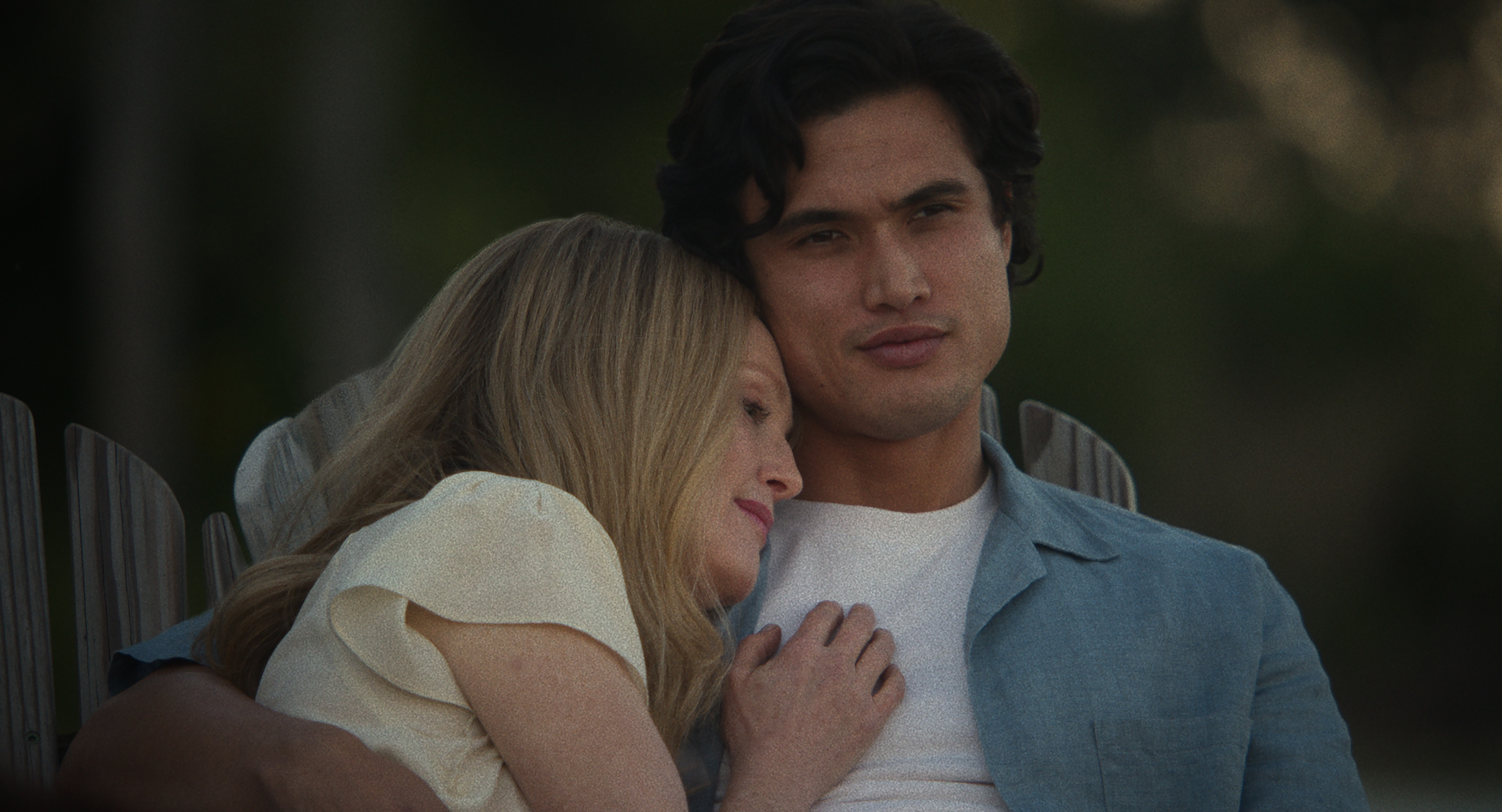
The story of May December (2023) is set in 2015 against the sunny backdrop of Savannah, Georgia. Loosely inspired by the real-life Mary Kay Letourneau scandal, Natalie Portman is Elizabeth Berry, an actress who desires to study the lives of Julianne Moore’s Gracie Atherton-Yoo and her partner Joe Yoo (Charles Melton). Elizabeth is set to play Gracie in an indie film, with latter being infamous for her twenty-three-year-long relationship with Joe, which started when he was thirteen. With a hook like that I was intrigued as to where the story would go with such a controversial subject matter dealing with a convicted sex offender and illicit romance. Here lies a major thematic thumbprint of the filmmakers.
What unfolds is a superbly acted and understated drama which really gets under the skin and into the mind. While watching the ever-shifting points-of-view and identification with the characters May December (2023) became so compelling to me. Gracie is a convicted sex-offender, but she married Joe for love and they had children together after she left jail. But should she have acted on her desires and rejected Joe as a thirteen year old? The simple answer is yes, but it is more complex than that as presented here. Because the couple felt so much emotion for each other that Gracie was prepared to go to jail. This is what attracts Berry and she homes in on Gracie and Joe like the proverbial moth to a flickering bulb.
Structured around Berry’s methodical probing into the past events and Gracie and Joe, she quizzes them, their children, family, friends, work colleagues and legal team. As Berry researches further it becomes apparent she is getting obsessive and almost predatory herself. There are several very awkward scenes involving Berry, notably when she visits the pet store where Gracie and Joe used to work together. As Berry revisits the past she begins to loosen the stitches of old wounds, as both Gracie, and Joe especially, reflect and question the moral validity of their relationship.
I am sure when Natalie Portman and Julianne Moore read the script for May December (2023) they must have been doing back flips with creative excitement. Because it is clearly is a layered screenplay of the highest intelligence, ambiguity, dark humour and intensity by Samy Burch. Along with Melton they deliver on the script with three tremendous performances too. Moreover, acclaimed director Todd Haynes directs this tonally awkward story with a deft touch drawing on the constant grey areas of drama so expertly. May December (2023) may not be for everyone because the film is a slow burn without much in the way of dramatic closure. Conversely, so much of the drama occurs in the acting and script’s subtext, yet it remains a fine example of ambiguous cinema. Finally, the re-orchestration and use of Michel Legrand’s music forThe Go-Between (1971) is a masterstroke.
As an alternative to the usual Christmas films that are on our TVs, streaming platforms and cinemas now, I have spent the last few weeks watching many recent horror film releases. Like a big, black Christmas stocking I present to you some quick reviews of said bloody entertainment with the usual marks out of 11.
Merry Christmas and a Happy New Year to you and your family!
BIRDBOX BARCELONA (2023)
Spanish sequel to the Netflix original and it’s not quite as good. Some excellent filmmaking and deadly set-pieces are hamstrung by poor structure and over-familiarity with the central alien-suicide concept. The themes of religion, sacrifice and guilt are well explored and the pacey death rate make it worth watching though.
Mark: 6.5 out of 11
BULL (2021)
Brutal British B-movie with Neil Maskell on deadly form as a vengeful career criminal killing off his former gang members after they left him for dead. There are better revenge films out there, but there is some bone-crushing gore to please horror fans like me.
Mark: 6 out of 11
THE CLOVEHITCH KILLER (2018)
Slow-paced but suspenseful rites-of-passage-horror with Charlie Plummer’s teenager suspecting his father (Dylan McDermott) may be a notorious serial killer. Inspired by the evil crimes of BTK murderer, Dennis Rader, this compels throughout until the slightly unbelievable ending.
Mark: 7.5 out of 11
CONTAINMENT (2015)
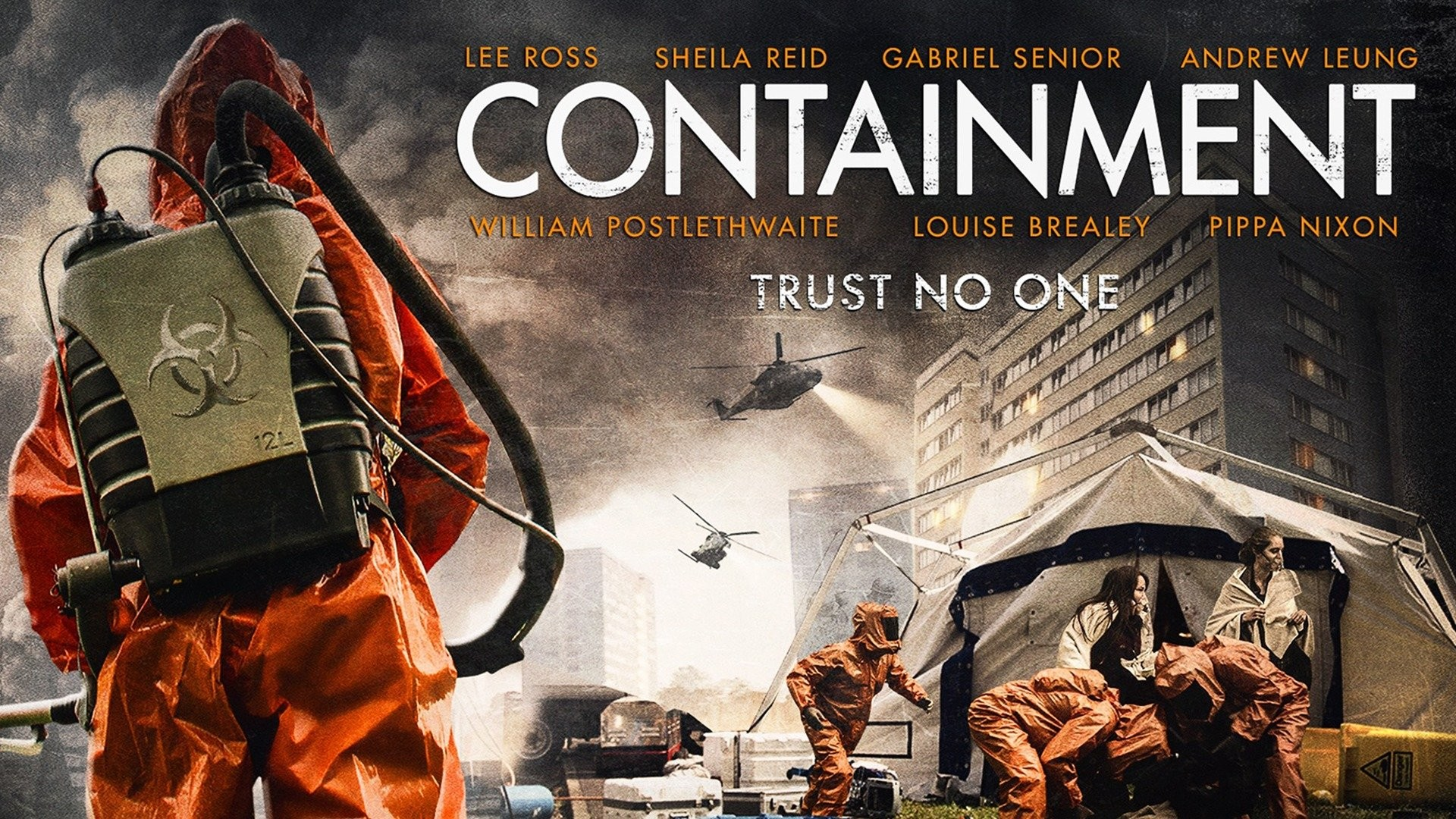
Low-budget British horror-thriller set in a tower block during a viral outbreak and deadly lock-down. A prescient and chilling film which finds authorities attempting to stop the contagion by all means necessary. Some nail-biting suspense ensues and decent ensemble cast drive a film where chaos and paranoia feel all too familiar to recent global events.
Mark: 7.5 out of 11
EL CONDE (2023)
Pablo Larrain’s horror-comedy-satire is based around a very funny one-joke premise. The gag is Chilean dictator General Pinochet was in fact a blood-sucking vampire draining the life out of the common people. After a really powerful and amusing opening twenty minutes, the film devolves into a Pinochet family drama that runs out of steam until the frankly insane ending which has to be seen to be believed.
Mark: 7 out of 11
EVIL DEAD RISE (2023)
Some fantastically horrific and bloody gore cannot save this Evil Dead reboot/sidequel from feeling both redundant and unnecessary. Contrived plot, paper-thin characters and so badly lit I could hardly see anything. I recommend you watch the original films or the series Ash versus Evil Dead instead, with the awesome Bruce Campbell kicking Deadite ass!
Mark: 6 out of 11
INFINITY POOL (2023)
Another off-the-chart offering from Brandon Cronenberg after the spectacularly grim sci-fi horror of Possessor (2020). Infinity Pool similarly deals with themes of alienation, identity and duality as a writer, portrayed by Alexander Skarsgard, ends up on the holiday from hell. With obnoxious characters and a screeching Mia Goth going full gonzo I almost turned this film off, but such is the misery heaped upon the privileged James Foster, I eventually felt sorry for this tortured narcissistic soul. Trippy and bloody thrills contrast the luxury of the beautiful coastal resort with Cronenberg convincing us there is only ever trouble in paradise.
Mark: 8 out of 11
LUTHER: FALLEN SUN (2023)
Idris Elba returns in this big budget Netflix film version of the BBC maverick cop drama. Stylish, moody and effective thriller with a scenery-chewing turn by Andy Serkis as the nemesis from hell. Favours pace and action over plot consistency, Elba is always excellent value for money even if the Luther character has always been quite slight. Serkis’ fiendish plan is written for shock value rather than actually making any sense.
Mark: 7 out of 11.
PEARL (2022)
Prequel to Ti West’s porno horror X (2022) (see mini-review below), this establishes the early years of Mia Goth’s eponymous anti-heroine, Pearl. As a young woman in 1918 she dreams of escaping and becoming a silent movie star. Yet her dominant mother cannot contain the passionate darkness within Pearl. I much preferred this stylish period and character horror to the exploitative and nasty X (2022). There remains much gruesome violence here but Mia Goth finally convinces me as Pearl, delivering one the best film monologues I have seen in some time.
Mark: 8 out of 11.
RENFIELD (2023)
This vampire story from the point-of-view of the familiar, Renfield, contains the most horrific filmmaking in the very worst way. With a hopeless script, terrible acting and bad CGI it wastes the talent of Nicholas Hoult and Awkwafina. While I expected Nicolas Cage’s Dracula to be over-the-top, the film direction is so tonally awful that I have to say this is one of the worst films I have seen all year.
Mark: 3 out of 11
THANKSGIVING (2023)
A very effective by-the-numbers grind-house slasher film from Eli Roth. Set around the eponymous American holiday period, a masked killer starts murdering a small town’s occupants a year after a Black Friday sale turns into a mall riot. The functional script and generic teenagers lack the spark of the classic Scream (1996), however, Thanksgiving (2023) has some highly imaginative murder scenes, with Roth respecting both the genre and audience. A bit more social satire about greedy capitalism would have raised my mark.
Mark: 7.5 out of 11.
VIOLENT NIGHT (2022)
Die Hard (1988) is NOT a Christmas movie, but a film set AT Christmas. Here Norwegian genre movie director, Tommy Wirkola, unofficially remakes Die Hard/Die Hard 2 (1990), with Santa (David Harbour) replacing John McClane fighting criminals and mercenaries robbing a rich businesswoman’s house. Wirkola made an even better version of the violent home invasion comedy inThe Trip (2021). But this rattles along, rings a lot of bells and crunches enough calcium and funny bones to make it worth a watch. David Harbour as Saint Nick sleighs us with his usual fine character acting work.
Mark: 7.5 out of 11.
X (2022)
I know he is a very well respected low-budget film director, and I should like Ti West’s work. Yet, for some reason, I have never enjoyed his previous horrors or Western that much. I feel like his previous films lack pace, contain unsympathetic characters and his horrors lack actual suspense. X (2022) finds a number of unlikable characters setting out to make a porno film on a rural farm, only to encounter danger lurking in the woods, lake and the farmhouse. I really wanted to enjoy this more than I did because Ti West has such control over exploitative material that delivers some genuinely sickening moments of horror. Mia Goth is the standout and West certainly casts her imaginatively, but I just did not connect with this expertly made Texas Chainsaw Massacre (1974) homage.
Produced by Emerald Fennell, Josey McNamara and Margot Robbie
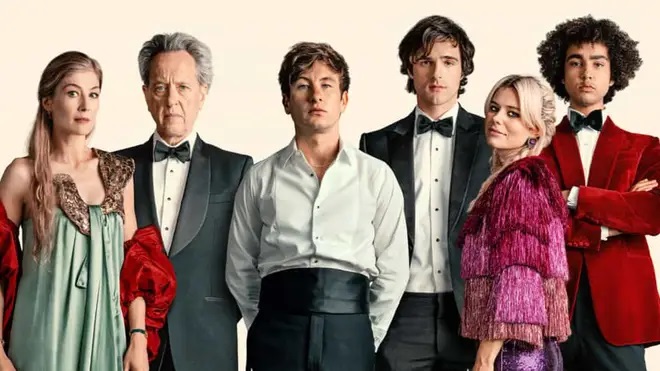
Cast: Barry Keoghan, Jacob Elordi, Rosamund Pike, Richard E. Grant, Alison Oliver, Archie Madekwe, Carey Mulligan, Paul Rhys, etc.
Cinematography by Linus Sandgren
*** MAY CONTAIN SPOILERS ***
As the awards garnered upon Emerald Fennell’s brilliant Promising Young Woman (2020) will testify, she is clearly a major talent. Fennell has also acted in TV shows such as Call the Midwife and The Crown, as well as writing and producing the second series of Killing Eve. Not only is Fennell an excellent actress, writer, director and producer, but is also now an Oscar and BAFTA winner. Thus, Fennell’s “difficult second film” arrives in the guise of the pitch black comedy,Saltburn (2023). Although to describe this hilarious, bleak, sexy, and often twisted exploration of the British class system as such evidently tests the very definition of comedy.
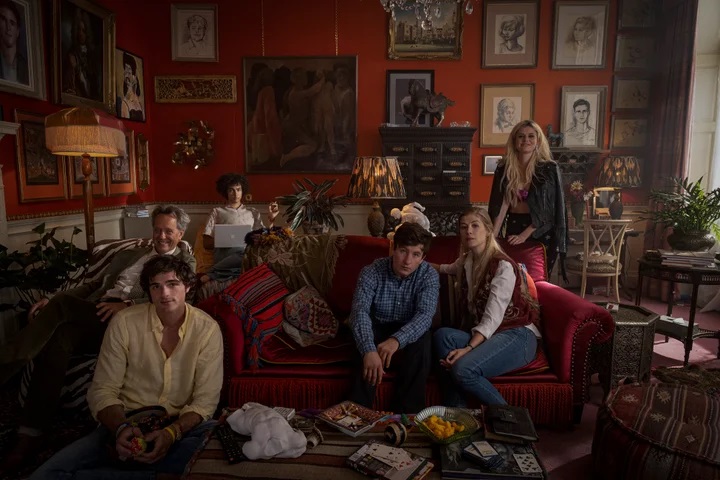
Saltburn (2023) is set in 2006. Oliver Quick (Barry Keoghan) attends Oxford University as a naive fresher with an inferiority complex and desire for company. While he is incredibly intelligent, coming from a lower class background places bookish Oliver as a very small fish in big water. Especially when compared to the so-called Oxford elite including handsome and wealthy, Felix Catton (Jacob Elordi) and his cousin, the handsome and not-as-wealthy, Farleigh Start (Archie Madekwe). While Farleigh is suspicious of Oliver, Jacob soon befriends him and takes the Northerner under his wing. The two connect and form an “odd couple” bromance, with Felix even going so far as to invite Oliver to his stately home, Saltburn, for the summer. There we meet the rest of Felix’s family including his flaky sister, Venetia (Alison Oliver), eccentric father, Sir James (Richard E. Grant) and effervescent mother, Lady Elspeth (Rosamund Pike).
After building Oliver and Felix’s characters carefully during their time at Oxford, Fennell’s savage and satirical screenplay gathers pace in the second act at Saltburn. Here Oliver tries to fit in and ingratiate himself into the Catton family, but it soon becomes clear that however friendly they may be, he will only ever be an outsider to them. Simultaneously, Farleigh sees Oliver as a rival for the Cattons’ emotional and financial affections and the two begin a retaliatory personal war amidst the balmy summer days, breakfasts, dinner parties and social gatherings. Oliver’s main journey is to connect as much with Felix as possible, so much so his passion veers toward obsession. But Felix is a roaming spirit and a hedonist and does not quite requite Oliver’s feelings. Yet, Felix does show compassion for Oliver, as illustrated when he drives him on a mercy mission to visit Oliver’s family. This is where the story takes an intriguing and ever deadly turn.
I cannot recommend Saltburn (2023) enough for its fantastically witty script, devastatingly brilliant cast and some quite disgustingly explicit, but contextually justifiable, character moments and scenes. Fennell takes the setting and structure of Evelyn Waugh’s Brideshead Revisited and turns it upside down, spinning a devious tale of infatuation, love, privilege and social climbing. Through the character Oliver Quick, and I really don’t want to give anything away, there is a powerful and jaw-dropping character arc of upward mobility. Rosamund Pike’s and Keoghan’s performances are both amazing and award-worthy. While the final act twists certainly do shock and surprise they arguably are rushed when compared with the more effective pacing of the opening and middle acts. Moreover, I am also unsure why the exquisite cinematography and stunning locations were presented in the 4:3 (1:33:1) aspect ratio. Why squeeze in Linus Sandgren’s light and framing and not expand them to the widescreen format?
Ultimately, Emerald Fennell proves herself an important voice in British cinema. Unafraid to test the boundaries of taste, genre, and audience expectations, she has crafted one of the most consistently challenging films of the year with Saltburn (2023). One could easily describe the themes presented here as a critique of the upper classes and how the uber-rich are bad people to be brought down to their knees. However, Fennell’s script is not that simplistic. It cleverly careers between love/hate for the characters and irony-bombing the class system, before becoming a damning indictment on the darkest flaws of humanity. Lest one forget the indelible one-liners throughout and THAT final dance sequence, which are both to die for!
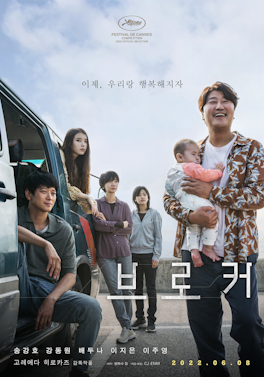
Cast: Song Kang-ho, Gang Dong-won, Bae Doona, Lee Ji-eun and Lee Joo-young.
Cinematography: Hong Kyung-pyo
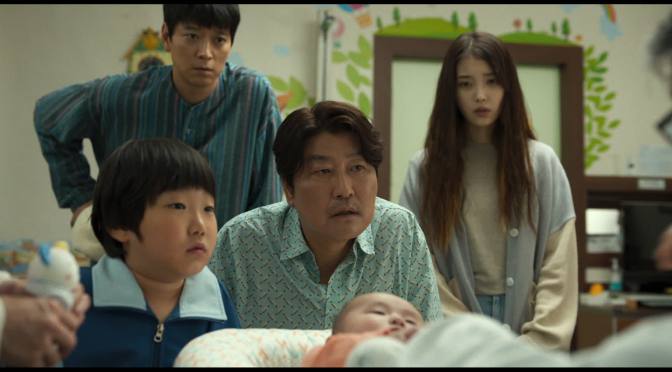
Arguably Japanese director’s Hirokazu Kore-eda’s most accessible film to date is the slice-of-life comedy-drama, BROKER (2022). Elements of Little Miss Sunshine (2006) meetsParasite (2019) meets Juno (2007) as kind-of-likeable and empathetic criminals create a dysfunctional family unit around stealing orphans and finding them families to makes ends meet. Lighter than many of his other brilliant human dramas, there is much to savour here from one of the best filmmakers working today.
There’s a lot going on in Broker (2022) as the duo of Sang-hyeon (Song Kang-ho) and Dong-soo (Gang Dong-won) work a grift of taking the unwanted babies, a police thriller involving murder, an impromptu road movie in a camper van, a cute kid looking for a surrogate father and a mother, Moon So-young (Lee Ji-eun) battling the dilemma of whether to sell or keep her child. A lesser filmmaker could have struggled balancing the many story, character and tonal shifts but Kore-eda manages it with aplomb.
Broker (2022) arguably has too many intertwining subplots though, as it strives to redeem all of the complex characters, but the wonderfully believable performances and brilliant screenplay really grabs you and rarely lets you go. Kore-eda’s direction is, as usual, masterly and assured as he balances the various tones confidently. Overall, this film makes you laugh, cry and is really moving as it highlights that family units can be lovingly born of collective experience, as well as blood.
Mark: 9 out of 11
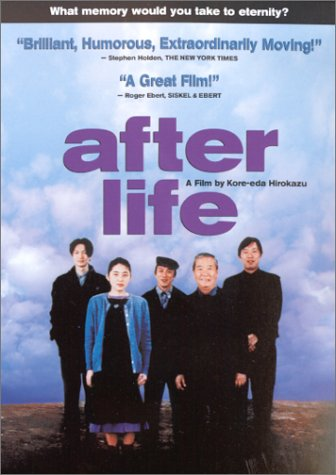
AFTER LIFE (1998)
Directed and written by Hirokazu Kore-eda Produced by Masayuki Akieda, Shiho Sato
What a delightful, surreal and beautiful film. AFTER LIFE (1998), is easily one of the most imaginative and human films I have watched in a long time. It is set in an administrative centre somewhere between the realms of life and death. Here the staff of the office, kind of social workers, welcome recently deceased people and ask them to recall their life and choose a single memory. After which the filmmaking staff will recreate the memory, shoot this scene and the souls will be able to re-experience this moment forever in heaven.
To me this is a mind-blowing concept for a feature film and I am surprised that it has not been remade (and probably ruined) by Hollywood for either cinema or TV. What makes it so great is, that despite the high concept idea, the design and delivery is so down-to-earth. The offices where events confirmed are not presented with any of the usual angelic or heavenly cliches. Instead, Hirokazu Kore-eda, of which this is only his second feature film, and his production team, decide that the after-life is an unglamorous place run by kindly bureaucrats.
One of the many strengths of After Life (1998) lies with the human representations, both the people who have passed and the office angels who counsel them. The love, humour and emotion derived from the various interviews given by many of the characters are full of joy, sadness and longing. Along with the soulful characters coming to terms with their recent passing, the narrative also focuses on two “young” counsellors, Takashi (Arata Iura) and Shiori (Erika Oda), who must overcome their personal conflicts while helping others. Overall, After Life (1998) builds slowly and beautifully weaves so many fantastic human stories. When the filmed memories are revealed my heart melted, as Kore-eda delivers cinematic moments that will stay with one eternally.
FILMS THAT GOT AWAY #16: OFFICIAL COMPETITION (2021)
Directed by Gastón Duprat and Mariano Cohn
Written by: Mariano Cohn, Andrés Duprat and Gastón Duprat
Produced by: Jaume Roures
Main cast: Penélope Cruz, Antonio Banderas, Oscar Martínez, José Luis Gómez, Irene Escolar, Manolo Solo, Nagore Aranburu, Pilar Castro Koldo Olabarri, etc.
Cinematography Arnau Valls Colomer
**MAY CONTAIN SPOILERS**
It’s no surprise there are an abundance of films about the actual process of filmmaking. The film industry is full of rich possibilities in terms of drama, action, tragedy, romance and comedy. Moreover, cinema down the years is replete with imaginative, tough, evil, spoilt, egotistical, eccentric, pretentious and frankly insane individuals working in the film industry. 8 1/2 (1963),Dolemite is My Name (2019), Shadow of the Vampire (2000), Sullivan’s Travels (1941), Barton Fink (1991), State and Main (2000), Once Upon A Time In Hollywood (2019), Hugo (2011), Living In Oblivion (1995), Boogie Nights (1997), The Disaster Artist (2017), Ed Wood (1994), The Player (1992), and Tropic Thunder (2008) are just a few brilliant films about filmmaking. Now you can add the hilarious Argentinian-Spanish co-production, Official Competition (2021) to that list.
With stunningly funny performances from Penelope Cruz, Antonio Banderas and Oscar Martinez, Official Competition (2021), centres on a film-within-a-film production, as Cruz’s ostentatious director, Lola Cuevas, helms a billionaire-backed-big-budget adaptation of a critically acclaimed book. Banderas is Felix Rivero, a famous movie star, while Martinez is a method-driven actor, and with the wildly unpredictable Cuevas between them, a rivalry soon develops between their different acting styles and personalities. As the production progresses any respect they had evaporates and descends into hilarious acrimony amidst a series of expertly staged comedic set-pieces.
I find it incredibly irritating that so many films get critical praise and win awards and you watch them and, while technically brilliant, they are ultimately boring and pretentious. Then we get Official Competition (2021), with a perpetually inventive screenplay by Mariano Cohn, Andrés Duprat and Gastón Duprat, that has not received nearly enough critical praise or awards. In fact, it mocks those artistically inflated directors and actors whom often get over-praised by fawning film critics and journalists. So, if you love films about filmmaking and funny ones at that, please do check this film out streaming on Netflix. It is certainly a cut above the pretentious films, actors and directors it is cleverly satirising.
Produced by: Anthony Bregman, John Carney, Peter Cron, Rebecca O’Flanagan and Robert Walpole.
Main Cast: Eve Hewson, Jack Reynor, Orén Kinlan and Joseph Gordon-Levitt.
Cinematography: John Conroy
Edited by: Stephen O’Connell
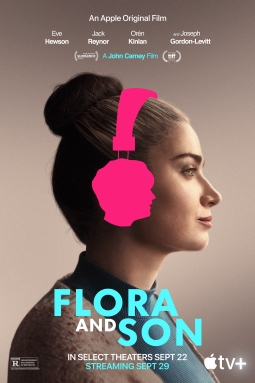
John Carney is a brilliant and honest filmmaker who is attracted to outsiders and people with real emotional turmoil. They tend to be at crossroads in their lives and are struggling with their dreams and relationships. He also loves musicians, flaws and all. In Begin Again (2013), a washed-up musical executive, portrayed by Mark Ruffalo, meets unhappy singer-songwriter, Keira Knightley and their first-world romance is played out to bittersweet consequences. Similarly, in Sing Street (2016), a troubled teenager comes of age through his 1980’s pop band and bittersweet romance with a rebellious and equally-troubled schoolgirl. Notice a pattern? Well, this style of music, gritty city backdrops and salty romances were established in Carney’s breakout hit, Once (2007) and are continued in his current underdog musical comedy, Flora and Son (2023).
Flora and Son (2023), believe it or not, is set in Dublin and centres around a single mum, Flora and her delinquent teenage son, Max (Oren Kinlan). Eve Hewson is the foul-mouthed-council-estate-joker, who uses anger and black humour to hide her feelings of insecurity and loss. A mourning for the loss of youth having brought up a child virtually single-handed. Her relationship with Max’s father, Ian (Jack Reynor) is fractured to say the least and they spit sarcastic barbs at each other as shared custodians of disaffected Max. While leaving her cleaning job at a middle-class household, Flora finds a battered guitar in a skip. Attempting to bond with Max, by giving him the guitar, Flora finds herself shunned. She then opens another bottle of wine, picks up the guitar and gives it a crack herself.
Taking online guitar lessons from charming and chilled American musician, Jeff (Joseph Gordon-Levitt), Flora initially flirts but then knuckles down to learn the plucking instrument. The stakes aren’t particularly high here, but the feelgood acoustic numbers from Carney and co-composer, Gary Clark, certainly breeze along nicely and breath gold onto the screen. Max’s white-rap-Irish-hip-hop tracks are pretty good too and the video he and Flora make is really funny. Thus, you get the theme again from Carney that music helps to connect and heal and provide salvation to the most troubled of human situations. Overall, Flora and Son (2023), is a slight but enjoyable film with enough earthy humour, strumming harmony and kicking beats to please most.
Produced by: David Heyman, Margot Robbie, Tom Ackerley and Robbie Brenner
Cast: Margot Robbie, Ryan Gosling, America Ferrera, Kate McKinnon, Michael Cera, Simu Liu, Helen Mirren, Issa Rae, Rhea Perlman, Will Ferrell, etc.
Cinematography: Rodrigo Prieto
*** MAY CONTAIN SPOILERS ***
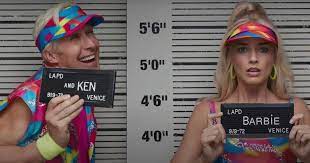
I saw Barbie (2023) a few weeks ago but work has been really busy so I am only just getting round to reviewing this cinematic adaptation of a lump of plastic that was moulded into a best selling toy. So, after the critical acclaim received for the excellent rites of passage film,Ladybird (2017), and recently starring in the existential comedic folly that is, White Noise (2022), Greta Gerwig takes the helm for this funny, intelligent, sarcastic and brightly coloured filmic vomit.
Gerwig shares writing duties with Noah Baumbach. These two major talents seem an unlikely duo to adapt a story of about an arguably sexist and outdated doll, that profiled unrealistic body images to the millions of people who owned it. I mean, I have never had a Barbie doll and didn’t really like dolls at all as a kid. I might have had an Action Man, but must admit I did enjoy owning my Star Wars figures. They somehow had more character and worth, despite also being made of synthetic polymer. My point is that Barbie (2023), aside from making money, I do not see any reason for a Barbie film to exist. However, it is to Gerwig and Baumbach’s credit they have crafted a wonderful and funny screenplay to ultimately sell more plastic dolls.
The story finds Margot Robbie’s ridiculously attractive blonde living in a utopian land entirely run by different versions of empowered Barbies. Many of which are played by an energetic who’s-who of an ensemble. Suddenly Barbie is struck by existential dread and a fear of death. Determined to discover why Barbie’s perfect life sucks, she goes on a journey to find the reasons why an anthropomorphic lump of processed oil isn’t going to live forever. Joining her on the trip to the real world is the dopey Ken (Ryan Gosling), who love-stalks Barbie like a pining puppy. Cue Barbie and Ken’s “fish-out-of-water” quest to find whatever in the real world. Yet, after a terrifically imaginative opening series of scenes and sequences, this is where the film starts to unravel.
The opening 2001: A Space Odyssey (1968) homage is easily the best thing about Barbie (2023) for me, along with some cracking one-liner gags throughout. Ryan Gosling also steals the show as the dim-witted Ken, whose character arc is ironically way stronger than Barbie’s. Robbie is sparkling as usual but I found the frenzied colours and manic ensemble a little overwhelming for my taste. The film is also way too long with too many unsatisfactory sub-plots, such as America Ferrara’s underwritten real-women-in-crisis narrative. Overall though, Gerwig and Baumbach have great fun satirising the patriarchy and corporate capitalism while at the same time upholding patriarchal values and making $hitload$ of cash in the process.
Produced by: Wes Anderson, Steven Rales, Jeremy Dawson
Ensemble Cast: Jason Schwartzman, Scarlett Johansson, Tom Hanks, Jeffrey Wright, Tilda Swinton, Bryan Cranston, Edward Norton, Adrien Brody, Liev Schreiber, Hope Davis, Stephen Park, Rupert Friend, Maya Hawke, Steve Carell, Matt Dillon, Hong Chau, Willem Dafoe etc.
Cinematography Robert Yeoman
*** MAY CONTAIN SPOILERS ***
Wes Anderson is a phenomenal filmmaker with an imaginative set of style and narrative conceits. Everyone one of his releases is a rich tapestry containing memorable ensemble casts, adjacent framing, effervescent use of colour, geographical pertinence, intellectual humour and subjects situated in the far-left field of genre cinema. Yet, I do not enjoy ALL his films. Often, they veer too far into eccentric pretentiousness. Indeed, I found The French Dispatch (2021), frustrating and, other than the tremendous story set in the asylum with the mad artist (Benicio Del Toro), disconnected with it overall. While it was another admirable work of cinema, I did not enjoy it as a paying punter.
Asteroid City (2023), however, is a film I enjoyed greatly. The famous actors immersed within the ensemble, the cinematic artifice, the clever meta-narrative structure, symmetrical shot composition, beautiful use of colour, offbeat characters, specific era and geographical setting, imaginative props and costume design, and witty humour are all present as per Anderson’s impressive body of work. But Asteroid City (2023) had a larger emotional heart than his recent films, and is my favourite since the superb, The Grand Budapest Hotel (2014).
A heady combination of genres, one could describe, Asteroid City (2023), as a hyper-sci-fi-Western-retro-romantic-futuristic-comedy and study of grief set in 1950s, America. Despite filming taking place in Spain. Anyway, Anderson establishes the characters through the structure of a film within a play. Bryan Cranston’s narrator introduces us to the various middle-class, working class, military and scientific personalities who become trapped in the town of Asteroid City by a series of unlikely but hilarious misfortunes. Throughout the chapter inter-titles the scenes return us to our narrator as Anderson cleverly comments on the process of creating a story while delivering the narrative events.
Anderson delves into familiar themes of grief via the story of war photographer, Augie Steenbeck (Jason Schwartzmann) and his four kids, one of whom is a genius, Woodrow (Jake Ryan). He is there for a Junior Stargazer competition amidst the setting of the gigantic meteorite bunker. Again, the theme of prodigious children is mined for great humour and intellectual wit by Anderson. The futuristic inventions created by the children are especially fantastic. The plot strand of the science geniuses being exploited by the military and corporate sharks is deftly done. Yet, the main emotional heft is delivered within Augie and Hollywood actress, Midge Palmer’s (Scarlett Johansson) budding relationship. Johansson is especially compelling in the role, anchoring the film in welcome pathos, amidst the flurry of idiosyncratic absurdities Anderson throws at us. His framing of Augie and Midge between the their chalets is aesthetically memorable, visually augmenting their growing human connection.
Asteroid City (2023) proves once again Wes Anderson is one of the most original filmmakers of this generation. Will he gain some more converts to his particular set of cinematic bag of tricks? Who knows. What I do know is that I was completely immersed in the colour, movement, pace, humour, aesthetics, performances and themes with the film. I must say though, while it was necessary, the “Area 51” style — and I don’t want to give it away — absurd plot-turn halfway through was not my favourite aspect of the piece. But I realise it was narratively integral to the story. The meta-framing also seemed to get in the way at times of the main action effecting the occupants of Asteroid City. But these are minor gripes at a thoroughly artistic, beautifully immersive, and technically impressive cinematic achievement.
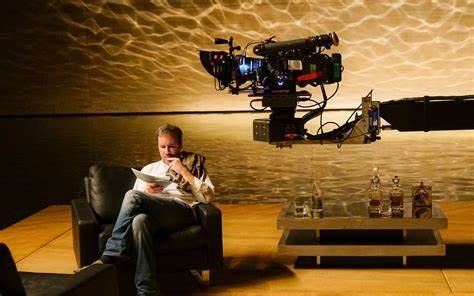
With the release of Dune: Part Two (2023) on the horizon for November 2023, I thought it may be worth appraising some of Canadian filmmaker, Denis Villeneuve’s amazing directorial work in this occasional strand, My Cinematic Romance. Note, I discipline my choices to only five films.
If you’re interested, I really wanted to like Dune (2021) more. One won’t see a more attractive and technically perfect rendition of a sci-fi world in the cinema in years. But, I could not connect with the narrative or lead protagonist. Seeing the big worms which made me want to watch Tremors (1990); a far superior and shorter version of a hero’s journey.
Nonetheless, award-winning Villeneuve is one of cinema’s surest hands when it comes to intelligent and compelling genre cinema. He has the touch of a film artist and takes certain risks, but not without resorting to indulgences which alienate the audience (take note Ari Aster!) Thus, I consider and list five of his great works, which I recommend wholly if you have not seen them.
*** MAY CONTAIN SPOILERS ***
POLYTECHNIQUE (2009)
This is a harsh watch. Any film about mass shootings is never going to be an easy experience to stomach. Still, it’s nothing compared to the sadness of those whose lives were struck from existence. The 1989 École Polytechnique massacre (also known as the “Montreal Massacre”) is re-enacted here in stark black and white film stock. The wintry setting and the cold-blooded murder of the events combine to create a heightened vision of anxiety cinema. Villeneuve objectively documents the massacre with a distance that paradoxically raises the emotions as opposed to lessening them. A film which you makes us confront the horror of humanity.
NEXT FLOOR (2010) – short film
Created by producer Phoebe Greenberg and directed by Villeneuve during a break from making feature film Polytechnique (2009), this devastating short film with its commentary on the horror of greed, is most likely an influence on grisly Spanish prison film The Platform (2019). One wishes Villeneuve would make a horror feature. I’d prefer to see how that might turn out than Dune.
INCENDIES (2010)
Incendies (2010) is the probably the best film you haven’t seen. If you have seen it then tell more people to see it. Spread the word on this incredible film. Villeneuve directs in an intelligent way, retaining empathy and emotion for both protagonists and antagonists devoured by war. Nawal Marwan’s story is especially heart-breaking and she is given a moving portrayal by Lubna Azabal. Nawal’s story is one of astounding power as the character experiences the hell of loss, war, torture and death. One which will shake you to the core for days and weeks and maybe even years!
PRISONERS (2013)
A superlative crime script written by Aaron Guzilowski has one of the best ensemble casts seen on screen in years, notably: Hugh Jackman, Jake Gyllenhaal, Viola Davis, Maria Bello, Terrence Howard, Melissa Leo, and Paul Dano. The story is absolutely compelling with a plot so tightly wound, you’re almost throttled throughout by the mystery and suspense. Jackman is especially truthful, playing a flawed everyman who obsessively, quite understandably, searches for his missing child. Dano plays another convincing outsider as the main suspect, while Gyllenhaal is, as always, brilliant as dogged cop, Detective Loki. Villeneuve proves once again he is one of the best directors of actors working today. Prisoners (2013) is a masterpiece of crime genre cinema.
ARRIVAL (2016)
The intriguing premise, brilliant script, ambient score, stylish effects, subtle cinematography and purposeful direction make this one of the best science fiction films of recent years. It is an intelligent and emotional science-fiction drama with a beautifully constructed narrative which constantly surprised and moved me. It also asks big questions on the nature of time, existence and love; informing us that not all extra-terrestrial life in movies has to be monstrous and deadly. Above all else Villeneuve, Amy Adams and screenwriter Eric Heisserer gain sheer kudos for creating a beautiful and moving love story.
Produced by: Andrea Berentsen Ottmar, Dyveke Bjørkly Graver
Cast: Kristine Kujath Thorp , Eirik Sæther, Fanny Vaager, Henrik Mestad, Andrea Bræin Hovig, Steinar Klouman Hallert, Fredrik Stenberg, etc.
Cinematography by Benjamin Loeb
*** MAY CONTAIN SPOILERS ***
Human beings are capable of incredible acts of compassion, creativity, kindness, artistry, charity, care and beauty. But I have to admit there is a flaw, and in some people a sickness, which makes them narcissistic, selfish and image-obsessed with the constant need for attention. Indeed, with the advent of mobile phones and social media anyone with an internet connection can drop a video on YouTube, Facebook, TikTok or Instagram and get instant gratification. Not to mention the plague of TV talent and reality programming which showcase the epitome of this “me-me-me” generation.
Maybe society has always been like this, full of attention seekers desiring to become actors or singers or comedians or artists. But now there is a constant platform for the talented, untalented and arguably mentally unbalanced to post their wares online for an ego hit, likes and if they’re lucky, to “go viral.” But it’s just a bit entertainment isn’t it? A bit of a laugh? Getting a bit of attention and maybe even becoming famous. But there is a dark, horrific side to social media and reality show attention. The internet is replete with stories about people who have killed themselves having found “fame” this way. Sometimes too much attention becomes too much for some.
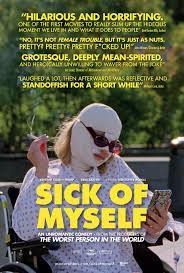
The Norwegian black comedy, Sick of Myself (2022) written and directed byKristoffer Borgli, darkly explores the themes of narcissism, art and attention-seeking through the twentysomething characters of Signe and Thomas. The couple live somewhat regular lives in Oslo. Signe is a coffee shop server, while Thomas is an aspiring artist. Two excellent scenes introduce their characters succinctly. Thomas, who it is revealed throughout to be a kleptomaniac, initially gets a hit stealing an expensive bottle of wine from a posh restaurant. While Signe gets a massive adrenaline punch from the attention she receives when assisting a bloodied customer savaged by a dog. These fascinating narrative strands are the foundation for a series of funny, cringeworthy and horrific scenes expertly developed by Borgli.
The film is very much delivered in a believable and realistic style as, Sick of Myself (2022), develops its character and thematic analysis with understated direction. But the actions of the characters are anything but understated. Signe diverts attention away from Thomas’ growing fame in the art world by resorting to more extreme ways to get people to notice to her. The initial comedic situations, such as Signe faking a nut allergy to interrupt Thomas’ speech in a restaurant, give way to constant lying and actual self-harm, as her personality is blighted by undiagnosed Munchausen’s syndrome. With echoes of DeNiro’s and Scorsese’s The King of Comedy (1983), Signe is a grotesque creation reflecting a dangerous side within our society. But whereas Rupert Pupkin had a goal to become a famous stand-up comedian, Signe, as portrayed with muted and natural brilliance by Kristine Kujath Thorp, has no such career desire other than to just be constantly noticed. She is a tragic character, like many in society, who desperately need psychological help.















 The Cinema Fix presents