Based on: Nightmare Alley by William Lindsay Gresham
Produced by: J. Miles Dale, Guillermo del Toro, Bradley Cooper
Cast: Bradley Cooper, Cate Blanchett, Toni Collette, Willem Dafoe, Richard Jenkins, Rooney Mara, Ron Perlman, Mary Steenburgen, David Strathairn, etc.
Cinematography: Dan Laustsen
*** MAY CONTAIN SPOILERS ***
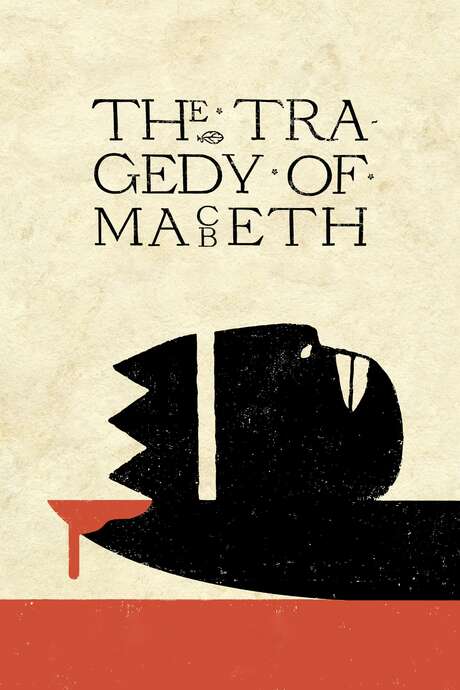
Guillermo Del Toro could probably have had his pick of film stories to choose from after the monumental box office and critical success of the majestic alternative love story, The Shape of Water (2017). But rather than build on the message of love and hope in that creature feature he has chosen to adapt the noir novel, Nightmare Alleyby William Lindsay Gresham. In the process Del Toro has also remade the classic 1947 film of the same name, starring Tyrone Power.
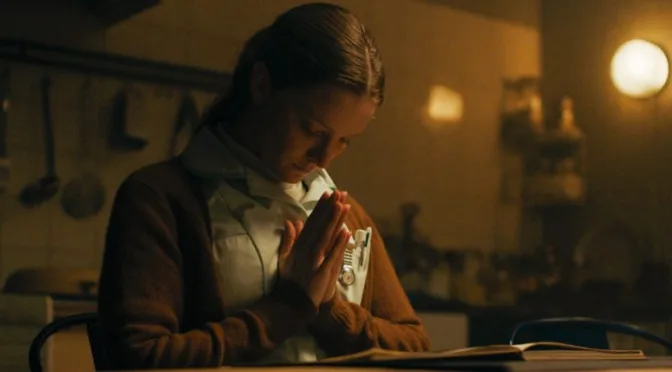
Essentially a $60 million dollar B-movie, the film is one of the most opulently dark and beautifully designed films I have witnessed in some time. Light, shadow, wood, gold, blood, fire, sweat, skin, snow, and night all collide and collude in a stunningly presented palette from Del Toro and lead production designer, Tamara Deverell. This film is a moving painting with inspiration from geniuses such as Picasso, Dali, Matisse and Edward Hopper. While the look of the Nightmare Alley (2021) and cast are a constant wonder, I had a nagging thought while watching the film which made me question who the audience was for this film. Also, there were many story elements which did not gel for me.
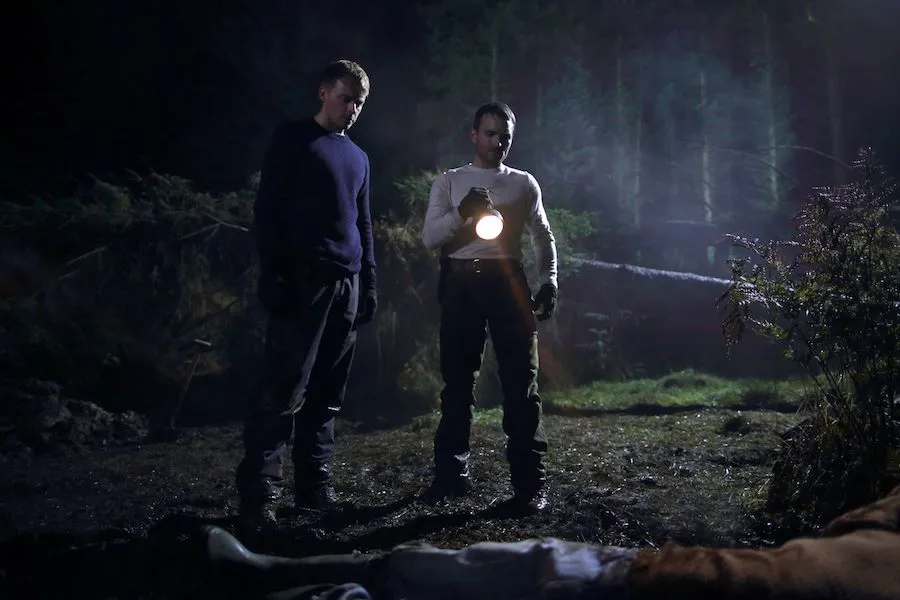
Nightmare Alley (2021) opens with fire and death. Drifter Stanton Carlisle (Bradley Cooper) then finds himself drawn to the carnival arena. It is full of shadowy characters, oddballs and tricksters, portrayed with dirty glamour by the likes of Toni Collette, Willem Dafoe, David Strathairn, plus the more innocent, Rooney Mara. Stanton fits right in and is soon making a name for himself as a mentalist, fooling audiences with carefully rehearsed cues and memory tricks. The first half of the film is its narrative strength. Only after Stanton’s story leaves the carnival his journey twists into something more sinister, but less satisfying.
I enjoyed Del Toro’s stunning visual magic employed in Nightmare Alley (2021). However, while Bradley Cooper has terrific star quality I did not care for his anti-heroic Stanton Carlisle. Cate Blanchett is also alluring as the latter second act enchanter, but ultimately the film lacks real depth. Themes relating to masculinity in crisis, war, psychoanalysis, crime, grief, the afterlife and what it means to be a freak or outsider are there, but only skimmed. I mean the plot has some decent twists, but I did not entirely commit to the downward trajectory of Carlisle’s tale. Overall, as a morality tale Nightmare Alley (2021) is not as frighteningly tragic as it could have been. Carlisle gets what he deserves, and I felt little pity or horror for his end. Unlike another classic noir from some years back, Angel Heart (1987).
Screenplay by: Harry Bromley Davenport, Michel Perry, Iain Cassie, Robert Smith
Story by: Harry Bromley Davenport, Michel Perry
Produced by: Mark Forstater
Cast: Bernice Stegers, Philip Sayer, Simon Nash, Maryam d’Abo, Danny Brainin etc.
Cinematography: John Metcalfe
*** MAY CONTAIN SPOILERS ***
Being a fan of the horror genre never fails to spring surprises, especially if you also love trashy-B-movie-exploitation-video-nasties too. Because what often occurs is a hidden or buried or previously banned film will reanimate and be located on one of the many streaming platforms we have today. I am both surprised and even more joyous if I find I have never even seen the said film. This is certainly the case with low-budget alien monster film, XTRO (1982).
There I was pressing play via Amazon Prime, thinking it was another schlocky American indie I had missed from yesteryear, only to discover Xtro (1982) is actually a bizarre British film which twists and riffs on the box office hit that was ET: Extra Terrestrial (1982). Xtro (1982), directed by Harry Bromley Davenport, is not a comforting family science fiction drama like its more famous counterpart though. Instead, it is a gory sci-fi shocker with many outrageously violent set-pieces and a budget lower than E.T.’s lunch bill.
Critically damned at the time, Xtro (1982), when released on home video in 1983, was subject to a prosecution case in relation to British obscenity laws and labelled a “video-nasty”. Watching it now I have to admit it is quite shocking still, but the practical effects are so gloriously over-the-top they are more humorous than sickening. Having said that there are some memorably gruesome moments involving alien births, crazy clowns, a live “Action Man” doll, weird space eggs, and transformative man-into-monster effects.
The film doesn’t hang about establishing character but propels, from the opening scene of a father playing in the garden with his son, straight into the disappearing parent plot. The father (Philip Sayers) vanishes without a trace and three years later his wife (Bernice Stegers) and son are attempting to repair their lives. Yet, the boy is suffering horrific nightmares when suddenly his father reappears attempting to reconcile. The familial drama within the script itself could have been further developed to some emotional impact. However, while Bernice Stegers gives a decent dramatic performance, the film soon descends into a mix of surreal and insane set-pieces, combined with the father’s metamorphosis into something from another world.
There’s much to like and much to loathe about, Xtro (1982), notably the gratuitous nudity sprinkled throughout. Yet, if you are drawn to exploitational B-movies there is much sick entertainment to be found in the blend of impressive practical effects and creature moments. Philip Sayer and Bernice Stegers keep the shlocky elements of the plot in check with sane acting performances and despite some eccentric writing throughout Harry Bromley Davenport and his team have delivered an out-of-this-world bona fide B-movie cult classic.
Produced by: Todd Black, Jason Blumenthal, Steve Tisch
Cast: Nicole Kidman, Javier Bardem, J. K. Simmons, Nina Arianda, Tony Hale, Alia Shawkat, Jake Lacy, Clark Gregg, etc.
Cinematography: Jeff Cronenweth
*** MAY CONTAIN SPOILERS ***
Lucille Ball and Desi Arnaz were entertainment, musical and business pioneers during the classic Hollywood television period. Lucille Ball alone was nominated for 13 Primetime Emmy Awards, winning five times, and the recipient of many other accolades, before being inducted into the Television Hall of Fame. Not only did the married couple produce and star in the seminal U.S. situation comedy, I Love Lucy, but their Desilu Studios production company would be the driving force behind creating famous TV series including Star Trek and Mission: Impossible. The couple broke viewing records and barriers in regard to race, gender and business practices. While they were not of my era, I recognise both Lucille Ball and Desi Arnaz as consummate professionals, business trailblazers and iconic stars.
Aaron Sorkin’s Being the Ricardos (2021), adapts a week-in-the-life of Lucille Ball (Nicole Kidman) and Desi Arnaz (Javier Bardem) as they prepare, audition and perform the episode ‘Fred and Ethel Fight’ of I Love Lucy. At the same time, Lucille faces shocking revelations about her alleged Communist past. Moreover, her marriage to Desi is also tested by suspicions he has slept with other women. Interspersed around these events Sorkin flashes back to reveal how the couple met, and Lucille’s flailing film career as a dramatic actress was re-ignited by a chance switch to radio comedy. As a consummate screenwriter Sorkin hops between these time periods with great aplomb and his customary whip-cracking dialogue fires zingers throughout. The production process of the TV episode is particularly brilliant, with crafty Nina Arianda and the awesome J. K. Simmons providing superb support as Lucille and Desi’s supporting couple, William Frawley and Vivian Vance, respectively.
Being the Ricardos (2021) spins a great many plates within the running time and it is rock solid entertainment. As he did with The Trial of the Chicago Seven (2020), Aaron Sorkin arguably takes liberties with the time of events to compress and finesse the truth for the sake of dramatic and comedic effect. But that’s fine as this is not a documentary. What we get instead is an authentic production design which expertly evokes the mood, look, glamour, costumes and sounds of the era. It also explores the business, sexual and ideological politics of age with Desi and Lucille facing and pushing back at sponsor and studio demands. Those who know I Love Lucy will be overjoyed at the recreation of some memorable comedy sketches.
At the heart of the film Nicole Kidman and Javier Bardem combine formidably to breathe life into these legendary talents. Kidman is an actor who is extremely brave taking on the role of an icon. Sure, she gets paid millions of dollars, but her performance as Lucille Ball is energetic and intelligent and very funny. It could be easy to criticise her casting but Kidman does sterling work here. She gives Ball’s characterisation an effervescence, intelligence and perfectionist approach to her craft one cannot help but admire. Javier Bardem is a cinematic dream. With effortless panache he lights up the screen and just is so damned charming. Together they create fine on-screen chemistry as Sorkin’s bullet-paced dialogue is delivered superbly by the stars and terrific ensemble cast.
Ultimately, neither dramatic enough to tug the heartstrings or funny enough to be called an all-out comedy classic, Being the Ricardos (2021) remains another intelligent Aaron Sorkin rendition of real people and actual events. It’s a classy affair with a stunning cast and script, overall paying fine tribute to the genius of Lucille Ball and Desi Arnaz.
Screenplay by Buck Henry based on To Die For by Joyce Maynard
Produced by Laura Ziskin
Cast: Nicole Kidman, Joaquin Phoenix, Matt Dillon, Casey Affleck, Dan Hedaya,
Cinematography Eric Alan Edwards
Edited by Curtiss Clayton
For the record, for me, an under-rated classic can be a film I love, plus satisfy the following criteria:
Must not have won an Oscar.
Must not have won a BAFTA.
Must not appear in the AFI Top 100 list.
Must not appear in the IMDB Top 250 list.
Must not appear in the BFI 100 Great British films.
Must not appear in the all-time highest grossing movies of list.
To Die For (1995) is a bona fide under-rated classic and I am surprised it received no Academy Award nominations, especially as Nicole Kidman was nominated for a BAFTA, and won a Golden Globe Award. Kidman is sensational in arguably her greatest performance as narcissistic and ambitious sociopath, Suzanne Stone. Indeed, Stone as the driven, media-hungry manipulator is one of the most glamorous monsters ever seen in cinema.
Told in mockumentary style, To Die For (1995) is deftly directed by Gus Van Sant in a somewhat punchier and more comedic tone than usual. Stone strives for fame as a TV newscaster but eventually becomes a weathergirl on a local TV station. Marrying local boy Tony Maretto (Matt Dillon) does not stop Stone’s ambition. In striving for hard-hitting new stories, she meets a group of young drop outs, featuring early roles for Casey Affleck and Joaquin Phoenix. The delusional Stone turns seductress and arch-conspirator as her husband becomes a victim of her venal plotting.
Both funny and tragic, To Die For (1995), has an almost perfect screenplay. There isn’t a wasted scene, with its use of direct address, media clips and interviews forming a rich tapestry of comedic scenes and character moments. The fact that Stone uses the teenagers to commit murder is so tragic as her husband, Tony, is a decent bloke who loves her so much. Such is her blind desire for fame, that while one is admirable of her forceful qualities, one questions her evil intent. Ultimately, To Die For (1995), is a film which has stood the test of time, especially in these days of rampant self-obsession on social media. Lastly, Kidman has never been better as a character who even up to her icy end thought her name would be up in TV lights.
Cast: Agathe Rousselle, Vincent Lindon, Garance Marillier, Laïs Salameh, etc.
Cinematography: Ruben Impens
*** THE WHOLE FILM IS A SPOILER ***
The difficult second album syndrome applies with Julie Decournau’s incredibly horrific, illogical and over-rated, Titane (2021). How the film won the Palm D’or at the Cannes Festival is beyond me. Maybe the jury were on the same acid as the ultra-talented writer-director when she created the script. Or, maybe the jury were belatedly rewarding her for the amazing contemporary horror film, Raw (2016).
Raw (2016) works on so many distinct levels with themes covered including: veganism, peer pressure, initiation, fitting in, animal cruelty, sexuality. lesbianism, same-sex attraction, animalism, sisterhood, hedonism, nature versus nurture, cannibalism, family, etc. It crosses genres effortlessly and has one of the greatest and disgusting scenes I have had the pleasure to see for some time. Raw (2016) is a shocking, intelligent and astounding modern-day masterpiece. Titane (2021) unfortunately is not.
Before I say why I did not enjoy Titane (2021), I must say that I constantly seek out challenging cinema that pushes boundaries. I love horror and want to be shocked, but also emotionally involved with the characters at the same time. Moreover, I am well prepared to commit to dream logic and surreal narratives, however, the filmmaker must also try not to over-indulge their artistic excesses, and respect the audience too. Of course, this is just my opinion, but I don’t feel Julie Decournau had a clear story path and rather went hell bent into delivering a variety of different ideas, none of which created a fulfilling emotional journey for the main protagonist, Alexia (Agatha Rouselle).
Rouselle, as the malevolent and tragic conduit of Ducournau’s twisted vision, does give a spectacularly brave performance. But her character is given so many complex set-ups at the beginning, I quickly gave up caring what happened to her. As a child she is badly injured in a car crash. This gives her a titanium plate in the skull. Alexia grows up and is an exotic dancer who either dreams of, or actually fucks cars. Oh, she is also a serial killer who violently kills for no apparent reason. Several gruesome set-pieces result in the goriest deaths ever seen in a Palm D’or winner. Indeed, by the time Alexia goes on the run and smashes her face into a sink to alter her features I was numbed by it all.
Titane (2021) at the midpoint then delivers one of the most dumb and insulting plot shifts I have seen in recent years. Yes-yes it’s an arthouse film and an expression of Julie Decournau’s vision of humanity, but I DID NOT CARE!! Not only did we get Alexia’s horrific behaviour, we are then introduced to another plot turn when she hides out with a bereaved and emotionally scarred firefighter, Vincent (Vincent Lindon). By this time I was actually laughing at certain scenes, finding it all tiresome and frankly embarrassing. I got the symbolism of human beings as machines and exploitation of females and that family represents death and blah-blah-blah! Yet, and I’m likely to be in the minority, Titane (2021) is one of the most narratively, emotionally and visually exhausting films I have seen in some time. Watch at your peril!
Produced by: Sara Murphy, Adam Somner, Paul Thomas Anderson
Cast: Alana Haim, Cooper Hoffman, Sean Penn, Tom Waits, Bradley Cooper, Benny Safdie etc.
Cinematography: Michael Bauman and Paul Thomas Anderson
Edited by Andy Jurgensen
*** MAY CONTAIN SPOILERS ***
Any film from Paul Thomas Anderson will certainly receive high critical praise and Licorice Pizza (2021) is certainly no different. Not only do I think this is his most over-rated film. I don’t even think it is a good one. Not for any technical reasons. Because as usual Anderson’s filmic skills as a director, the scintillating cinematographic style, the evocative rendition of early 1970’s Californian suburbs, plus two star-making turns within a formidable cast, ensure Licorice Pizza (2021) is deservedly going to win many plaudits. But I just did not get the story about pretty much nothing and did not connect with the lead romance.
Set in 1973, Licorice Pizza (2021), is part slice-of-life period drama and part character comedy, with a spine consisting of an odd romance between entrepreneurial fifteen-year-old, Gary Valentine (Cooper Hoffman) and twenty-five-year-old, Alana Kane (Alana Haim). While containing many brilliantly directed scenes, the film is a hot mess of indulgent rooting through Paul Thomas Anderson’s historical research and anecdotal events inspired by real-life film producer, Gary Goetzman.
Being asked to root for a relationship which is dubious on the surface and extremely complex to say the least is not beyond me. But Licorice Pizza (2021) doesn’t address the age difference, aside from a couple of moments in the script. I know Cooper Valentine is an old head on young shoulders, but why Alana doesn’t hang out with people her own age was weird for me. I’m not being politically correct or a prude, but is Anderson asking for us to root for what could end up being statutory rape. Am I over-thinking this? Well, all I can say is it impacted my emotions of a major aspect of the story.
Licorice Pizza‘s (2021) worst crime is it’s virtually plotless and I could not identify with the characters. I liked Gary to a certain extent as he ducks and dives to make a living, but what was at stake? Nothing really. Yeah, I get it is art but I found Anderson’s vision boring. Sure, the actors are great, especially the effervescent Alana Haim. Virtual cameos from Sean Penn, Bradley Cooper and Tom Waits failed for me though, with Cooper’s coke-addled and womanising impression of Jon Peters about as funny as an enema. Of course, the cinematography, period design, soundtrack and costumes are exquisitely presented, but they exist in an emotional vacuum. Finally, Licorice Pizza (2021) made me want to watch Paul Thomas Anderson’s previous 1970s masterpiece, Boogie Nights (1997). Now, that film deserved all the critical praise that came its way.
THE CINEMA FIX PRESENTS: 10 FAVOURITE FILMS OF 2021!
Following on from the extremely tricky global issues of 2020, the cinema saw further transitions amidst lockdowns and the rise of even more streaming platforms. Traditional timetables for film releases remain all over the place due to the effects of the pandemic on our culture. Plus, big budget productions are now going straight to the living room more often than not. Especially if the proposed cinema release date is postponed on several occasions. What studios lose in terms of cinema release profits, they are now looking to claw back with reduced marketing budgets and subscriptions to their own respective channels.
In the past my favourite film of the year lists were all films I saw at the cinema. Now they are a mixture of cinema and online releases. There is some overlap too in the given year when I watched such films due to the scheduling changes. I’m really not a fan of this as I don’t like change to routine as a rule. But if it means I still get to see my favourite films online or at the cinema then it’s hardly a trial or major issue to adjust.
List Notes
There are LOADS of films I have NOT SEEN! Please comment below MUST-SEE films not on the list.
The Bond film is not on here. It was fantastic entertainment, but NOT a good Bond movie.
There are no MARVEL/DC films on the list as I have not watched them all. Plus, I have superhero film formula fatigue.
Nomadland (2020), while good, was completely over-rated.
White Tiger (2021) would be on this list, but I only watched it yesterday. So, it qualifies for assessment in 2022.
For comparison here is my list of favourite films in 2020. A starter if you will, before the main cinematic course.
Happy New Year – have a great 2022!
TWELVE FAVOURITE FILMS of 2020!
1917 (2019) DARK WATERS (2019) DA 5 BLOODS (2020) I’M THINKING OF ENDING THINGS (2020) THE INVISIBLE MAN (2020) MANGROVE (2020) PARASITE (2019) PORTRAIT OF A LADY ON FIRE (2019) SAINT MAUD (2019) TENET (2020) THE TRIAL OF THE CHICAGO SEVEN (2020) UNCUT GEMS (2019)
“… with Thomas Vinterberg’s expert direction, evocative natural cinematography, and Mads Mikkelsen giving yet another acting masterclass, the humorous narrative soon leaves the laughs behind to become a bittersweet, yet still uplifting, work of Nordic cinema.”
“… David Lowery is an original thinking talent, and someone I categorise as an alternative genre filmmaker… The Green Knight (2021) certainly has scale and magic and astounding cinematic power.”
“… Edgar Wright has delivered one of the most thrilling and spectacularly energetic films of the year. The nostalgic and heavenly soundtrack is to die for, with so many songs I recall growing up listening to. Likewise, the cinematography and lighting design sparkle in hues of black, fluorescence, shadow and neon.”
“… Levee Green does not see the bigger picture and is sucked in by the promise of money, women and fame. He is blinded by the bright city lights and the closer he gets to them the easier it is for the record producers to pick his pocket. In such a tragic character August Wilson has created a memorably complex persona, perfectly rendered by the acting genius, Chadwick Boseman. R.I.P.”
“… the scenes where David antagonises his unconventional grandmother are hilarious. Youn Yuh-jung as the elderly matriarch is fantastic, deservedly winning a best supporting actress role at the Oscars. Moreover, Lee Isaac Chung gets a miraculous performance from child actor, Alan Kim.”
“… The loss of a child is never going to be an easy experience and it is something an individual will never get over. As I followed Martha’s journey intensely the smallest incremental shift in her personality is felt massively. Vanessa Kirby, in particular, is stunning as a woman cut-off from the world by this devastating grief.”
“… I’m not always a fan of poetic cinema, especially within a narrative presented as a quasi-Western. Mostly I like to be punched in the gut, not branded slowly from the inside out. Yet Jane Campion’s expert adaptation of Thomas Savage’s novel, The Power of the Dog (2021), contains some bite. You just don’t see when and how it happens.”
“… I’ve seen some so-so reviews for The Rental (2020), but it’s the kind of tightly plotted suspense thriller I really thrive on. What starts as an idyllic getaway for two relatively wealthy couples is carefully unravelled by Dave Franco’s well-paced direction, complimented by Brie and Steven’s committed performances, has wonderful locations and a seriously proper killer ending.”
“… Sound of Metal (2019) beats along steadily but with incredible purpose and rhythm. It teaches us that losing a major sense need not be the end of one’s life, but rather the beginning of an altogether different one.”
“… Everything about the film screams colour, energy and movement. The dancing and editing and swinging beats take you on a breathless journey through the romance and street war. West Side Story (2021) keeps all the memorably catchy songs… and if there is a better directed, choreographed and edited set-piece all year in the Gee, Officer Krupke number then I haven’t seen it.“
Based on: The House of Gucci: A Sensational Story of Murder, Madness, Glamour, and Greed by Sara Gay Forden
Produced by: Ridley Scott, Giannina Scott, Kevin J. Walsh, Mark Huffam
Cast: Lady Gaga, Adam Driver, Jared Leto, Jeremy Irons, Salma Hayek, Al Pacino etc.
Cinematography: Dariusz Wolski
*** MAY CONTAIN SPOILERS***
I’m not a fan of fashion. I wear clothes obviously and like to be smart and clean. Yet, the idea of believing one’s garments, shoes and accessories mean you are important, superior or worthy of adulation sickens me to be honest. However, fashion is a multi-billionaire industry and I get that people of variant social standing love it as a cultural phenomena. People either own or aspire to own over-valued garments and objects to inflate their ego or sense of importance is beyond me. Then again, I passionately enjoy watching human beings kick a ball into a net, so everyone has irrational passions. C’est la vie!
I didn’t go to see House of Gucci (2021) to look at the clothes though. My interest in this star-studded, big budget crime drama directed by the legend, Ridley Scott, was more because I did not know anything about the lives and personalities within the Gucci empire. Who would have thought that a wealthy family unit could have turned out so poisoned by greed and envy?
Covering a period of twenty or so years from the late 1970s into the 1990s, the story is structured around the relationship between Patrizia Reggiani (Lady Gaga) and Maurizio Gucci (Adam Driver). They fall passionately is lust, much to the chagrin of his spiteful father (Jeremy Irons) and marry against his will. Patrizia genuinely loves the sensitive Maurizio, but also has green eyes for the Gucci empire and the power that can bring. As her desire for influence in the family business grows, then so does cracks in their marriage. Crumbling relationships, business chicanery and family treachery dominate the narrative, all coming to a head with tragic results.
As a morality tale about how greed corrupts and drives human beings toward unnecessary tragedy, The House of Gucci (2021) is certainly worth a watch. Is there a sense the Gucci family were cursed by there wealth. Perhaps? But the film and screenplay as a whole present this theme without really drawing them out to full dramatic effect. However, the cast are absolutely fantastic throughout with Al Pacino, Adam Driver, and Lady Gaga on particularly exceptional form. Jared Leto dominates many scenes with his bald head, extra weight and screechy voice. While entertaining, the director could have reigned Leto in slightly to extract more pathos from the sad clown that is represented in Paulo Gucci.
I had a few issues with The House of Gucci (2021) inasmuch as it felt incomplete. At times it was as though I was watching a test screening version. The transitions between years were often confusing. What year is it, Ridley? Adam Driver’s arc from likeable young academic to selfish adulterer was rushed and unearned. I got the evocation of a Fredo and Michael Corleone dynamic between Maurizio and Paulo, but this really could have been developed further. The cinematography was grey and dull with the natural lighting style working against the expected colour and vibrancy of the 1980s era. I also wondered if the film had been graded?
While watching The House of Gucci (2021) I just kept thinking of more superior crime and gangster films. It is also mildly disrespectful to a genius like Ridley Scott to say Martin Scorsese would have knocked this story out of the park. I truly felt, while Lady Gaga was excellent in her role, her character could have been written and given a voice-over up there with that of Henry Hill’s. Nonetheless, I still enjoyed the film but wonder if there is a director’s cut out there which doesn’t feel rush released. Or even the possibility HBO or Showtime may adapt it into a longer drama series in time. Yet, does one want to spend more time with such avaricious and vain characters? Depends who is telling the story I guess.
Produced by: Dede Gardner, Jeremy Kleiner, Christina Oh
Cast: Steven Yeun, Han Ye-ri, Alan Kim, Noel Kate Cho, Youn Yuh-jung, Will Patton, etc.
Cinematography: Lachlan Milne
Music by: Emile Messeri
*** MAY CONTAIN SPOILERS ***
I missed Minari (2020) at the cinema. Which is a shame because out of all the Oscar-nominated films from earlier in the year it is now my favourite. Further, it should certainly have won the best film award. (Note: I have yet to see The Father (2020).) It has the heart and warmth and realistic hope that eventual winner, Nomadland (2020) lacked. Chloe Zhao’s powerful character study was arguably too meditative and glacially paced, without any real diversion from the plodding repetition of monotonous existence. I love slice-of-life and character-driven work, but I want some drama too. While Minari (2020) has certain meditative qualities, writer-director Lee Isaac Chung has crafted a supeb cinematic memoir of tender power and emotion.
Set in 1983, Minari (2020), centres around the Yi family. They had been working in California, but have moved to Arkansas to farm the land. The father, Jacob (Steven Yuen) dreams of growing produce to sell to fellow Korean businesses. However, the farm and static caravan he has purchased is remote with no guarantee of water to ripen the fruits and vegetables. Jacob must either pay exorbitant prices from the water company or find a natural spring underground. Alas, rain rarely threatens the Arkansas plains.
Jacob’s wife, Monica (Han Ye-ri) hates the caravan and does not share his farming dream. This marital conflict drives the much of the narrative as the two argue constantly. Monica is especially angry that her young son, David (Alan Kim) is so far from a hospital. The boy has a heart condition and like any good mother she consistently worries. Their teenage daughter, Anne (Noel Kate Cho) is too young to be a full-time caregiver to David while Jacob and Monica support themselves working at a local chicken factory. To placate Monica, Jacob brings grandmother, Soon-ja (Youn Yuh-jung) to the farm for support. Here a beautiful and funny parallel plot begins as David and his grandmother’s relationship comes to the fore.
I watched Minari (2020) on a Sunday morning at home, relaxed and cosy, filled with breakfast and coffee. I loved experiencing the film. The music wondrously supports the beautiful photography that illuminates the green and wheats that fill the lens’ gorgeous palette. Like the masterpiece, Parasite (2019), Minari (2020) represents a working-class family striving to stay together and survive in difficult times. The main difference though is the Yi family were doing it with honest hard graft rather that grifting, ducking and diving. The Yi’s connect with nature and the land rather than skimming the city and the rich. I really rooted for the Yi’s. Jacob’s desires and battles to find water reminded me of the equally moving French classic,Jean De Florette (1986).
Minari (2020) doesn’t take the obvious route of making the Arkansas locals racists who rail against the Yi’s. While there are some scenes involving cultural clashes, much of the drama and humour derives from the families interactions with each other. Indeed, the scenes where David antagonises his unconventional grandmother are hilarious. Youn Yuh-jung as the elderly matriarch is fantastic, deservedly winning a best supporting actress role at the Oscars. Moreover, Lee Isaac Chung gets a miraculous performance from child actor, Alan Kim. Special mention for a busy, but nuanced portrayal of a troubled but helpful worker, Paul, by Will Patton. His deeply pious character could have easily been made an antagonist, but Chung ensures he is another relatable human being in a film full of them.
SIX OF THE BEST #34 – AMAZING FILMS I DO NOT LIKE!
Are there box office hits, cinematic phenomena and damned fine films loved by critics which you DO NOT like? That isn’t to say they aren’t great films, but subjectively you just don’t enjoy them? I mean some people dislike much of Christopher Nolan’s work! What!? Okay, Interstellar (2014), was not his best, but hey that’s just my opinion. It’s all just opinions.
Now, I like to be positive on this blog and have critical balance when writing my reviews. In fact, some films I choose not to review because I don’t want to slag something off which is just not for me. I also generally avoid reviewing films I consider terrible because I prefer to avoid negativity.
Thus, this article is not about having a pop at classic films or saying they are over-rated for attention. The truth is – I AM IN THE WRONG HERE! But I think it’s interesting to examine why I don’t like these six excellent films. After all, many talented people have worked passionately on them, so in no way do I want to disrespect their craft. Which is why, I repeat, I am wrong!
*** CONTAINS SPOILERS ***
AVATAR (2009)
James Cameron is one of the greatest genre filmmakers of all time. He is also a technological innovator and genius. In Avatar (2009), he truly topped himself in regard to creating not only the beautiful world and inhabitants of Pandora, but by using never-seen-before motion-capture cinematic techniques. Moreover, the film would go on to make over $2 billion at the box office, so I’m not worthy enough to criticise Avatar (2009). But the script is incredibly flat and derivative. The lead characters are mostly unlikable and I genuinely found the amount of blue on show irritating to the eye. Worst of all is the hypocrisy that a film this expensive, and with a carbon footprint this big, is critiquing capitalist corporations who destroy the natural world.
THE BLAIR WITCH PROJECT (1999)
Yes, this horror film had one of the smartest and ingenious marketing campaigns of all time. Yes, I should be praising it because I love horror films and also get excited when indie filmmakers hit the big time with low budget films. But, The Blair Witch Project (1999) has no real story as it just a clever series of jump scare set-ups. More importantly, it has no characters you can root for as they are so stupid and obnoxious. Worst of all it wasn’t scary or suspenseful. That’s because I wanted the bickering trio to die. I mean, who throws away a map. They were morons! Plus, this expertly crafted movie committed the worst crime of all – bringing back the found footage film! Now, don’t get me started on THAT cinematically moribund subgenre!
CLOSE ENCOUNTERS OF THE THIRD KIND (1977)
What’s not to like about an award winning, box office smash directed by arguably the most brilliant director of a generation? Furthermore, Close Encounters of the Third Kind (1977) also contains some of the most breath-taking and ground-breaking special effects. So, with the Oscar winning cinematography and majestic score, why don’t I enjoy this Steven Spielberg sci-fi masterpiece? In short, I cannot stand the choices Richard Dreyfus’ character makes. I did not believe his journey. Why would you want to go to space and connect with aliens? Why would you abandon your family and head off on some frantic search for something from the sky? Eat the mash potato! Don’t make mini-mountains out of it. I get that there is pseudo-religious metaphors going on, but why were we meant to care? Amazing spectacle, but devoid of emotional connection and an ending that didn’t make much logical sense to me.
THE MASTER (2012)
I really love films and documentaries about cults. Especially where religion is used to control human beings and make them do crazy things. What possesses another person to want to control others? They are often extremely charismatic and talented people too, so always fascinating to explore. In Paul Thomas Anderson’s The Master (2012), and while this has been denied, he studies the relationship between a lost soul drawn to a movement that may or may not be a reflection of Scientology. Freddie Quell (Joaquin Phoenix), a World War II veteran is pulled toward Lancaster Dodd (Hoffman), a leader of a cult known as “The Cause”. But not much happens other than Quell having a series of breakdowns amidst post-traumatic stress and alcoholism. Anderson is one of the great humanist and existential filmmakers working today, but The Master (2012) was too impenetrable and alienating for me.
MULHOLLAND DRIVE (2001)
I am a massive fan of David Lynch’s oeuvre. He is one of the most incredibly idiosyncratic and original voices is cinema. Lynch is visually, aurally and cinematically able to deliver both coherent and surreal narratives that blow your mind and heart out. After bamboozling audiences with Lost Highway (1997) he delivered an emotionally moving road movie in The Straight Story (1999). After that I’m not sure what was in his damn fine coffee when Mulholland Drive (2001) was devised. My understanding was it was a rejected filmed pilot which transmuted into a feature film. Crossing many genres including thriller, detective, horror and romance, the narrative splinters via many characters in Hollywood, notably Naomi Watts portraying an actress experiencing a career and identity crisis. That’s just the tip of an extremely enigmatic iceberg and the bottom line was I just didn’t care. Critics love Mulholland Drive (2001) and it often tops best film lists. I have absolutely no idea why.
THE WITCH (2015)
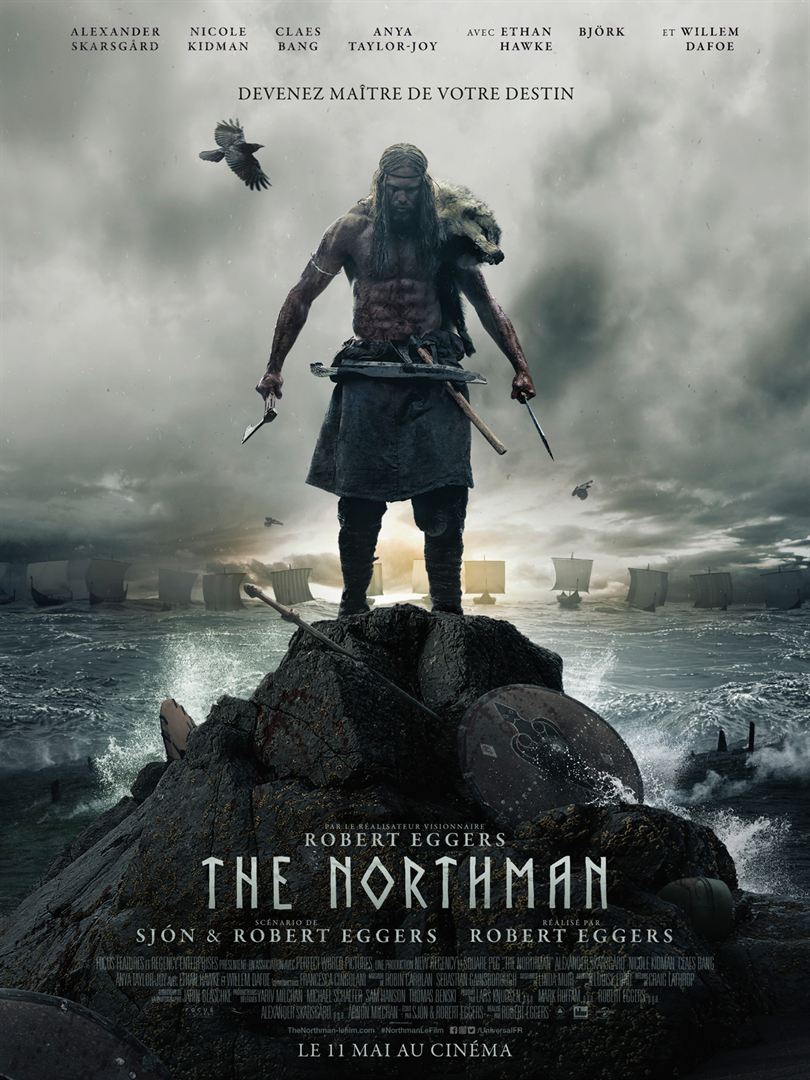
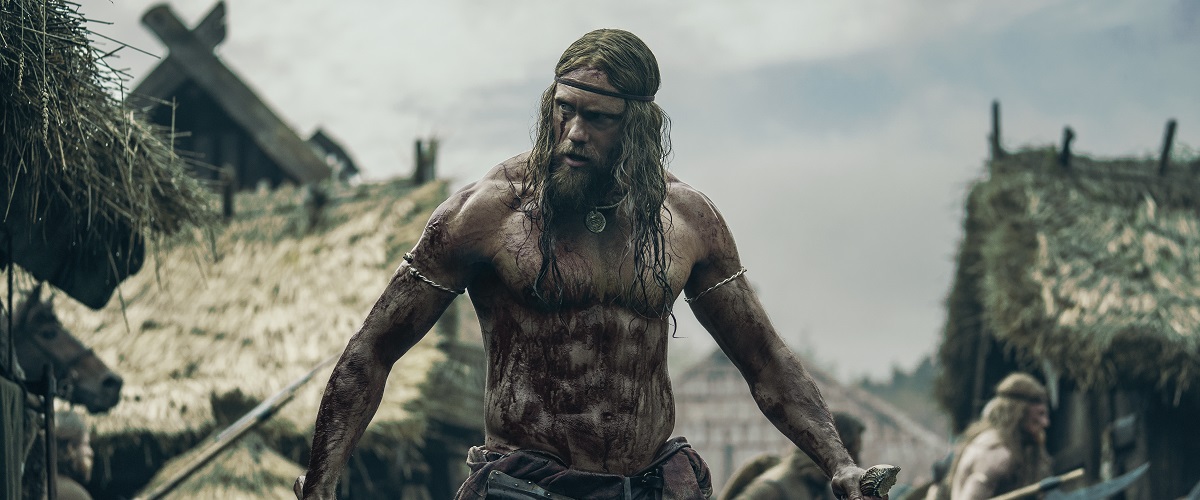
My filmmaking and screenwriting career is more a hobbling hobby these days. Other than not getting on the right career train, or getting lost in the smoke of an overcrowded creative platform, one main reason I may not have succeeded is because I arguably don’t have an original vision. Maybe I am just too generic. One cannot say that about Robert Eggers. This is one truly talented filmmaker. His debut film The Witch (2015) was a low budget folk horror masterpiece which became a sleeper hit at the box office. Set in 1630s New England, it is an authentically designed and brilliantly acted period drama with Anya Taylor Joy standing out. But aside from the historical accuracy of the language, locations and costumes the story was SO slow. I realise The Witch (2015) is an arthouse classic, but I just did not connect with the characters and was bored all the way through. There are some occasional scares, but it’s more a film which draws horror from underlying dread and enigma rather than the classic horror style I prefer.