Tag Archives: Hereditary

Cinema Review: Eddington (2025) – a daring Western satire on COVID-era America, US politics and the poison of social media!

Cinema Review: Eddington (2025)

Directed by Ari Aster

Written by Ari Aster

Produced by: Lars Knudsen, Ari Aster & Ann Ruark

Main Cast: Joaquin Phoenix, Pedro Pascal, Luke Grimes, Deirdre O’Connell, Micheal Ward, Austin Butler and Emma Stone.

Cinematography by Darius Khondji

*** MAY CONTAIN SPOILERS ***
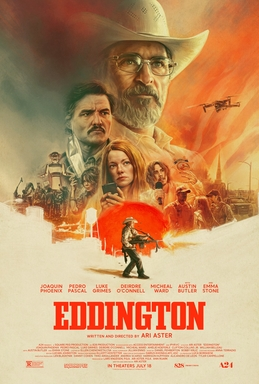


Ari Aster’s first two horror films, Hereditary (2018) and Midsommar (2019) were rightly critically acclaimed and delivered at the box office too. His third film Beau is Afraid (2023) was a flop when compared and in my view not surprising. The film was arguably, depending on your view, a hilarious, risk-taking arthouse tragi-comedy or a self-indulgent act of egregious career self-sabotage. Safe to say I did not enjoy it, so approached the latest A24-produced film of Aster’s, Eddington (2025), with emotional caution.

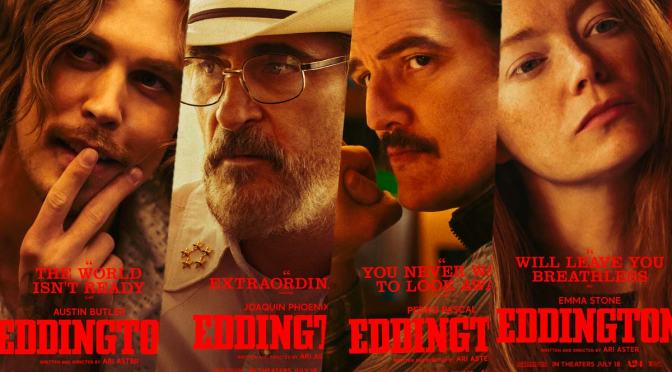
Thankfully Aster’s screenplay, characters and all-round production of Eddington (2025), are far more accessible and focused than his third feature. Pedro Pascal and Joaquin Phoenix anchor Eddington (2025) superbly, as Aster delivers a blistering small-town allegory that uses a public health crisis as the spark for something far larger. What begins with Mayor Ted Garcia (Pascal) dutifully following the Governor’s lockdown orders quickly escalates when Sheriff Joe Cross (Phoenix) refuses to comply and runs for Mayor himself. This casts the town and people into a conflict that mirrors America’s own political division.
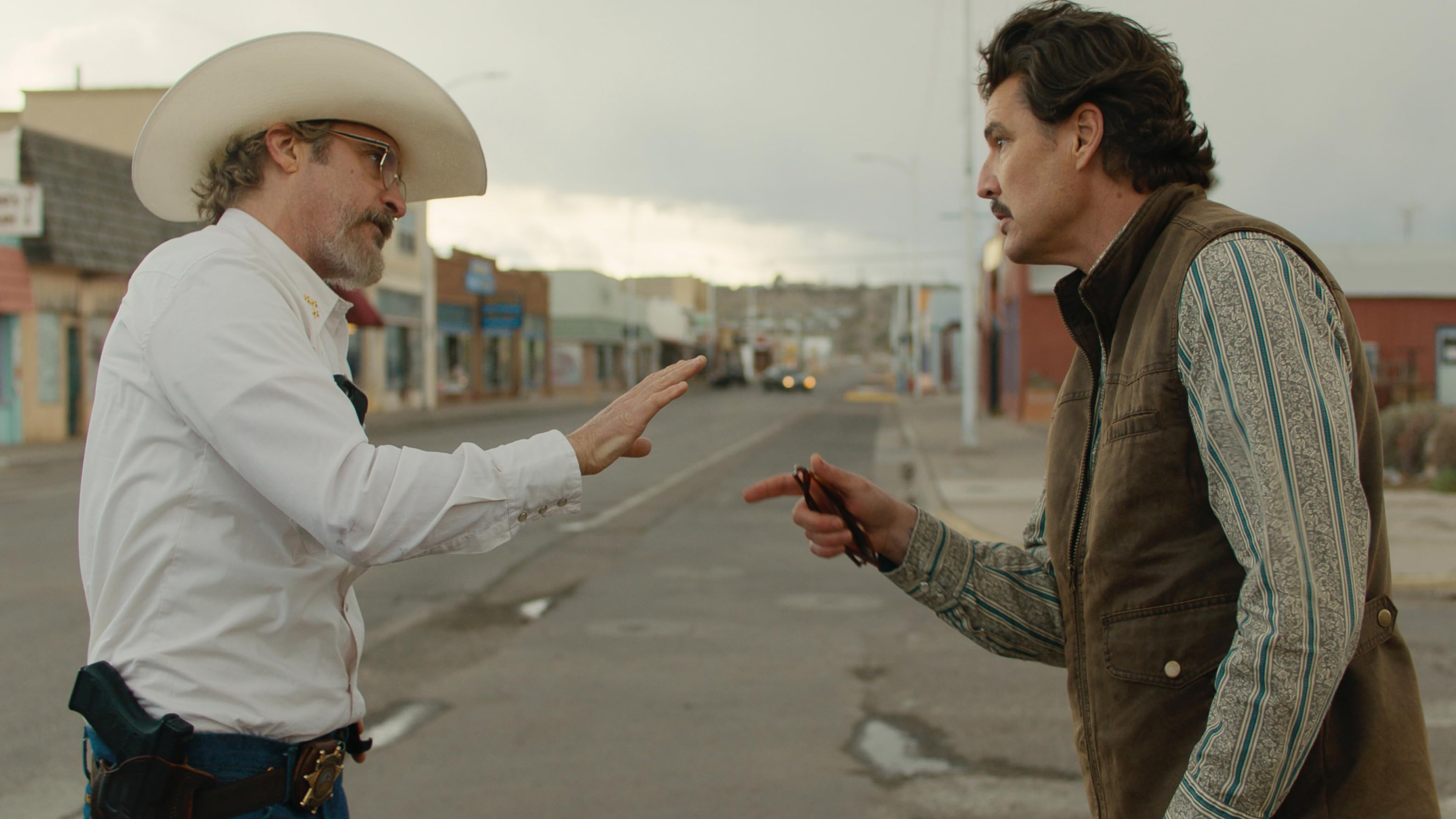


Phoenix brings his trademark intensity to Sheriff Cross, whose defiance feels equal parts principled and unhinged, while Pascal’s Mayor, revealed to be a corporate puppet, balances him as a leader losing grip on his authority. Thus, Eddington (2025) is a powerful film whose strength lies in the performances and a brave, intelligent screenplay which asks many questions. The main issues I had were under-developed character arcs for Emma Stone’s and Austin Butler’s characters. Further, as in previous films Aster relies heavily on left-field plot turns, which go more for shock, rather than understandable character development. Indeed, the final act Western-style shootout, while incredibly exciting, seems out-of-sync with the thoughtful build-up and drama established in the first hour.

Ultimately, Director Ari Aster resists turning Eddington (2025) into just a COVID-era-morality tale; instead, the film confidently threads together a powerful mix of left and right-wing US politics, toxic masculinity, historical sexual abuse, conspiracy and alternative theories, cultish religious fervour, white saviour virtue-signalling, homegrown terrorism, algorithmic influence of social media, and the creeping threat of corporate greed. Each theme and subplot fold back into the central question: who really controls the narrative in modern America or is it a nation spiraling out of control toward inevitable civil war? The result is a tense, unsettling portrait of a town—and a country—at war with itself.
Mark: 8 out of 11


Cinema Review: Bring Her Back (2025) – a powerfully disturbing study of grief, obsession and matriarchal mania!

Cinema Review: Bring Her Back (2025)

Directed by Danny and Michael Philippou

Written by Danny Philippou and Bill Hinzman

Produced by Samantha Jennings, Kristina Ceyton

Cast: Billy Barratt, Sora Wong, Jonah Wren Phillips, Sally Hawkins, Sally-Anne Upton, etc.

Cinematography by Aaron McLisky

*** MAY CONTAIN SPOILERS ***


It’s become something of a cliché to lament the state of theatrical cinema: superhero fatigue, endless sequels, spin-offs and reboots, streaming overflow. Original stories—particularly in multiplexes—feel increasingly rare. Yet one genre has bucked the trend and, against all industry logic, placed original visions front and centre: horror. In an era of IP dominance, horror’s persistence as the great innovator is growing. It thrives on shadows, but in today’s cinema landscape, it’s also the brightest light.

Across the last few years, titles like Barbarian (2022), Pearl (2022), Skinamarink (2022), Nope (2022), Talk to Me (2023), Infinity Pool (2023), When Evil Lurks (2023), Late Night With the Devil (2023), Totally Killer (2023), Heretic (2024), Longlegs (2024), Sinners (2025), and the soon-to-be-reviewed, Weapons (2025) have proved again and again that audiences crave fresh nightmares. Even 28 Years Later (2025), though technically part of an ongoing series, represents a rare franchise event grounded less in brand synergy than in directorial reinvention and raw cultural appetite.

Unlike superhero spectacles or sci-fi epics, horror thrives on modest budgets and audacious ideas. A film like Skinamarink (2022), shot for a reported $15,000, can turn experimental textures into a viral theatrical moment. Personally, I found this film difficult to digest, however, the more commercial, Talk to Me (2023), made for $4.5 million, earned nearly twenty times that worldwide. These aren’t just hits; they’re validations of originality as a business model.


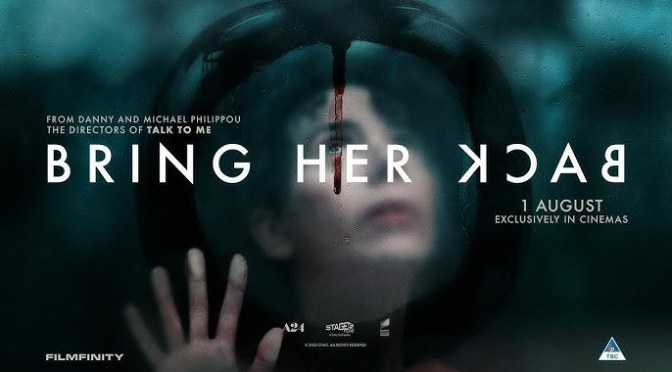
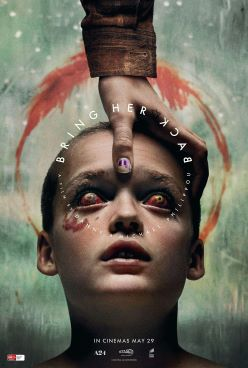
Horror is also a proving ground where young or unexpected filmmakers leap into the cultural spotlight. Zach Cregger (Barbarian (2022) twisted narrative structure into something memorable. The Philippou brothers Talk to Me (2023) translated YouTube viral adrenaline into terrifying cinematic language. But, what of their latest film, Bring Her Back (2025)? Well, for me they have surpassed their debut feature not only in genuinely sickening moments of dread, but also in terms of powerfully emotional horror scenes.

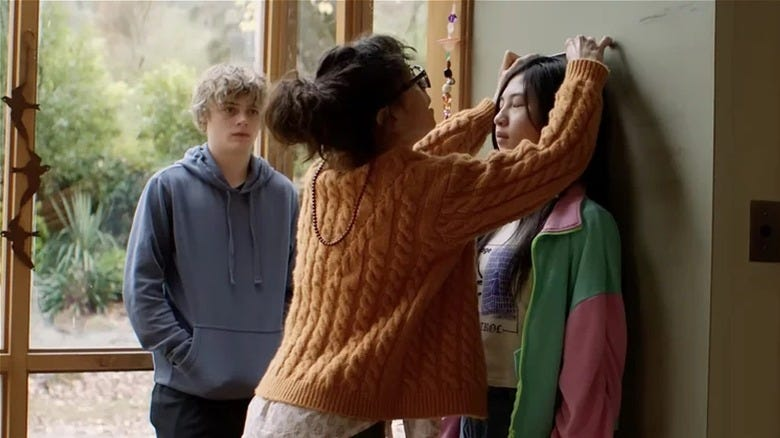
The narrative of Bring Her Back (2025) begins as it means to go on with a rapidly series of unsettling scenes. After discovering their father dead in the shower, 17-year-old Andy (Billy Barratt) and his partially sighted step-sister Piper (Sora Wong) are placed in the care of Laura (Sally Hawkins). Laura is an eccentric former counselor living on the outskirts of town and suffered the loss of her teenage daughter to drowning. In her home, the siblings encounter Oliver (Jonah Wren Phillips), a mute foster boy who seems terrified of the house’s locked outhouse. Andy eventually realizes Laura’s obsessive behaviour is far more threatening than he could imagine and they are all in danger.

Like Toni Collette in Hereditary (2018) and Lupita Nyong’o in Us (2019), Sally Hawkins delivers a powerfully intense performance that pushes horror into the realm of high drama. She carries the film with raw, nerve-shredding vulnerability, shifting from fragile grief to volcanic fury with startling precision. Every gesture—whether a whispered plea or a full-bodied breakdown—feels lived-in and emotionally scalding, grounding the supernatural terror in something painfully human. Also, Billy Barratt and newcomer Sora Wong offer excellent support as the in-peril ‘Hansel and Gretel’ siblings. Barratt is especially good carrying the audience’s fearful perspective.


The Philippou brothers draw on a potent brew of horror traditions—satanic ritual, grief, abduction, parental abandonment, and matriarchal hysteria—to craft Bring Her Back, a haunting and gut-wrenching descent into obsession. The film thrives on its willingness to plunge into emotional extremity, channeling raw pain into sequences of near-operatic dread. Several knife-in-the-teeth jolts of terror punctuate the story, as everyday necessities such as water, food and parental love are twisted into deathly hazards.

While the script occasionally wavers and certain narrative and backstory elements required sharpening, the thematic and emotional core remains undeniable. At its best, Bring Her Back (2025) isn’t just another exercise in occult horror—it’s a powerful study of grieving obsession, of the lengths people will go to fill a void that cannot be healed. The result is a film that lingers, not only for its shocks but for the raw ache that underpins them.

Mark: 9 out of 11


SHUDDER HORROR CLASSIC REVIEW – THE CHANGELING (1980)

SHUDDER HORROR CLASSIC REVIEW – THE CHANGELING (1980)

Directed by: Peter Medak

Produced by: Joel B. Michaels, Garth H. Drabinsky

Screenplay by: William Gray, Diana Maddox

Story by: Russell Hunter

Cast: George C. Scott, Trish Van Devere, Melvyn Douglas, John Colicos, Jean Marsh, Helen Burns, Madeleine Sherwood,

Cinematography: John Coquillon

***MAY CONTAIN SPOILERS***


If, teenagers being stalked and slashed by a crazed non-speaking maniac are your preference, then you probably would not enjoy the classic ghost story, The Changeling (1980). However, if you are rivetted and chilled by expertly crafted cinematic horror, built on a compelling screenplay, excellent performances and fine cinematography, then this is a film for you.

Not to be confused with the kidnapping thriller, Changeling (2008). The Changeling (1980) feels like one of those older films which created the mould for many other contemporary ghost narratives. A few examples include: The Woman in Black (2012), Candyman (1992), the Ring series and more recently, Hereditary (2018). Such films often feature genre tropes like:

  1. Grieving or vulnerable lead protagonist(s).
  2. A vengeful ghost or spirits who were murdered or done wrong when alive.
  3. A creepy house or location which holds a dark secret and becomes a character in it’s own right.
  4. A detective plot structure which finds said protagonist attempting to solve the mystery of the ghost’s past.
  5. Lots of creepy supernatural comings and goings that ultimately lead to the ghost’s redemption or a successfully chilling retribution.

Of course, the model for such conventions lay in the pages of classic literary ghost stories, however, having not seen The Changeling (1980) for over thirty-years, I felt like I was watching a masterpiece of the supernatural film genre. It doesn’t hurt having Oscar winning actor, George C. Scott, subtly playing the lead as grieving John Russell, a musical professor trying to come to terms with the death of his wife and child. Moreover, the mature approach to pacing and direction by Peter Medak slowly builds the terror to a real crescendo. The horror within the plot, involving a murdered child, is ably imbued by the compelling score, elegant editing and John Coquillon’s exquisite camera movement and lighting composition. Ultimately, I enjoy a good slasher film, but give me a classy supernatural tale such as The Changeling (1980) any night of the week.

Mark: 9 out of 11


MIDSOMMAR (2019) – CINEMA REVIEW – AMAZING FILMMAKING LET DOWN BY WEAK STORYTELLING!

MIDSOMMAR (2019) – CINEMA REVIEW

Written and directed by: Ari Aster

Produced by: Lars Knudsen, Patrik Andersson

Cast: Florence Pugh, Jack Reynor, William Jackson Harper, Vilhelm Blomgren, Will Poulter etc.

Music: The Haxen Cloak

Cinematography: Pawel Pogorzelski

**MAY CONTAIN SPOILERS**

Midsommar (2019), is ultra-talented filmmaker Ari Aster’s second feature film. His first Hereditary (2018), was two-thirds domestic horror masterpiece and one-third insane, symbolic, nonsensical and demonic denouement. Both films have a lot in common. Both have communes or cults at the centre led by strong matriarchal figures. Both find seemingly innocent characters suffering from grief being lured to a fateful demise. Both have incredibly rich visual systems full of striking imagery, sudden violence and mythological folklore. Both, especially Midsommar (2019), are overlong, pretentious and indulgent B-movie stories masquerading as art.

I have to say, and I am not coming from simply a mainstream perspective, Ari Aster is a film artist. However, unlike many great film artists he has, in my opinion, not managed to marry his vision with coherent and emotionally powerful storytelling. Midsommar, for example, takes an age to kick its narrative into gear and when it finally gets started it drags and drags and drags. How many long, drifting tracking master shots can you abide? How many drawn-out-so-pleased-with-myself takes do you have the patience for? Well, get a strong coffee because when the story cries out for pace, Aster puts the brakes on, marvelling in his own indulgent genius. I might add that a plethora of characters screaming and crying does not make good drama either, unless there is sufficient context.

The narrative is very simple. In a nutshell, it’s Eli Roth’s Hostel (2005) meets British horror classic The Wicker Man (1973). Florence Pugh, Jack Reynor, William Jackson Harper and Will Poulter are college students who take a summer break to experience a communal pageant in rural Sweden. While they are PHD students they are not particularly intelligent given the choices they make later in the film.

Moreover, aside from Pugh’s grief-stricken Dani, the script doesn’t particularly imbue them with much in the way of empathetic characterisation. Indeed, the film relies on Pugh’s dominant performance to create emotion for our protagonists. Aside from providing some comic relief there is no actual point to Will Poulter’s character at all. Lastly, there is some absolutely terrible dialogue throughout this film too.

As the film crawls along slowly, it’s reliant on the music to inform us we’re meant to be scared. Then when the gore does kick in during a particularly shocking ritual, I was almost falling asleep. Don’t get me wrong the production design is flawless with an amazing setting and incredible concepts from Aster. The death and torture scenes are particularly memorable. However, the overall pace and rhythm of the film is so bloody slow I just did not care about anyone by the end.

I don’t mind methodical films establishing dread and psychological fear, but I think Aster has been watching too many Kubrick films. Aster seems to believe slow equals art. What Kubrick did though was usually to have characters that were engaging. They may not have been likeable, but Kubrick’s characters hit you in the heart and mind. Not since The Blair Witch Project (1999) have I wanted such dumb characters (Pugh aside) to die so painfully in a horror film. Likewise, the characters in the Swedish commune are mere ciphers of Aster’s fantasy horror and two-dimensional at best.

Visually stunning Midsommar (2019), will no doubt impress critics and other reviewers. However, at nearly two-and-a-half hours it’s an indulgent-arty-collage-of-film-masquerading-as-therapy. The ending was so loopy that the audience I was with were laughing at how ridiculous it was. Perhaps that was the filmmakers’ aim, but I’m not so sure. Yes, I get that this is meant to be allegorical and symbolic about grief and guilt and religion and a relationship break-up and fate and cultural differences. Furthermore, I get the intellectual depth of the themes on show, but Aster tortures the audience as much as his characters. Mostly, it just doesn’t take so long to tell this kind of derivative narrative, however beautiful and artistic the film is presented.

Mark: 6 out of 11

HEREDITARY (2018) – CINEMA REVIEW

HEREDITARY (2018) – CINEMA REVIEW

Directed by: Ari Aster

Produced by: Kevin Frakes, Ridley Scott, Buddy Patrick

Written by: Ari Aster

Starring: Toni Collette, Alex Wolff, Milly Shapiro, Ann Dowd, Gabriel Byrne

Music by: Colin Stetson

Cinematography: Pawel Pogorzelski

**MAY CONTAIN SPOILERS**

hereditary-trailer_0

I’m tempted to do two reviews of this movie. Because there’s a minority part of me that feels its bravura and beautifully crafted horror film; but the majority part just could not get over the illogical and surreal elements which unhinge the carefully plotted family tragedy it promised to be. Nonetheless, the writer and director Ari Aster is clearly an ultra-talented filmmaker who deserves much praise for creating a series of impressively creepy scenes throughout. Still, he does throw a lot of ideas at the wall hoping they stick so many critics will probably love Hereditary, unfortunately it lost me some way through due to a major plot and tonal turn which, while foreshadowed, did not really make any emotional sense.

Hereditary-trailer_1

The story begins with the Graham family mourning the death of Annie Graham’s (Toni Collette) mother. From beginning to the end Collette’s portrayal is absolutely incredible and she deserves any awards that are coming to her. Indeed, Collette anchors the film with moving and incredibly dramatic performance. Her character is very empathetic suffering tragedy after tragedy and attempting to come to terms with the devastation life brings.  She is ably supported by Gabriel Byrne as her husband; while Alex Wolff and Milly Shapiro offer excellent support as their troubled kids. Shapiro especially is well cast as the unstable teenage girl who may or may not have some darker force within her.

The film begins slowly and creeps along for forty minutes or so building dread and atmosphere. Collette has some fine speeches about grief and family relationships and this is where the writing is very strong. These scenes showcase Collette’s acting ability before the action takes a vicious twist with one grandstanding horror moment half-way through. This is where, in my view, the film suddenly started to become lop-sided and full of debateable plot-holes. Don’t get me wrong, if you read the film as a supernatural fantasy full of surreal and dream logic like the cinema of Luis Bunuel and David Lynch, you can swallow much of what happens in the final act.  Moreover, symbolically and thematically Hereditary is very strong with issues relating to grief and dysfunctional family relationship very well explored. However, due to a ridiculous final act where the film moves away from this my empathy for the family was lost in a number of wildly over-the-top scenes, which while scary, made little sense in my humble opinion.

Hereditary-Trailer

Hereditary (2018) is a “Mother” of a horror film!!  Indeed, it has much in common with last year’s divisive work of cinema directed by Darren Aronofsky called Mother (2017). Like Mother (2017) it is a brilliantly directed horror story with great acting throughout, that alas, falls apart at the end with narrative illogic, plot-holes and a laughable denouement. It’s a shame because the first half of Hereditary is beautifully set up. The visual style involving miniatures, shadows, weird dolls’ head and bird decapitations is creepy and very impressive. However, the filmmaker’s fantastic work is destabilised by a narrative desire to twist the film into something pretty crazy. Yet, Ari Aster deserves much praise for taking risks in the horror genre and his and Collette’s craft are of the highest order; at least until the ending.

(Mark 7.5 out of 11)