
Classic Film Review: The Master (2012)
Directed by Paul Thomas Anderson
Written by Paul Thomas Anderson
Produced by: JoAnne Sellar, Daniel Lupi, Paul Thomas Anderson, Megan Ellison etc.
Main cast: Joaquin Phoenix, Philip Seymour Hoffman, Amy Adams, Laura Dern, Jesse Plemons, Ambyr Childers, Rami Malek, etc.
Cinematography by Mihai Mălaimare Jr.
*** MAY CONTAIN SPOILERS ***
Of late, I have been watching, as research to develop a feature film concerned with religion, faith and complex human behaviour, many religious themed films. Indeed, I especially love films and documentaries about cults. Especially where religion is used to control human beings and make them do crazy things. What possesses another person to want to control others? Power, lust, greed or all of the above?
Cult leaders are often extremely charismatic and talented people too. Further, they can be dangerous people who use their influence to make money, commit crime, manipulate and abuse others. Thus from a human and dramatic perspective, cults and religious characters are always fascinating to write about.
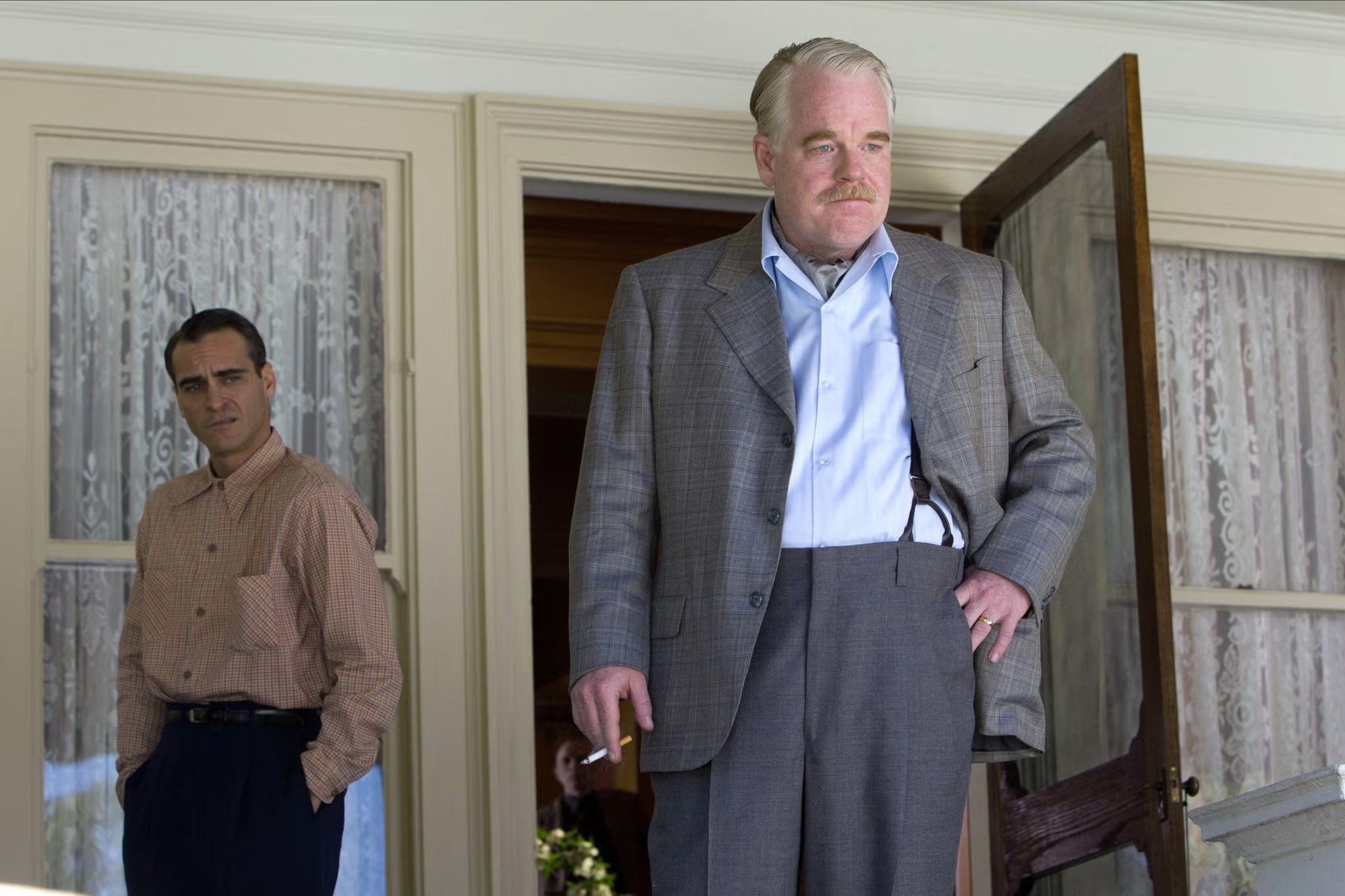
In Paul Thomas Anderson’s The Master (2012), he explores the relationship between a lost soul drawn to a movement that may or may not be a reflection of Scientology. Freddie Quell (Joaquin Phoenix), a World War II veteran is pulled toward Lancaster Dodd (Philip Seymour Hoffman), a commanding leader of a cult known as “The Cause”. But, arguably, not much happens other than Quell having a series of breakdowns amidst post-traumatic stress and alcoholism, before taking his chaos and violence into Dodd’s church and family. Anderson is one of the great humanist and existential filmmakers working today, but The Master (2012), having watched it at least twice, I found it too impenetrable and alienating for me.
Yet, in my filmic research I have watched The Master (2012) a third time and have now identified a number of reasons why I have not connected with the film. They are both structural and thematic. My expectations were that this film would be a deep historical dive into the establishing of L. Ron Hubbard’s creation of Scientology. Albeit, it would be a veiled one to avoid the ire of the Scientologist organisation, who are known to attack people or companies that critique their ways. So, I am complicit there because ultimately one should not judge a work before watching it. Anderson’s choices and approach are way more personal than a traditional biopic and I should not be so arrogant to expect him to make a film just for me.
So, with my expectations on an in-depth analysis of the cult of Scientology quelled, structurally The Master (2012) further jars with me on a story level. Such narrative cracks appear all through the overall character arc of character Freddie Quell. If the film, as the first act establishes well, effectively delivered a character study of a sex-addicted, alcoholic, PTSD suffering, angry World War 2 veteran struggling to cope with existence, I could certainly have been compelled by that. Ultimately, The Master (2012) is a dramatic two-hander facing Quell’s out-of-control, human car-crash versus Lancaster’s intelligent and controlling patriarch. Anderson also once again, as he did in Hard Eight (1996), Boogie Nights (1997), and There Will Be Blood (2007), explores the father-son power dynamic between these two characters.
Yet, introducing Lancaster and “The Cause” to Quell’s character development has little or no effect on him. I understand Anderson may be saying Quell is a lost soul, but what emotional impact or feeling can the audience to take from this? Quell finishes the film relatively unchanged by Lancaster’s auditing, “spiritual” advice and fatherly tutelage. Yes, in real life, people often don’t change and behave the same throughout their lives committed to the same self-destructive behaviour. However, I felt that if Quell could not change for the better perhaps he could have gone even deeper into despair within his religious experience.
To conclude: Paul Thomas Anderson’s The Master (2012) is, on a purely cinematic level, close to technically perfect. It contains some of the finest acting ever committed to screen, particularly from Philip Seymour Hoffman as Lancaster Dodd. Hoffman manages to make Dodd charismatic, ridiculous, paternal, threatening and strangely vulnerable, often within the same scene. His performance is matched by Joaquin Phoenix’s extraordinary physical transformation as Freddie Quell, but it is Hoffman who fascinates me most: the booming confidence of the public performer repeatedly giving way to flashes of insecurity, anger and desperation whenever his authority is challenged.
Technically, the film is equally remarkable. Mihai Mălaimare Jr.’s 65mm cinematography gives the images an extraordinary richness and clarity, while the colours, period detail, compositions and use of light make virtually every frame feel meticulously constructed. There are moments when The Master (2012) is simply one of the most beautiful American films of the twenty-first century. And yet, for all that mastery, I have never enjoyed the film as much as its critical reputation suggests I should.
Its central problem for me is the almost broken-backed, water-and-oil combination of Freddie Quell’s under-nourished emotional journey and the film’s tantalising but ultimately limited exploration of Dodd’s movement, “The Cause”. The parallels with Scientology are obvious and fascinating, yet Anderson seems reluctant to investigate the psychology, mechanics and seductive power of cults with the depth the material promises. Instead, the film repeatedly retreats towards the relationship between Freddie and Dodd — a relationship performed magnificently but one in which Freddie’s emotional development can feel frustratingly elusive.

