FILMS THAT GOT AWAY #16: OFFICIAL COMPETITION (2021)
Directed by Gastón Duprat and Mariano Cohn
Written by: Mariano Cohn, Andrés Duprat and Gastón Duprat
Produced by: Jaume Roures
Main cast: Penélope Cruz, Antonio Banderas, Oscar Martínez, José Luis Gómez, Irene Escolar, Manolo Solo, Nagore Aranburu, Pilar Castro Koldo Olabarri, etc.
Cinematography Arnau Valls Colomer
**MAY CONTAIN SPOILERS**
It’s no surprise there are an abundance of films about the actual process of filmmaking. The film industry is full of rich possibilities in terms of drama, action, tragedy, romance and comedy. Moreover, cinema down the years is replete with imaginative, tough, evil, spoilt, egotistical, eccentric, pretentious and frankly insane individuals working in the film industry. 8 1/2 (1963),Dolemite is My Name (2019), Shadow of the Vampire (2000), Sullivan’s Travels (1941), Barton Fink (1991), State and Main (2000), Once Upon A Time In Hollywood (2019), Hugo (2011), Living In Oblivion (1995), Boogie Nights (1997), The Disaster Artist (2017), Ed Wood (1994), The Player (1992), and Tropic Thunder (2008) are just a few brilliant films about filmmaking. Now you can add the hilarious Argentinian-Spanish co-production, Official Competition (2021) to that list.
With stunningly funny performances from Penelope Cruz, Antonio Banderas and Oscar Martinez, Official Competition (2021), centres on a film-within-a-film production, as Cruz’s ostentatious director, Lola Cuevas, helms a billionaire-backed-big-budget adaptation of a critically acclaimed book. Banderas is Felix Rivero, a famous movie star, while Martinez is a method-driven actor, and with the wildly unpredictable Cuevas between them, a rivalry soon develops between their different acting styles and personalities. As the production progresses any respect they had evaporates and descends into hilarious acrimony amidst a series of expertly staged comedic set-pieces.
I find it incredibly irritating that so many films get critical praise and win awards and you watch them and, while technically brilliant, they are ultimately boring and pretentious. Then we get Official Competition (2021), with a perpetually inventive screenplay by Mariano Cohn, Andrés Duprat and Gastón Duprat, that has not received nearly enough critical praise or awards. In fact, it mocks those artistically inflated directors and actors whom often get over-praised by fawning film critics and journalists. So, if you love films about filmmaking and funny ones at that, please do check this film out streaming on Netflix. It is certainly a cut above the pretentious films, actors and directors it is cleverly satirising.
Based on: Killers of the Flower Moon by David Grann
Produced by: Dan Friedkin, Bradley Thomas, Martin Scorsese and Daniel Lupi
Main cast: Leonardo DiCaprio, Robert De Niro, Lily Gladstone, Jesse Plemons, John Lithgow, Tantoo Cardinal, Scott Shephard, etc.
Cinematography: Rodrigo Prieto
Edited by: Thelma Schoonmaker
*** MAY CONTAIN SPOILERS ***
Who can tell how the world and society as we know it would’ve evolved if Christopher Columbus, the explorer credited with finding the Americas in 1492, had not landed and begun the first steps toward colonising this uncharted part of Earth. Of course, there were existing natives in the Americas and over time they would experience first contact with Spanish, Portuguese, British and other European, predominantly white, settlers. It may be that the natives would have had equally difficult experiences, and colonists brought with them many positive things. But one has to surmise they would not have had their land and lives gradually taken from them over the centuries without the European invasion.
The violent theft of land and wealth from Native Americans forms the bedrock of the narrative of Martin Scorsese’s latest epic drama, Killers of the Flower Moon (2023). Adapted from David Grann’s critically acclaimed nonfiction book, the film centres on the series of murders of wealthy Osage people that occurred in Oklahoma in the early 1920s. The motive for the heinous culling was the greed of white men. Such individuals lusted after the richness present after big oil deposits were discovered beneath the Osage people’s land. Whereas Grann’s book is a monumental study of the murders, perpetrators, the Osage culture, politics of the era, and how the newly formed FBI delved into the crimes, Scorsese’s incredibly slow and long adaptation does all that, while also exploring the romance and murderous treachery between Osage native, Mollie (Lily Gladstone) and war veteran, Ernest Burkhart (Leonardo DiCaprio).
Opening by establishing how the oil erupted and blackened the green land, the film then firmly sets up how the American businessmen used the legality of the headright system to manipulate the flow of sudden wealth that came to the Osage people. One such man is William King Hale (Robert DeNiro) who presents himself as a benefactor to the Osage, but truly speaks with a forked tongue. Having left the infantry unit after World War One, Hale’s nephew Ernest joins him to work and ultimately do his bidding. Hale cajoles Ernest to romance wealthy Mollie and get further feet under the table and closer to that beloved black gold money. Yet, enough is never enough for the likes of Hale and driven by another formidable Scorsese directed performance, De Niro delivers a deviously evil characterisation.
DiCaprio here takes the less charismatic role as the doltish Ernest. As Hale urges him to do further misdeeds the banality of everyday evil is palpable in Ernest’s actions. Along with a litany of professional and thuggish cowboy types Ernest and Hale’s other minions wreak havoc on the Osage people, committing arson, murder, poisonings, robbery, and shootings. All just for more money. The tragedy is that Ernest clearly has feelings for Mollie, serenely portrayed by a revelatory Lily Gladstone, but he just cannot stand up for himself against his wicked uncle. So much so that I just wondered why the hefty runtime was concentrating on Ernest’s character. I mean, Scorsese and DiCaprio give us little in the way of anti-heroism to bounce off, or even some cathartic sense of redemption. Ernest starts out as a loser and finished the story the same. Over three hours spent with a gurning idiot left me frustrated.
Directed, as one would expect with a masterful hand, mind and eye by Scorsese, who once again surrounds himself with an incredibly talented cast and production crew. Not to forget the unbelievable $200 million budget. But Scorsese’s movement of late to ultra-long and methodical cinema is an artistic choice that requires much patience. While Killers of the Flower Moon (2023 is thematically very powerful, beautifully filmed, and contains a number of exceptionally impressive sequences, there was genuinely not enough story to justify such a long running time. Whereas The Irishman (2019) was slow, it was methodically thrilling and absorbing throughout. Killers of the Flower Moon (2023) on the other hand becomes repetitive in its reveals of greedy Cowboys breaking bad and raising hell to the cost of the Osage. The introduction of the FBI and their subsequent investigation comes way too late to save the over-bloated length and pace. However, there is no doubt, the film remains vital in highlighting the historial horror perpetrated upon the Osage land and people. Perhaps Apple TV should have just given the money to the Osage descendants as reparation?
Produced by: Gareth Edwards, Kiri Hart, Jim Spencer, Arnon Milchan
Main Cast: John David Washington, Madeleine Yuna Voyles, Gemma Chan, Ken Watanabe, Sturgill Simpson, Allison Janney, Ralph Ineson and Marc Menchaca.
Cinematography: Greig Fraser and Oren Soffer
*** MAY CONTAIN SPOILERS ***
The Creator (2023) is Gareth Edwards first directorial release since the tremendous Star Wars prequel Rogue One (2016). Of all the Disney-funded Star Wars products that remains my favourite. Overall, Rogue One (2016) is not just a great Star Wars film but a brilliant movie too, as it transcended the franchise while delivering a pulsating, heroic, nostalgic and emotional film experience. It also had an influence on the stunning visual look, action, and effects of The Creator (2023) too. So much so, The Creator (2023), in terms of style, often felt like a Star Wars film in all but name.
With The Creator (2023), Gareth Edwards and his talented production and effects team have invented a continually innovative futuristic look based around Artificially Intelligent robots and technologically modified humans. Indeed, based on all his directorial works, jaw-dropping visuals and themes of humans overcoming machines and monsters are always very much to the fore. But in The Creator (2023) one of the major themes poses the question – who are the real monsters? The humans or their computerised creations? As the narrative begins, in 2055, with the machines detonating a nuclear attack on Los Angeles the Americans declare war on the robots. More specifically, Southeast Asia, who still utilise A: I technology. Fast forward several years and John David Washington’s Joshua, remains part of the U.S. military plans, as they attempt to finish off the A: I threat for once and for all.
As Joshua is manipulated by the US Government, through a past romantic connection with Gemma Chan’s Maya, he is dropped behind “enemy” lines in Asia to destroy the A: I’s secret weapon called, “Alpha-O.” Along, with a paper-thin characterised group of U.S soldiers, Joshua finds the mission going south and ultimately goes on the run with “Alpha-O.” Edwards and his writers humanize the dangerous processor by giving it the body of a young girl portrayed by Madeleine Yuna Voyles. Despite the powerful visuals of the film, I found The Creator (2023) buckling under the wright of over-used ideas from other films. The cute “genius” kid being just one of those.
It’s The Terminator (1984) meetsArtificial: Intelligence (2001) meets Avatar (2009) meets any number of action-hero-saves-young-child narratives. I mean can at least one film TRY and make the American warmongers more nuanced? Yes, the action, cinematography and sound design are especially impressive and thrilling and there is certain emotion on screen. However, I personally did not feel much emotion in my heart, unfortunately. Watch it on the biggest screen you can, because what The Creator (2023) lacks in original narrative and character elements, it more than makes up in nifty robotic concepts and visual cinematic grandeur.
Without planning it I watched a number of Burt Lancaster films over the last few months. It gave me a chance to reflect and re-evaluate this giant of the screen. I say “giant” because not only was Burt Stephen Lancaster physically a big guy, he also had a giant of an acting career. One which spanned fifty years in the business.
From his memorable first screen appearance in noir-classic The Killers (1946) to final performance in Field of Dreams (1989) he appeared in seventy films, as well as many television roles. Lancaster was a formidable actor, film star, producer and political activist. His fierce personality, intelligence and passion often explodes on the screen in so many classic films. But he was also capable of quiet and subtle power too. In keeping with the rules of the ‘My Cinematic Romance’ remit, here are just five of those said memorable acting performances.
** CONTAINS FILM SPOILERS **
SWEET SMELL OF SUCCESS (1957)
While this is not based around actual gangsters or career criminals you won’t find a bleaker or more cynical film noir. Morals are in short supply as Tony Curtis’ pushy press agent attempts to work his way up the greasy media pole in New York. His and many a character’s nemesis is Lancaster’s media kingpin, J.J. Hunsecker, who can make or break a career with the click of a finger. Hunsecker’s unhealthy obsession with his sister drives the downfall of all the characters where no one gets what they want. Lancaster is never afraid to play a flawed and complex personality. Razor-sharp dialogue and James Wong Howe’s stark photography, allied with Lancaster’s dominant presence, the Sweet Smell of Success (1957) is a striking morality tale warning of the perils of greed, fame and ambition.
ELMER GANTRY (1960)
Wow! I’d never seen this incendiary film adaptation of the Sinclair Lewis’s 1927 novel. Starring Lancaster, Jean Simmons, Arthur Kennedy, Shirley Jones and Patti Page, Lancaster is electric as the eponymous anti-hero. Gantry is a travelling salesmen-turned evangelist, who is down-on-his knees when he sees a golden opportunity to sell God instead of vacuum cleaners. Jean Simmons has never been better, but Lancaster delivers a devilishly complex characterisation of a man seeking wealth, sex, and adulation but without true belief. His firebrand sermons are powerful but without substance, and Gantry soon realises he cannot escape the emptiness of his soul. He preaches God without soul in a scathing damnation of organised religion set during the depression. Lancaster unsurprisingly won an Academy award for best actor in a risky role and intelligent film that rarely gets made these days.
BIRDMAN OF ALCATRAZ (1962)
I recall watching Birdman of Alcatraz (1962) when a teenager with my dad and being entranced by Burt Lancaster’s thoughtful, yet powerful performance of dangerous prisoner, turned ornithologist, Robert Stroud. Off-screen Lancaster rallied against the death penalty and argued for rehabilitation over eye-for-an-eye punishment. Thus, this story of a complex, rebellious personality who attempted personal absolution via education certainly would have had creative and thematic merit in Lancaster’s mind. From research the actual Robert Stroud was reported to be a brutal psychopath and beyond redemption. Yet, it’s a noteworthy film and stirring performance from Lancaster about a human paradox. Indeed, when did Hollywood ever let the truth get in the way of a great story. What is the truth anyway?
THE SWIMMER (1968)
Well, this was something of a surprise. I had never watched this adaptation of John Cheever’s short story, The Swimmer (1968) until I recorded it on Talking Pictures TV last month. At fifty-five, Lancaster is in incredible shape as middle-class American alpha-male, and seemingly popular, Ned Merrill. He decides one day he can “swim” across a series of Connecticut pools and back home to his wife and children. It’s certainly an original premise and peculiar take on the road movie subgenre. Merrill’s journey is peppered with both friendly and unenthusiastic meetings with his neighbours, friends and former lovers. Although it soon becomes apparent that something, despite his carefree confidence, isn’t quite right with Merrill. A progenitor to John Hamm’s Don Draper, Merrill is such a nuanced iceberg of a soul; charismatic yet with dubious ‘of-the-era’ morals. I think this could be Lancaster’s finest performance in a truly memorable masculinity-in-crisis cult character study. It’s an odd film, but worth staying with until the incredible ending.
ATLANTIC CITY (1980)
As he aged, Lancaster’s continued working with abandon. He wasn’t averse to taking a paycheck in B-movies such as The Cassandra Crossing (1977) andThe Island of Dr Moreau (1979), but he also struck critical gold in Louis Malle’s romantic crime drama, Atlantic City (1980). Both Lancaster and Susan Sarandon are impressive. They have an intense chemistry in this ‘May to December’ love story, as two characters thrown together amidst the malfeasant underbelly of the gambler and gangster strewn ocean city. It’s a morally ambiguous, powerful and complex story of two characters fighting their way out of a dangerous place. Again, Lancaster proved he wasn’t fearful of taking risky roles, even in the latter stages of his career. Atlantic City (1980) would deservedly receive several Oscar nominations, including Lancaster for Best Actor.
Life and work have been extremely positive and busy of late, but I have still found time to watch a number of films during September. Here are some quick reviews of just a few of the ones I have seen.
** MAY CONTAIN SPOILERS **
65 (2023)
How could a sci-fi-creature film with Adam Driver battling dinosaurs sixty-five million years ago be so uninspired? This probably would have been amazing with Arnold Schwarzenegger in the lead and John McTiernan directing in the nineties, but the limp father-daughter narrative propellent and severe lack of dinosaur carnage left me feeling disappointed.
Mark: 5 out of 11
CINEMA REVIEW: A HAUNTING IN VENICE (2023)
I love Agatha Christie and I love Poirot. The recent renditions from Kenneth Branagh have been mixed. Murder on the Orient Express (2017) was fantastic, especially for a very familiar murder mystery, while Death on the Nile (2022)was overcooked with a number of miscasts. A Haunting in Venice (2023) is a return to form and a real Halloween treat. The murder mystery isn’t the most interesting part as the plot points, apart from one decent twist, are mostly obvious. But the spooky lighting, eerie sound, imaginative use of lenses and camera angles, plus the claustrophobic and spooky atmosphere created within the Venetian palazzo are extremely impressive. I actually wanted more supernatural scares. The cast are great, although Tina Fey was glamorously miscast as the author, Ariadne Oliver. The ITV/David Suchet version was more faithful and had a better story, but I really enjoyed this excellent piece of comfort cinema.
Mark: 8 out of 11
APPLE TV REVIEW: CAUSEWAY (2022)
Jennifer Lawrence produces and stars as a U.S. soldier/engineer blown up in Afghanistan who, while suffering from PTSD, struggles to get her life back together in New Orleans. A lower-budget and lower key drama that clearly gave Lawrence a change of pace from the blockbusters she has been starring in for years. Causeway (2022) reminded me how great an actress Lawrence is and also, how brilliant Bryan Tyree Henry is. But the character study meanders with a lack of narrative drive, clarity and dynamism Lawrence showed inSilver Linings Playbook (2012). Indeed, while a worthy advocate for a soldier’s suffering, there wasn’t muchJoy (2015) to be found here.
Mark: 6.5 out of 11
SKY CINEMA REVIEW: DUNGEONS AND DRAGONS: HONOR AMONGST THIEVES (2023)
I missed this at the cinema as I was probably washing my hair at the time; what there is of it. However, this latest uber-budgeted attempt to breathe life into the table-top-dice-throwing Dungeons and Dragons game is actually really entertaining. Chris Pine, Michelle Rodriguez and Hugh Grant lead the energetic cast in a series of fantastically funny and frenetic action set-pieces involving magic, monsters, wizards, castles, stolen booty and of course, dragons. Pine and Grant are always very watchable, but Michelle Rodriguez steals the film with smashing physicality and deadpan humour as the barbarian, Holga Kilgore. The script has many fine gags throughout, as the likeable characters and pacey heist plot rip along wonderfully. You cannot go wrong with a ragtag group of outsiders finding community while fighting against a pernicious foe. Well, actually you can. But, Dungeons & Dragons: Honor Among Thieves (2023) does not!
Mark: 8 out of 11
DISNEY+ REVIEW: NO ONE WILL SAVE YOU (2023)
Kaitlyn Dever’s Brynn exists in a town where no one seems to speak to her or each other. But suddenly the place is overrun with aliens and Brynn must fight for her life while still not uttering a word. Hmmmm. . . in between the no dialogue cinematic contrivance becoming a bit of a bore, Brian Duffield’s excellent B-movie has some terrific action and a committed lead performance from the sensational Kaitlyn Dever. Since her breakthrough appearance in Short Term 12 (2013), she has gone from strength-to-strength as a performer. As a work of pure suspense cinema the film works mostly because of a weaponised Dever, the dynamic camerawork and the cracking sound and editing. However, the story has a number of holes, especially toward the end, which is frankly ridiculous. But Brian Duffield is a very talented writer and director and it is great that he strived for some formal originality in a familiar genre. Even though there was (yes I know it raises the tension) no organic narrative reason for the lack of speech throughout.
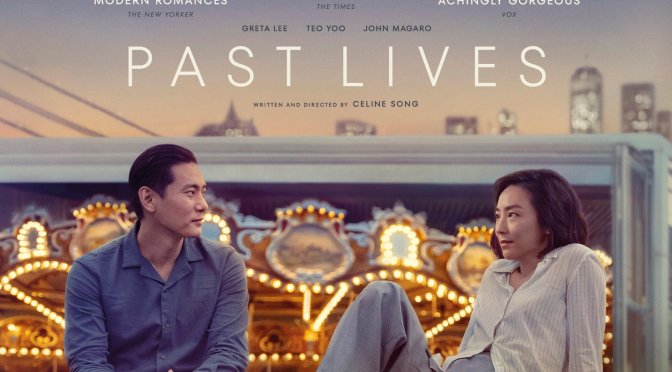
Produced by: David Hinojosa, Christine Vachon and Pamela Koffler, etc.
Main cast: Greta Lee, Teo Yoo, John Magaro, Ji Hye Yoon, Choi Won-young, etc.
Cinematography: Shabier Kirchner
Edited by: Keith Fraas
*** MAY CONTAIN SPOILERS ***
“It’s an in-yeon if two strangers even walk past each other in the street and their clothes accidentally brush, because it means there must have been something between them in their past lives. If two people get married, they say it’s because there have been 8,000 layers of in-yeon over 8,000 lifetimes.” – Nora fromPast Lives (2023)
Are we fated to connect with the ones we love through each life we lead? Is love a connecting force for good which enriches and links us to our forever soulmate? Or is it a complex chemical reaction driven by three chemicals in the brain such as noradrenaline that stimulates adrenaline production, dopamine, and phenylethylamine. Be it spiritual or chemical, love drives many of the highs of our lives, but it is also responsible for disappointing lows. Safe to say that love and romance are also a staple for many emotionally charged and beautiful works of cinema, of which Celine Song’sPast Lives (2023) is certainly one of them.
Past Lives (2023) is a love story which transports the audience across time and continents through the spiritual and spatial connection of characters, Na Young (Greta Lee) and Hae Sung (Teo Yoo). The opening act establishes the relationship of the two as schoolfriends in Seoul. Alas, any potential fledgling romance for the teenagers is blocked as Na Young’s family moves to Canada, leaving Hae Sung’s alone with his future unknown. The film then moves twelve years forward where Na Young, now known as Nora, lives in New York. Through a chance quirk of social media fate, she reconnects with Hae Sung. Is that adolescent spark still there?
In the second act, Song’s elegantly devised screenplay explores and Nora Hae Sung’s long distance relationship over several heartfelt online calls. But complex emotional circumstances dictate the two cannot reconcile the friendship further. The two drift apart and they take other partners as another twelve years pass. With Nora in a strong relationship with the sensitive and kindly, Arthur (John Magaro), it would appear Nora and Hae Sung’s friendship is at an end. Or is it? Because Song delivers one of the most powerfully moving third acts I have seen at the cinema in some years.
Without explosions, or car chases, or superheroes or fast-paced cutting or extraordinary heroes defeating powerful foes, Past Lives (2023), is one of the most impactful and stirring films of this year. Celine Song achieves this with a delicate hand in the writing and direction, plus a purposeful naturalistic cinematographic palette delivered by Shabier Kirchner. Above all else Song creates two honest characters who you root for from the start, as the one feels the romantic electricity build on the screen. Indeed, Greta Lee and Teo Yoo’s on-screen chemistry is an acting masterclass, with John Magaro further providing touching support within the triangle.
Now, I am not without sensitivity, but it’s virtually impossible to make me cry at the cinema. But Past Lives (2023) almost did. It made my heart swell and ache. It made me laugh as well, because Song’s script has lovely humour throughout. Above all else, whether it is karma or chemicals, it made me grateful to have known love.
Cast: Sophie Wilde, Alexandra Jensen, Joe Bird, Otis Dhanji, Miranda Otto, Zoe Terakes, Chris Alosio, Marcus Johnson, Alexandria Steffensen, etc.
Cinematography: Aaron McLisky
*** MAY CONTAIN SPOILERS ***
A cold paw of death, stiff fingers, rotting black nails, gripped by a living hand and opening a portal, a link to the other side to make contact with lost spirits. What does the hand represent or symbolise in terms of contemporary subtext? Is it mobile phones? Or social media? Or is it just a creepy device with which to layer chills and suspense and scare teenagers on a Friday night at the cinema. Does a horror film have to have a deeper meaning as long as it scares us?
Saw (2004), Paranormal Activity (2007), The Blair Witch Project (1999), Night of the Living Dead (1968) and most recently, Get Out (2017), are low budget horror films which became breakout box office hits. Similarly, to Peele’s debut chiller, Talk To Me (2022), is at the higher echelon of “low” budget cinema costing circa $4 million to produce. Yet, it has given A24 its biggest hit to date thanks to a nifty premise, impressive young cast, and compelling direction from yet another filmmaking sibling duo in Danny and Michael Philippou.
The film takes the phrase “talk to the hand” literally as a bunch of dopey Aussie teens play party games for kicks by connecting with the afterlife through a disembodied hand. Before you can say, “Candyman, Candyman, Candyman!” the ghost has decided they don’t want to return home and chooses to remain with the living. I hate it when that happens! Cue all sorts of creepy and unsettling shenanigans.
The emotional core of this overfamiliar ghoulish tale is represented in the grieving teen angst of Sophie Wilde’s Mia. In attempting to overcome the recent passing of her mother, Mia leaves herself open to the torment of the nefarious spirits. So, once she has shook the dead hand at a party she is suddenly connected with her dead mother’s spirit. Or is she cursed by something altogether more evil. What do you think?
For all the over-used tropes within Talk to Me (2022) is a very suspenseful and scary film. While Wilde’s acting is slightly overwrought, her character is the least irritating of the dumb teenage protagonists not thinking through the consequence of their actions. Thematically it is quite strong as it explores the nature of grief and how it impact one’s mental health. My one main criticism of the production was Aaron McLisky’s cinematography was too dark, even for a horror film. Nonetheless, the hand itself is an iconic prop, and will no doubt lead to a slew of most likely inferior franchised sequels.
Produced by: David Heyman, Margot Robbie, Tom Ackerley and Robbie Brenner
Cast: Margot Robbie, Ryan Gosling, America Ferrera, Kate McKinnon, Michael Cera, Simu Liu, Helen Mirren, Issa Rae, Rhea Perlman, Will Ferrell, etc.
Cinematography: Rodrigo Prieto
*** MAY CONTAIN SPOILERS ***
I saw Barbie (2023) a few weeks ago but work has been really busy so I am only just getting round to reviewing this cinematic adaptation of a lump of plastic that was moulded into a best selling toy. So, after the critical acclaim received for the excellent rites of passage film,Ladybird (2017), and recently starring in the existential comedic folly that is, White Noise (2022), Greta Gerwig takes the helm for this funny, intelligent, sarcastic and brightly coloured filmic vomit.
Gerwig shares writing duties with Noah Baumbach. These two major talents seem an unlikely duo to adapt a story of about an arguably sexist and outdated doll, that profiled unrealistic body images to the millions of people who owned it. I mean, I have never had a Barbie doll and didn’t really like dolls at all as a kid. I might have had an Action Man, but must admit I did enjoy owning my Star Wars figures. They somehow had more character and worth, despite also being made of synthetic polymer. My point is that Barbie (2023), aside from making money, I do not see any reason for a Barbie film to exist. However, it is to Gerwig and Baumbach’s credit they have crafted a wonderful and funny screenplay to ultimately sell more plastic dolls.
The story finds Margot Robbie’s ridiculously attractive blonde living in a utopian land entirely run by different versions of empowered Barbies. Many of which are played by an energetic who’s-who of an ensemble. Suddenly Barbie is struck by existential dread and a fear of death. Determined to discover why Barbie’s perfect life sucks, she goes on a journey to find the reasons why an anthropomorphic lump of processed oil isn’t going to live forever. Joining her on the trip to the real world is the dopey Ken (Ryan Gosling), who love-stalks Barbie like a pining puppy. Cue Barbie and Ken’s “fish-out-of-water” quest to find whatever in the real world. Yet, after a terrifically imaginative opening series of scenes and sequences, this is where the film starts to unravel.
The opening 2001: A Space Odyssey (1968) homage is easily the best thing about Barbie (2023) for me, along with some cracking one-liner gags throughout. Ryan Gosling also steals the show as the dim-witted Ken, whose character arc is ironically way stronger than Barbie’s. Robbie is sparkling as usual but I found the frenzied colours and manic ensemble a little overwhelming for my taste. The film is also way too long with too many unsatisfactory sub-plots, such as America Ferrara’s underwritten real-women-in-crisis narrative. Overall though, Gerwig and Baumbach have great fun satirising the patriarchy and corporate capitalism while at the same time upholding patriarchal values and making $hitload$ of cash in the process.
Based on: American Prometheus by Kai Bird and Martin J. Sherwin
Produced by: Emma Thomas, Charles Roven, Christopher Nolan
Cast: Cillian Murphy, Emily Blunt, Matt Damon, Robert Downey Jr., Florence Pugh, Josh Hartnett, Casey Affleck, Rami Malek, Kenneth Branagh, Tom Conti and many more.
Cinematography: Hoyte van Hoytema
*** MAY CONTAIN SPOILERS ***
One wonders if Christopher Nolan sees himself reflected, on some subconscious level, in the character of J. Robert Oppenheimer. Both are geniuses within their chosen field, and both have had their critics who do not always agree with their choices. The intrinsic difference is that the work of Oppenheimer and his team of scientists created one of the most expensive and deadly weapons the world has even seen. His actions led to destruction and death on a mass scale. Christopher Nolan, on the other hand, merely creates expensive drama and destruction on a cinema screen for our entertainment.
J. Robert Oppenheimer is clearly a complex character to bring to life on the screen. Indeed, scientists are not always the most riveting of characters, nor particularly cinematic. Especially since they spend their days in laboratories, classrooms and have their heads buried in books. Thus, visually speaking it is a constant challenge for filmmakers to present such biopic narratives. Moreover, thematically, and philosophically there is much internal conflict to wrestle with. Especially someone as (in)famous as Oppenheimer. I mean, how does a man overcome the guilt of being responsible for the deaths of so many people?
Having said that, Oppenheimer, as the leader of the ‘Manhattan Project’ at Los Alamos, could also be interpreted as the saviour of lives. The invention of nuclear weapons is an act of aggression, but paradoxically also a shield of peace. Such is the fear generated by such a devastating tool we will never know how many lives the existence of nuclear bombs has saved. Unfortunately, human beings find other ways to kill each other. That sadly will never stop. Does Nolan explore these themes within the intense three hours of cinematic propulsion, Oppenheimer (2023)? It is certainly there in the subtext, but perhaps not as pronounced as I would have hoped.
Adapting American Prometheus by Kai Bird and Martin J. Sherwin, Christopher Nolan’s screenplay is highly intelligent and clearly professionally researched. It is also, when compared with the often-baffling Tenet (2020), simply structured. Events from Oppenheimer’s early life, post-war troubles with the United States government and the key stages of the ‘Manhattan Project’ are cut together in juxtaposing timelines throughout the lengthy running time. Nolan builds from the Senate and court hearings Oppenheimer faces after the war, where his security status is threatened with revocation due to his alleged association with the Communist party before the war.
That McCarthyistic-Red-Scare-paranoia was vilifying genuine heroes such as Oppenheimer is quite incredible, but unsurprising. I mean, here is a man, who served his country to personal cost and his own mental degradation. It is therefore a measure of his character, as presented via Cillian Murphy’s formidable portrayal, that he refuses to break in the face of constant questioning of his patriotism and commitment to America. I felt that the constant jolts from the Senate hearings, where Robert Downey Jnr’s, Lewis Strauss, is seeking election, to Oppenheimer’s security status “trial,” brought about an overly repetitive and talky series of scenes which bogged down the emotions for me.
Where the film truly blooms is when Oppenheimer makes his scientific breakthrough, builds his team of geniuses and the construction and testing of the nuclear weapons at Los Alamos. There is palpable suspense (even though we know what happens) in the race with the Germans to make the bomb first. Imagine if the Germans had won the race? It does not bear thinking about. The history of the world would have been irrevocably altered beyond comprehension. Nolan also does an effective job of keeping the scientific language at an understandable level, as he promotes personalities over jargon. Indeed, Nolan’s ultra-talented ensemble cast including Matt Damon, Rami Malek, Josh Hartnett, Dane DeHaan, Jason Clarke, Florence Pugh and the best of the lot, Robert Downey Jnr, are all superbly marshalled by the director.
As well as being rich in history and thematic power,Oppenheimer’s (2023) visuals, allied with Hoyte Van Hoytema’s pristine cinematography, are unsurprisingly impressive. Nolan makes the choice to switch between black-and-white and colour photography. This is initially jarring but works with the shifting character perspectives it is intended to denote. On the other hand, I would say the pulsating sound design and score felt overbearing at times. Similarly, one could argue the overload of cutting, aural battering and switching of film colour stock combine to overload the viewer and remove emotional and dramatic resonance.
Oppenheimer (2023) is another Nolan masterwork as he and Cillian Murphy will surely get Oscar nominations. Lastly, the film works best as a bullet-pointed history lesson, a fine tribute to a complex and flawed genius, and a powerful damnation of United States paranoid politics. However, the solipsist nature of Oppenheimer’s character study and crowd of talking heads often becomes dizzying, watering down the drama and emotion of this immaculate and nuclear work of cinema.
CINEMA REVIEW: Mission: Impossible – Dead Reckoning Part One (2023)
Directed by: Christopher McQuarrie
Written by: Christopher McQuarrie and Erik Jendresen Based on: Mission: Impossible by Bruce Geller
Produced by: Tom Cruise and Christopher McQuarrie
Cast: Tom Cruise, Hayley Atwell, Ving Rhames, Simon Pegg, Rebecca Ferguson, Vanessa Kirby, Esai Morales, Pom Klementieff, Mariela Garriga, Henry Czerny etc.
Cinematography: Fraser Taggart
*** MAY CONTAIN SPOILERS ***
To be honest, I did consider just cutting and pasting my review of the previous Mission Impossible film here again and changing the title. Such is the familiarity with the franchise’s stylistic tropes. Would my seven loyal readers or the odd random one who visits by mistake actually notice such devious self-plagiarism?
But then I decided that I would not do my usual hack job. Surely I must have something new to say when reviewing the latest Tom Cruise/Christopher McQuarrie spy action genre masterpiece? After all, Tom Cruise himself has been portraying the same character for years in Ethan Hunt and still has so much energy to give. Furthermore, with Christopher McQuarrie as writer-director, Cruise has managed to breathe fresh inspiration into this well worn franchise, which as been on the go since the 1960’s television show screened.
While the films follow a certain formula, McQuarrie and Cruise don’t appear to have succumbed to the lure of using artificial intelligence to write the screenplay for Mission: Impossible – Dead Reckoning Part One (2023). In fact, rather cleverly they have made a sentient computer programme and ever-developing algorithms the enemy of the story. Of course, humans are the ultimate evil as they did create the devious A:I code called ‘The Entity.’ But, along with insane acolytes, arms brokers and various government agencies searching for ‘The Entity‘, the IMF team are faced with defeating a power which can track their every move, listen to and imitate human’s voices and also control thousands of digital systems worldwide. Well, it isn’t called Mission: Impossible for nothing!
Along with stalwarts of the series in Cruise, Simon Pegg, Ving Rhames and Rebecca Ferguson, the ensemble are joined on the mission by Hayley Atwell’s arch-thief, Grace. In keeping with the themes of shifting identities in the film and TV series, Grace may or may not be her actual name. Atwell is very effective in the role. But she doesn’t have the stunning physical ability or magnetic allure of Ferguson’s Ilsa Faust, who is arguably under-used in this film. Of the rest of the cast, Simon Pegg again delivers some brilliant zingers and balances out Cruise’s “Übermensch” persona. But, of course, Cruise again steals the show with his coolness, wit and sheer physical bravado in many high-octane stunts. So much running too. Tom Cruise’s running is almost as iconic as the M:I theme tune.
‘The Entity’ itself as an over-arching nemesis is impressively zeitgeist, but Esai Morales as Gabriel is a pretty good human baddie too. He is backed up by two-dimensional, but seductive hench-person, Paris, rendered by Pom Klementieff. Thus, the IMF, CIA, Entity fanatics, and various other agencies chase the (McGuffin) dual-key system which unlocks ‘The Entity.’ In turn, Mission: Impossible – Dead Reckoning Part One (2023), follows the structure of: spectacular action set-piece followed by IMF talking in darkened-safehouse followed by negotiated meetings between adversaries ending in fighting, double and triple crosses, followed by another spectacular action set-piece with much Tom Cruise running interspersed etc. all set in various fascinating global destinations.
Overall, Mission: Impossible – Dead Reckoning Part One (2023) is overlong with many dialogue scenes which could have been shaved or combined with action. However, the action sequences again are of the highest standard in terms of cinematic blockbuster grandeur and invention. Cruise, McQuarrie and his production team deserve all the plaudits they can carry for the funny and suspenseful airport set-piece. Moreover, the final act extended action sequence set on the Orient Express is one of the most exhilarating I have experienced in a cinema. To write, design, choreograph and deliver a series of astonishing stunts and create such kinetic suspense must be commended. Such breath-taking work is the peak of blockbuster action cinema and something artificial intelligence can never reproduce. Eat your heart out ChatGPT!!