
Netflix Film Reviews – Winter 2025
Netflix’s auteur-driven cinema push has seen the platform hand enormous creative freedom—and budgets—to filmmakers like Noah Baumbach, Rian Johnson, Kathryn Bigelow, Edward Berger, and Guillermo del Toro, pairing them with world-class casts and top-tier crews to produce works of unmistakably cinematic ambition.
The paradox is that many of these films—designed with theatrical scale, craft, and seriousness—ultimately premiere to mass audiences via Netflix’s online platform rather than traditional movie theatres, reflecting a fundamental shift in how prestige cinema is financed, distributed, and culturally consumed in the streaming era.
What can you do? Well, pay the Netflix subscription and watch them from the comfort of one’s living room. Here are my reviews with usual marks out of eleven. Happy 2026!
A House of Dynamite (2025)
Kathryn Bigelow’s A House of Dynamite (2025) is an expertly directed and intriguingly structured disaster movie, unfolding across three interlocking chapters that chart a nuclear attack on the United States by an unknown enemy. Each section reframes the same escalating crisis through a different lens—the White House intelligence apparatus, the military response, and the political sphere—culminating in the perspective of the President, played with sensitivity and gravitas by Idris Elba.
As events overlap and repeat, the script cleverly ratchets up tension, revealing new information through subtle shifts in context, while Bigelow’s command of pacing and scale, combined with sterling filmmaking and a who’s-who ensemble cast, keeps the film gripping on a moment-to-moment level. Yet for all its craft, the film ultimately plays like a fear-mongering piece of propaganda and an implicit recruitment advert for the U.S. government and military. Its refusal to name a perpetrator suggest the U.S. has many enemies thus justifying huge spending on defence and weapons. The abrupt ending could be interpreted as brave storytelling, but for me it undercut the suspense, leaving the experience feeling oddly hollow and non-plussed rather than provocatively unresolved.
Mark: 6 out of 11
Ballad of a Small Player (2025)
The Ballad of a Small Player (2025) follows Lord Doyle, played by a magnetic Colin Farrell, as he lies low in Macau, numbing himself on casino floors with deep debt, bad bets, and the stubborn hope that the next hand will fix everything. Farrell is phenomenal here, turning compulsive gambling into a form of slow self-harm, his performance layered with exhaustion, bravado, and quiet panic. When he’s offered a fragile lifeline by the enigmatic Dao Ming, played with poised restraint by Fala Chen, the film hints at redemption.
Director Edward Berger and his production team deliver a ravishingly beautiful film, capturing Macau’s neon glow and claustrophobic interiors as both seduction and trap. At its best, the film is a melancholy character study about addiction for a protagonist who is often deeply annoying and morally bankrupt. However, the final act falters, introducing fuzzy, unearned twists that soften the film’s harder truths and dilute its emotional impact. While the journey is engrossing and Farrell’s performance alone makes the film worth seeing, the conclusion ultimately cheats the audience out of a powerful Uncut Gems (2019)-style denouement.
Mark: 7 out of 11
Frankenstein (2025)
Is Guillermo Del Toro’s big budget adaptation of Mary Shelley’s classic gothic novel really necessary? There are much better versions out there, yet, Netflix and Del Toro certainly thought so. Oscar Isaac is a great actor but miscast or misdirected here for me. Then again, even in Shelley’s seminal novel Dr Frankenstein is a colossal whinger! Thankfully, Jacob Elordi gives a hearty and emotional rendition of the tragic creature, who again is the most interesting character. Safe to say the majestic production values provide a visual and aural feast, but, aside from a scintillating opening in the North Pole, Del Toro’s slog of a script ultimately fails to bring Shelley’s story to life in a sustained enjoyable fashion. Don’t get me wrong, the production and design is of the highest order but I just didn’t connect emotionally or philosophically or even as a horror fan.
Mark: 6 out of 11
Jay Kelly (2025)
Jay Kelly (2025) is a mild, reflective comedy drama that sees George Clooney doing what he’s long perfected: playing a famous film star grappling with past and present relationships while barely appearing to break a sweat. As Kelly travels to Tuscany to collect a lifetime achievement award, the film drifts between memories, regrets, and professional compromises, offering Clooney ample opportunity to deploy his trademark charm—stretching his range (not), but doing so with effortless ease. The more grounded emotional texture comes from Adam Sandler, who is quietly excellent as Kelly’s long-suffering manager, bringing a lived-in, humane quality that feels more emotionally honest.
Director Noah Baumbach has delivered far sharper and more incisive work and Jay Kelly (2025) never quite pushes its Hollywood satire of spoiled first-world creatives as far as it could. Still, there’s an undeniable pleasure in Baumbach’s dialogue and structure, with clear echoes of Wild Strawberries (1957) and 8½ (1963) filtering through in its introspective, memory-haunted moments. The film ultimately has its cake and eats it—content to indulge its characters rather than interrogate them—but it remains a very pleasant cake all the same: soft, well-made, and easy to enjoy.
Mark: 7 out of 11
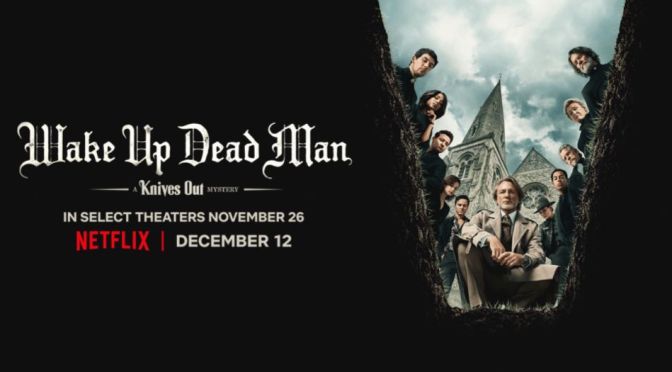
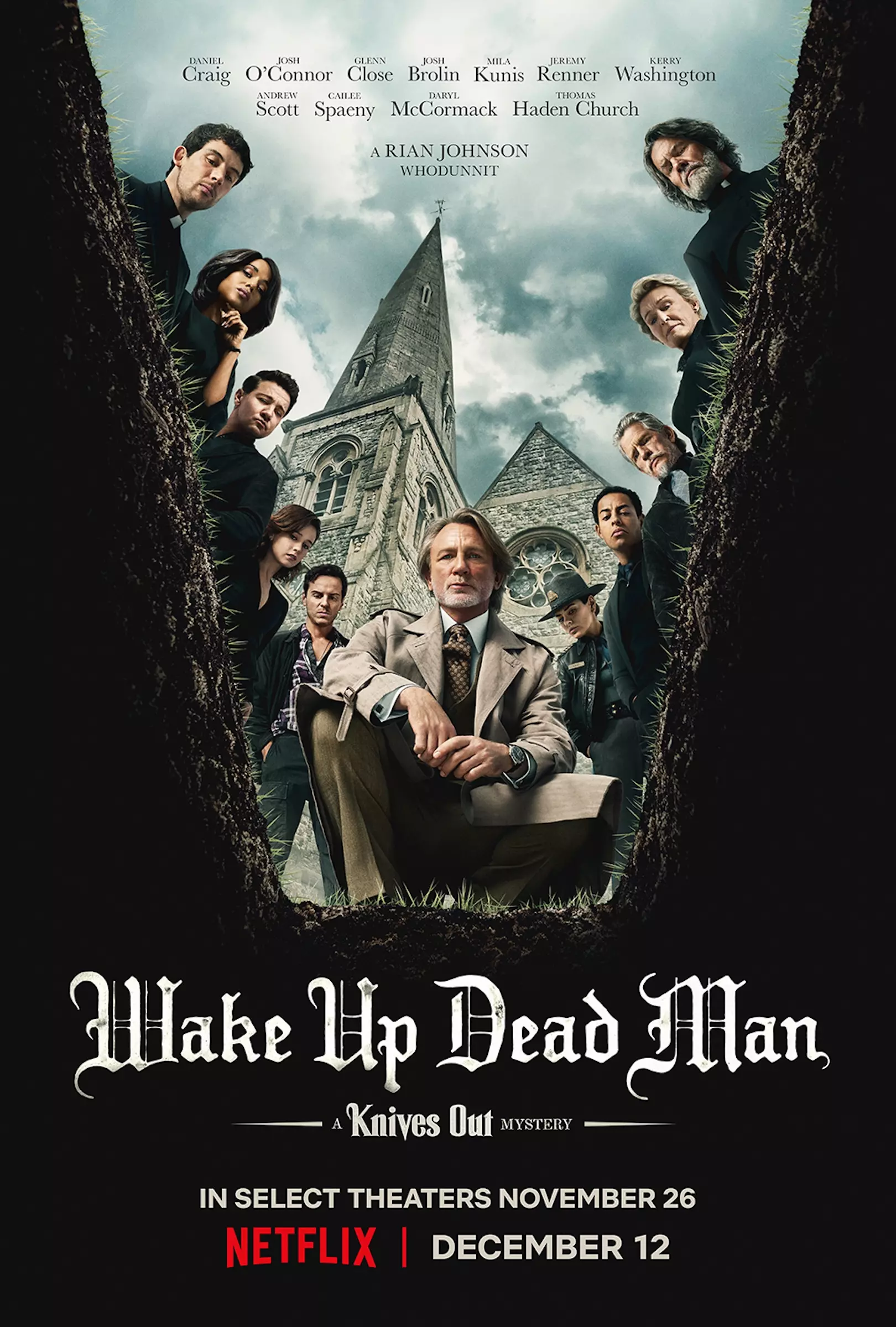
Wake Up Dead Man: A Knives Out Mystery (2025)
Wake Up Dead Man (2025) stands as the clear high point of Netflix’s auteur-driven releases from November and December 2025, confirming Rian Johnson as a post-modern master of the classical whodunnit. Once again drawing from the elegant clockwork of Agatha Christie’s works, Johnson constructs a devilishly complicated mystery centred on the murder of the tyrannical Monsignor Wicks, played with thunderous menace by Josh Brolin. The suspect list is gloriously stacked—church staff and parishioners portrayed by Glenn Close, Jeremy Renner, Kerry Washington, Andrew Scott, Cailee Spaeny, Daryl McCormack, Thomas Haden Church, and a young visiting priest, Jud Duplenticy (Josh O’Connor)—each performance feeding into a puzzle that’s as playful as it is precise.
What elevates the film beyond genre excellence is its sharply observed character work, particularly in the portrayal of Wicks as a Trump-like authoritarian figure ruling his congregation through fear and humiliation. Johnson smartly frames the mystery as a moral clash between Old Testament wrath and New Testament compassion, allowing the film to interrogate power, faith, and hypocrisy without ever losing its entertainment value. The script crackles with brilliant one-liners and sly, witty exchanges, especially when Daniel Craig’s Poirot-style detective peels back layers of deceit with theatrical relish. Among the ensemble, Josh O’Connor delivers a superbly nuanced performance, injecting emotional specificity and intelligence that rise above what could have been more generic material. Clever, funny, thematically sharp, and immaculately engineered, Wake Up Dead Man isn’t just Netflix’s best auteur offering of the season—it’s one of Johnson’s most satisfying achievements to date.





 The Cinema Fix presents