Tag Archives: Cailee Spaeny

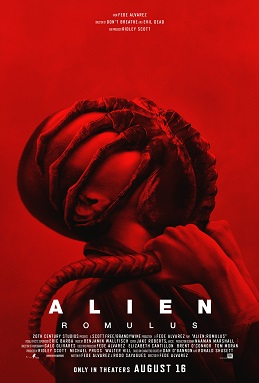
CINEMA REVIEW- ALIEN: ROMULUS (2024)

CINEMA REVIEW – ALIEN: ROMULUS (2024)

Directed by Fede Álvarez

Written by Fede Álvarez & Rodo Sayagues

Based on Characters by Dan O’Bannon & Ronald Shusett

Produced by Ridley Scott, Michael Pruss, Walter Hill etc.

Main Cast: Cailee Spaeny, David Jonsson, Archie Renaux, Isabela Merced, Spike Fearn and Aileen Wu etc.

Cinematography by Galo Olivares

*** CONTAINS SPOILERS ***


Did we need another Alien film? Prometheus (2012) was a box office success while the entertaining, if bland, Covenant seemed to have killed off any possibility of more bleeding chest-bursting. As original director, Ridley Scott, concentrates on the unnecessary sequel Gladiator 2 (2024), Fede Alvarez helms unnecessary prequel, Romulus (2024), set some time between the classic original and one-of-the-best-sequels-ever, Aliens (1986).

The franchise is renowned for its blend of horror, science fiction, and action, with iconic elements that have become staples of the series. To create a successful prequel within this franchise, it’s essential to incorporate certain tropes and thematic elements that resonate with fans while expanding the lore in a meaningful way. So, while it is very entertaining and directed with fine energy, Romulus (2024), is essentially one of the biggest budget fan films ever.


As the script for this film seemed to be written by ChatGPT, I ask you to enjoy a game of Alien: Bingo with me. So, when you watch Romulus (2024), take this list with you and check them off.

  1. Ancient Alien Ruins: Introduce ancient, mysterious structures or artifacts related to the Engineers or other ancient civilizations, which hint at the origins of the Xenomorphs.

  2. Uncovering the Unknown: The protagonists should gradually discover the horror of their situation, with an escalating sense of dread as they uncover the truth about the Xenomorphs.

  3. Weyland-Yutani Corporation: The presence of the Weyland-Yutani Corporation, or its precursor, should be central, with their unethical practices and obsession with the Xenomorphs for profit and weaponization playing a key role.

  4. Corporate Deception: Characters may be manipulated or deceived by corporate agendas, often leading to their doom.

  5. Body Horror: Incorporate the visceral, gruesome body horror elements that are a signature of the franchise, such as chest-bursters, acid-for-blood, or other horrific ways the Xenomorphs reproduce and evolve.

  6. Mutations and Experiments: Show early experiments with the Xenomorphs or other creatures, emphasizing the grotesque consequences of tampering with alien biology.

  7. The Alien Xenomorph: Introduce early forms or ancestors of the Xenomorph, exploring how they evolved into the perfect killing machines.

  8. Bioweapon Origins: Delve into the origins of the Xenomorphs as potential bio-weapons, being exploited by the Weyland-Yutani Corporation.

  9. The Engineers: Expand on the lore of the Engineers, their culture, technology, and their role in the creation of the Xenomorphs.

  10. Claustrophobic Settings: Use isolated, claustrophobic environments like derelict ships, alien worlds, or underground facilities to enhance the feeling of dread and helplessness.

  11. Slow-Burn Suspense: Build tension gradually, with a focus on atmosphere, sound design, and visual storytelling, allowing the horror to unfold slowly.

  12. Synthetics (Androids): Include synthetic characters (like Ash, Bishop, or David), exploring their complex relationships with humans and their potential hidden agendas.

  13. Small, Vulnerable Crew: Focus on a small group of characters who are outmatched by the alien threat, emphasizing their vulnerability and the high stakes of survival.

  14. Foreshadowing: Include subtle nods or direct connections to the events or characters of the original “Alien” films, creating a sense of continuity.

  15. Iconic Imagery: Use familiar visual motifs like the Xenomorph egg, facehugger, and the bio-mechanical aesthetic associated with H.R. Giger’s designs.

As well as a superb dirty industrial look and striking cinematography, all of the above tropes and more are present in Romulus (2024). The cast are mostly bland, notably the young Ripley clone portrayed by Cailee Spaeny. Having said that, David Jonsson as Andy, brings tremendous depth and humanity to the character of Andy. Once again, ironically the android character is the most interesting aspect of a recent Alien offering. Jonsson is destined for a great acting career and rises above this often thrilling, if highly generic, horror film.

Mark: 7 out of 11

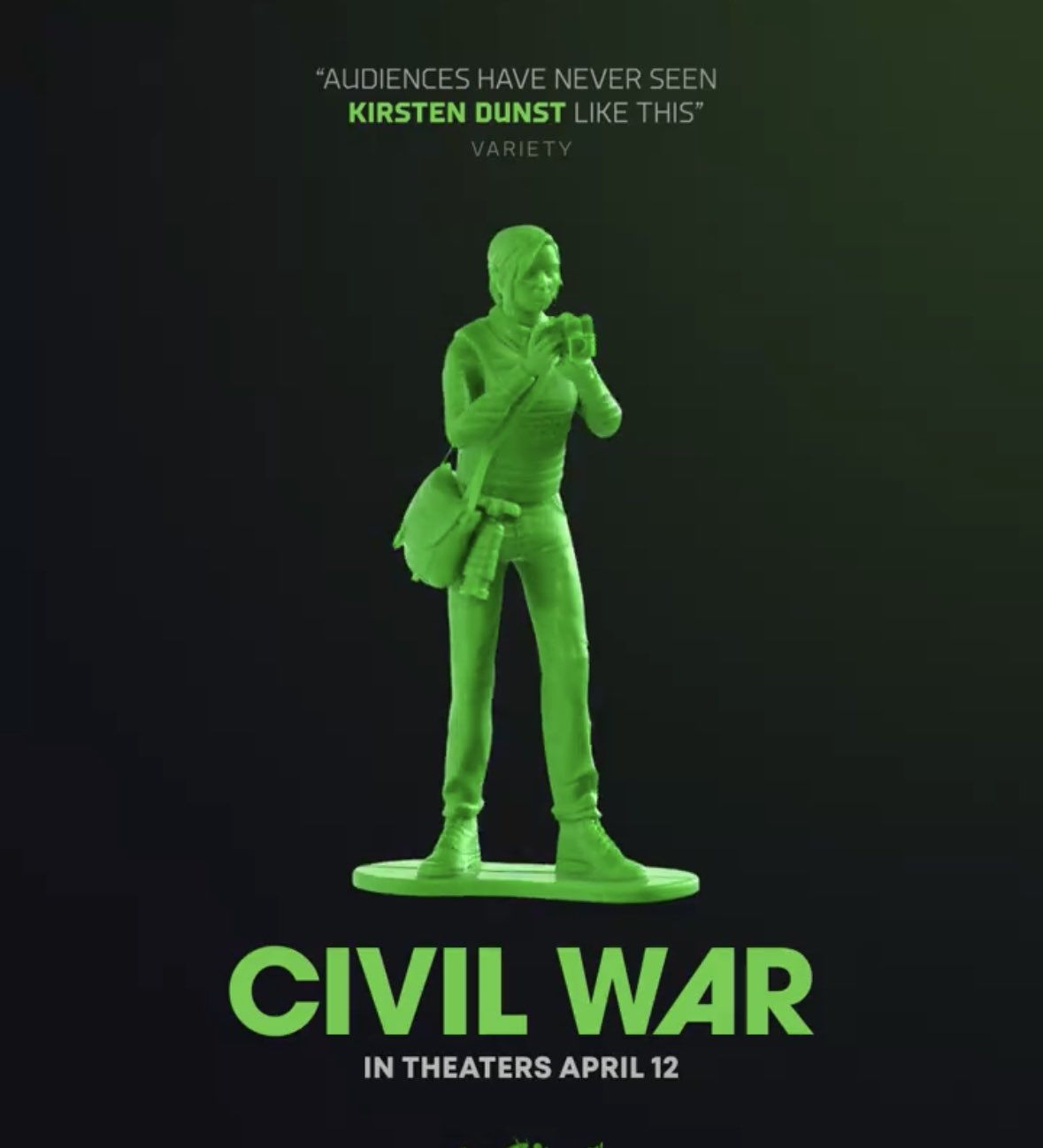
CINEMA REVIEW: CIVIL WAR (2024)

CINEMA REVIEW: CIVIL WAR (2024)

Directed by Alex Garland

Written by Alex Garland

Produced by Andrew Macdonald, Allon Reich, Gregory Goodman

Main Cast: Kirsten Dunst, Wagner Moura, Cailee Spaeny, Stephen McKinley Henderson, Sonoya Mizuno, Nick Offerman, etc.

Cinematography by Rob Hardy

*** MAY CONTAIN SPOILERS ***


Alex Garland has an impressive literary, cinema and televisual curriculum vitae. He gained acclaim as the writer of the novel, The Beach, before moving onto screenwriting duties with fine films such as: 28 Days Later (2002), Sunshine (2007), Never Let Me Go (2010), and under-rated Dredd (2012). He made his directorial debut with Ex Machina (2014), which earned him an Academy Award nomination for Best Original Screenplay. His second film, Annihilation (2018), garnered further acclaim, so much so, FX bypassed a pilot and went straight to series for his science fiction TV narrative, Devs (2020).

While I am a massive fan of Garland’s work, I wasn’t too enamoured of Annihilation (2018). I found it brilliantly made with some fantastic concepts and incredible moments, yet overall it was too slowly paced. With eight superlative episodes of Devs (2020), Garland delivered a story which really connected with me by merging a compelling technological espionage plot to an intelligent exploration of philosophical thought and human behaviour. Where Devs (2020) presciently examined the impact of artificial intelligence, Garland’s new political thriller, Civil War (2024), prophetically imagines an apocalyptic America in the throes of war between combined California and Texas state rebel forces and the current President’s (Nick Offerman) retreating army.

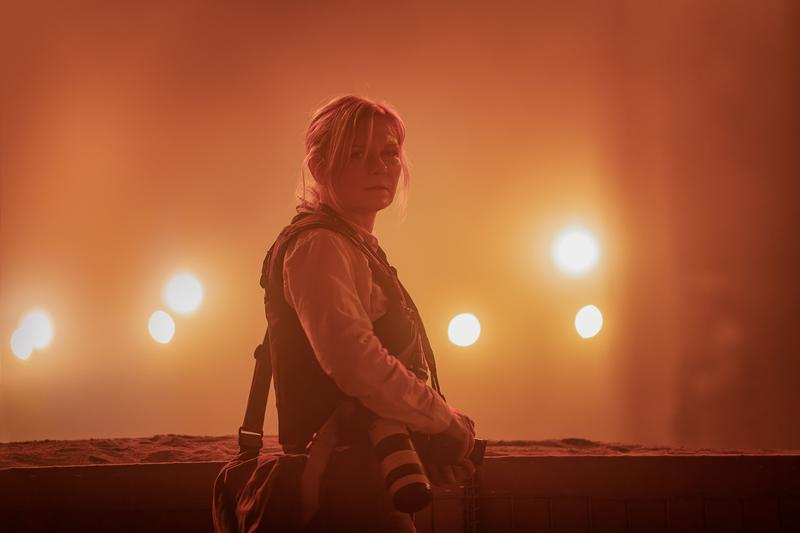
With the ‘January 6 United States Capitol attack’ in mind, Garland opens up a “what if” narrative where the whole of America is conflicted and consuming itself from within. At the heart of the violence is the war photographer, represented by Lee Smith (Kirsten Dunst) and Reuters journalist, Joel (Wagner Moura). Their journey to Washington to photograph the President reveals confusion, destruction and further bloodshed. Generically speaking, a road movie meets dystopian thriller, Civil War (2024) contains thought-provoking themes and incredible cinematography, but with shaky writing in places.


Films about war photographers and/or journalists can be problematic for me. Such characters lend themselves to heroic and the anti-heroic. The writing has to be right because I can lose empathy between such crusading journos and the narcissistic adrenaline junkies looking to deflect their own loathing and self-destructive tendencies. Civil War (2024) struggled to get me onside with the lead characters, although Dunst’s characterisation of Lee Smith is superb. However, her mentor-apprentice relationship with Cailee Spaeny, Jessie Cullen, was under-developed. Spaeny’s “innocent” being used more as a suspense device as opposed to learning the true horrors of humanity and war. Perhaps Garland intended for her to be a sociopath without depth just looking for blood? She finds it!

Moreover, Jessie’s journey from a political perspective was weak as there was no real sense of development in her character. That’s where the decision not to overtly take political sides causes a lack of sociological depth. War films such as Salvador (1986) and The Killing Fields (1984) are more successful as Civil War (2024) loses political impact by not choosing precise sides. But I guess whether they are Democratic or Republican is the whole point. Garland is saying that political parties are all as bad as each other, with human beings their own worst enemy. Politics, like football, gender, sexuality, and religion, are propellants for humans to fight each other.

For a film about photographers, the images on show are incredible and Rob Hardy’s work is genius. Fire, blood and war have never looked so brutal and aesthetically impressive. As well as Dunst, Wagner Moura and Stephen McKinlay Henderson are terrific in their respective roles. Further, there are some nail-biting and suspenseful scenes, notably one involving a film-stealing performance from Jesse Plemons. However, many of the characters’ decisions were weakly written for me. This is surprising given Garland’s prodigious literary and screenwriting talent. Civil War (2024), however, remains another stunning addition to his oeuvre and for all my perceived script weaknesses, the hell of war has never been so artistic and artful.

Mark: 8 out of 11


FX /BBC TV REVIEW – DEVS (2020) – ONE OF THE BEST TV EXPERIENCES OF 2020!

FX / BBC TV REVIEW – DEVS (2020)

Created, written and directed by Alex Garland

Executive producers: Alex Garland, Andrew Macdonald, Allon Reich, Eli Bush, Scott Rudin, Garrett Basch

Cast: Sonoya Mizuno, Nick Offerman, Jin Ha, Zach Grenier, Alison Pill, Stephen McKinlay Henderson, Cailee Spaeny, Karl Glusman, Jefferson Hall, Liz Carr, Janet Mock, Aimee Mullins, Linnea Berthelsen etc.

Cinematography: Rob Hardy

Composers: Ben Salisbury, Geoff Barrow, The Insects

Distribution / Screening Platform: FX / Hulu / BBC


*** MAY CONTAIN SPOILERS ***


“I read more about science than anything else, and it started with two things. One was getting my head around this principle of determinism, which basically says that everything that happens in the world is based on cause and effect. . . One is that it takes away free will, but the other is that if you are at a computer powerful enough, you could use determinism to predict the future and understand the past.” Alex Garland – Creator of Devs


Alex Garland has an impressive literary, cinema and now televisual curriculum vitae. He gained acclaim as the writer of the novel, The Beach, before moving onto screenwriting duties with fine films such as: 28 Days Later (2002), Sunshine (2007), Never Let Me Go (2010), and Dredd (2012).  He made his directorial debut with Ex Machina (2014), which earned him an Academy Award nomination for Best Original Screenplay. His second film, Annihilation (2018), garnered further acclaim, so much so, FX bypassed a pilot and went straight to series for his latest science fiction narrative, Devs (2020).

While I am a massive fan of Garland’s work, I wasn’t too enamoured of Annihilation (2018). I found it brilliantly made with some fantastic concepts and incredible moments, yet overall it was too slowly paced. With the eight superlative episodes of Devs (2020), Garland has kept the meditative pace of Annihilation (2018), but also delivered a story which really connected with me this time. With Devs (2020) he has successfully merged a compelling technological espionage plot to an intelligent exploration of philosophical thought and behaviour. Moreover, Garland presents a complex group of themes and characters relating to Silicon Valley tech firms and how their work could control individuals, companies, governments, society as a whole, and actual time itself.


Set now in San Francisco, the narrative opens with two employees of the Amaya Corporation, Lily Chan (Sonoya Mizuno) and Sergei Pavlov (Karl Glusman), attending work. Sergei has a big presentation to pitch to Amaya CEO, Forest (Nick Offerman) and chief designer, Katie (Alison Pill). It goes well and Sergei is invited to work on the mysterious DEVS project. At DEVS he finds wondrous halo-style lighting in the woods and an incredibly expensive set of buildings, capsules, platforms, workstations and screens. Dominating the landscape also is a gigantic model of a young girl (Forest’s daughter, Amaya) who looms over the company and the San Franciscan horizon. These spectacular props, sets and locations are complimented by impressive cinematography from Rob Hardy throughout the eight episodes.

Sergei’s tenure at DEVS does not last long though as he goes missing. Lily, who was in a loving relationship with Sergei, is distraught and, with the help of ex-CIA head of security, Kenton (Zach Grenier), attempts to locate him. When Sergei turns up dead from an apparent suicide, Lily is convinced there is a conspiracy occurring in the Amaya company so begins a dangerous investigation. Even more intriguing, however, is the work that is occurring at DEVS itself. Led by Forest’s desire to “resurrect” his deceased daughter, this complex computer programme can somehow view events from the past, recreated via particle-driven software and projected on huge screens. Using this application the developers and programmers are attempting to determine the future from what has occurred in the past. If they can determine the future they may be able to control it. Mind blown yet? Safe to say, Lily’s investigation into Sergei’s death and the DEVS system become inextricably linked as the drama unfolds. As such, the drama works well as a conspiracy thriller as well as thoughtful sci-fi as Garland punctuates the brooding pace with some crushing stunts and brutal murder set-pieces.

I’ll be honest, the technological side of Devs (2020) was outside my knowledge repertoire as I do not comprehend coding or programming jargon. Nonetheless, I did understand what was occurring in the narrative as it was presented in a clear and digestible fashion. Unlike say the most recent seasons of HBO’s Westworld, which tied itself in knots with looping and over-lapping timelines, Alex Garland’s deft script, excellent direction and fantastic cast make Devs‘ (2020) complex science and tech theories comprehensible throughout. While Garland is dealing with theories relating to free will and deterministic cause and effect, the elegant structure, both linear and with flashbacks, builds a gripping narrative which maintains emotional impact for the characters and the choices they must make. Indeed, Lily Chan is a very empathetic leading protagonist and Sonoya Mizuno gives a compellingly magnetic acting portrayal. It was also fascinating to see Nick Offerman outside of his Parks and Recreation ‘Ron Swanson’ persona playing a highly driven and grieving father. Thus, to conclude, if you enjoy clever, meditative and Kubrickian style television in the science-fiction genre, then you should definitely use your free will and be determined to watch Devs (2020).

Mark: 9.5 out of 11


BAD TIMES AT THE EL ROYALE (2018) – MOVIE REVIEW

BAD TIMES AT THE EL ROYALE (2018) – MOVIE REVIEW

Directed by:    Drew Goddard

Produced by: Drew Goddard, Jeremy Latcham

Written by: Drew Goddard

Starring: Jeff Bridges, Cynthia Erivo, Dakota Johnson, Jon Hamm, Cailee Spaeny, Lewis Pullman, Chris Hemsworth

Music by: Michael Giacchino

Cinematography: Seamus McGarvey

**MAY CONTAIN SPOILERS**

elroyale

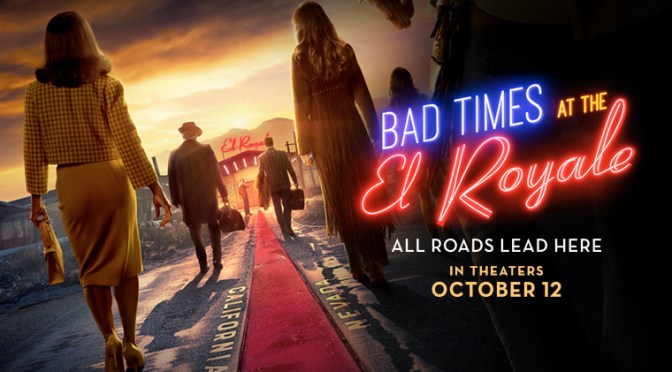
Expectations are a fascinating thing. Based on the prior screenwriting work of Drew Goddard and his amazing debut feature film, the genre-bending horror film, Cabin in the Woods, I was really looking forward to this crime thriller. With a terrific cast of actors in place and an intriguing setting of a hotel split between the United States of Nevada and California there promised to be cinematic fireworks. There were indeed fireworks but, like fireworks, the film paints bright and pretty colours and bangs loudly in the sky yet somehow felt hollow afterwards. This comes from those darned expectations, I guess.

There are seven main characters in the film; all of whom have secrets to keep. They range from: John Hamm’s vacuum-cleaner salesman; Lewis Pullman’s hotel employee; Dakota Johnson’s mysterious femme fatale; Jeff Bridges’ shady priest; plus a couple of other devils who enliven proceedings later in the film. All the characters are seemingly unconnected but soon fate and fortune take hold as Goddard weaves his screenwriting magic. Before you know they are all at each other’s throats jousting verbally and physically; double and triple crossing, resorting often to extreme violence. What Goddard does superbly well is place these various characters in a form of narrative hell or purgatory. He looks into the heart of humanity and finds blood and darkness at every turn.

Bad-Times-at-the-El-Royale-interview-700x300

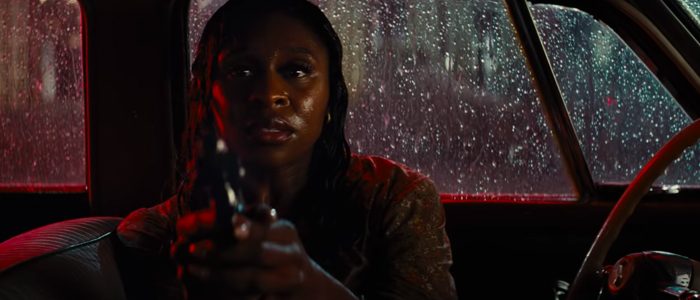
Bad Times at the El Royale main strengths are the brilliant script, skilled cast and a wondrous production design. Indeed, the rich neon colours and lighting glow amidst with the foreboding darkness surrounding the hotel.  In terms of performance, Jeff Bridges is just great; in everything! Dakota Johnson and Cynthia Erivo also excel and breathe emotion into their archetypal characterisations. John Hamm is ever the solid player; but Chris Hemsworth’s grand entrance in the second act, almost steals the show with his messianic “Jim Morrison” grandstanding. All told the ensemble has a scream within the clever pyrotechnics of the screenplay.

Overall, Drew Goddard deserves praise for delivering a very sharp script. Structurally, we cleverly move back in time to fill in back-stories. Events are also from multiple perspectives heightening the twisting nature of the narrative. While mainly style over substance the film still manages to critique the racism of the late 1960s setting; satirises celebrity scandals, and also has a dig at religious cults. So, ultimately this is a satisfying B-movie-pulp-fiction-violent-extravaganza with twists and turns galore, that provides an entertaining blast in the noir night sky.                                                                                            

Mark: 8 out of 11