Tag Archives: loss

Cinema Review: Weapons (2025) – a finely constructed horror mystery!

Cinema Review: Weapons (2025)

Directed by Zach Cregger

Written by Zach Cregger

Produced by Zach Cregger, Roy Lee, Miri Yoon, J. D. Lifshitz, Raphael Margules, etc.

Main Cast: Josh Brolin, Julia Garner, Alden Ehrenreich, Austin Abrams, Cary Christopher, Benedict Wong and Amy Madigan.

Cinematography by Larkin Seiple

*** MAY CONTAIN SPOILERS ***


Zach Cregger’s Barbarian (2022) was an intriguing feature debut that captivated viewers with a suspenseful, tension-filled first half, expertly building a sense of dread and mystery. The film begins with a seemingly simple premise — a woman arrives at an Airbnb, only to find it double-booked — but what starts as a quiet psychological thriller quickly takes an unexpected turn. As the plot unfolds, the sense of unease grows, drawing viewers deeper into its web of secrets.

However, the second half of the film ventures into increasingly bizarre and chaotic territory, unravelling into a frankly insane series of twists and reveals. While it might initially seem like a more grounded thriller, Barbarian (2022) pushed the boundaries of genre, diving head first into over-the-top absurdity. It’s a thrilling ride that keeps you on the edge of your seat, even if the madness of the final act leaves you both bewildered and entertained. In some ways Cregger’s follow-up Weapons (2025) shares such structural and thematic similarities with his first film, however, it is a much more controlled and impactful mystery. Until the end.

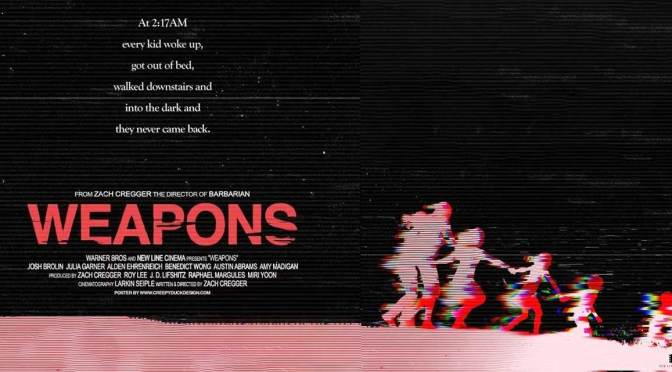
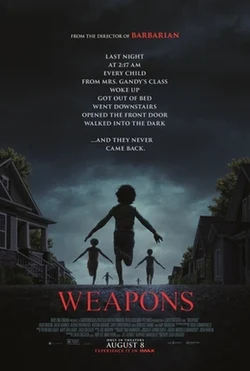
Weapons (2025) immediately hooks viewers with the mystery of the seventeen children going missing in the town of Maybrook. This instantly draws us into a world brimming with tension and unanswered questions. The authorities investigation into their disappearance soon stalls and how the townsfolk react becomes the central thread, gradually unraveling a complex, carefully structured narrative. Thus, Cregger’s postmodern fairy-tale unfolds through the eyes of various interconnected characters, each of whom brings a unique perspective and layer to the plot.
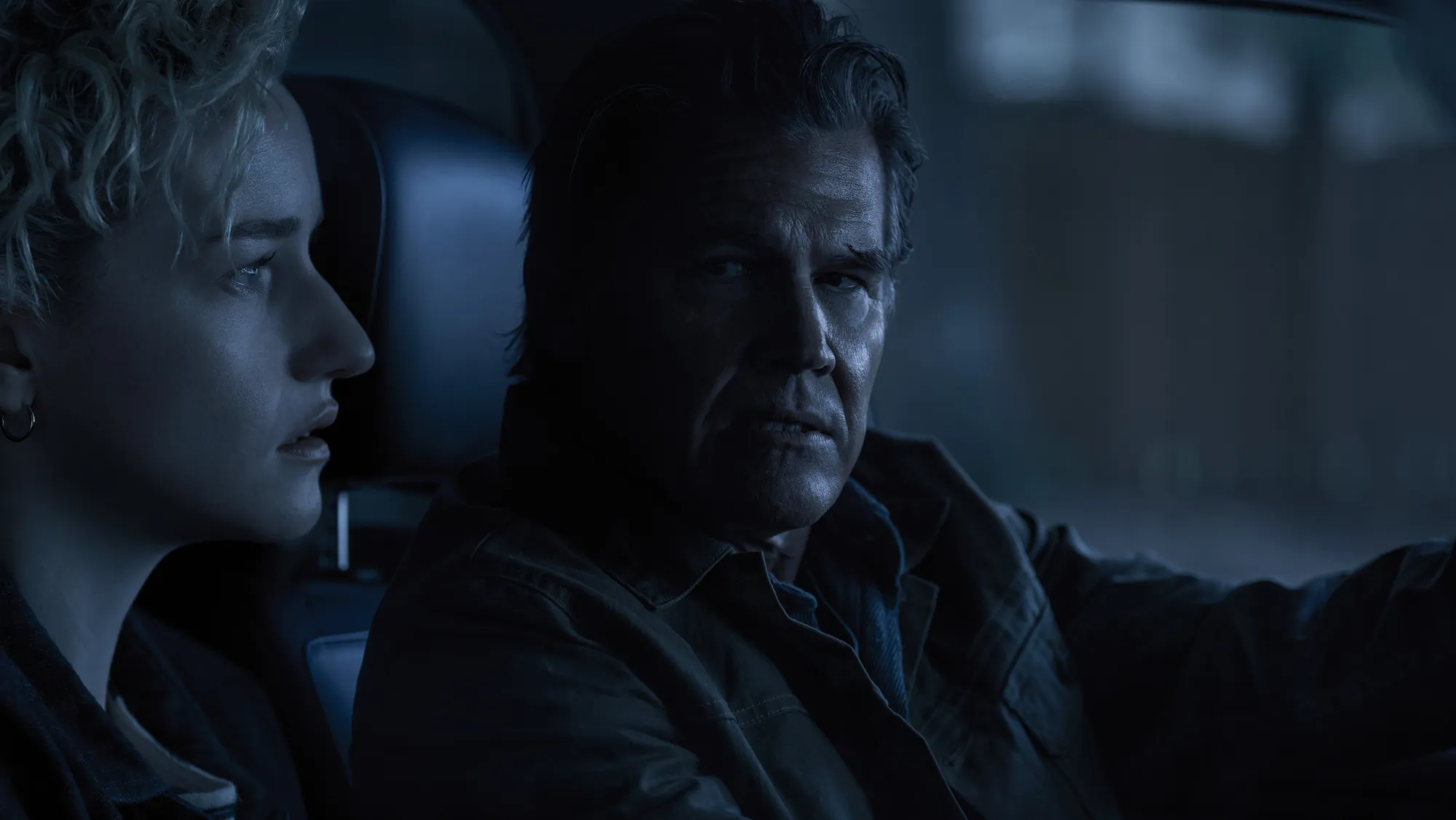


Josh Brolin plays Archer Graff, a father grieving the disappearance of his son Matthew, one of the missing children. His portrayal is poignant, balancing grief with a desperate need for answers, and his journey pushes the narrative forward with a personal stake in the outcome. Next, Julia Garner’s Justine Gandy, a dedicated teacher, adds another emotional dimension. She’s devastated when she discovers that nearly all of her students have vanished without a trace, with the exception of Alex Lilly (played by Cary Christopher), the only child from her class who remains. Justine’s struggle to find out what happened to her students, coupled with her own crumbling personal life and alcoholism, make her a compelling protagonist.

Other characters include Alden Ehrenreich’s Paul Morgan, a troubled police officer with his own set of demons, is a reluctant ally to Justine. Their past relationship adds a layer of tension as they navigate the growing sense of danger and urgency surrounding the missing children. Then, Austin Abrams brings a sense of raw, chaotic energy to James, a homeless drug addict and burglar whose past intersects with the mystery in unexpected ways. Lastly, Benedict Wong plays Marcus Miller, the school principal, who serves as an important figure in Justine’s quest for answers. Though sympathetic to her, Marcus is often caught between his professional responsibilities and the mounting pressure of the situation.

Weapons (2025) masterfully weaves its non-linear narrative with a striking array of tense, spine-chilling moments that keep audiences on edge throughout. As the plot unfolds through intersecting character arcs, the film expertly intersperses surprising scares, thrilling foot chases, and creepy locations, all while pulling you deeper into its twisting mystery. The jumps in time and the interconnected storylines create a sense of disorientation that builds forces viewers to constantly question what’s real and what isn’t.

Each character’s journey is filled with psychological unease and physical danger, leading to some genuinely heart-pounding sequences. Meanwhile, the eerie, claustrophobic settings—ranging from decaying homes to ominous, unfamiliar spaces—serve as perfect backdrops for the increasing horror. These moments contribute to the growing sense that something monstrous is lurking just beneath the surface, waiting to break free. Further, the film also plays with ambiguity, surreal dreams and unreliable narrators, allowing characters’ perspectives to fracture.

However, similar to Barbarian (2022), Weapons (2025) takes a tonal right-turn in the final moments, descending into all-out mania and Savini-style gore. The reveal of the matriarchal menace, who emerges as a central ‘Pied Piper’ type villain, feels somewhat unearned, undermining the narrative choices before. The ending also didn’t quite fully connect with the deeper themes or subtext of the film that were promised in the set-up. Yet, despite such inconsistencies Cregger’s Weapons (2025) has been marketed incredibly well and as has deservedly done great box-office business. Lastly, Creggers is a very talented filmmaker and his second film remains a smartly written and gripping ride filled with tension, scares, and that insane final act.

Mark 8.5 out of 11


MUBI REVIEW: AFTERSUN (2022)

MUBI REVIEW: AFTERSUN (2022)

Directed by: Charlotte Wells

Written by: Charlotte Wells


Produced by: Adele Romanski, Amy Jackson, Barry Jenkins & Mark Ceryak.

Main cast: Paul Mescal, Frankie Corio, Celia Rowlson-Hall, etc.

Cinematography: Gregory Oke

Edited by: Blair McClendon

Music by: Oliver Coates

***CONTAINS SPOILERS ***


The invisible mist that envelops many human beings and imperceptibly cannot be treated in conventional ways like that of a broken bone, headache or a skin rash. It can be experiential, dependent on one’s life situation or genetically sewn into the mind, blood and persona with often no evident cure. Sure, medicine can be used to push back the fog. However, it’s hit and hope treatment to a chastening fugue that is all encompassing and never ending. According to research, depression effects around 1 in 6 people in the UK each year alone.

Aftersun (2022) is an intimate character study on film written and directed by Charlotte Wells. After creating several critically acclaimed shorts, Aftersun (2022) is Wells debut feature film. It welcomes an intelligent, perceptive and brave new visionary in world cinema. Aftersun (2022) is a hypnotic, mournful and heartbreaking exploration of depression, love, loss and family which quietly pushes the viewer into a beautiful pain that makes it difficult to breathe at times.


This artful drama features Paul Mescal as Calum and Frankie Corio as his 11-year-old daughter, Sophie. It follows their holiday at a Turkish resort on the eve of his 31st birthday. Together, the actors performances and Wells’ subtle direction effortlessly builds emotional power in the father and daughter relationship on screen. Mescal especially is as magnetic as a modern-day Brando, with many soulful scenes of him trying to handle his invisible pain. Sophie is unaware of Calum’s clouding moods as he battles to keep it from her. Holidays are meant to be fun and the father does his best to ensure his daughter is protected from the existential despair. Wells hints at what may happen to Calum in the future, juxtaposing an adult Sophie recalling key moments from the holiday that play out like a raw home movie of haunting reminiscence.

Attempting to portray depression visually is a challenge for any filmmaker. Yet, Wells and their cinematographer, Gregory Oke, use a number of styles to propel the internal conflict of the characters. Sophie often sees her father through the eyes of a camcorder lens and mini-screen. Calum is also framed from behind and through the mirrored distance of a television screen. On occasions, Wells overdoes the artiness of such photographic choices. Mainly because Mescal’s portrayal of Calum is so good, I wanted even more direct focus on his character acting. Yet, one cannot argue with the creative power of Wells’ dialectic choices, notably in the contrast between the sunny Turkish landscapes and pulsating strobe-lit nightclub scenes linking older Sophie and Calum’s internal mindscapes.

Aftersun (2022) has rightfully received critical acclaim and accolades from BAFTA, BIFA and the Oscars. It is a slow burning film which takes patience to connect to. But once you get into the film’s rhythm there are an abundance of cerebral and emotional rewards. As an arthouse genre film Wells combines rites of passage with a deep analysis of grief. Sophie’s family holiday in Turkey is not without humour and joy as she finds real affection and love with her brave father. The tragedy is the not-knowing that this is the last time she will ever spend time with him. Sophie has her home movies and memories of Calum. But it is no substitute for her father being alive. If only he hadn’t stayed forever in life’s departure lounge.

Mark: 9.5 out of 11


R.I.P – HELEN MCCRORY (1968 – 2021) – SIX GREAT SCENES!

R.I.P – HELEN MCCRORY (1968 – 2021) – SIX GREAT SCENES!

“I’m heartbroken to announce that after a heroic battle with cancer, the beautiful and mighty woman that is Helen McCrory has died peacefully at home, surrounded by a wave of love from friends and family. ‘She died as she lived. Fearlessly. God, we love her and know how lucky we are to have had her in our lives. ‘She blazed so brightly. Go now, Little One, into the air, and thank you.”Damian Lewis


Sad news that one of my favourite actors, Helen McCrory, passed away on the 16th of April 2021 from cancer.

Helen McCrory had an amazing career on stage, television and in cinema. She began studying acting at the Drama Centre in King’s Cross, London. After which she rapidly gained fabulous onstage notices, appearing in theatrical productions at the Donmar Warehouse, National Theatre and Almeida Theatre. It didn’t take long before she was starring in prominent roles on television and cinema screens.

An actress of immense quality and charisma, McCrory would bring a sophistication and heart and magnificent class to every role she inhabited. Her characters were always strong, independent and a little bit dangerous. In tribute, I have chosen six scenes which showcase her incredible talents. No words can describe how big a loss Helen McCrory is to the world and my condolences go out to her family.

*** THE FOLLOWING SCENES CONTAIN SPOILERS ***


HESTER – THE DEEP BLUE SEA (2016 STAGE PRODUCTION)

I haven’t even seen this production, but this excerpt from the play immediately makes me feel so much for Helen McCrory’s character. She gives such a beautifully magnetic performance.


ROSANNA CALVIERRI – DOCTOR WHO (2010)

I personally would have loved to have seen Helen McCrory star as Doctor Who. But she made a wonderfully dark-hearted villain in this episode. This scene is so brilliant as it builds slowly with two fine actors bringing both humour and pathos and stirring drama to their characters.


NARCISSA MALFOY – HARRY POTTER AND THE HALF-BLOOD PRINCE (2009)

Originally cast in the role of Bellatrix Lestrange, McCrory had to leave the role out due to pregnancy. Eventually cast as the wonderfully name, Narcissa Malfoy, Helen McCrory’s evocative voice and elegance perfectly enlivened the character.


TABITHA – INSIDE NO. 9 (2014)

Many of Helen McCrory’s earlier roles found her portraying strong young women, however, as she matured she grew even more powerful and was also cast in darker more gothic roles. Once such character was the enigmatic Tabitha in the awesome anthology series, Inside No.9 episode, The Harrowing.


POLLY GRAY – PEAKY BLINDERS (2013 – 2019)

The BBC’s flagship drama is a muscular-bleeding-tattooed-up-parade-of-masculinity, but it also presents a set of powerful female characters too who are just as deadly. Helen McCrory as tough-talking, Polly Gray, more than holds her own as a leader within Cillian Murphy’s gang.


MRS POOLE – PENNY DREADFUL (2014 – 2015)

One of my favourite television dramas of recent years had a some incredibly beautiful writing, a wondrous cast and the most elegant of bloody horror. Helen McCrory revelled in the role of Evelyn Poole/Madam Kali, stealing every scene with an over-the-top performance as the immortal uber-witch casting spells and wreaking havoc throughout.


NETFLIX FILM REVIEW: PIECES OF A WOMAN (2020)

NETFLIX FILM REVIEW: PIECES OF A WOMAN (2020)

Directed by: Kornél Mundruczó

Produced by: Kevin Turen, Ashley Levinson, Aaron Ryder

Screenplay by: Kata Wéber

Based on the play: Pieces of a Woman by Kornél Mundruczó and Kata Wéber

Cast: Vanessa Kirby, Shia LaBeouf, Ellen Burstyn, Molly Parker, Sarah Snook, Iliza Shlesinger, Benny Safdie, Jimmie Fails etc.

***THIS REVIEW CONTAINS SPOILERS***


Every human being has been present at one birth at least – namely their own. Not that one can remember or recall the experience, however, it is something all of us have in common. Many more people, either as parents, or life partners, or medical staff, or relatives and friends have also witnessed a child being born into the world. Birth is both a magnificent and tumultuous wonder of nature. Moreover, it can, while delivering a miracle into the world, be extremely painful for the person giving birth. The incredible progress of medical science means that it has never been safer. However, as my partner experienced when our son was born, it can be traumatic if the procedure has issues. Thankfully, our son was fine after the birth, but almost eighteen-hours in labour on an under-staffed and chaotic maternity ward was stressful. Thus, I was able to identify very much with the characters in the searing grief drama, PIECES OF A WOMAN (2020).

When I say identify, I mean I felt like I was really with the couple, Martha (Vanessa Kirby) and Sean (Shia LaBeouf) as prospective parents. Martha is heavily pregnant and when Sean returns from work as an engineer she goes into labour. Sean works on building huge bridges. Yet, as events unfold within Pieces of a Woman (2020), bridges are the last thing built metaphorically and emotionally. The opening scene is a cinematic tour-de-force which portrays the couple’s home birth in one long moving and harrowing take. Brilliantly filmed and acted, by Kirby and LaBeouf, the one-take device is employed to devastating effect as it impacts emotional power rather being a filmic gimmick. When their first-choice midwife cannot attend, the replacement, Eva (Molly Parker) arrives. The birth is not without problems and the sequence is both intense and suspenseful. The filmmakers really put you in the heart of the trauma. Quickly concern for the new-born child becomes relief when it is born alive. Alas, Martha and Sean’s joy suddenly turns to misery when nature deals the couple a fateful blow.


After the relentless tension of the opening act, Pieces of a Woman (2020), along with Sean and Martha, enters a redoubtable period of grieving. Martha’s personality prior to the event seemed outgoing and confident. After the death of her child she, unsurprisingly, transitions into an insular and hollow shell. Sean, on the other hand, is more explosive. He openly cries and shouts and self-harms by relapsing back into drug and alcohol addiction. Sean, more than Martha, attempts to fix their broken relationship, but Martha’s pain is too great and the distance between them only increases. Martha’s mother, Elizabeth Weiss (Ellen Burstyn), attempts to get some control back by taking court action again the midwife, Eva. Further, she desperately attempts to thwart her daughter from allowing the child’s body to be donated to medical science. In such moments Ellen Burstyn’s performance is absolutely formidable. Indeed, the scenes she shares with Vanessa Kirby are some of the best in the film.

Based on the play of the same name, Pieces of a Woman (2020), is overall an utterly gruelling emotional experience. I must admit I found it difficult to reach Martha’s character as she was so isolated for much of the film. However, that is exactly what the writer, Kata Wéber, and director, Kornél Mundruczó want you to feel. The loss of a child is never going to be an easy experience and it is something an individual will never get over. As I followed Martha’s journey intensely the smallest incremental shift in her personality is felt massively. Personally, I would have preferred more focus on Molly Parker’s character during the second act and more outwardly emotional scenes. Because those within the film featuring LaBeouf, Kirby and Burstyn are so compelling. Vanessa Kirby, in particular, is stunning as a woman cut-off from the world by this devastating grief, making Pieces of a Woman (2020) a memorable human drama that makes you feel fortunate to be alive.

Mark: 9 out of 11


FILMS THAT GOT AWAY #6 – THE UMBRELLAS OF CHERBOURG (1964)

FILMS THAT GOT AWAY #6 – THE UMBRELLAS OF CHERBOURG (1964)

Written and Directed by: Jacques Demy

Produced by: Mag Bodard

Music by: Michel Legrand

Cast: Catherine Deneuve, Anne Vernon, Nino Castelnuovo, Marc Michel, Ellen Farmer, Mirielle Perrey etc.

**MAY CONTAIN SPOILERS**


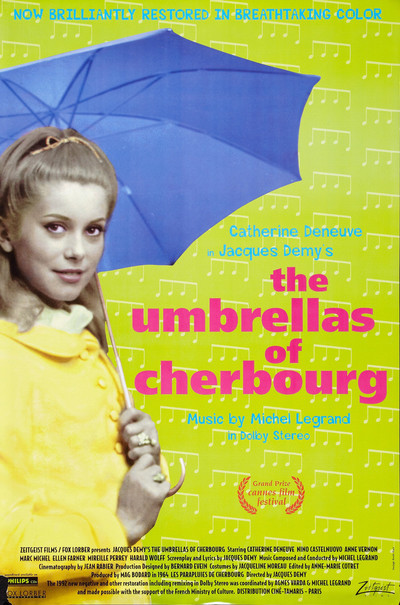
I knew there were good reasons to get married. The obvious one is the positive nature of a caring relationship and not becoming a lonely, bitter old man. The other is that given my wife loves films too, she will introduce me to the occasional classic film I may have missed. Thus, we went to the BFI and watched the classic musical The Umbrellas of Cherbourg (1964). While she is a massive fan of the musical genre, I can take or leave it generally. Every now and then though I will really love a musical film. The Umbrellas of Cherbourg (1964) is now one of them.

Starting in 1957 and structured over three acts that end in 1963, we follow the lives and loves of two main protagonists, Genevieve (Catherine Deneuve) and Guy (Nino Castelnuovo). The ups and downs of their romance drives the narrative. The two struggle to keep their love alive amidst the obstacles of military conflict, social convention and family pressure. While the story is relatively simple, Jacques Demy’s wonderful script and direction warms you to the two young lovers. So much so, by the emotionally gut-wrenching ending, even a grizzled cynic like myself felt like crying.

The Umbrellas of Cherbourg (1964) is not your classic all-singing-all-dancing musical. It is more an opera of everyday life and love. The actors sing the dialogue all the way through and once I got used to this, the device really worked well for the story. Of course, Michel Legrand’s incredible score literally drenches the colourful sets and mise-en-scene with wonder. Moreover, Demy’s cinematographer, Jean Rabier, works miracles; his camera gliding around the actors in small spaces such as shops, garages, apartments and French cafes. Lastly, Catherine Deneuve and Nino Castelnuovo are such an attractive, but beautifully tragic screen couple. Clearly their touching story, amazing music and Jacques Demy’s cinematic brilliance had a massive influence of Damian Chazelle’s splendid La La Land (2016).

Mark: 9.5 out of 11


ON CHESIL BEACH (2017) – CINEMA REVIEW

ON CHESIL BEACH (2017) – CINEMA REVIEW

Directed by: Dominic Cooke

Produced by: Elizabeth Karlsen, Stephen Woolley

Screenplay by: Ian McEwan (Based on: On Chesil Beach by Ian McEwan)

Starring: Saoirse Ronan, Billy Howle, Emily Watson, Anne-Marie Duff, Samuel West, Adrian Scarborough

Cinematography: Sean Bobbitt

**MAY CONTAIN SPOILERS**

on-chesil-beach-600x450

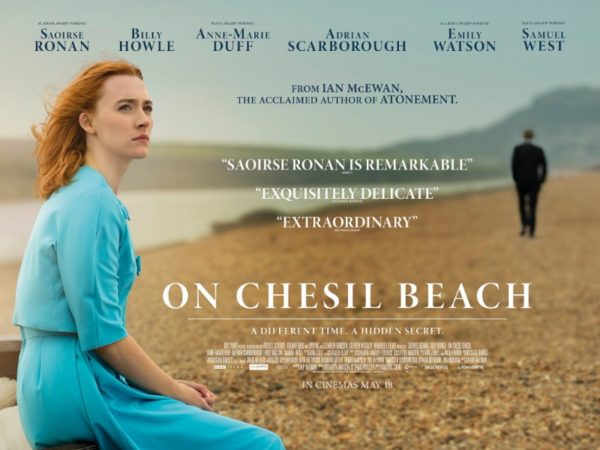
I watch a lot of films. I also write screenplays. Indeed, over the last twenty-five years I have studied and read many “how to” write screenplay courses, books, and articles. One of the major rules of screenwriting, as opposed to radio and television writing is to SHOW and not tell. Deliver your story via the images, performance and shot composition rather than obvious dialogue which spells everything out. As a writer of incredible talent Ian McEwan has, along with director Dominic Cooke and their editor, created an intriguing story of lost love and romance. It flashes forward and back between the past and present beautifully and certainly shows rather than tells the story in a less than obvious fashion. In fact, for me it was ultimately TOO subtle in delivery and the emotional ramifications of certain events are lost in the subtext.

saoirseyouhavemyheart

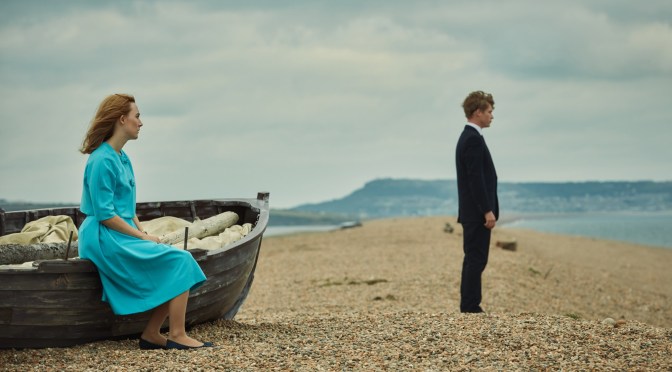
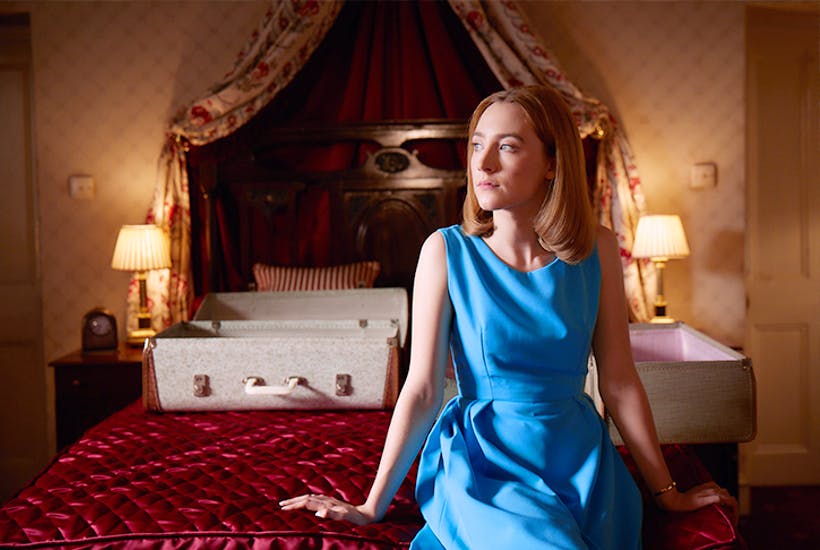
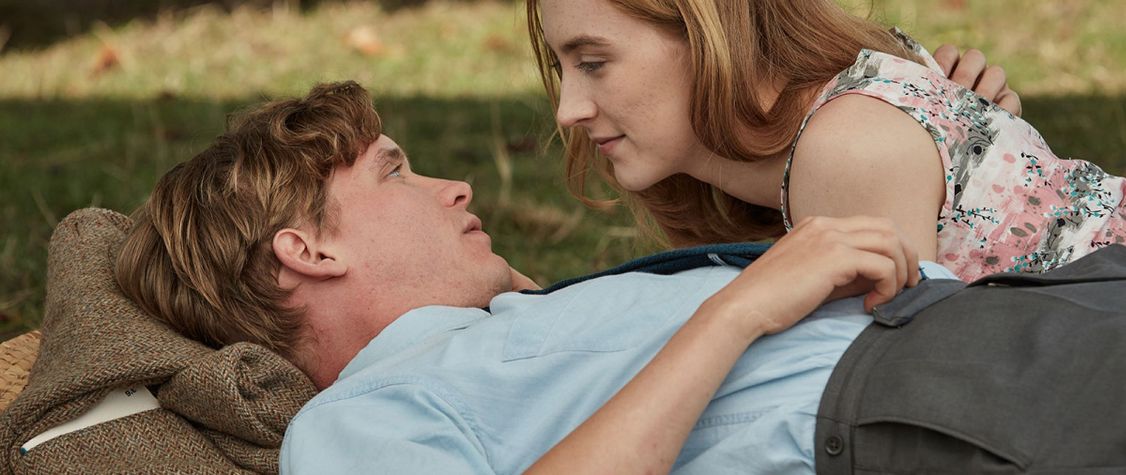
The story begins in the 1960s as newlyweds, Florence and Edward, nervously entwine on their wedding day. As portrayed by the imperious Saoirse Ronan and compelling Billy Howle we are immediately empathetic of their situation and time. Because traditionally, unlike the more sexualised mores of today, religion and social convention would dictate that the couple were more likely to be virgins. Therefore the nervous glances and small-talk slowly build a sexual tension creating an incredibly awkward and embarrassing mid-point moment between the characters. McEwan’s script also flashes back to the past establishing how the characters met. Edward is a lower-middle class boy from a rural background while Florence’s family are more upper-middle class capitalists. As presented in other McEwan works class tensions also propel the drama as Florence’s family look down on Edward somewhat.

There is a lot of depth within the characterisations notably from Ann-Marie McDuff as Edward’s unfortunate mother. Although, at times I wasn’t sure how her mental condition was linked to the themes of the piece, the performance of the actor alone was fascinating throughout. Ultimately, it’s a film about love, loss and terrible secrets; notably how past events can haunt the present. However, in choosing to bury the big reveal within a blink-and-you-miss-it flashback, the poetic editing, in my opinion, took away from the dramatic power and potential catharsis in denouement. On occasions telling us as well as showing us can empower an audience to feel even more for the characters.

lg_b549311376ba-on-chesil-beach-tiff-still-1200x520

Dominic Cooke marshals the film with an assured hand as befits an experienced theatre director. Ronan and Howle give brilliant performances. In fact, I don’t think there is a better and more consistent young actor than Saoirse Ronan. In films such as: Atonement (2007), Hanna (2011), Brooklyn (2015), Lady Bird (2017) and now On Chesil Beach (2017), she has proved herself capable of capturing depth and emotional power with her performances. Ronan and her romantic counterpart, Howle, make the film worthy of your attention even if I was left mildly bewildered, valiantly trying to work out why their characters’ relationship was doomed to fail.

(Mark: 8 out of 11)