Produced by: Coralie Fargeat, Tim Bevan and Eric Fellner
Main Cast: Demi Moore, Margaret Qualley and Dennis Quaid
Cinematography by Benjamin Kracun
*** MAY CONTAIN SPOILERS ***
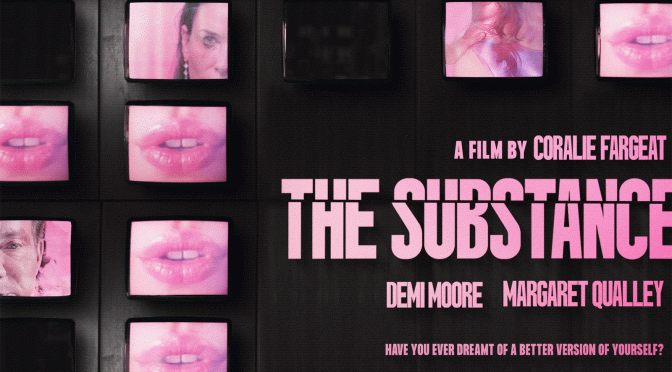
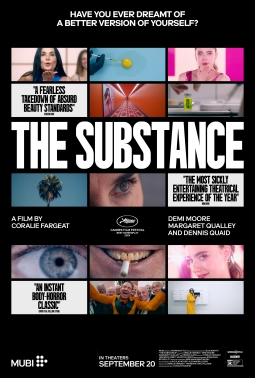
The Substance (2024), directed by Coralie Fargeat, is a visually striking and visceral film that pushes the boundaries of body horror and psychological terror. Fargeat, known for her raw and relentless style in Revenge (2017), once again delivers an unforgettable experience by weaving references to classic literature and horror cinema into a narrative that is at once familiar and entirely original.
Demi Moore portrays a former Hollywood star, Elizabeth Sparkle, now relegated to doing a mildy successful cable TV aerobics show. However, Dennis Quaid’s oily production executive is on the lookout for younger talent. Elizabeth soon finds herself on the media scrapheap. Desperate to regain her youth and career, Elizabeth is drawn to the hypnotic promise of a new product called ‘The Substance.’
Before you can say, “Dorian Gray”, Elizabeth is lured to a strange white room full of lockers and has committed to the process. Similar to Gremlins (1984), there are rules to follow. As she follows the steps and injects the potions, Elizabeth goes through a painful and incredibly impactful transformation process. She literally gives birth to a young and beautiful alter ego called, Sue (Margaret Qualley). Elizabeth and Sue then get seven days each to live their life before they have to swap back. What could go wrong?
The film’s core themes draw heavily from Robert Louis Stevenson’s Dr. Jekyll and Mr. Hyde, exploring duality, identity, and the monstrous potential hidden within human nature. Like Stevenson’s tale of inner conflict, The Substance delves into the consequences of scientific ambition. It investigates moral transgression but with a modern, feminist twist. Fargeat’s use of body horror, particularly in the transformation sequences, echoes the grotesque, unsettling work of David Cronenberg. The nightmarish atmosphere and surreal visuals are reminiscent of David Lynch’s unsettling dream logic. This is notably seen in Eraserhead (1977) andMulholland Drive (2001).
The film also pays homage to John Carpenter’s The Thing (1982), with its transmogrifying frights, sense of creeping paranoia and rising conflict. But rather than a group of men fighting each other Elizabeth and Sue turn on each other over ownership of their physical existence and Hollywood status. The final act descends into hellish and bloody satire echoing Peter Jackson’sBraindead (1992), with gore galore. Moreover, Stanley Kubrick’s influence is palpable in the film’s meticulous framing, production design and tension-building. The climactic body-morphing scenes, however, most clearly nod to Brian Yuzna’s Society (1989), with its grotesque depictions of class and conformity, fused with Fargeat’s unique vision of female empowerment, revenge and resistance.
The Substance (2024) feels like a bigger budget film in look and style, but you soon realise the minimal number of sets used and a lack of crowd scenes, finds the narrative effectively becoming a two-hander in the middle act by focusing on Sue and Elizabeth’s internal retaliatory vindictiveness. There are some amazing framing, colour design and cinematographic choices as showers become tombs to trap the protagonists. The book-ended Hollywood star montage and returning final shots are imaginative and unforgettable. Got to say that Demi Moore, as an actress taking on a role of an aging and neurotic former star is genius casting. While Qualley delivers a sexually charged and energetic performance, it is Moore who carries the weight of the complex themes as Elizabeth’s journey dives deeper into the stuff of nightmares.
Overall, The Substance (2024) is a postmodern classic and a film that honors its influences while forging its own path. Fargeat uses these references to enrich the narrative, creating a damned ugly and beautiful satire on those seeking narcissistic perfection through unnatural means, ultimately paying the price of those seeking eternal youth and fame.
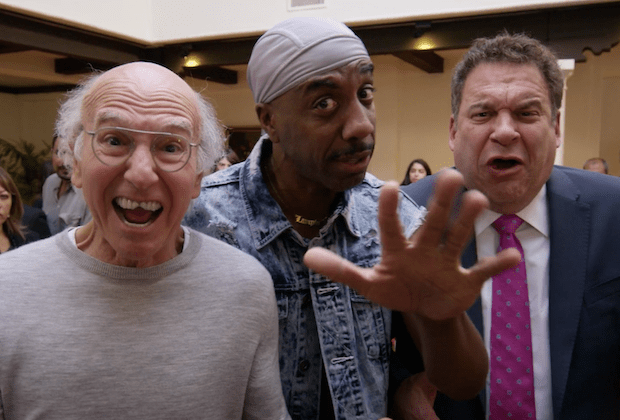
Main Cast: Larry David, Jeff Garlin, Cheryl Hines, Susie Essman, J. B. Smoove, Ted Danson, Richard Lewis, Vince Vaughan, Kaitlin Olson etc.
Guests: Mila Kunis, Clive Owen, Laverne Cox, Chris Martin, Sean Penn, Jonah Hill, Jon Hamm, Philip Rosenthaland many more.
Distribution Platform: HBO (USA) – SKY (UK)
**CONTAINS MASSIVE SPOILERS**
“AH! INTERESTING. . . “
During a lengthy hiatus from 2011 to 2017, fans of Curb Your Enthusiasm were left bereft of their dose of Larry David’s inimitable and eccentric behaviour. The multi-millionaire writer of Seinfeld had carved out a wonderfully politically incorrect comedy series, full of misunderstanding, farce and hilariously embarrassing situations. Thankfully, he returned with season 9, and it was absolutely brilliant. Larry managed to get himself a death sentence, having written a musical called Fatwa, along with all manner of other comedic shenanigans. Season 10 has now followed and, once again, anti-heroic Larry delivers ten more fantastically offensive and funny episodes. More often than not we find his behaviour abhorrent as he goes about upsetting friends, family members, celebrities, and strangers on a daily basis. However, sometimes we are with Larry and his actions have merit and reason. Furthermore, due to the wonderful writing, improvising, cast and situations the humour is always more than pretty, pretty good!
NARRATIVE ARC (OF THE COVENANT)
Usually, Curb Your Enthusiasm episodes can stand alone due to the richness of the narrative strands Larry David and his writers create. But most seasons will have a very solid narrative arc running through it to provide looping rejoinders, a structural spine and a fitting conclusion. In season 10, there were echoes of storylines from prior seasons. Larry wanted to get back with Cheryl and they even committed divorced adultery, cuckolding Ted Danson in the process. However, the main arc revolved around the return of coffee store owner, Mocha Joe (Saverio Guerra). Larry pisses Mocha Joe off because he complains about “cold” coffee, wobbly tables and weak scones. Following Larry’s customary banishing he swears revenge on Mocha Joe. This takes the form of the wonderfully named ‘spite store’ he sets up next door. Thus, Latte Larry’s is born, and ten episodes of fast-paced, tit-for-tat, vengeful and hilarious scenes ensue.
“THE GOLDEN RULE” – STYLE AND THEMES
Curb Your Enthusiasm is not just funny because of the situations, dialogue, observations, guest stars and acting performances. It is also very sophisticated and stupid, combining a variety of comedy styles to fuel the humour. Earlier seasons could be argued to be more based in reality per se. The interactions between the characters felt more natural, in keeping with the pilot episode which was shot as a mockumentary about Larry returning to stand-up. Later seasons, especially seasons 9 and 10, upped the gag rate and one could even say felt slicker. Don’t get me wrong, the jokes have always come thick and fast in Curb Your Enthusiasm, but in the last two seasons there is not only a reliance on the usual comedy of embarrassment, observations and satire, but farce, slapstick and gross-out humour too have been added to the palette. Lastly, the show has always skated close to the edge in regard to non-PC humour and causing offence. Evidently, Larry David has now fully thrown himself over that edge and is happy to offend everyone in a two-fingered salute to so-called snowflakes or liberals out there.
In regard to thematics, Larry David clearly has his finger on the pulse relating to contemporary society, politics and human behaviour. Much of the humour and funny scenarios derive from what is acceptable behaviour and certain “rules” within everyday living. In season 10, Larry finds himself questioning, among other things: the behaviour of a pregnant woman; the merits of artificial fruit; what is and what isn’t’ sufficient praise; usage of disable parking badges; whether he should be in a restaurant’s ‘ugly section’; whether sex with Cheryl’s sister is post-relationship cheating; and the overall benefits of running a spite store. These elements, the running feuds with Ted Danson, Mocha Joe and Larry’s assistant, Alice, and themes relating to the Harvey Weinstein scandal and #MeToo movement; Larry and Leon’s continued chats about the nature of being black/white; Donald Trump’s presidency; fat shaming; suicide; Susie’s alleged plot to murder Jeff; nationalist ridicule; egotistic actor types; and transgender issues, all connectedly make this season a very rich product, full of ideas and challenging storylines.
“PRETTY GOOD. . . ” – EPISODE RATINGS
Episode 1 – Happy New Year – (8.5 out of 10)
Larry goes to war with Mocha Joe and reignites his romance with Cheryl. His relationship with his assistant also descends into accusations of sexual harassment.
Highlight: Larry wearing his Donald Trump, “Make America Great Again!”and ensuring no one wants to be seen with him.
Episode 2 – Side Sitting – (8.5 out of 10)
Larry’s relationship with his assistant, Alice, is possibly going to court unless he settles and makes amends. His attempts to get back with Cheryl are rebuked, so he dates his lawyer’s assistant.
Highlight: Larry gives Susie a portrait of herself as a birthday present. She loves it – but Jeff doesn’t.
Episode 3 – Artificial Fruit – (9 out of 10)
Larry’s donation to a charity fails to bring forward redemption when he refuses to hug Laverne Cox at an event, because she has a cold. Meanwhile, Richard and Larry argue over who is paying a lunch bill, leading to a very embarrassing escapade at a Spanish funeral.
Highlights: Larry is unsure if the Heimlich manoeuvre is appropriate when his assistant is choking. Plus, Larry’s doodle debate with Christine Lahti blows up into a serious disagreement.
Episode 4 – You’re not going to get me to say anything bad About! – (9 out of 10)
Larry, Donna (his new girlfriend), Cheryl, Jeff, Susie and Leon go to Cabo San Lucas for a friend’s wedding. Larry becomes fixated with Donna’s yo-yo dieting, but he and Leon do find some incredible coffee beans for Latte Larry’s.
Highlight: Larry’s determination to locate a toothbrush descends into a farcical conclusion. Later, at the wedding, Ted discovers Larry and Cheryl’s infidelity in a hilarious fashion.
Episode 5 – Insufficient Praise! – (9 out of 10)
Preparations for Latte Larry’s gather pace as Larry asks for a specific urinal type. Larry also gets a new housekeeper and is given a sex doll by Freddy Funkhouser. Meanwhile, Larry clashes with actor Clive Owen and Richard Lewis’ new girlfriend; a professional “crier”.
Highlights: Larry’s frantic battle with the sex doll resulting in his housekeeper and Cheryl catching him. Also, Clive Owen’s brilliantly pretentious send-up of narcissistic acting types.
Episode 6 – The Surprise Party! – (8.5 out of 10)
Larry meets a German inventor who has an anti-Semitic Alsatian called Adolf, and he gains joy from the use of a disabled parking badge. He also clashes with Susie over the surprise party she intends to throw for Jeff.
Highlight: Despite not having an appointment, Larry uses his cardiologist’s reception area to wait, because it’s a “waiting room”.
Episode 7 – The Ugly Section! – (9.5 out of 10)
Larry consistently keeps getting placed in the “ugly section” at the back of a restaurant. Simultaneously, he attempts to woo the widow of his friend who recently committed suicide.
Highlights: Larry asking Jane Krakowski’s character where she got the handles for her husband’s coffin. Later, Larry ruins a possible sexual liaison with her by arguing about the New York Jets. Lastly, Larry insults Susie as she should be in the restaurant “ugly section”.
Episode 8 – Elizabeth, Margaret and Larry! – (10 out of 10)
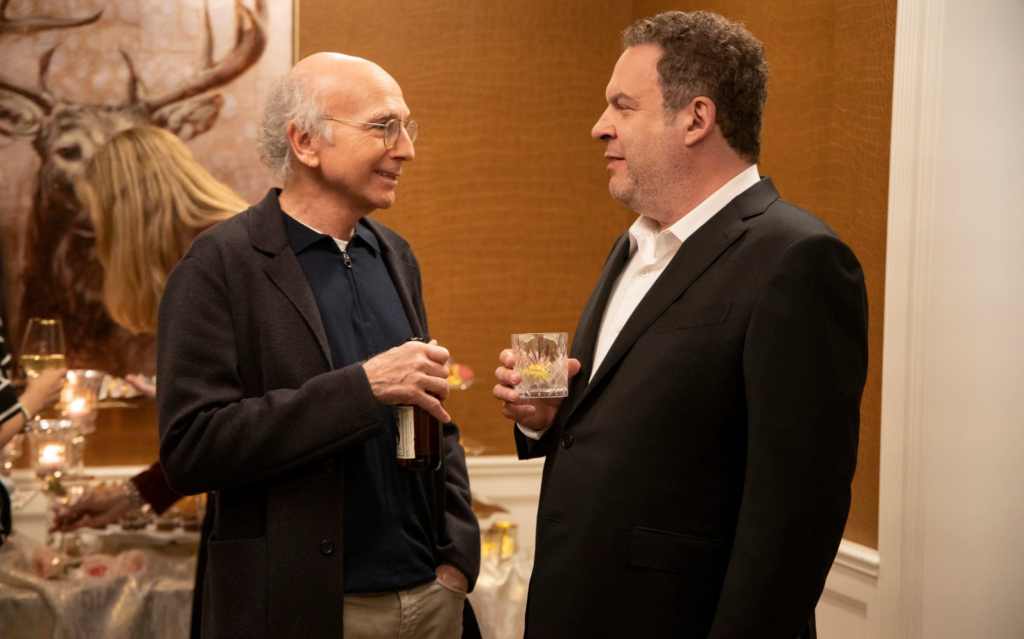
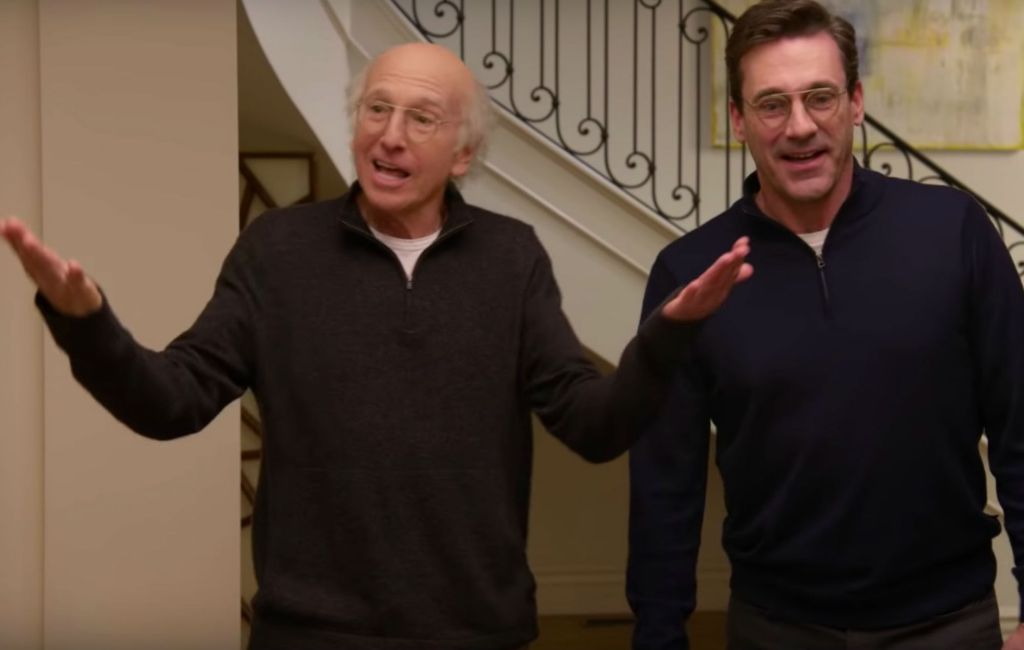
Actor, Jon Hamm, shadows Larry as he prepares to play a character like him in a film. Larry and Leon start a new business venture which initially proves profitable. Cheryl is angered when Larry spontaneously begins a relationship with her sister, Becky.
Highlights: Jon Hamm slowly turning into Larry throughout the episode, culminating in them both being ejected from a dinner party. Also, Kaitlin Olson returning as Becky and the surprising sex with Larry.
Episode 9 – Beep Panic! – (9 out of 10)
Larry strikes up a friendship with a waitress that dripped sweat into his soup. He also becomes obsessed with the liqorice at his car showroom. Meanwhile, Mocha Joe plots his own revenge using DVD film screeners.
Highlights: Leon and Larry succumb to the severe laxative effect of the liqorice in a silly bit of toilet humour.
Episode 10 – The Spite Store! – (10 out of 10)
Latte Larry’s is well and truly open, and it inspires other celebrities to open similar spite stores. Larry is irked by siren abusers and gives a job to Joey Funkhouser, but his big penis causes the store no end of issues.
Highlights: Sean Penn’s opening a spite-driven pet store. All Larry’s innovations at the coffee store ultimately lead to a very explosive downfall.
“NO GOOD?” – CONCLUSION
In preparing for this review I rewatched season 9 and watched season 10 twice. So, it’s obvious to say that I love, Curb Your Enthusiasm. Overall, I found the latest season to be a wonderful mix of old-fashioned slapstick and farce, combined with Larry David’s original and skewed vision of humanity. What was also impressive was the structural coherence of juggling so many comedy plots and situations. Plus, Larry behaves appallingly, and this is very appealing in an ever-increasingly politically correct world. Many times, throughout the season Larry is shown to be a provocative arsehole, but on occasions he very much has a valid point. Larry’s issues are very much first world problems, but because of the skilled writing and consistently high joke rate I related greatly to this season. Plus, Larry doesn’t win. His spiteful plotting and perpetual disagreements with those around him mostly fail. Indeed, ultimately, the joke is always on him.
CAST: Aubrey Plaza, Elizabeth Olsen, Billy Magnussen, O’Shea Jackson Jr., Wyatt Russell, Pom Klementieff,
**CONTAINS MINIMAL SPOILERS**
Grief is something which we will, or have already experienced, and given the dramatic possibilities, death and overcoming the death of a loved one propels many narratives in the cinema, literature and music etc. Ingrid Knows Best is one such narrative and while much is made of the plague that is social media and Instagram culture, this is ultimately a story of how our anti-hero deals with the loss of her mother and, in some ways, her own identity. In short: she doesn’t handle it very well, but rather disassociates her grief and fixates on so-called on-line celebrities in order to distract herself and escape the pain.
Aubrey Plaza is brilliant as Ingrid and she is fast becoming one of my favourite actors. I loved her in Office-influenced sitcom, Parks and Recreation and the brilliant lo-fi-sci-fi-rom-com Safety Not Guaranteed (2012). However, in this film and the mind-bending science fiction series Legion (2017), she completely owns the show. Plaza has a rare skill for vulnerable insanity where she does crazy stuff but at the same time you really empathise with her character.
In the opening scene she commits an act of pretty despicable revenge but once you see her living arrangements and family situation you really gain understanding of her character. Even when Ingrid heads west and begins stalking her next obsession, Plaza’s doe-eyed-butter-wouldn’t-melt façade and crumbling inner humanity ensure you never lose empathy for her. The writing is excellent as the script creates humour, drama and skilful satire of the facile, narcissistic and selfie-obsessed culture we live in today. Elizabeth Olsen too is impressive as the “Instagram Queen” and object of Ingrid’s obsession.
Overall, this was just #brilliant #dark #funny #sad! I was really satisfied with this film and while the slightly off-kilter crime-plot-turn near the end slightly unhinged the character study, the touching and thematically perfect ending was a brilliant pay-off for Ingrid’s character. Plaza though is the shining light of the film as she imbues Ingrid with not only the pathos of a zeitgeist Travis Bickle, but also a comedic mania which really brings the satire home.






/cdn.vox-cdn.com/uploads/chorus_image/image/55991485/Screen_Shot_2017_07_28_at_3.44.06_PM.0.png)
 The Cinema Fix presents