Tag Archives: Netflix

NETFLIX FILM REVIEW – I’M THINKING OF ENDING THINGS (2020)

NETFLIX FILM REVIEW – I’M THINKING OF ENDING THINGS (2020)

Directed by: Charlie Kaufman

Produced by: Anthony Bregman, Charlie Kaufman, Robert Salerno, Stephanie Azpiazu

Screenplay by: Charlie Kaufman (Based on: I’m Thinking of Ending Things by Iain Reid)

Cast: Jesse Plemons, Jessie Buckley, Toni Collette, David Thewlis

Music by: Jay Wadley

Cinematography: Łukasz Żal

***MAY CONTAIN SPOILERS***


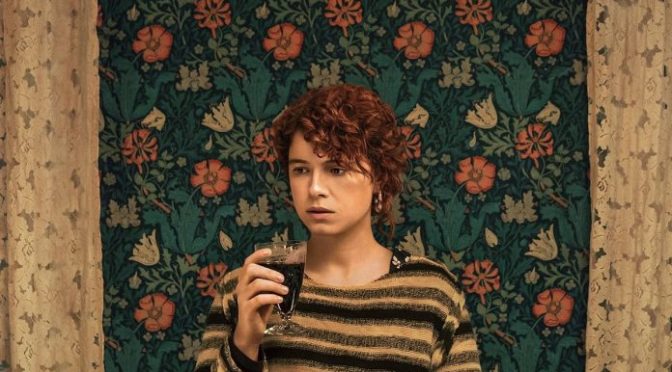
I read some background information online about Charlie Kaufman’s latest film adaptation for Netflix, I’m Thinking of Ending Things (2020), and there is a leaning to describe it as a psychological horror. Of course, in order to market their films, studios write copy to entice an audience for their film. However, this adaptation of Iain Reid’s novel is far more than a psychological horror. It has elements from a whole plethora of genres including: surrealism, comedy, romance, thriller, arthouse, road movie, and even dance, animation and musical genres. Safe to say that once again Charlie Kaufman has delivered yet another ingenious cinematic smorgasbord that defies easy categorization. But is it any good?

The film opens gently with the lilting voice of Jessie Buckley’s voiceover. We hear her character deliver a set of poetic existential queries, and her mantra throughout the film: “I’m thinking of ending things. . .” over a set of seemingly unconnected images. She waits for her boyfriend of a couple of months, Jake (Jesse Plemons), as they plan to meet his parents, portrayed by David Thewlis and Toni Collette, for the first time at their farm. So far, so straightforward; kind of. However, as Jake and the young woman’s (whose name changes during the film) drive through picturesque and snowy landscapes, Kaufman intercuts to an elderly Janitor going about his cleaning duties at a high school. How these juxtaposed situations eventually marry together is open to many interpretations. While certainly obtuse and narratively impenetrable to many, I really connected with Kaufman’s surreal trip. Because I’m Thinking of Ending Things (2020) is certainly as much about the journey than the ultimate destination.


As he has demonstrated since his debut feature film screenplay, Being John Malkovich (1999), Kaufman has an urgent desire for original invention, sight gags, existential examination, exploration of mental health, relationship breakdowns, non-linear structure and intellectual discourse. The respective journeys of characters like Jake and the young woman are taken by road and in the mind. Whose mind the film is in and out of is also open to question. The car journey is treacherous both due to the weather and the anxious tension between the couple. This is brought about by the young woman desiring to end things. Is it her life or her relationship she wants to end? Or is it both? Things between the two aren’t made easier by the surreal visit to Jake’s parents’ farm. Thewlis and Collette inject much humour and pathos into their characters. Their performances, a succession of visual punchlines and the brilliant dialogue combine to really bring the film to life during the middle act.

After the couple leave the parents’ farm and head back home, events get even stranger as connections with the aforementioned Janitor intensify. An extremely anxious pitstop at an ice-cream parlour, an animated pig and a ballet dance sequence threatened to destabilize the narrative. But once I had suddenly interpreted my truth and understanding of Iain Reid’s and Kaufman’s vision, it all kind of almost made sense. Indeed, compared to Kaufman’s surreal meta-fictional masterpiece, Synecdoche, New York (2008), I’m Thinking of Ending Things (2020) is arguably more accessible, funnier and less bleak.

Having said that, given Kaufman’s predilection for characters on the edge of nervous, depressive and existential breakdowns, some may find this film’s journey tough to complete. But I loved the invention and constant ideas on show throughout. Kaufman’s takes risks structurally, visually and thematically and I congratulate him for challenging the audience. Lastly, I’m Thinking of Ending Things (2020) has a wondrously cinematic look, sound and dreamlike feel to it. Plus, in Jessie Buckley and Jesse Plemons, Kaufman has cast two exceptional acting talents, who are certainly worth going on the road with. However, bizarre and twisted that road may be.

Mark: 9 out of 11


NETFLIX FILM REVIEW: JUNGLE (2017)

NETFLIX FILM REVIEW: JUNGLE (2017)

Directed by: Greg McLean

Produced by: Todd Fellman, Mike Gabrawy, Gary Hamilton, Mark Lazarus, Dana Lustig, Greg McLean

Screenplay by: Justin Monjo

Based on: Jungle by Yossi Ghinsberg

Cast: Daniel Radcliffe, Alex Russell, Thomas Kretschmann, Yasmin Kassim, Joel Jackson, Jacek Koman etc.

Music by: Johnny Klimek

***MAY CONTAIN SPOILERS***


It’s one of my least favourite sub-genres of cinema and literature: the survivalist story. Don’t get me wrong, I have nothing against an individual striving to find themselves or seek out adventure. I don’t wish them ill or death and am glad they somehow survived, or alternatively, not glad they perished. However, I do have problem when it all goes wrong and they end up gaining fame or money or praise for poor life choices. They are not heroes or heroines but narcissistic thrill seekers, generally from a privileged standing who get films made about them as apparently their stories are inherently cinematic.

Begrudgingly, I admit, in many circumstances such as: 127 Hours (2010), Into the Wild (2007) and Touching the Void (2003), survivival stories create compelling film narratives. Alas, the film Jungle (2017) is nowhere near as good as those films I mention, but it provides a means to escape to the dark corners of the Amazon from the comfort of one’s own living room.  The moronic characters we follow into said jungle are led by Daniel Radcliffe’s, Yossi. He and two friends decide, against the advice every audience member screaming at the screen, to broaden their selfish adventurous spirits by going native with Thomas Kretschmann’s shady German guide. Safe to say, after experiencing the unforgiving terrain, torrential rain and strange creatures in the jungle, this middle-class trio find they are well out of their depth. Thus, very slowly the film crawls like a giant slug toward further catastrophe.

Jungle (2017) is not a bad film, but it isn’t a particularly good one. The direction and cinematography are excellent and Daniel Radcliffe proves he is an exceptionally honest actor. Radcliffe works his guts out with a shell of a character we rarely care about or empathise with. Perhaps that’s the point? Maybe it’s a cautionary tale about how Yossi stops being such an arsehole and learns to appreciate life and the environment. My main issue was the screenplay, which rushes to get us in the jungle and then takes an age to get to the real drama. What was great about a film like Into the Wild (2007), also based on a true story, was Christopher McCandless was a character who rejected society to find his own place in the world. He wasn’t just a tourist on a holiday that went a bit wrong. I mean, in Jungle (2017), people lost their lives, but the greatest tragedy was the film doesn’t make us care about them at all.

Mark: 6 out of 11


NETFLIX FILM REVIEW: HIS HOUSE (2020)

NETFLIX FILM REVIEW: HIS HOUSE (2020)

Directed by: Remi Weekes

Produced by: Aidan Elliott, Martin Gentles, Arnon Milchan, Ed King, Roy Lee

Screenplay by: Remi Weekes

Story by: Felicity Evans, Toby Venables

Cast: Wunmi Mosaku, Sope Dirisu, Matt Smith, etc.

Cinematography: Jo Willems

***MAY CONTAIN SPOILERS***


Similar in spirit to the Jacques Audiard directed film, Dheepan (2015), the latest Netflix film release, His House (2020), takes the migrant experience as a key narrative driver, then filters it through exciting genre style. While Dheepan (2015) started as a story of survival before crossing over into thriller territory, His House (2020) superbly combines social commentary with the horror genre. Moreover, a key plot reveal later in His House (2020) is extremely similar to that found in Dheepan (2015). Nonetheless, it is a powerful film, both unnerving and thought-provoking in equal measure.

His House (2020) introduces us to Bol (Sope Dirisu) and Rial (Wunmi Mosaku), a refugee husband and wife seeking asylum in Britain from South Sudan. Having survived a treacherous journey from this war-torn part of the world, their young daughter is not so lucky. Alas, Nyagak (Malaika Agibaka) dies during a stormy boat journey. This incident and their social status immediately garners sympathy and empathy for the protagonists. Allied to this, on achieving probational asylum status their jaded case worker, Mark (Matt Smith), brings them to a rundown council estate to live in. It is to Bol and Rial’s credit that they accept their new abode with gratitude. Bol especially is keen to mix with the locals and fit into the British way of living. However, the two soon encounter indifference, racism and prejudice.

This image has an empty alt attribute; its file name is 1024px-his_house_film_poster-1.png

As the narrative continues Bol and Rial have more to contend with than ignorant locals. Rial is resistant to integration as she desperately holds onto her Sudanese clothes and customs. While Bol is clearly trying to distract himself from the tragedy, Rial’s grieving takes the form of clinging onto the memory of her daughter and their Sudanese ways. This familial division is exacerbated by disturbing supernatural phenomena, as a strange dark spirit and the ghost of Nyagak both appear. Could it be grief and guilt manifesting such spectres? Or are they suffering from post-traumatic stress following their harrowing journey to Britain? Or has a genuinely evil spirit hijacked their attempts to build a home and find peace?

Declaring himself as a director to keep tabs on, Remi Weekes, has written and directed an excellent first feature film in, His House (2020). The pacing of the story is excellent as we get flashes of Bol and Rial’s past in Sudan, juxtaposed with their attempts to acclimatise in Britain. As someone whose life is extremely privileged when compared to that of such characters, I was both moved and fearful for the protagonists. This is not only down to an excellent script full of subtext, symbolism and dread, but also due to Sope Dirisu and Wunmi Mosaku’s compelling performances. Furthermore, you really feel the pain of the couple’s loss and suspense created by that which lurks within the stained walls of their apartment. While there are many tense moments, my one reservation with His House (2020) was there arguably wasn’t enough true horror moments. Having said that, the actual reality of Bol and Rial’s situation in losing a daughter, suffering British administrative red-tape and living amidst everyday prejudice, is far scarier than ghosts and monsters can ever be.

Mark: 8.5 out of 11

NETFLIX FILM REVIEW: THE DEVIL ALL THE TIME (2020)

NETFLIX FILM REVIEW: THE DEVIL ALL THE TIME (2020)

Directed by: Antonio Campos

Produced by: Jake Gyllenhaal, Riva Marker, Randall Poster, Max Born

Screenplay by: Antonio Campos, Paulo Campos

Based on: The Devil All the Time by Donald Ray Pollock

Cast: Tom Holland, Bill Skarsgård, Riley Keough, Jason Clarke, Sebastian Stan, Haley Bennett, Eliza Scanlen, Mia Wasikowska, Robert Pattinson, Harry Melling, etc.

Narrated by: Donald Ray Pollock

Music by: Danny Bensi, Saunder Jurriaans

Cinematography: Lol Crawley

***MAY CONTAIN SPOILERS***


Netflix’s latest major film release is a literary adaptation of Donald Ray Pollock’s psychological thriller, The Devil All the Time (2020). One has to believe it is a pretty faithful adaptation because the novelist himself narrates the tale to us via voiceover. Set in the years after World War II, the grim events unfold in the states of Ohio and West Virginia, respectively. While the action is not located in the deep South, the story has many of the tropes synonymous with the Southern Gothic genre, notably: religious fanaticism, explicit sexuality, flawed characters, sickening violence, poverty and human alienation.

The film, directed by Antonio Campos — who helmed the under-rated character study, Christine (2016) — starts extremely purposefully. Returning soldier, Miller Jones (Bill Skarsgard), meets a waitress on his bus journey home and eventually marries her. Both Skarsgard and Hayley Bennett, portraying his wife, inhabit empathetic characters working hard to bring up their son and saving for their own place. Jones, however, is haunted by a traumatic incident in the Pacific, and strives for solace in God and family. Indeed, the corrupt force of religious mania spreads like a cancer throughout The Devil All the Time (2020), becoming a constant threat and reason for many of the characters downfall.


Just as I was connecting with Jones’ life and becoming absorbed by Bill Skarsgard’s commanding performance, tragedy strikes and the narrative takes one of several jarring switches between characters. As such the film does not really have a strong plot, meandering from one character to another witnessing all manner of horrific events fate throws at them. Because, let’s be honest, The Devil All the Time (2020), is no way close to being a feelgood film. In fact, it revels in representing the evil acts of so-called human beings. Thus, throughout I felt a constant sense of dread and anxiety. Barely had Skarsgard misery ended and we are then introduced to the tragedies of characters portrayed by Harry Melling and Mia Wasikowska. Simultaneously, Jason Clarke and Riley Keough join the fray as two violent and sex-driven thrill-seekers. Yet, they are weakly written characters who again drive the mood of the film into pitch blackness.

The film gathers some strength and momentum n the middle act when Tom Holland’s son of Miller Jones comes of age. By focussing on his story we get more drama and emotion, especially where his relationship with his step-sister (Eliza Scanlan) is concerned. Holland gives an excellent performance as the young man attempting to make his way in this filthy and ungodly world. Similarly, Robert Pattinson’s oily Preacher oozes repugnant charm in another sterling piece of acting work. Alas, Sebastian Stan’s Sheriff and Douglas Hodge’s rural gangster are given short shrift in another crime subplot which goes nowhere.

Overall, Antonio Campos delivers an extremely solid thriller from an acting and thematic standpoint. Unfortunately, the fragmented screenplay should arguably have been given a more committed plotline. Of course, it has most likely shadowed the structure of the source novel so therein lies the rub. Having said that, despite the structural shortcomings, there are many shocking and violent set-pieces to satisfy horror fans. Ultimately though, The Devil All the Time (2020) lacks redemption, catharsis and even some decent suspense. By the end we are given few characters to care about and delivered the pessimistic vision that life is a belt of misery. Even a suggestion of sugar helps the poison go down and this film offers very little in the way of sweetness or light.

Mark: 7.5 out of 11


“CINEMA” REVIEW: THE NIGHTINGALE (2019)

“CINEMA” REVIEW: THE NIGHTINGALE (2019)

Directed by: Jennifer Kent

Produced by: Kristina Ceyton, Steve Hutensky, Jennifer Kent, Bruna Papandrea

Written by: Jennifer Kent

Cast: Aisling Franciosi, Sam Claflin, Baykali Ganambarr, Damon Herriman, Harry Greenwood, Ewen Leslie, Charlie Shotwell, Michael Sheasby, etc.

Music by: Jed Kurzel

Cinematography: Radek Ladczuk

***MAY CONTAIN SPOILERS***


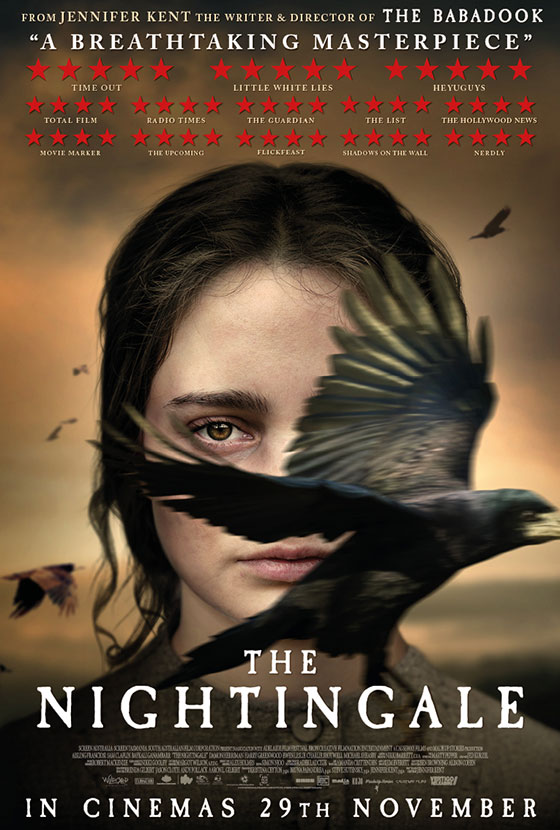
THE NIGHTINGALE (2019) is a brutal film about rape and murder. It’s about the rape of an individual. The rape of a nation. The murders of youth, race, nature, humanity and life itself. It is an extremely powerful and impactful viewing experience, but not for those of a faint heart or sensitive disposition. When released it caused much controversy with some audience members walking out during festival screenings. This is no doubt due to several scenes displaying sickening moments of violence against men, women and children. However, the director Jennifer Kent, has not written and helmed a mere exploitation revenge film here. Instead, she has fashioned a beautiful and ugly tragedy, which prevails damning indictment against masculine savagery, colonialism and British rule.

Set in 1825 in the penal colony of Van Diemen’s Land (presently Tasmania), THE NIGHTINGALE (2019), follows a young female convict seeking revenge for an unspeakable act of violence committed against her family. Clare Carroll, nicknamed “Nightingale” due to her lovely singing voice, is a young mother and wife looking to be given her freedom. It is held by Sam Claflin’s abusive British officer, Hawkins. Rather than free her he decides to thrust himself upon her sexually. Yet, when she rebuffs his drunken and lurid behaviour, he goes mob-handed to take her. Then when her husband intervenes, Hawkins and his soldiers act without honour or courage, leaving a family wrecked in their wake.


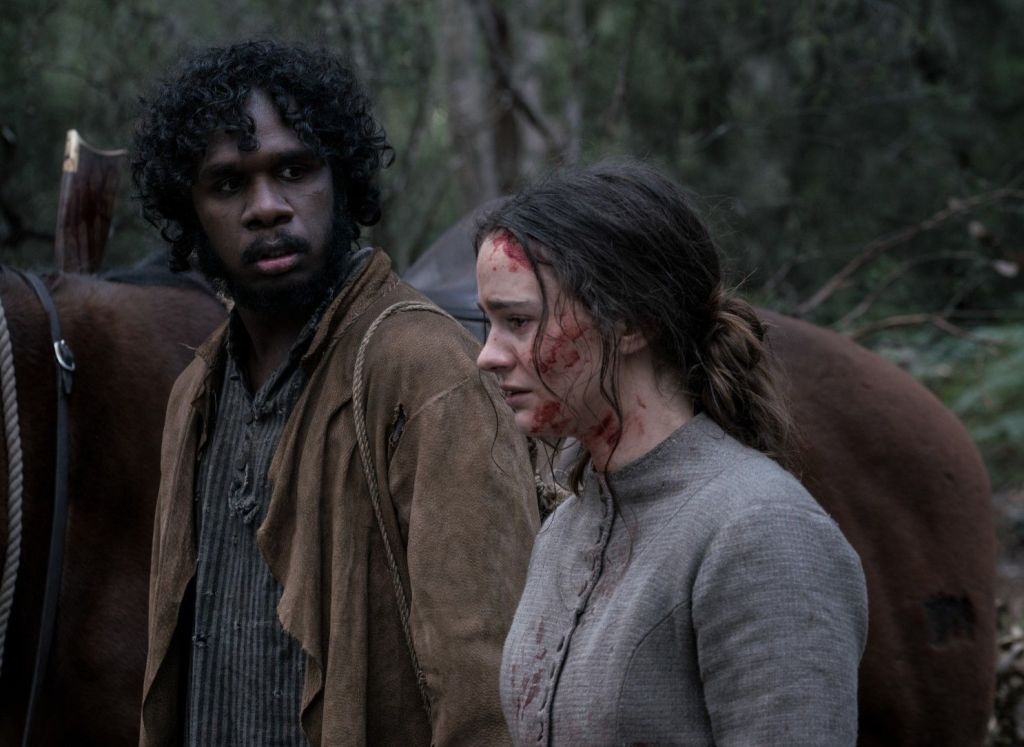
Hawkins and his men venture through the bush to Launceston the next day, to gain a promotion from the top brass he believes he deserves. Claire rallies and pursues them with bloody revenge in mind. She is assisted in her search by Aboriginal guide, “Billy” Mangana (Baykali Ganambarr). Billy is initially reluctant to chase British soldiers. Not surprising as the British have ravaged his people, land and culture, leaving the indigenous people outcasts in their own country. While Claire and Billy initially conflict they soon realise they have a common foe. Thus, while revenge supplies the bones for the narrative, the screenplay fleshes out their chase with intriguing cultural clashes and reconciliation. Indeed, the unlikely pair will eventually come to respect each other’s differences and find common ground over the course of the story.

Having received much critical acclaim with the low-budget horror film THE BABADOOK (2014), Jennifer Kent has moved from inner demonic possession to a more epic and external approach to horror. Because amidst the bucolic wonder of the Australian wilderness, the British brought death and chaos to the area. While one understands the need to have a place to house its prisoners (the barbarous treatment of the working classes is a whole different story), the rapacious desolation of the indigenous culture is a vital message within the film. Claire Carroll and Billy Mangana are symbols of a lost and damaged generation. They are emblems of people who deserve justice and reparation. Moreover, the message remains valid today, especially with the rise of the alternative-right and the continued sexual abuse faced by women everyday. Lastly, with a moving and tough leading portrayal by Aisling Franciosi, Baykali Ganambarr providing a spiritual heart, and Sam Claflin giving a fearlessly repugnant representation of British aggression, THE NIGHTINGALE (2019), tells a horrific, disturbing, but righteously relevant tale.

Mark: 9 out of 11


NETFLIX REVIEW: DARK (2020) – SEASON 3 – AND SO CONCLUDES ONE OF THE BEST TV DRAMAS EVER MADE!

NETFLIX REVIEW: DARK (2020) – SEASON 3

Created by: Baran bo Odar, Jantje Friese

Written by: Jantje Friese, Ronny Schalk, Marc O. Seng, Martin Behnke, Daphne Ferraro

Directed by: Baran bo Odar

Cast: Louis Hofmann, Karoline Eichhorn, Lisa Vicari, Maja Schöne, Stephan Kampwirth, Jördis Triebel, Andreas Pietschmann, Paul Lux, Moritz Jahn, Christian Hutcherson, Oliver Masucci, Peter Benedict, Gina Stiebitz, Deborah Kaufmann, Daan Lennard Liebrenz, Julika Jenkins, Carlotta von Falkenhayn, Tamar Pelzig, Dietrich Hollinderbäumer, Mark Waschke, Leopold Hornung, Christian Pätzold, Will Beinbrink, Hermann Beyer, Christian Steyer, Lisa Kreuzer, Anne Ratte-Polle, Walter Kreye, Lydia Maria Makrides, Tom Philipp, Nele Trebs, Tatja Seibt, Lea van Acken, Shani Atias, Max Schimmelpfennig, Ella Lee, Peter Schneider and many more.

Composer(s): Apparat, Ben Frost

Executive producer(s): Justyna Müsch, Jantje Friese, Quirin Berg, Max Wiedemann, Baran bo Odar,

Cinematography: Nikolaus Summerer

Original Network: Netflix

***MAY CONTAIN SPOILERS***


“Time is an illusion.” ― Albert Einstein


And so the end is nigh, and we reach the final season of uber-drama, DARK. If you have Netflix and you like to have your mind scrambled and heart moved, then I urge you to watch it. It is easily one of the best television dramas I have seen in a long time. It’s edgy, nightmarish, confusing, twisted and to be honest, virtually unreviewable. I say that because I don’t want to give away any spoilers but, trust me, if you like emotionally, structurally and artistically complex plots involving multiple characters, locations and timelines then this German thriller is for you. It had me confused in a good way and totally immersed in the plot and characters. You will be lost, searching for the light, yet you will be astounded too by the audacity of the writing, direction and looping insanity of the show.

Time, space and dimensional rifts are central to the drama. The cycles of life and death are also integral within the fabric of DARK. The action occurs in the German town of Winden as the narrative entwines the past, present and futures of four families: Kahnwald, Nielsen, Doppler, and Tiedemann.  One could argue that the state of Saṃsāra is invoked as a key theme. Saṃsāra is a fundamental concept in all Indian religions. It is linked to the karma theory, and refers to the belief that all living beings cyclically go through births and rebirths. The term is related to phrases such as the cycle of successive existence, including the karmic cycle or the wheel of life. What occurs within the twenty-six episodes of DARK is a cyclical lunar convergence of 33 years, taking place initially in 1987 and 2020. Well, that’s just in season one. From season two onwards things temporally twist beyond into other years on the cycle.

During season two and much of season three I was often lost with the various characters criss-crossing each other on different timelines and at various ages of their lives. I finally found some semblance of understanding in DARK, after much frustration and almost giving up, by distilling the events to the human strands of childhood, adulthood and old age. Like a moving vision of Titian’s painting, The Three Ages of Man, all the major characters, notably Jonas Kahnwald, Claudia Tiedemann and Ulrich Nielsen, feature in these three stages of existence. Interestingly, the programme events show they have different agendas and perspectives, with older versions either teaching their younger selves or acting as their own nemesis. Proving that existentially speaking life is ultimately a constant battle with oneself.


Temporal paradox is central also to DARK. More specifically, it features the Bootstrap Paradox. This refers is a theoretical paradox of time travel that occurs when an object or piece of information sent back in time becomes trapped within an infinite cause-effect loop in which the item no longer has a discernible point of origin. Indeed, closed causal loops, such as the Predestination Paradox or Bootstrap Paradox, find time running in a repeating circle. When such circles over-lap in DARK, conflict is derived in the story because certain characters are trying to keep the loops going and others are trying to destroy them.

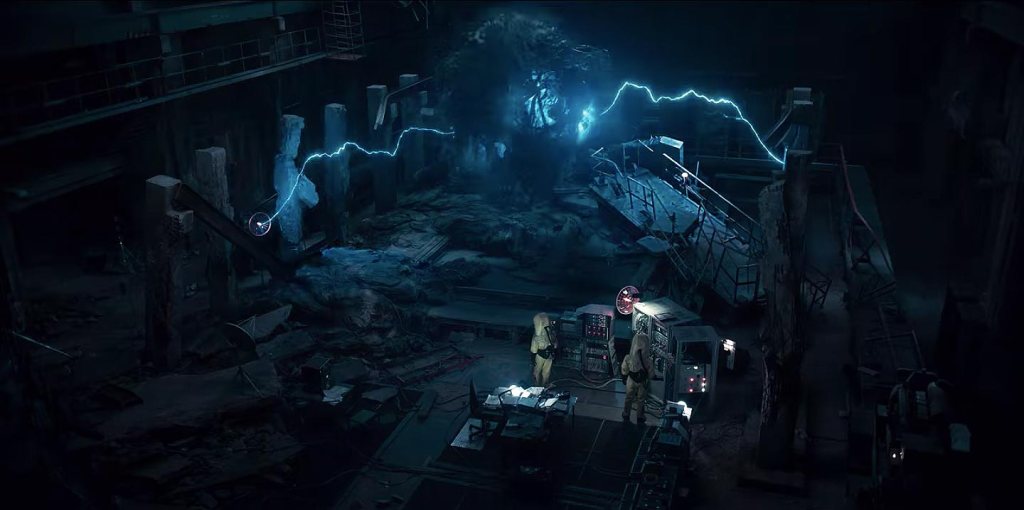
Which brings us to another major theme of the drama, the death of the self and death of the world. With the spectre of Chernobyl hanging over the town of Winden, the nuclear power station becomes a central harbinger of catastrophe throughout the various cycles. In the early years it is a beacon of prosperity, energy and employment. In later years it is the precipitous location for the apocalypse. Lastly, philosophically the textual richness in DARK is endless. While temporally speaking the looping timelines can be confusing, the final season, while leaving many questions unanswered provides a satisfying closure to this extremely human story. Amidst the science fact and fiction and philosophical explorations of life and death this is ultimately a television series about family and community. Because as soon as the cracks begin to show in the family unit we are destined to fall through the fissures of destiny. Only together can we conquer fate; but only if time allows.

Mark: 10 out of 11


ALL 4 TV REVIEW – FRIDAY NIGHT DINNER (2011 – 2020)

ALL 4 TV REVIEW – FRIDAY NIGHT DINNER (2011 – 2020)

Created and written by: Robert Popper

Directors: Steve Bendelack, Martin Dennis

Cast: Tamsin Greig, Paul Ritter, Simon Bird, Tom Rosenthal, Mark Heap, Tracy Ann Oberman, etc.

Number of Seasons: 6 (37 episodes)

Original Network: Channel 4

*** MAY CONTAIN SPOILERS ***


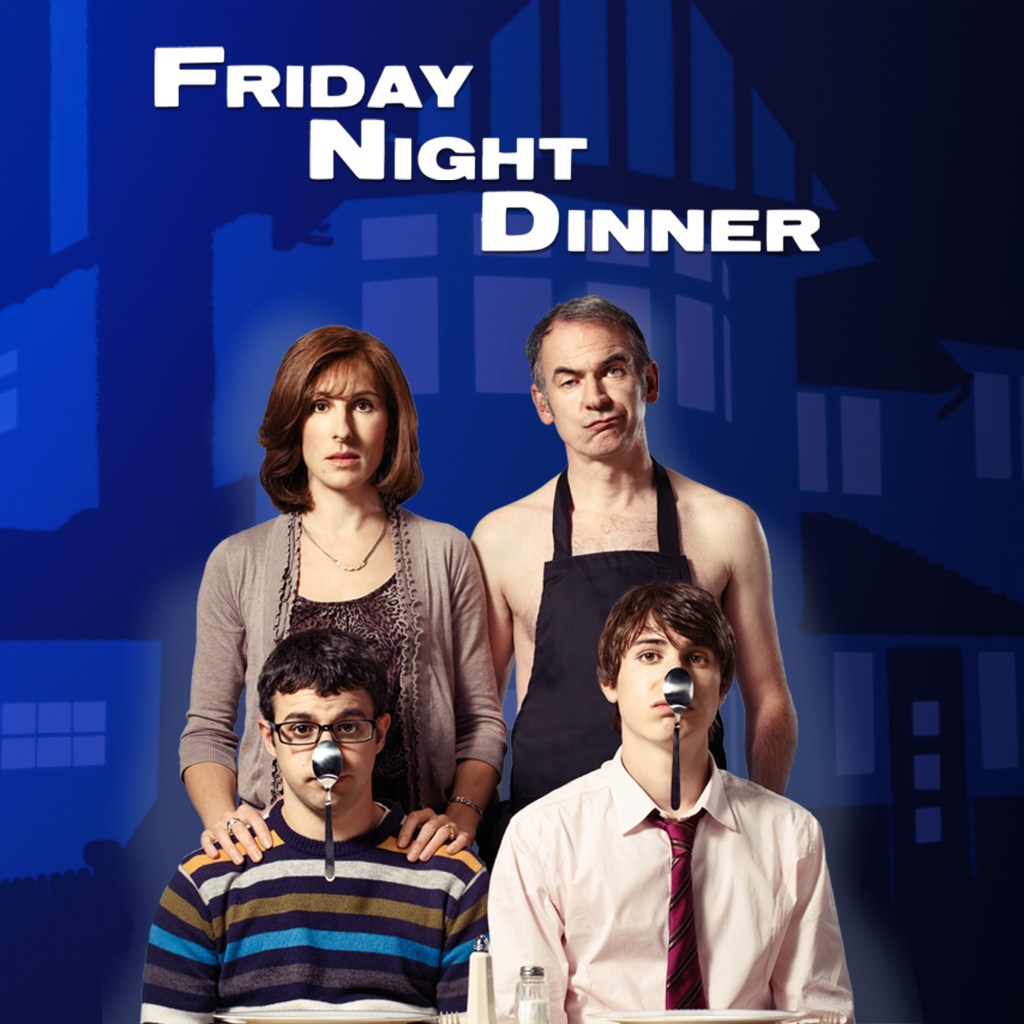
I decided to take a break from watching the usual murder, drama, time-travel, fantasy and crime-based TV shows I gravitate toward, by bingeing all six seasons of the Channel 4 (also available on Netflix) family situation comedy, Friday Night Dinner. Created and written by Robert Popper, this hilarious, energetic and feelgood show is set within the Goodman family household in North London. While recent British comedies such as The Mighty Boosh, Spaced and Psychoville tended toward the meta-fictional and surreal genre of humour, Friday Night Dinner is very much a traditional family-based programme. The laughs come thick and fast from the characters and events that unfold during a traditional Jewish Friday night meal.

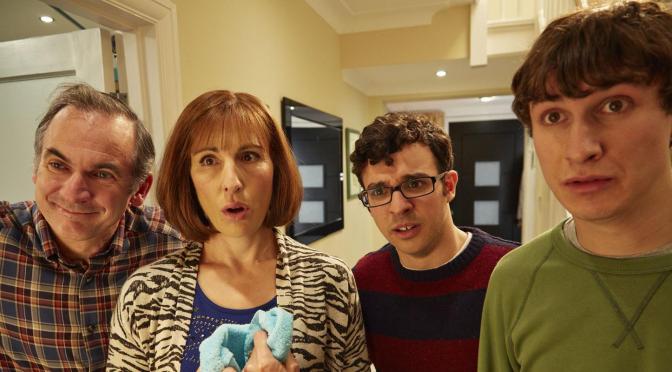
Friday Night Dinner establishes a very structured formula and sticks to it pretty much through all the six seasons. Each episode usually opens with the “bambinos” or “the boys”, Adam (Simon Bird) and his younger brother, Jonny (Tom Rosenthal), arriving at their parent’s home. There they are greeted by half-dressed father, Martin (Paul Ritter) — who often has his shirt off because he is “boiling” — and their doting mother, Jackie (Tamsin Greig). Several story strands then quickly unravel as dinner, more often than not, descends into chaos and farce. Dinner table conversation usually revolves around Mum and Dad asking if their sons have any “females” or romantic entanglements. Moreover, the parents often embarrass their kids by over-sharing details of their own sex life, or “nippy-nippy”, as they call it.


The humorous dialogue, family squabbles and constant banter is augmented by Jonny and Adam’s consistently hilarious prank pulling, plus the appearance of the Goodman’s very strange neighbour, Jim (Mark Heap) and his dog, Wilson. Where comedy series like Taxi had Latka and Seinfeld had Kramer, Jim is a similar oddball whose weird behaviour makes the rest of the family almost seem normal. I mean, the father Martin, while very eccentric in his ways, is positively sane when compared to Jim. Actually, I very much enjoyed Jim’s ridiculous attempts to “understand” the Jewish culture. His hapless ignorance often sees Jonny and Adam Goodman giving him false information about their traditions, leading to all manner of ridicule and misunderstanding. This is one of the many running gags the writer, Robert Popper, entwines throughout the six series. Such repeated jokes and funny catchphrases are the comedic fabric of a very well written and constructed show.

If you’re looking for a comedy that reinvents the wheel, then award-winning Friday Night Dinner is probably not for you. However, if you like traditional farcical comedy with fast-paced gags, physical slapstick and relatable everyday situations, then you should definitely check it out. The cast are absolutely brilliant, and all imbue their characters with likeability, empathy and just a touch of insanity. Tamsin Greig shines as the put-upon mother having to deal with her bickering sons, and hard-of-hearing husband, Martin, who is never far from causing a home disaster. I loved Paul Ritter as the in-his-own-world-hoarder, Martin, while Simon Bird and Tom Rosenthal add to the fun with their sharp comedy timing and physical hilarity. Above all else, the series works fantastically well as a comedy of errors about a warm-hearted, loving, if hopelessly dysfunctional family unit.


SIX OF THE BEST FRIDAY NIGHT DINNER EPISODES (ONE PER SERIES)

The Date – Series 1 – Episode 6 – Jackie invites a girl around for date with Adam. The only problem is Adam knows nothing about it, and he is mortified with embarrassment. At the same time, Jonny revels in Adam’s horror.

Mr Morris – Series 2 – Episode 2 – Jackie’s mother has a new gentleman friend and he has come to dinner. Mr Morris though, turns out to be very aggressive and ruins the night for everyone.

The Fox – Series 3 – Episode 3 – Martin has a dead fox in the freezer, which he intends to stuff. He asks the boys to help him extricate it to the shed without Jackie noticing. Safe to say things don’t go according to plan.

The Funeral – Series 4 – Episode 5 – Martin’s Uncle Saul has unfortunately passed away meaning they must spend the day at a funeral, and even worse, spend time with Martin’s mother AKA “Horrible Grandma.”

The Tin of MeatSeries 5 – Episode 2 – Aunty Val has been staying with the family as she is getting a divorce. Martin despairs as Val keeps throwing away all of his stuff. Finally, Martin and Val clash big time over a twenty-year old tin of meat.

The Caravan – Series 6 – Episode 1 – Martin purchases a crappy old caravan and, to Jackie’s dismay, parks it outside the house. Meanwhile, Jim has a new addition to his household, but becomes obsessed with the caravan toilet.

Mark: 9.5 out of 11


NETFLIX TV REVIEW – DIRTY JOHN (2018)

NETFLIX TV REVIEW – DIRTY JOHN (2018)

Created by: Alexandra Cunningham

Based on articles and podcast: Dirty John by Christopher Goffard

Directed by: Jeffrey Reiner

Writers: Alexandra Cunningham, Christopher Goffard, Sinead Daly, Lex Edness, Kevin J. Hynes, Evan Wright, Diana Son, etc.

Producer(s): Melinda Whitaker, Christopher Goffard, Nan Bernstein Freed, Jonathan Talbert, etc.

Cast: Connie Britton, Eric Bana, Juno Temple, Julia Garner, Jean Smart, Shea Whigham, Alan Ruck, Kevin Zegers, etc.

Composer: Mark Mothersbaugh

Original networks: Bravo (USA) and Netflix (UK)


Such is the veracious appetite journalists, writers, filmmakers, TV producers, podcasters and the audience have for true crime stories, it’s no surprise that the life of con-man, John Meehan, and his victims, was turned into a thrilling eight-part drama shown on Bravo and Netflix respectively. After decades of cons, fakery, impersonations, drug addiction, robberies, lawsuits, insurance scams, harassment, spying, stalking and consistent lying, Meehan’s criminal activities came to an end as recently as 2016. Meehan had been trained in the “art” of the con by his father from a young age. Alas, his nature could not, unlike his sister, overcome such spurious nurture and Meehan was destined for a life of crime. They say truth is stranger than fiction and that is very much the case here with some of his venomous antics quite unbelievable. However, Meehan must have had so much charm and confidence to trick the many women he deceived, his character sadly stands as a heinous example of toxic masculinity.

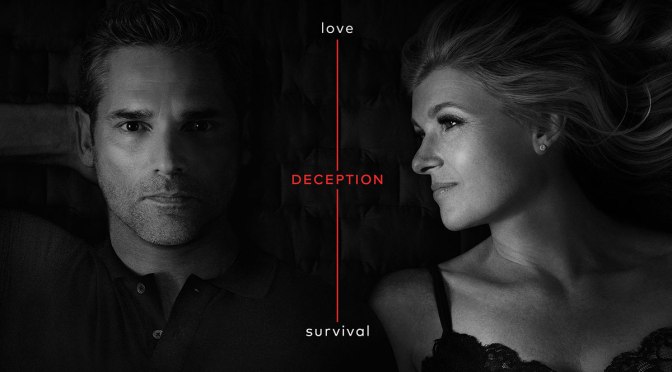
Eric Bana portrays John Meehan in Dirty John (2018). Bana is an excellent actor and arguably, based on his breakthrough performance in the film, Chopper (2000), one who I thought would achieve possibly more critical acclaim. His career is full of sterling work though and his handsome looks and rugged charisma are perfectly utilised as John Meehan. Indeed, when we first encounter him he is meeting Debra Newell (Connie Britton) for a date. After a sticky start the romance develops very quickly. Debra is a wealthy interior designer with her own business, and her character is exceptionally kind, but somewhat gullible. Even when her kids, Veronica (Juno Temple) and Terra (Julia Garner), warn her that something is rotten about John, her desire for John overcome any doubts she may harbour. As Debra, Connie Britton gives a brilliant representation of a woman who is desperate for love and companionship. Having said that, Juno Temple steals every scene as the mouthy daughter, Ronnie, someone who is certainly way more suspicious of John than her good-natured mother.


Structured around John and Debra’s developing romance are flashbacks to John’s prior relationships and crimes. While he is shown to be a really bad man, context is given during scenes from his youth. His father, portrayed by the excellent character actor, Shea Whigham, has young John eating a Taco with glass placed in it, so he can scam the restaurant. Such twisted examples of dire parenting give reason to John’s later behaviour, however, they should not excuse his actions in adulthood. They also explain John’s dependency on narcotics. This addiction to opiates, as well as a sociopathic desire to lie and cheat, drive the character and narrative powerfully. In the scenes where Debra, having incredibly given John another chance, helps him go cold turkey, Bana’s acting levels are most impressive.

As the drama proceeds and Debra and her daughters begin to discover the crimes of John’s past they themselves become targets of his malevolence. John is a beast Debra has alas invited into her life and one feels so much empathy for her and his other victims. Moreover, even when cornered and accused John Meehan is at his most dangerous. He often savagely attacked his accusers and their family members with severe vengeance. But, the scariest part for me was that he was “qualified” to be a Certified Registered Nurse Anaesthetist; a profession he exploited to rob and feed his drug addiction. Ultimately, I can recommend Dirty John (2018), to those who enjoy absorbing crime dramas. Some shows, with such “real life” narratives, can be exploitational in tone. However, this is a high quality production with excellent acting, writing and directing throughout. It really was edge-of-your-seat viewing, with Eric Bana’s multi-dimensional acting delivering a true monster for the millennium.

Mark: 8.5 out of 11


NETFLIX DOCUMENTARY REVIEW: DIRTY MONEY (SEASONS 1 & 2)

NETFLIX REVIEW: DIRTY MONEY (S1 – S2)

Directors: Alex Gibney, Jesse Moss, Erin Lee Carr, Kristi Jacobson, Brian McGinn, Fisher Stevens, Dan Krauss, Zachary Heinzerling, Daniel DiMauro, Morgan Pehme, Stephen Maing, Kyoko Miyake, Margaret Brown

Executive producer(s): Adam Del Deo, Yon Motskin, Lisa Nishimura, Stacey Offman, Jason Spingarn-Koff, Alex Gibney

Production company(s)  Jigsaw Productions

Distributor: Netflix


Do you remember that scene in The Matrix (1999)? Not the famous one where Neo (Keanu Reeves) is given the choice of taking the red pill or blue pill. Not the scene where he is told the blue pill will allow him to remain in the fabricated reality of the ‘Matrix’; whereas the red pill will let him locate his body in the real world to be “unplugged” from the ‘Matrix.’ No, I’m talking about the scene where Cypher (Joe Pantoliano) asks specifically to be sent back into the ‘Matrix’, so he can forget about the horrific nature of his reality. He’s so sick of feeling powerless and fighting against a system he cannot beat, he is prepared to sell out his comrades and go back to blissful ignorance of the alien control machine. I call this unenviable and traitorous decision, “Cypher’s Choice.” I mean, he’d taken the red pill, but the truth was so unpalatable he wanted to reverse it and live in an artifical fiction.

‘Cypher’s Choice’ is one that can face many of us who have a modicum of thought, sensitivity and understanding of the world we live in. It’s also something which struck me when watching both seasons of the superior Netflix documentary, Dirty Money (2019 – 2020). Here is a very well produced, researched and edited set of films which really make one question the very core of human behaviour. This capitalist system which we live in just continues to produce unbelievable greed, corruption and questionable, almost psychopathic, acts of abuse. More often than not the individuals, corporations and governments perpetrating these morally repugnant acts are even acting within the law, or some twisted version of it. So, does one just accept that we are living in a cesspool of greed, hypocrisy and sociopathic moneymen? Further, does one accept one is powerless to stop it? Does one take ‘Cypher’s Choice’ and head back into the ‘Matrix’? Or fight the machine? It’s an incredibly difficult decision to make.


One way of fighting back or, at the very least holding a mirror up to the corruption in the world, is a trial by media. Conversely, Dirty Money (2019 – 2020), presents a frightening, but compelling series of documentaries featuring some illuminating exposes into negative, and illegal, corporate and government practices. Netflix, to their credit, have banded together a whole host of determined documentary filmmakers including: Alex Gibney, Jesse Moss, Dan Krauss, Fisher Stevens, Erin Lee Carr, and Margaret Brown, to name a few. These twelve documentary films are carefully presented and are hugely serious programmes. While they posit a certain journalistic objectivity, and lack the personal style of say Michael Moore, Nick Broomfield and Louis Theroux, they certainly cut their targets down to size from a left-of-centre standpoint.

Personally, I believe we need to transcend agendas and opposing political viewpoints and move toward a collective humanist goal where everyone treats everyone equally. That is clearly an ideological non-starter though. However, whatever your political standpoint may be, whether you’re a gun-carrying right-winger or Marxist pinkie or libertarian Darwinist, you have to agree that the current financial systems we have are busted. They must be or we would not get documentaries alleging: criminal pay-day loan scams; the Volkswagen emission scam; a Malaysian President siphoning off tax-payer money to fund an extravagant lifestyle; HSBC money-laundering for Mexican drug cartels; nefarious landlords screwing tenants for all the money they have; price-gouging Pharmaceutical firms; and the likes of Wells Fargo Bank aggressively cross-selling and inventing customers to boost their share price.

These and many more legal and moral crimes are represented in Dirty Money (2019 – 2020) and they shock one to the core. How can people be so greedy? How can companies lie so much? Why isn’t enough ever enough? Are they sadists or even psychopaths? Why can’t they share or redistribute their wealth? Why are they hellbent on destroying the Earth we live in? Why do some people constantly lie and steal from others? Why do they deny they have done anything wrong? And am I part of the problem living in this world and doing nothing to change it? Finally, these documentaries truly make you question whether you want to be part of this world. Does one look away though; swallow that blue pill again and take ‘Cypher’s Choice’? It’s probably way easier to do exactly that. Thankfully, though there are many out their battling the system and seeking justice for the wrongs that have been done. Long may the fight continue. It’s not ending anytime soon.


NETFLIX FILM REVIEW: DA 5 BLOODS (2020)

NETFLIX FILM REVIEW: DA 5 BLOODS (2020)

Directed by: Spike Lee

Produced by: Jon Kilik, Spike Lee, Beatriz Levin, Lloyd Levin

Written by: Danny Bilson, Paul De Meo, Spike Lee, Kevin Willmott

Cast: Delroy Lindo, Jonathan Majors, Clarke Peters, Norm Lewis, Isiah Whitlock Jr., Mélanie Thierry, Paul Walter Hauser, Jasper Pääkkönen, Jean Reno, Chadwick Boseman etc.

Music by: Terence Blanchard, Marvin Gaye

Cinematography: Newton Thomas Sigel

Distribution: Netflix

***MAY CONTAIN SPOILERS***


Shelton Jackson “Spike” Lee has been a prolific actor, director, producer and polemicist for some time now. An ultra-talented and outspoken cinematic artist, he has directed thirty fiction and documentary films since his debut feature film She’s Gotta Have It (1986). Plus, all manner of promos, commercials, music videos, short films and television series. An energetic firebrand of a director he has made films in many genres and is a risk-taker in subject, theme and style. Whether you agree with what he has to say he is a filmmaker who is always creating situations and characters who must be heard.  

His latest film, Da 5 Bloods (2020), is a timely Netflix film release which encapsulates crime, heist, political, war, drama, Blaxploitation, comedy, documentary, love and experimental film genres. Lee has never been afraid of taking risks and sometimes his films have not worked because of it. However, with BlacKKKlansman (2018) he succeeded in making one of the best films of 2018 and should have won Best Film Oscar in my view. Da 5 Bloods (2020) grabs the power baton of Lee’s prior film and runs with it, delivering an entertaining, funny, thought-provoking, stylish and brilliant genre-blending story full of sustainable socio-political arguments in the era of the Black Lives Matter movement.


The narrative begins by establishing four aging Vietnam veterans, portrayed by the magnetic ensemble of Delroy Lindo, Clarke Peters, Norm Lewis and Isiah Whitlock Jr. They meet in Ho Chi Minh City in order to venture into the jungle and locate the remains of their squad leader. During some very stylised, richly colour-saturated and impactful flashbacks, it is revealed their friend, “Stormin Norman” (the charismatic, Chadwick Boseman), was killed in combat. Furthermore, and this is the money reason they are back in ‘Nam – there is army gold in those hills. Thus, the comrades set out to locate their friend’s body, and the gold, in order to find reparation and hopefully some form of redemption.

The film begins warmly as we enjoy the company of these great actors portraying reunited friends on an old boys outing. However, the film, as it introduces further subplots involving Jean Reno’s suspicious businessmen, Desroche and Delroy Lindo’s Paul crumbling mental state, moves into far darker territory the further the men get into the jungle. Lindo himself gives arguably the best performance of his career as a soldier grieving for his lost friend and desperate to get compensation for the unjust loss of so many lives in Vietnam. His character’s downward mental trajectory is one of the most powerful elements of Da 5 Bloods (2020). No doubt Lindo will be nominated come awards time and so he should be.

The cinematic excellence on show too from Spike Lee and his production crew is to be applauded too. Lee’s box of magic tricks includes: jump cuts, aspect ratio switches, colour saturation, Shakespearean soliloquies, documentary footage, flashbacks, conveyor-belt camera tracks, stills photography, slow-motion, direct address and many other devices. The exceptional cinematography is drenched in an opulent score from Terence Blanchard and the incredible voice of Marvin Gaye. I guess my main reservations about the film would be the elongated running time, with some scenes indulgently over-running. Moreover, there were also a couple of convenient plot coincidences which could have been ironed out. Nonetheless, with Da 5 Bloods (2020), Spike Lee has delivered another bravura mix of genre and socio-political filmmaking which, like classics such as The Treasure of Sierra Madre (1948) and Apocalypse Now (1979), stare into the dark heart of humanity and find greed, war and death there. Unlike those two films though, Da 5 Bloods (2020), also contains hope, light in the tunnel, and the idea that togetherness brings strength in the face of adversity.

Mark: 9 out 11