Tag Archives: film adaptation

Classic Film Review: Woman in the Dunes (1964)

Classic Film Review: Woman in the Dunes (1964)

Directed by Hiroshi Teshigahara

Screenplay by Kōbō Abe
Based on The Woman in the Dunes
by Kōbō Abe


Produced by Kiichi Ichikawa and Tadashi Ono

Main cast: Eiji Okada, Kyōko Kishida, Kōji Mitsui

Cinematography by Hiroshi Segawa

*** MAY CONTAIN SPOILERS ***
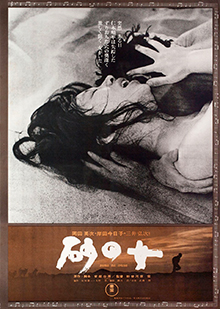


I’d never seen Woman in the Dunes (1964) before, but after watching the director’s cut on the BFI Player, it has now catapulted into one of the best films I have ever seen. This could be first-watch bias, however, thematically, emotionally, philosophically and stylistically speaking, it absolutely touched upon, connected and spoke to me greatly about my life’s experiences and the human condition.

Niki Junpei (Eiji Okada), a frustrated schoolteacher and amateur entomologist from Tokyo, travels to a remote coastal village in search of rare insects. After missing the last bus home, he accepts an invitation to stay overnight with a young widow (Kyōko Kishida) who lives alone in a hut at the bottom of a vast sand dune. He soon learns that her husband and daughter were killed in a sandstorm and that she spends every night shovelling away the endless sand that threatens to bury her home. Though Junpei initially sees himself as a temporary guest, strange comments from the villagers hint that something more sinister is unfolding.

The following morning, Junpei discovers that the rope ladder leading out of the sand pit has been removed. Trapped by the villagers, he realizes he has been chosen to become the widow’s permanent companion and labourer, helping her dig sand that the village secretly sells for profit. As he struggles to escape, Junpei learns that the widow is also a prisoner of the community, both of them controlled through dependence on the villagers for food and water. What begins as an accidental overnight stay becomes a nightmare of confinement, survival, and the gradual erosion of freedom beneath the relentless weight of the sand.
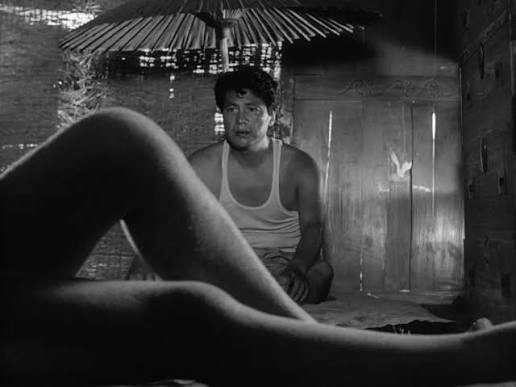


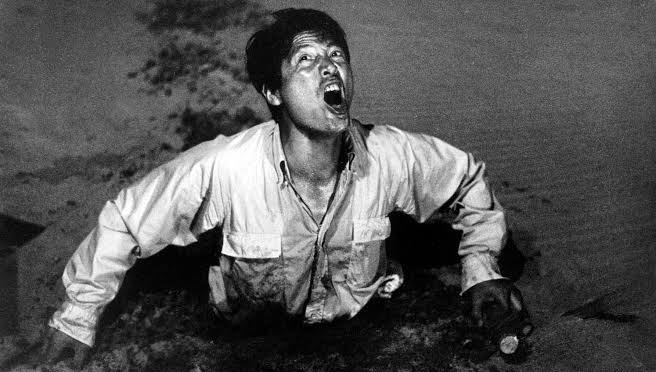
Hiroshi Teshigahara’s Woman in the Dunes (1964) is one of those rare films where image, character, theme and performance become inseparable. Shot in pristine black and white by cinematographer Hiroshi Segawa, it is visually astonishing: every grain of sand, bead of sweat and shadow across a human body is rendered with an almost microscopic intensity. The beauty of the photography is deliberately juxtaposed with the darkness of Niki Junpei’s predicament. What begins as an innocent expedition to collect insects becomes an existential prison, as he finds himself trapped by commerce, a surrogate marriage and, most powerfully, the natural wall of sand that pins both him and the unnamed widow to their strange subterranean existence.

The sand is both physical and metaphorical. It shifts, pours, consumes and rebuilds itself, turning Junpei’s captivity into a distinctly Sisyphean struggle. Every attempt at escape merely seems to return him to where he started, yet what makes Junpei such a compelling character is his absolute refusal to surrender. He builds ladders, devises increasingly ingenious escape plans, attempts to train crows to carry messages and continually tries to outwit the villagers who have ensnared him. Each failure intensifies rather than diminishes his determination. Like Sisyphus pushing the rock back up the hill, Junpei is condemned to confront an obstacle that endlessly renews itself.

Yet Woman in the Dunes (1964) is far more complicated than a straightforward story of imprisonment. Junpei is trapped by the villagers, but also by economic necessity, social expectation and an enforced domestic relationship that gradually begins to resemble a marriage. The villagers need the sand removed; the widow needs a man to help her survive; Junpei needs water, food and eventually human companionship. Teshigahara transforms this bizarre situation into a miniature society in which freedom itself becomes increasingly difficult to define. The more Junpei fights against his surroundings, the more deeply he becomes connected to them.

The relationship between Junpei and the widow, played with extraordinary physical and emotional commitment by Eiji Okada and Kyōko Kishida, gives the film its human core. Their intimacy moves between hostility, dependency, tenderness and desire without ever becoming conventional romance. Although sex is an important element of the film, Teshigahara rarely needs explicit imagery. Bodies appear as silhouettes, fragments and outlines; Kishida’s naked form is often suggested rather than displayed. A shoulder, a curve, a shadow or sand clinging to skin can communicate more than an explicit image ever could. One sees more from less throughout.
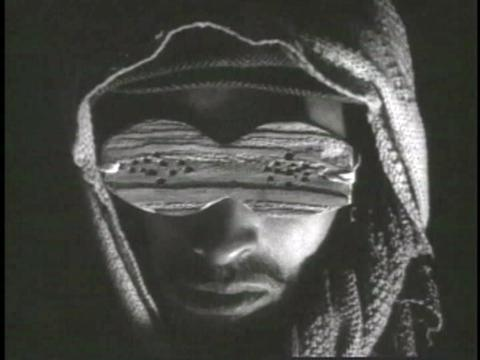


That principle extends to the entire film. Teshigahara makes the smallest details monumental. Sand resembles water, skin resembles landscape and the walls of the pit sometimes appear infinite. Extreme close-ups turn grains of sand into an entire universe, while wider compositions emphasise just how insignificant these two people are against the enormous shifting landscape surrounding them. The immaculate monochrome photography makes the film simultaneously beautiful and suffocating. The sand can look almost luminous in one shot and utterly threatening in the next.

There is also a wonderful irony at the heart of Junpei’s predicament. He arrives as an entomologist searching for insects, only to become a specimen himself: captured, observed and contained within a pit from which he cannot escape. The collector has become the collected. Teshigahara never labours the metaphor because he does not need to. It exists naturally within the imagery and situation, allowing the audience to discover its implications rather than having them explained.

Woman in the Dunes (1964) is virtually flawless in character, theme, cinematography, direction and performance. More than sixty years after its release, it remains startlingly modern and visually unlike almost anything else. Its central image — two human beings endlessly shovelling away a mountain of sand that will simply return tomorrow — is cinema distilled into an unforgettable metaphor for existence itself.

The only negative? Why didn’t I watch it sooner?
Mark: 10.5 out 11


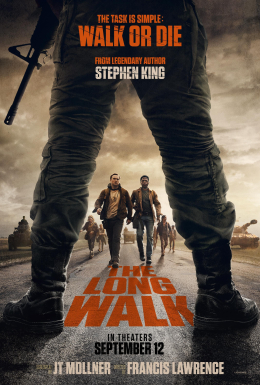
Cinema Review: The Long Walk (2025) – a compelling adaptation of Stephen King’s anti-war allegory!

Cinema Review: The Long Walk (2025)

Directed by Francis Lawrence

Screenplay by JT Mollner

Based on The Long Walk by Stephen King

Produced by Roy Lee, Steven Schneider, Francis Lawrence, Cameron MacConomy

Main Cast: Cooper Hoffman, David Jonsson, Garrett Wareing, Tut Nyuot, Charlie Plummer, Ben Wang, Roman Griffin Davis, Joshua Odjick, Judy Greer, Mark Hamill etc.

Cinematography by Jo Willems

*** MAY CONTAIN SPOILERS ***


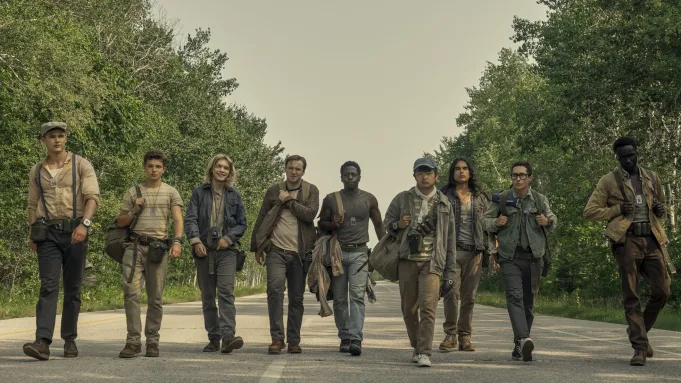
This compelling and moving anti-war film was adapted from the Stephen King novel, The Long Walk (1979), originally published under his pseudonym, Richard Bachman. The story is set in a dystopian alternative version of the United States ruled by a totalitarian regime; a new military-driven world order. The plot follows the fifty young male contestants of a gruelling annual walking contest, who must follow a set of rules or face the grim consequences. Ultimately, most of their fates are doomed as only the last boy standing gains the prize.

As an aside, I often wondered why King published under a pseudonym and after a quick net search I found that the author was limited to publishing one book per year, since publishing more would be “unacceptable” to the public. King therefore wanted to write under another name in order to increase his publication without saturating the market for the King “brand”. So, there you go. But what of The Long Walk (2025)? How does it compare to the plethora of other King film adaptations?


Grim, unrelenting, and devastatingly poignant, The Long Walk (2025) transforms a brutal endurance contest into an unmistakable anti-war allegory. Fifty young men, each plucked from a different state, march forward under the banner of national pride and promised glory — but what unfolds is the slow annihilation of their bodies and spirits. The premise, simple on the surface, becomes a searing critique of how nations sacrifice youth for power, money, and hollow ideals.

The film thrives on the camaraderie and conflict between the boys: fleeting alliances form, bitter rivalries crack open, and in moments of exhaustion or terror, we glimpse the fragile humanity beneath their forced bravado. Echoes of The Hunger Games franchise, also directed by Francis Lawrence, are impossible to miss. However, this story clearly influenced The Hunger Games and other examples of survivalist literature. Yet, The Long Walk (2025) is way more rawer, more intimate, and ultimately more scathing in its indictment of systemic cruelty.

Among the excellent ensemble cast, Cooper Hoffman as Ray and David Jonsson as Peter emerge with standout performances. Their characters, drawn together in unlikely connection, add emotional depth to the carnage, grounding the relentless attrition in genuine feeling. As their bond develops, the horror of the “Walk” feels sharper, the futility more unbearable. Overall, aside from slight repetition of action and an ending I’d have preferred to have gone a different way, The Long Walk (2025) carries hypnotic and bloody power. It is both a war story without a battlefield and a coming-of-age tale without the promise of adulthood — a haunting testament to how societies can destroy their own sons in pursuit of an impossible prize.

Mark: 8.5 out of 11


NETFLIX FILM REVIEW – I’M THINKING OF ENDING THINGS (2020)

NETFLIX FILM REVIEW – I’M THINKING OF ENDING THINGS (2020)

Directed by: Charlie Kaufman

Produced by: Anthony Bregman, Charlie Kaufman, Robert Salerno, Stephanie Azpiazu

Screenplay by: Charlie Kaufman (Based on: I’m Thinking of Ending Things by Iain Reid)

Cast: Jesse Plemons, Jessie Buckley, Toni Collette, David Thewlis

Music by: Jay Wadley

Cinematography: Łukasz Żal

***MAY CONTAIN SPOILERS***


I read some background information online about Charlie Kaufman’s latest film adaptation for Netflix, I’m Thinking of Ending Things (2020), and there is a leaning to describe it as a psychological horror. Of course, in order to market their films, studios write copy to entice an audience for their film. However, this adaptation of Iain Reid’s novel is far more than a psychological horror. It has elements from a whole plethora of genres including: surrealism, comedy, romance, thriller, arthouse, road movie, and even dance, animation and musical genres. Safe to say that once again Charlie Kaufman has delivered yet another ingenious cinematic smorgasbord that defies easy categorization. But is it any good?

The film opens gently with the lilting voice of Jessie Buckley’s voiceover. We hear her character deliver a set of poetic existential queries, and her mantra throughout the film: “I’m thinking of ending things. . .” over a set of seemingly unconnected images. She waits for her boyfriend of a couple of months, Jake (Jesse Plemons), as they plan to meet his parents, portrayed by David Thewlis and Toni Collette, for the first time at their farm. So far, so straightforward; kind of. However, as Jake and the young woman’s (whose name changes during the film) drive through picturesque and snowy landscapes, Kaufman intercuts to an elderly Janitor going about his cleaning duties at a high school. How these juxtaposed situations eventually marry together is open to many interpretations. While certainly obtuse and narratively impenetrable to many, I really connected with Kaufman’s surreal trip. Because I’m Thinking of Ending Things (2020) is certainly as much about the journey than the ultimate destination.


As he has demonstrated since his debut feature film screenplay, Being John Malkovich (1999), Kaufman has an urgent desire for original invention, sight gags, existential examination, exploration of mental health, relationship breakdowns, non-linear structure and intellectual discourse. The respective journeys of characters like Jake and the young woman are taken by road and in the mind. Whose mind the film is in and out of is also open to question. The car journey is treacherous both due to the weather and the anxious tension between the couple. This is brought about by the young woman desiring to end things. Is it her life or her relationship she wants to end? Or is it both? Things between the two aren’t made easier by the surreal visit to Jake’s parents’ farm. Thewlis and Collette inject much humour and pathos into their characters. Their performances, a succession of visual punchlines and the brilliant dialogue combine to really bring the film to life during the middle act.

After the couple leave the parents’ farm and head back home, events get even stranger as connections with the aforementioned Janitor intensify. An extremely anxious pitstop at an ice-cream parlour, an animated pig and a ballet dance sequence threatened to destabilize the narrative. But once I had suddenly interpreted my truth and understanding of Iain Reid’s and Kaufman’s vision, it all kind of almost made sense. Indeed, compared to Kaufman’s surreal meta-fictional masterpiece, Synecdoche, New York (2008), I’m Thinking of Ending Things (2020) is arguably more accessible, funnier and less bleak.

Having said that, given Kaufman’s predilection for characters on the edge of nervous, depressive and existential breakdowns, some may find this film’s journey tough to complete. But I loved the invention and constant ideas on show throughout. Kaufman’s takes risks structurally, visually and thematically and I congratulate him for challenging the audience. Lastly, I’m Thinking of Ending Things (2020) has a wondrously cinematic look, sound and dreamlike feel to it. Plus, in Jessie Buckley and Jesse Plemons, Kaufman has cast two exceptional acting talents, who are certainly worth going on the road with. However, bizarre and twisted that road may be.

Mark: 9 out of 11