Category Archives: Cinema

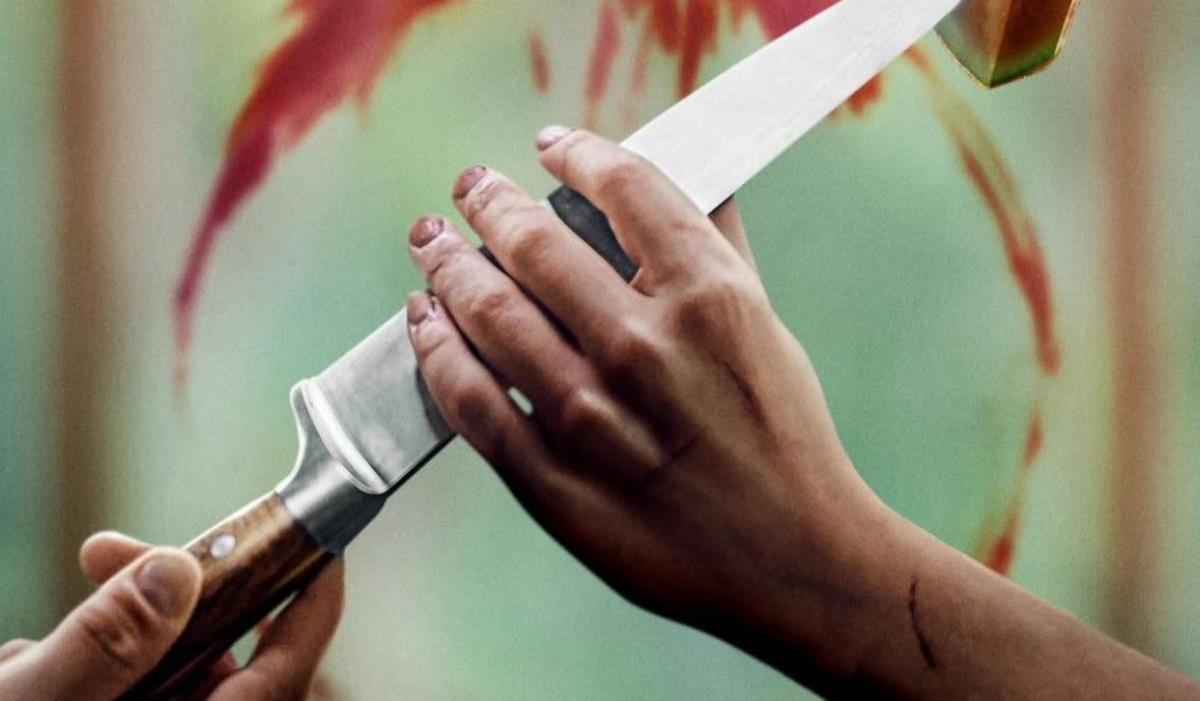
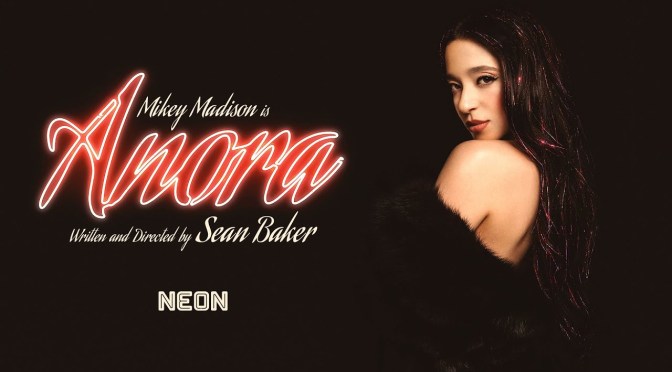
Sky Cinema review: Anora (2024) – Sean Baker’s exhilarating indie filmmaking skills deliver yet another ensemble of obnoxious characters!

Sky Cinema review: ANORA (2024)

Directed by Sean Baker

Written by Sean Baker

Produced by: Alex Coco, Samantha Quan, Sean Baker

Main cast: Mikey Madison, Mark Eydelshteyn, Yura Borisov, Karren Karagulian, Vache Tovmasyan, Darya Ekamasova, Aleksei Serebryakov, etc.

Cinematography by: Drew Daniels

** MAY CONTAIN SPOILERS **


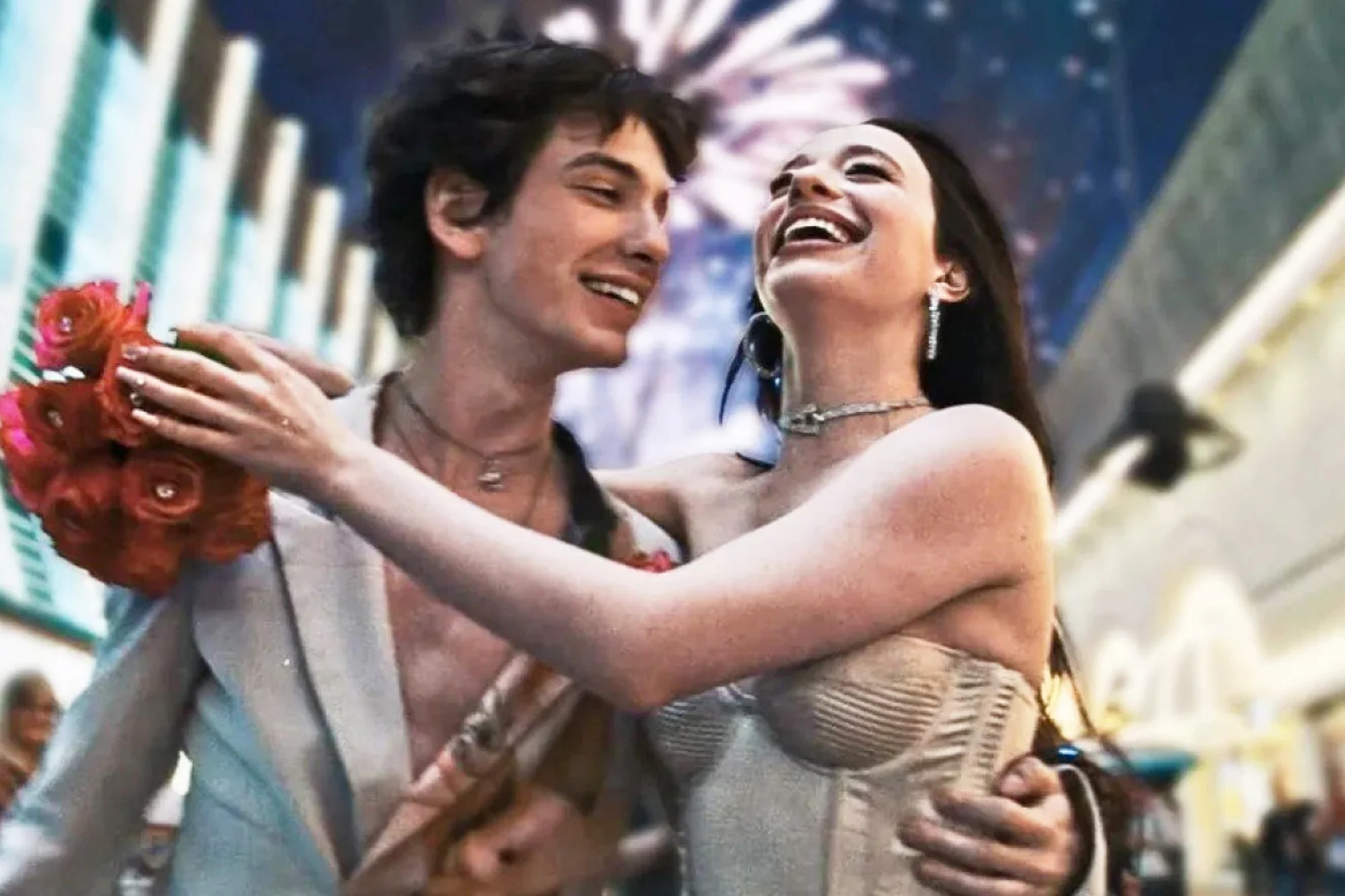
The Sean Baker’s film I have seen — Tangerine (2015), The Florida Project (2017), Red Rocket (2021), and now Anora (2024) — form a cohesive body of work united by consistent stylistic and formal strategies. Across these films, Baker blends naturalistic storytelling with bold creative choices on low budgets, creating a cinema that is both socially conscious and viscerally alive. Moreover, Baker consistently foregrounds characters on the economic and social fringes of American life such as: Tangerine (2015) – Trans sex workers navigating Los Angeles on Christmas Eve; The Florida Project (2017) – a single mother and her daughter barely surviving in a motel near Disney World; Red Rocket (2021) – a disgraced ex-porn star returns to a struggling Texas town to rebuild his existence and Anora (2024) – featuring Mikey Maddison as a Brooklyn stripper who marries into a wealthy Russian oligarch family.

    Such films explore themes relating to sex work, informal economies, the American underclass, children as witnesses to or casualties of adult instability, doomed romances, infidelity, and moral ambiguity. Stylistically they often feature flawed protagonists, non-professional actors, episodic structures, bright color palettes, profane language, irreverent humour, pop culture references, real locations, improvised dialogue and a neo-realistic look delivered via a kinetic visual energy at the edges of that delusional idea, the American dream.

    So, I’ve long admired Sean Baker’s fiercely independent spirit and his commitment to telling stories Hollywood wouldn’t touch. Baker has carved out a singular path in American cinema — one rooted in realism, empathy, and a punk sense of creative autonomy. His work is purposeful, politically conscious, and technically impressive. He’s the kind of independent filmmaker I support. But watching Anora (2024), as with most of his earlier films, I find myself wrestling with an ongoing disconnect: I simply don’t always enjoy the experience.


    Baker’s protagonists — whether Sin-Dee in Tangerine (2015), Mikey Saber in Red Rocket (2021), or Anora herself — are often abrasive, chaotic, and maddeningly self-destructive. Red Rocket (2021) in fact was so objectionable as a character study it put me off wanting to watch Anora (2024), hence the delay seeing it. While I understand that these are underdog characters surviving in systems rigged against them, their relentless hysteria and lack of introspective growth make them hard to root for. I feel like Baker got it most right during the ugly-beauty of The Florida Project (2017), but Anora (2024) presents another narrative uphill struggle.

    The film is overlong despite a simple ‘Pretty Woman’ premise of the tart-with-the-heart meeting a Russian rich kid who threatens to rescue her only to be a – surprise-surprise – spoilt-drug-addicted-narcissist-controlled-by-his-stupidly-wealthy-parents. A large part of the second act is spent chasing this obnoxious c*nt after he does a runner. It’s not so much excellent writing or acting as a succession of screeching and swearing and car crash human behaviour. I’m not asking for likability, but some degree of emotional access. Yes, Anora (2024), is sexy and funny in places, but I felt pushed away by the obnoxious ensemble and the sense of anxiety experienced throughout.

    Overall, I recognize Baker’s talent. The filmmaking here is sharp, confident, and often electric. Mikey Madison is indeed amazing with an instinctively smart and energetic performance, and at a stretch, I could understand the acclaim — but Oscars? And over Demi Moore’s tour-de-force, career-resurrecting performance? No – that feels like a massive glitch in the matrix and every surrounding multiverse.

    Mark: 6 out of 11


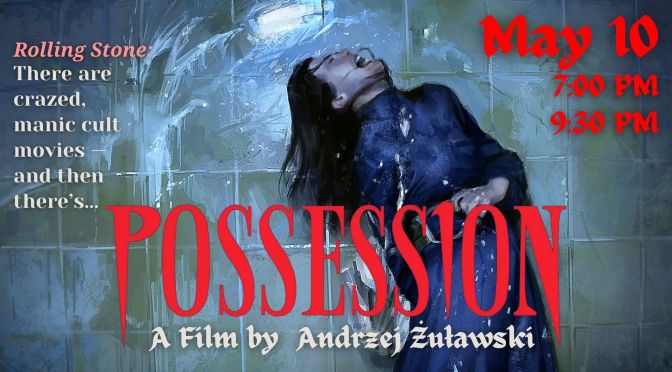
    Cult Film Review: Possession (1981)

    CULT FILM REVIEW: POSSESSION (1981)

    Directed by Andrzej Żuławski

    Screenplay by Andrzej Żuławski

    Adaptation and dialogue by Andrzej Żuławski & Frederic Tute

    Produced by Marie-Laure Reyre

    Main cast: Isabelle Adjani, Sam Neill & Heinz Bennent

    Cinematography by Bruno Nuytten

    Edited by Marie-Sophi Dubus & Suzanne Lang-Willar

    Music by Andrzej Korzyński

    *** MAY CONTAIN SPOILERS ***


    Andrzej Żuławski’s Possession (1981) is a film that doesn’t just defy genre—it annihilates the very idea of categorization. Part spy thriller, part domestic psychodrama, part Lovecraftian horror, and part apocalyptic hallucination, the film barrels forward with such manic intensity that it becomes less a movie and more an exorcism of the soul. It resists structural and emotional compartmentalizing at every turn, choosing instead to implode in a flurry of shrieks, flailing bodies, and gooey, pulsing monstrosities.

    Set in a divided Berlin, the film ostensibly begins as a break-up story: Mark (Sam Neill), a shell-shocked spy, returns home to discover that his wife Anna (Isabelle Adjani, in a performance of pure, unrelenting hysteria) wants a divorce. But from there, the film spirals rapidly out of the realm of conventional melodrama and into something far more surreal and terrifying. Mark’s confusion curdles into obsession, Anna’s descent becomes biblical, and reality itself begins to warp and splinter.


    Is it a Cold War spy film? Yes, but only in fragments, and those are quickly consumed by the escalating emotional chaos. Is it a break-up film? Certainly—but filtered through an expressionist nightmare where the grief and rage of separation erupt as literal body horror. Horror film? Undoubtedly, though the fear is less about monsters and more about the abyss that opens when love dies. And as the narrative crumbles into bloody symbolism and metaphysical dread, Possession (1981) begins to feel like an apocalyptic drama—one where the apocalypse is internal, intimate, and unstoppable.

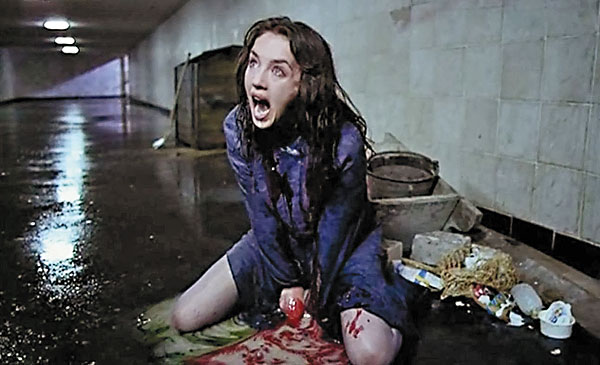
    Żuławski directs like a man possessed, matching his characters’ unhinged energy with a restless camera and wild tonal shifts. The result is a fever dream of shrieking confrontations, doppelgängers, collapsing identities, and one of the most infamous subway scenes in cinema history. Possession (1981) is not an easy film—it’s messy, abrasive, and frequently overwhelming—but it’s precisely in its refusal to conform that its power lies. Indeed, much of the dialogue is obtuse non-sequitur in delivery as the actors deliver prose-like philosophical statements that have clearly influenced the writing of Yorgos Lanthimos and Efthymis Filippou.

    To watch Possession (1981) is to witness cinema used as a weapon against coherence, comfort, and calm. I almost had a panic attack watching it. Neill, usually a calm on-screen presence looks as though he is lost in a nightmare he cannot escape. Heinz Bennent, as the lover, fully embraces Zulawski’s insane vision, while Adjani literally has a mental breakdown on screen. It is an unbelievably fearless embodiment of psychotic sexuality, arguably only matched in a commercial release by Eva Green’s Vanessa Ives from the majestic gothic TV series, Penny Dreadful (2014-2016). Ultimately, Possession (1981), is as much about the disintegration of self as it is about the end of a marriage, the failure of ideology, or the horror of being alive. One doesn’t simply watch Possession (1981)—one survives it.


    Classic Film Review: Bleak Moments (1971) plus Mike Leigh Q & A (Prince Charles Cinema, London.)

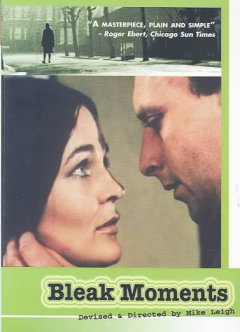
    Classic Film Review: Bleak Moments (1971)

    Directed by Mike Leigh

    Written by Mike Leigh – Based on 1970 stage play by Mike Leigh

    Produced by Leslie Blair

    Cast: Anne Raitt, Sarah Stephenson, Eric Allan, Joolia Cappleman, Mike Bradwell, Donald Sumpter etc.

    Cinematography by Bahram Manocheri

    Camera Assistant: Roger Pratt

    Edited by Leslie Blair


    One of the quiet yet profound joys of cultural life is finding a creative or sporting figure—or team—whose journey you follow from an early age, growing alongside their work as it evolves. Whether it’s the cinematic brilliance of the Coen Brothers or Mike Leigh, the ever-shifting energy of Primal Scream, or the lifelong, often agonising commitment to Tottenham Hotspur FC, these long-term relationships offer a deep sense of continuity. They become personal landmarks in our emotional and cultural landscapes, threading through decades of change and grounding us with shared history, joy, and—especially in Spurs’ case—a touch of heartache.

    I was born just a year before Mike Leigh’s Bleak Moments debuted in 1971, and it became a defining cultural touchstone for me. First encountering it in the early 1980’s, I was captivated by its raw honesty and quiet power—a film I returned to again and again on that solid-format VHS tape over the years. It marked the beginning of a lifelong relationship with Leigh’s work, a body of cinema that has shaped and shadowed my own personal and cultural journey. That connection endures to this day, most recently renewed with his 2025 release, Hard Truths—a testament to a career and vision that continue to evolve with undiminished integrity.


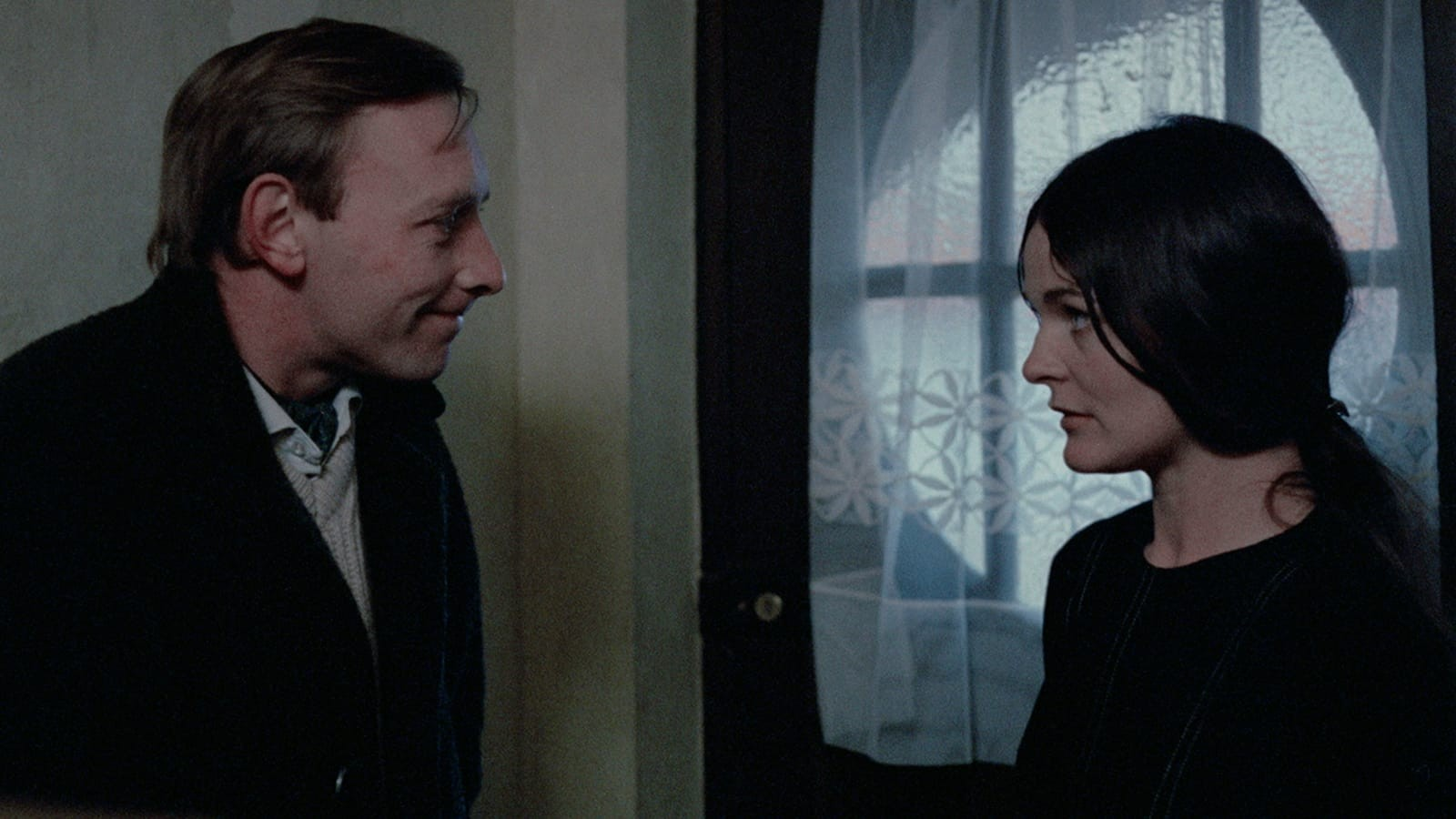
    Bleak Moments centres on Sylvia (Anne Raitt), a lonely, introspective young woman navigating the quiet desolation of her suburban life while caring for her mentally challenged sister, Hilda (Sarah Stephenson). Trapped between duty and desire, Sylvia reaches tentatively toward human connection—most notably with a shy schoolteacher—yet every encounter is marked by awkward silences and emotional hesitations. Mike Leigh crafts a delicate, unflinching portrait of isolation and unmet longing, where the most powerful moments are found in what remains unsaid. Indeed, I would say it would have a powerful influence on awkward cinema or television such as Gervais and Merchant’s, seminal show The Office.

    I hadn’t seen the film for twenty years and in a packed Prince Charles Cinema, what struck me was how Bleak Moments, while raw and unvarnished in style, unfolds with a beautifully episodic structure that gently accumulates emotional weight. Each scene offers a quiet vignette—moments of everyday awkwardness, tentative exchanges, and domestic stillness—that together create a deeply human portrait of loneliness and restraint. Despite its sombre tone, the film is laced with dry, observational humour and a deep sense of pathos, revealing the absurdity and ache of unspoken lives.

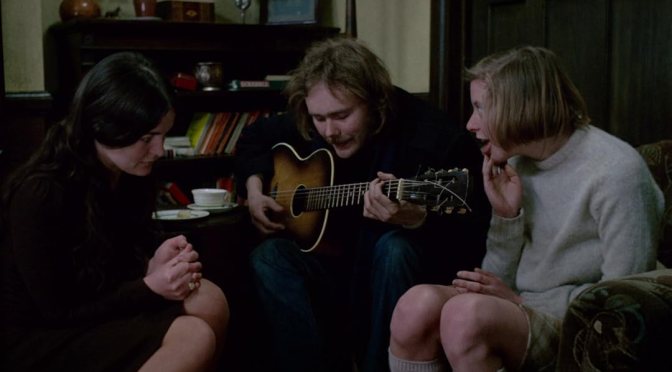
    Mike Bradwell’s Norman and his dryly hilarious songs, and the most awkward of “romantic” dinner scenes in the Chinese restaurant just stood out to me as deeply funny. Raitt’s performance too is a masterclass of comedic understatement. Overall, these qualities—emotional nuance, character-driven storytelling, and a commitment to realism—would become defining hallmarks of Mike Leigh’s oeuvre, already fully formed in this striking debut. Finally, it was great to see and hear from Leigh, now in his eighties, answering some great questions with sharp wit and batting away some stupid ones too with his usual intelligence and droll honesty. Leigh remains a hero in my life’s cultural journey.


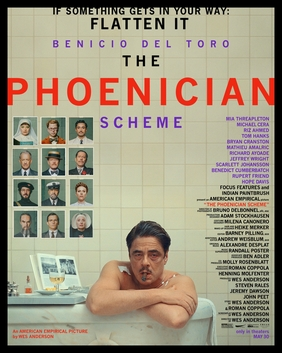
    Cinema review: The Phoenician Scheme (2025) – plus Wes Anderson’s Top 11 films ranked in order of favourite!

    Cinema review: The Phoenician Scheme (2025)

    Directed by Wes Anderson

    Screenplay by Wes Anderson

    Story by Wes Anderson and Roman Coppola

    Produced by Wes Anderson, Steven Rales, Jeremy Dawson, John Peet

    Cinematography by Bruno Delbonnel

    Main cast: Benicio del Toro, Mia Threapleton, Michael Cera, Riz Ahmed, Tom Hanks, Bryan Cranston, Mathieu Amalric, Richard Ayoade, Jeffrey Wright, Scarlett Johansson, Benedict Cumberbatch, Rupert Friend, Hope Davis, etc.


    Reviewing films for me is a form of study—a way to sharpen one’s eye, expand one’s perspective, and gain insight into the craft of filmmaking. It’s a dialogue between the film and the viewer, where curiosity, analysis, and empathy fuel a deeper appreciation for the storytelling process. Yet, Wes Anderson’s films often feel unreviewable in the traditional sense because they exist entirely within their own meticulously crafted universe—one governed by its own visual grammar, emotional tone, and narrative rhythm. His work defies conventional cinematic benchmarks not because it fails to meet them, but because it invents new ones.

    His films are stylized to the point of abstraction: symmetrical compositions, pastel palettes, theatrical performances, deadpan dialogue, and storybook framing devices. These are not aesthetic flourishes added to conventional storytelling—they are the storytelling. Every element is calibrated to serve a singular artistic vision that prioritizes mood, irony, and emotional restraint in a way that often bypasses mainstream emotional cues. As a result, trying to evaluate Anderson’s films on the basis of relatability or realism can feel like trying to critique a painting for not being a photograph. You either enter his world and accept its rules, or you don’t.


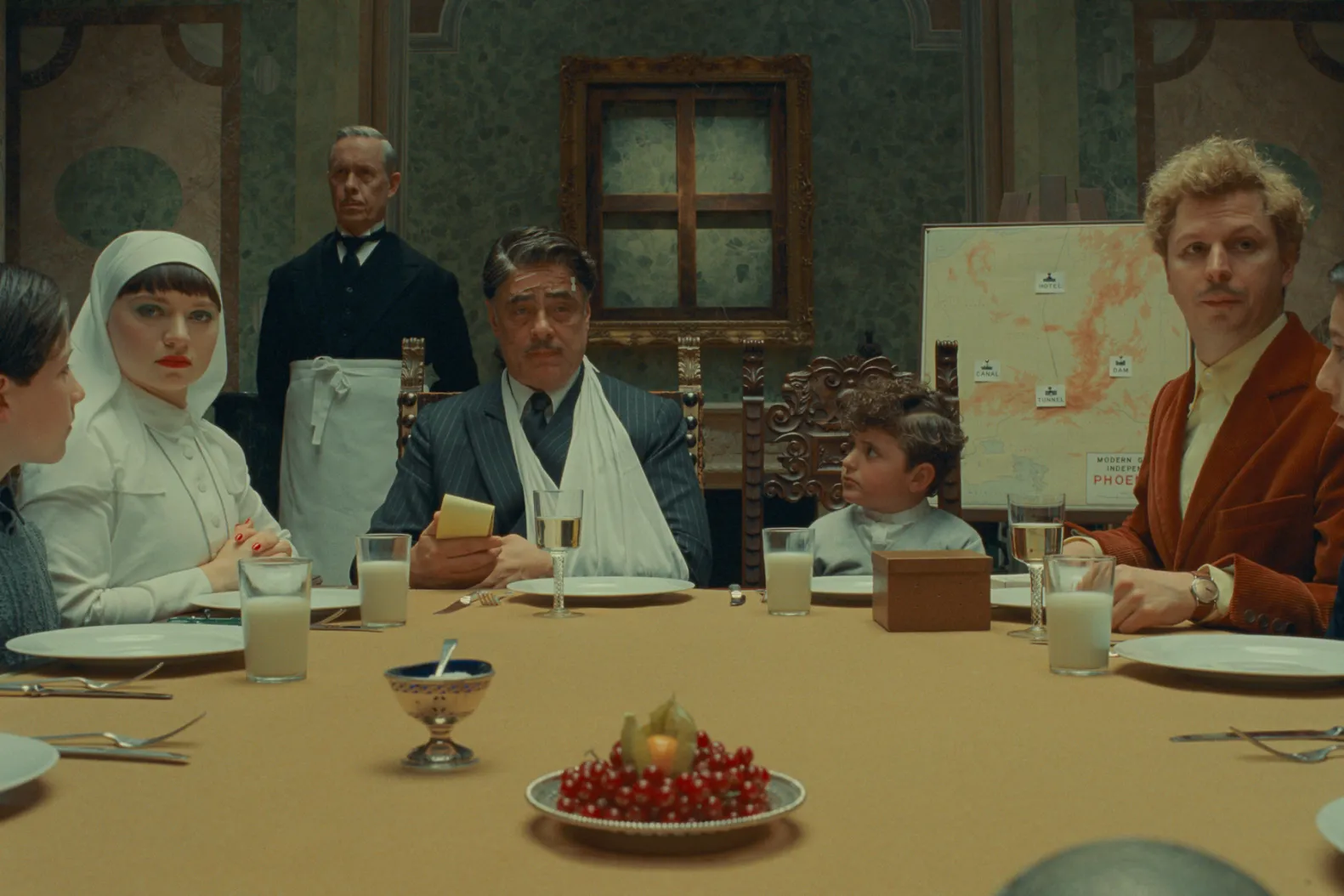
    The Phoenician Scheme (2025) is a whimsically convoluted tale of betrayal, bureaucracy, and buried emotion, anchored by a surprisingly tender pairing: Benicio Del Toro and Mia Threapleton as an estranged father and daughter navigating a pastel-hued world of espionage, assassination attempts and eccentricity. Del Toro brings his signature quiet intensity—filtered through Anderson’s signature deadpan—as Anatole “Zsa-Zsa” Korda, a controversial businessman seeking backing from an array of peculiar business types. Threapleton, in a breakout performance, plays Sister Liesl, a guarded young nun.

    As always, Anderson’s aesthetic is immaculately controlled—every frame a still life, every line delivered with just-so detachment. But where the plot sometimes meanders through its own labyrinth of quirk, the film’s emotional core remains grounded in Del Toro and Threapleton’s quiet push-and-pull: a relationship built on misread intentions, half-kept promises, and a strange kind of inherited stoicism. Michael Cera is on splendid form too as Bjørn Lund, a Norwegian entomologist, tutor, and Korda’s administrative assistant.

    Overall, The Phoenician Scheme (2025) is best enjoyed as a moving art installation and while thematically strong in terms of the father-daughter-reconciliation theme, doesn’t reach the narrative heights of Anderson’s best work. It’s a visually charming and emotionally sincere entry—proof that even in a world of plane crashes, quirky business deals, weird relatives, religious fervour, eccentric guerrillas, the arc of connection between a father and daughter can still feel radical.

    Mark: 7.5 out of 11


    Wes Anderson’s Top 11 films ranked in order of MY favourites!

    1. Rushmore (1998)

    2. The Grand Budapest Hotel (2014)

    3. The Royal Tenenbaums (2001)

    4. Bottle Rocket (1996)

    5. Asteroid City (2023)

    6. Isle of Dogs (2018)

    7. Moonrise Kingdom (2012)

    8. The Darjeeling Limited (2007)

    9. The Phoenician Scheme (2025)

    10. The Life Aquatic with Steve Zissou (2004)

    11. The French Dispatch (2021)


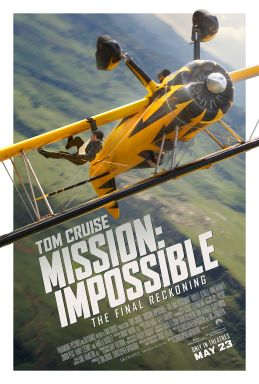
    Cinema Review: Mission Impossible – The Final Reckoning (2025) plus my 1-8 ranking of the franchise.

    CINEMA REVIEW: MISSION IMPOSSIBLE – THE FINAL RECKONING

    Directed by Christopher McQuarrie

    Written by Christopher McQuarrie & Erik Jendresen

    Based on Mission: Impossible by Bruce Geller

    Produced by Tom Cruise & Christopher McQuarrie

    Main Cast: Tom Cruise, Hayley Atwell, Ving Rhames, Simon Pegg, Henry Czerny, Angela Bassett, Pom Klementieff, Esai Morales, Holt McCallany, Janet McTeer, Mark Gatiss, Nick Offerman, Tramell Tillman, Shea Wigham, Rolf Saxon, etc.

    *** MAY CONTAIN SPOILERS ***


    Christopher McQuarrie returns to helm the final chapter of Mission: Impossible, delivering exactly what fans have come to expect—exquisite stunt work, globe-trotting chaos, MacGuffins galore, and Tom Cruise running like the fate of cinema depends on it. What stands out during Dead Reckoning (2025) is McQuarrie’s deft layering of callbacks from across the franchise: masks, betrayals, teamwork, sacrifice and even thematic echoes to Ethan Hunt’s original arc as a man constantly outpaced by the very institutions he serves. I mean bringing back Rolf Saxon as banished CIA analyst, William Donloe, from the first film is absolute genius.

    Further highlights include the icy St Matthew Island cabin shootout. Plus, the hauntingly atmospheric silent submarine sequence is an exercise in pure cinematic tension that, while a bit dark on the screen I saw it on, was incredibly designed and delivered. In the final thrilling act McQuarrie and his team flex their editing chops in a virtuoso ticking-clock sequence that cross-cuts a rapidly escalating nuclear threat with a spiraling physical stunt—clearly tipping its hat to Dr. Strangelove but with a modern blockbuster pulse. The bi-plane action that Cruise and the stunt team perform is just breathtaking. Lastly, there was also some emotional weight in certain scenes as Hunt shares touching moments throughout, especially with stalwart, Ving Rhames, Luther Stickell.

    But while the ambition is laudable, one can’t help but question whether it all needed to stretch across a bum-numbing three hours, weighed down by dense exposition about AI, allegiance, and global power games. The storytelling sometimes forgets to trust the audience, explaining what we already understand or could intuit. It’s thrilling, yes—but occasionally exhausting, especially as Mission: Impossible – Dead Reckoning Part One (2023), had done a lot of the heavy work setting up the Entity and Esai Morales as the nemeses of the piece. Still, along with an impressive ensemble cast, expert production team and of course Tom Cruise doing what he does best, McQuarrie proves himself the rare modern action director who respects his audience’s intelligence and patience—even if he tests both.

    Mark: 8 out of 11


    MISSION IMPOSSIBLE – MY FAVOURITES 1 to 8

    1. Mission ImpossibleFallout (2018)
    2. Mission Impossible – Rogue Nation (2015)
    3. Mission Impossible – Ghost Protocol (2011)
    4. Mission Impossible (1996)
    5. Mission Impossible – Dead Reckoning (2023)
    6. Mission Impossible III (2006)
    7. Mission Impossible – The Final Reckoning (2025)
    8. Mission Impossible II (2000)


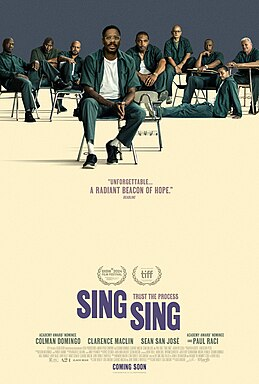
    Amazon Prime Film Review: Sing Sing (2023) – displays the redemptive power of art and performance!

    Amazon Prime Film Review: Sing Sing (2023)

    Directed by Greg Kwedar

    Screenplay by Clint Bentley & Greg Kwedar

    Story by Clint Bentley, Greg Kwedar, Clarence Maclin & John “Divine G” Whitfield

    Based on “The Sing Sing Follies” by John H. Richardson and Breakin’ the Mummy’s Code by Brent Buell

    Produced by Clint Bentley, Greg Kwedar & Monique Walton

    Main cast: Colman Domingo, Clarence Maclin, Sean San José,
    Paul Raci, Sharon Washington, Jon-Adrian “JJ” Velazquez, Patrick “Preme” Griffin, Sean “Dino” Johnson, Miguel Valentin and more.


    Cinematography by Pat Scola


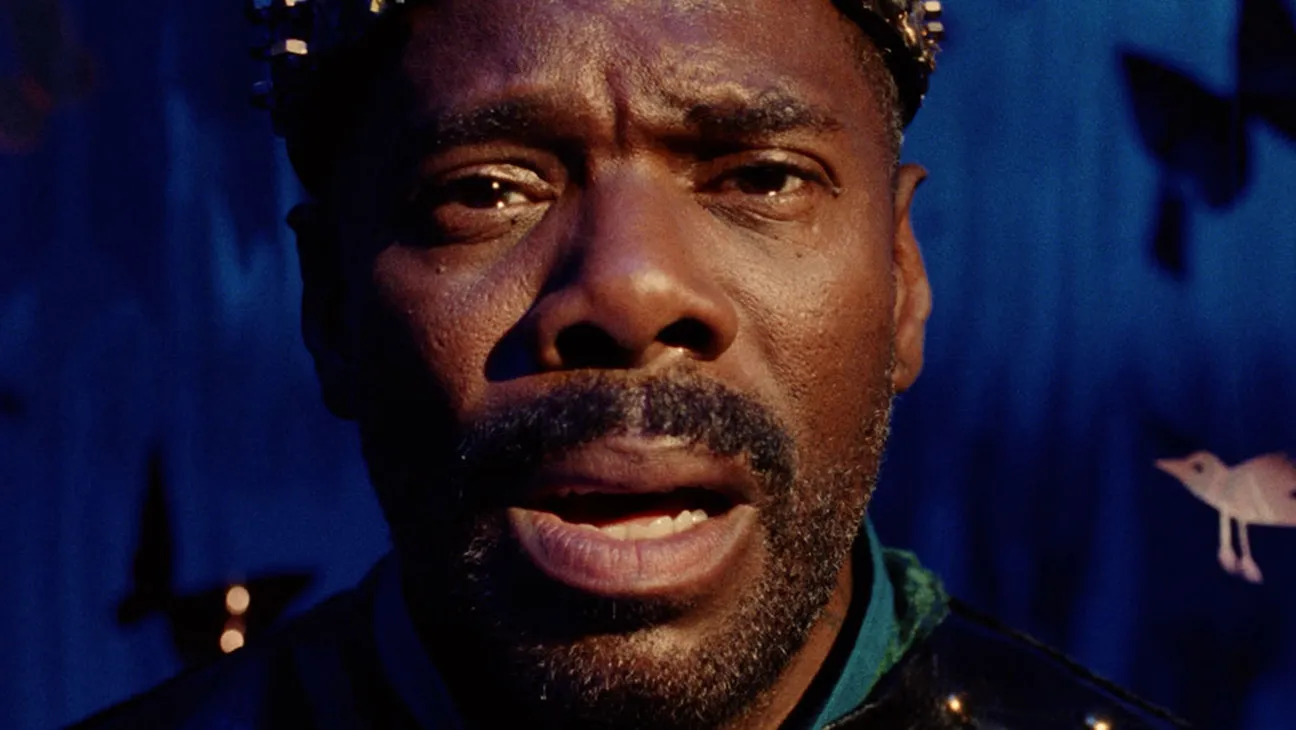
    Sing Sing (2023) is a powerful prison drama directed by Greg Kwedar, based on the real-life Rehabilitation Through the Arts (RTA) program at New York’s Sing Sing Correctional Facility. The film follows John “Divine G” Whitfield (portrayed by Colman Domingo), a wrongfully convicted man who finds purpose and transformation through participation in a prison theatre group. As the group prepares to stage an original comedy, tensions arise, particularly between Divine G and a new, skeptical member, Clarence “Divine Eye” Maclin (played by himself).

    The reported $2 million budget for the prison-based theatrical drama Sing Sing (2023) underscores a powerful truth in filmmaking: emotional impact and narrative power are not dictated by the size of a production’s budget. In an industry often dominated by multi-million dollar spectacles and high-concept visual effects, Sing Sing (2023) stands out as a reminder that authenticity, performance, and purposeful storytelling can achieve more than sheer spending ever could. In this way, the film charts a path forward for filmmakers: it shows that profound emotional connection comes not from lavish resources but from the courage to tell deeply human stories with clarity, care, and conviction.

    By investing modestly but wisely—prioritizing casting choices, intimate direction, and a grounded script—the filmmakers harness the emotional gravity of the story itself. Featuring real formerly incarcerated individuals alongside professional actors, the film creates a resonance that can’t be manufactured with money alone. The restraint in budget mirrors the thematic focus of the film: confinement, transformation, and human dignity. There’s a raw, stripped-down sincerity in Sing Sing (2023) that aligns with its financial humility, allowing viewers to focus not on spectacle but on spirit.


    At the heart of the film is Colman Domingo majestic performance. Without question he is one of the most enthralling actors working today. With a presence that radiates both gravitas and vulnerability, he has the rare ability to inhabit characters so fully that they feel less like performances and more like revelations. In Sing Sing, his work is restrained, generous, and deeply moving—serving not just as a lead, but as a quiet conduit for the emotional power of those around him. It’s the kind of performance that reminds you what acting is for.

    There’s a grounded nobility to Domingo’s recent choices—films that matter, that uplift overlooked voices, and that seek to transform rather than simply entertain. In an era where so many talented actors get absorbed into the ever-expanding Disneyverse or other IP-driven machines, one can only hope that Domingo continues on this path. His gifts are too profound, too precise, to be flattened into quips and CGI battles. He belongs in films like Sing Sing (2023) where the stakes are human and the impact is lasting.

    Directed with subtle power by Greg Kwedar he delivers a drama of transcendent creative expression as the inmates forge deep bonds, confront personal demons and change societal perceptions. Featuring performances by both professional actors and real-life formerly incarcerated individuals, Sing Sing (2023) offers an authentic and moving exploration of redemption, resilience, and the transformative power of art. Of course not all of them are innocent and are guilty. The film does not apologise for their crimes or glamourise them, but allows these men to find light amidst the darkness; a spiritual and cultural escape from the walls and bars which surround them.

    Mark: 9 out of 11


    Cinema Review: Sinners (2025) – a blazing, bold and bloody blues opera!

    Cinema Review: Sinners (2025)

    Directed by Ryan Coogler

    Written by Ryan Coogler

    Produced by Zinzi Coogler, Sev Ohanian, Ryan Coogler

    Main cast: Michael B. Jordan, Hailee Steinfeld, Miles Caton, Jack O’Connell, Wunmi Mosaku, Jayme Lawson, Omar Miller, Delroy Lindo, etc.

    Cinematography by Autumn Durald Arkapaw


    After the bleakly lustful vision of Robert Eggers’ Nosferatu (2024) — a film steeped in shadow, dread, and tragic sensuality — Ryan Coogler offers a wildly different, electrifying take on the vampire mythos: a bold, colourful, and deeply soulful experience that pulses with life even as it drinks from the dead. Where Eggers lingers in gothic majesty, with Sinners (2025), Coogler surges forward with kinetic energy, blending grind-house thrills and emotional depth with From Dusk Till Dawn-style narrative turns.

    Coogler’s film is set in the richly textured American South of the 1930s, a world still nursing the scars of the Great War and on the cusp of social upheaval. Into this volatile landscape, he drops the muscular Michael B. Jordan as twin war veterans turned Chicago gangsters, Smoke and Stack — men who carry both physical and spiritual wounds from the trenches — now repurposed as businessman looking to set up a juke joint. These characters feel reminiscent of the working class anti-heroes of Peaky Blinders, their emotional trauma rendered in everything from flickering glances to bursts of brutal, operatic violence. The twins have ghosts of the past and present to battle including relationship issues with Stack’s ex-girlfriend, Mary (Hailee Steinfeld), as well as Smoke’s painful reunion with his wife, Annie (Wunmi Mosaku).

    Sinners (2025) plot is muscular and sinewy, establishing the characters impressively before shifting the moody Southern gothic tale into an all-out genre-bender. The film contains a fine ensemble cast knitting a series of substantial supporting characters each with their own personalities, humour and wants. The most striking is Miles Caton as the twins’ cousin, Sammie “Preacher Boy” Moore, a young blues musician with an incredible ability, that proves to be a somewhat dangerous talent. Delroy Lindo also throws in another memorable performance as the ebullient pianist, Delta Slim. With the first night’s festivities in full swing three mysterious strangers appear from the near dark, desiring to be let in. Their leader is charismatic Remmick (Jack O’Connell) and he has more than partying in mind.


    Visually, Coogler lets his imagination loose, notably in a memorable cross-generational musical montage that literally burns up the cinema screen. Gone is the shadow-heavy monochrome of Eggers; in its place is a palette of dusk reds, moonlit silvers, and deep bayou greens. The film pulses with colour, sex, motion, and sweat. Blood flows, but it never feels gratuitous — it feels earned, ritualistic, even sacramental. But what ultimately makes Coogler’s film so potent is its soul. Amid the genre thrills and gore, there’s a beating heart full of soul. These vampires are not romanticised, nor merely feared; they are hungry creatures. Coogler gives them back their humanity, and in doing so, reanimates the genre with urgency.

    Music is where the film truly soars. Coogler and his production team, attuned to the cultural pulse, curate a soundtrack that fuses Delta blues, Appalachian folk, and early jazz into a feverish, ghostly soundscape. There are scenes where the music alone tells the story: a backwoods funeral scored by a bone-dry slide guitar; a juke joint confrontation where the rhythm of violence matches the stomp of the blues; a haunting lullaby sung by Remmick the migrant vampire that channels generations of sorrow. It is music as memory, as resistance, as raw emotional texture.

    Sinners (2025) is not just a vampire film. It’s a blues opera. A folk horror elegy. A pulpy, poignant, and powerfully visceral story about the things that haunt us, and how we fight to keep our humanity intact. What begins as a slow-burning period drama smolders into a blood-soaked explosion of action and moral reckoning. Coogler even delivers a Klan-blasting and redemptive shoot-out final act set-piece. Lastly, in Coogler’s hands, the vampire becomes more than a monster; it’s a metaphor for trauma, addiction, religion, racism, and survival. Coogler reclaims the myth for a new generation, one shaped by history, crime, grief, music, and spiritual struggle, delivering a genre masterpiece that bites deep and lingers long after the lights come up.

    Mark: 9.5 out of 11


    Apple TV+ Film Review: The Gorge (2025) – an exciting sci-fi shoot-em-up with a nuclear-powered romance!

    Apple TV+ Film Review: The Gorge (2025)

    Directed by Scott Derrickson

    Written by Zach Dean

    Produced by David Ellison, Dana Goldberg, Don Granger, Scott Derrickson, C. Robert Cargill, Sherryl Clark, Adam Kolbrenner, Zach Dean and Gregory Goodman.

    Main cast: Miles Teller, Anya Taylor-Joy, Sigourney Weaver and Sope Dirisu.

    Cinematography by Dan Laustsen


    Action romance genre films are notoriously tricky to get right because they require a delicate balancing act between two genres that often have conflicting priorities. So, for every great action romance film such as The African Queen (1951), Romancing the Stone (1984), Last of the Mohicans (1992), and Casino Royale (2006), you can end up with unbalanced and indifferent ones like: Mr. & Mrs. Smith (2005), The Tourist (2010), This Means War (2012), and the recent filmic travesty, Ghosted (2024).

    Successful action romance films must find the sweet spot between playing with high-stakes action, pulsating adventure and effervescent charm. Above all else, as the vehicles race, hearts pound and bullets ping there must be electricity and chemistry between the two leading actors. The audience must care not only about the characters, but must believe the characters care passionately for each other as they fight to survive. A successful combination of action, pace, wit, charisma and emotional depth is the key. So, does the recent Apple TV+ blockbuster, The Gorge (2025) achieve this difficult feat? I think overall it does, even considering that it even throws in fantastical horror elements too.


    Scott Derrickson, a really good genre filmmaker, directs Miles Teller as Levi Kane, and Anya Taylor-Joy as Drasa. They are two highly-trained East / West operatives appointed to guard towers on opposite sides of a vast and highly classified gorge, protecting the world from a mysterious evil that lurks within. They are each advised NOT to make contact with the other, but rules are made to be broken eh! A lot of fun is had as the two court each other. The two characters redefine the meaning of a long-distance relationship. After connecting romantically across the gorge Levi and Drasa’s passion is then threatened by the hideousness that lies beneath. When the action kicks in the established romance really made me care about these characters, even as further incredible plot details are revealed.

    I had an absolute blast with The Gorge (2025). It’s just the kind of big-budget-B-movie I enjoy when done right. With its seriously attractive leads, a shadowed, stylish setting, and a story that gleefully veers into the fantastical and downright monstrous, it was a wild ride from start to finish. Anya Taylor-Joy and Miles Teller share an electric physical and emotional chemistry that truly lights up the screen as every moment they’re together feels charged. Moreover, the action sequences are sharp, inventive, and genuinely thrilling. The Gorge (2025) is the kind of guilty pleasure film that I don’t feel guilty about enjoying at all. Stylish chaos, star power, and some surprisingly sincere moments? I was all in!

    Mark: 8.5 out of 11


    Exploding Cinema: Screening Innovation and Cult Film Community – Set Social, Peckham – 3rd April 2025!

    Exploding Cinema Appreciation Post! Set Social, Peckham – 3rd April 2025!


    Exploding Cinema’s independent screening events have been a vital force in supporting and sustaining independent filmmakers in London and beyond for over two decades. Founded in the early 1990s, this grassroots collective has consistently provided a democratic, non-hierarchical platform for filmmakers working outside the mainstream industry, long before digital distribution made it easier to reach audiences. What makes Exploding Cinema truly unique is its commitment to screening work that’s often excluded from traditional film festivals—no matter the format, budget, or level of polish.

    For emerging and experimental filmmakers, Exploding Cinema offers something increasingly rare: a chance to show work without gatekeepers, submission fees, or rigid curatorial criteria. It’s a space where film is celebrated as a communal, live experience, not just a product. Events are usually held in non-traditional venues—warehouses, social centres, pubs—transforming them into vibrant spaces of DIY creativity, complete with live visuals, eclectic soundtracks, and a wonderfully mixed crowd.


    But their impact doesn’t stop at London’s borders. By inspiring similar initiatives and collaborating with artists internationally, Exploding Cinema has helped fuel a global underground film culture. Its ethos—accessibility, experimentation, and community—resonates far beyond the UK. For filmmakers without industry connections or institutional backing, these events are not just screenings—they’re lifelines.

    In a world where independent voices are often drowned out by algorithms and commercial demands, Exploding Cinema remains a loud, flickering beacon of artistic freedom and collective energy. So thanks for screening my film Inferis (2024) on the 3rd April 2024 at Set Social, Peckham and for screening many other wonderful independent short works. For information and history of Exploding Cinema please check out their website here:


    Cinema Review: Mickey 17 (2025) – a multi-faceted sci-fi adaptation that leaves one drunk, but somehow still thirsty!

    Directed by Bong Joon Ho

    Screenplay by Bong Joon Ho – Based on Mickey 7 by Edward Ashton


    Produced by Dede Gardner, Jeremy Kleiner, Bong Joon Ho and Dooho Choi

    Main Cast: Robert Pattinson, Naomi Ackie, Steven Yeun, Toni Collette, Mark Ruffalo, Patsy Ferran, Cameron Britton, Daniel Henshall, Anamaria Vartolomei, etc.

    Cinematography by Darius Khondji


    Bong Joon Ho’s adaptation of Mickey 7, the 2022 sci-fi novel by Edward Ashton, showcases a compelling convergence of the director’s distinctive thematic interests with the novel’s narrative. Known for his ability to blend genre elements with incisive social commentary, Bong’s version of Mickey 7, now titled Mickey 17 (2025) is a comedic, at-times-crazy and imaginative sci-fi film exploring human resilience, class struggles, scientific malpractice, environmental abuse, genocidal terra-forming, plus the existential impact of technology within the workplace.

    Robert Pattinson is the eponymous Mickey, a “disposable” worker sent on perilous missions to terra-form a distant planet, with his life repeatedly put in danger only for him to be replaced if he dies. This directly ties into Bong’s recurring exploration of human resilience in the face of dehumanizing systems, something seen in his earlier films, such as Snowpiercer (2013) and Okja (2017). Bong’s protagonists are often ordinary people facing systems designed to strip away their individuality, and Mickey’s repeated resurrections emphasize the fragility of life within these systems.

    Another prominent theme in Bong’s films is the exploration of class and social inequality. In Parasite (2019), he delved into the gap between the wealthy Park family and the impoverished Kim family, using the home as a microcosm of societal hierarchies. In Mickey 17 (2025), the corporate-driven space mission echoes the exploitation seen in these films. Mickey’s status as an expendable worker mirrors the broader economic systems that exploit individuals for labour without regard for their well-being. The fact that Mickey is repeatedly discarded without consequence is an unsettling reflection of how capitalist structures often devalue human life for the sake of profit.

    Bong has always critiqued the alienation of labour, especially how working-class individuals are treated as replaceable cogs in the machine. In Mickey 17 (2025), this theme is amplified as Mickey’s life is literally expendable, offering a stark commentary on the commodification of labour within the context of futuristic colonization. The struggle for survival and dignity, against an uncaring corporate entity, will likely resonate with themes Bong has previously explored. Likewise, in Memories of Murder (2003), the search for truth is tied to the characters’ understanding of themselves and their roles in society. Such societal and existential crises fit perfectly with Bong’s broader thematic preoccupation with the fragility of the human experience in the face of overwhelming, often oppressive, external forces. The question remains: is Mickey 17 (2025) any good?


    Robert Pattinson, who plays various versions of the titular character Mickey, brings his signature range of brooding intensity and offbeat charisma to the role. His performance is a key part of what makes the film such an intriguing watch. Pattinson excels in portraying Mickey’s emotional journey—a man repeatedly resurrected after dying in increasingly perilous circumstances, struggling with his own identity, and questioning the morality of the system that disposes of him so easily. However, Pattinson’s performance also contributes to the film’s unevenness. While his portrayal is captivating, the character’s arc and motivations can occasionally feel too vague or inconsistent, leading to moments where it’s unclear whether Mickey is supposed to be a tragic figure, a comic relief, or something in between.

    The visual effects in Mickey 17 (2025) are nothing short of stunning. Bong Joon Ho, along with his team, creates a visually immersive universe, blending futuristic technology, the planet landscapes of Niflheim, quirky alien creatures and mind-bending visuals to evoke a sense of awe. The digital photo-copying resurrection process that Mickey undergoes is a feat of visual storytelling, with the film using cutting-edge effects to show Mickey’s multiple deaths and resurrections in creative and striking ways. The film’s alien planet, with its strange, luminous terrain and exotic creatures, also adds a surreal and fantastical quality to the narrative. Indeed, the theme of environmental and indigenous protection is vital, but does eventually clash with that of the existential worker.

    Where Mickey 17 (2025) truly shines—and stumbles—is in its wacky, unpredictable storytelling. Bong Joon Ho has always been a director unafraid to blend genres and tones, and here he creates a narrative that swings wildly between dark comedy, sci-fi absurdity, and existential dread. One moment, you’re laughing at Mickey’s off-kilter interactions with his fellow colonists, and the next, the film veers into dark, serious territory as Mickey grapples with his own mortality and the ethical dilemmas of his existence. Moreover, the film’s narrative structure itself is erratic. There are moments where the plot careers off course, lost in the chaos of its high-concept premise.

    As Robert Pattinson’s charismatic, multi-faceted performance anchors the film, the performances of Mark Ruffalo and Toni Collette—as the grotesque antagonists—topple the tone too far into bad theatre. Finally, Bong Joon Ho’s trademark brilliance is evident throughout, but Mickey 17 (2025) ultimately suffers from the very risk-taking that makes it unique. It’s a thrilling, uneven ride that fascinates, frustrates, makes one laugh and leaves you with a lot to think about—once the space dust has settled. Perhaps I should have had what Bong Joon Ho and his production team were drinking before I watched it. If so, I should certainly of made it a double!

    Mark 7.5 out of 11